Regency painters – Part One

Oath of the Horatii - Jaques-Louis David, 1784

At the time of my story Notorious Match, painting, along with the other fine arts, was transitioning toward Romanticism.  Think Turner and Constable.  In the next few posts, the blog will concentrate on painters of the Regency period and how their visual interpretation of subjects greatly affected their audience in England.

Neo-Classicism was in full force by the time of the Regency in England.  Paintings were eschewing the rococo manner so beloved by the ancienne regime to become more commonly executed in a formal, restrained manner, using classical subjects ranging from mythological figures to Corinthian columns.

Like previous styles of painting, and future ones to come, neo-Classicism was eventually taken over by the political movement of the times.  At the height of his power, Napoleon discovered an affinity for the symmetric, incisive nature of the classical heroic movement and used it to demonstrate his own personal power and that of the Republic.

He chose for his portrait painter Jacques-Louis David, a major contributor to the stylistic painting of this period both in France and England.  David had rejected the earlier passion for indolent aristocrats riding beribboned swings, pursuing love and other nonsense among flowers.  He hated rococo, you see. So much better to paint great gods of Olympus and sturdy mortals of Rome imposing order by sword and mighty oaths.

By Jove, it makes one want to get to one’s bootmaker and demand a pair of dashed sandals.

David was an ardent supporter of the French Revolution and had been favored by Citizen Robespierre, before the fellow got himself guillotined.

Napoleon at the St. Bernard Pass - 1801

It was David who executed the famous, but dreary pencil sketch of a grim Marie Antoinette awaiting Madame La Guillotine.  He voted as a member of the General Assembly to have Louis XVI executed.  It was alleged he participated in the death of the young dauphin after the boy was forced to testify against his mother on several crimes, including incest, to secure her execution.

It was not as easy to execute women in those days, you see.

One of David’s great friends was the revolutionary Paul Murat, an architect of the Terror.  The artist was so distraught when Murat was found murdered in his bath, he painted one of art’s great masterpieces, immortalizing him and the revolutionary for all time.

“(It was) a moving testimony to what can be achieved when an artist’s political convictions are directly manifested in his work.”  Boime, Albert (1987), Social History of Modern Art: Art in the Age of Revolution, 1750-1800 volume 1, Chicago, IL: The University of Chicago Press, ISBN

Napoleon commissioned David to create the giant Coronation mural as well as the famous Marengo painting (above).  The painter died an exile from France after Napoleon’s defeat, run over by a carriage.

From Notorious Match:

Diana asked Griffin about his family.

“My father left Wales for France after some scandal,” he told her.  “A scandal I’m sure your grandmother, Lady Nellie, can better explain than I.  In any case, I never knew him.  He married my mother, the daughter of a minor noble, but left her for Paris after I was born.”

“Who raised you?” Diana probed.

“Mostly my grandfather.   My mother was killed when I was ten.  During the Revolution.”

Diana’s eyes widened.  “Oh, Griffin.  Was she—”

“No, she was not a victim of Madame la Guillotine,” he explained, matter-of-factly.   “Instead, my mother was hung.  For conspiring to murder the revolutionary Jean-Paul Murat.”

“Good God.  Wasn’t it Charlotte Corday who stabbed him in his bath?  The one they call the Angel of Assassination?”

Griffin nodded.  “My mother and Charlotte were schoolmates in Caen.  When Charlotte was arrested for killing Murat, my mother went to Paris to beg for her freedom.  She was warned to stay away on penalty of death.  But she could not.  It seemed incomprehensible to her, you see, that her beloved friend should be executed for killing one man to save one hundred thousand.”

The Death of Murat, 1793

Ignominious Burial

In Notorious Match, the hero uncovers the truth behind the carriage wreck that killed the Earl of Northam and his wife.  See this post for further detail.

Diana shook her head at the pity in Griffin’s expression.

“My uncle always blamed himself for my parents’ death,” she explained.  “He still did, even after the evidence all pointed to murder-suicide.  Of course, it was all very hushed up.  But the state of the earldom’s finances could not lie.  My father was under a mountain of debt and about to lose everything.  So he took my mother with him and left me.”

Griffin stepped forward and cradled her face in his hands, his shoulders strangely hunched up as if she were something fragile.

Poor little rich girl.

 She pulled away, feeling the revulsion against herself coming up from her stomach to gag her.  “Don’t do that, please.  It’s quite unnecessary.”

“Good God, Diana, why shouldn’t I?  You’ve—”

“Don’t pity me, for God’s sake,” she interrupted, her voice quavering so much she wanted to choke herself.  “Please.  I’ve done absolutely nothing to deserve your pity.”

Griffin remained silent, inviting her to continue.

“I wasn’t glad that they died,” she said.  “Not even I could be so heartless.  But I was ever so glad they left me behind.”

Robert Stewart, Marquess Londonderry

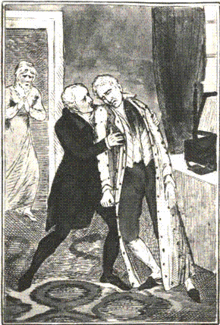
Suicide deaths were condemned right through the Regency.  Diana’s uncle, the Marquess Wimberley, did everything possible to shield the truth of his older’s brother’s death from the ton. 

Why?

To avoid the horror of the ignominous burial.

Case in point:  Marquess of Londonderry, 1822.

Robert Stewart served as Chief Secretary for Ireland and was known as Viscount Castleraugh for most of his life before succeeding to his father’s title as marquess. He was a force to be reckoned with in British politics.  The Napoleonic Wars required extraordinary skill in diplomacy and his lordship provided ample support as a member of the Ministry of all the Talents (yes, that was a real ministry).  See an earlier post on the matter.  He was Lord Secretary of Ireland, securing union with that land to prevent it from becoming a French satellite as Scotland had been three hundred years before.  He became Secretary of State of War and the Colonies and later Foreign Secretary, an illustrious diplomatic career that culminated in the Congress of Vienna.

His wife was Amelia (Emily) Hobart, daughter of the second Earl of Buckinghamshire.  Regency lovers know her as a Patroness of Almack’s.  The couple had no children but remained devoted to one another.  She was there to support her husband when he fell in a deep depression from his widespread unpopularity.  Even the poet Shelley excoriated him:

I met Murder on the way/He had a face like Castlereagh

The marquess had the unfortunate destiny of being reviled for effecting decisive policies for the kingdom.  It is a fate which no politician, even to this day, can escape.

In any case, his sovereign, George IV, was so alarmed at his condition His Majesty took it upon himself to notify Stewart’s doctor.   It was too late.  Robert Stewart used a penknife, left forgotten in a desk drawer, to slit his throat.

It was a terrible scandal.  Were the marquess declared a suicide, he would have commited a felo de se, or crime against the self.  It was an old common law offense that bedevilled prosecution until a more horrible penance could be devised–one that was extracted from the survivors.  The body of a suicide was denied burial in consecrated ground.  Worse, it would be consigned to an ignominious burial in a highway crossroads where all manner of cartage and transport may occur over the body.  A demeaning location of anonymity where the remains would suffer the indignity of offal and every kind of refuse, to be trampled and mingled with the earth that held the body of a person once kissed, caressed and held.

Worse, the decedent’s body would be staked through the heart.  Presumably to prevent removal by the family.

Even Byron was relishing the prospect of this suicide’s burial:

Posterity will ne’er surveyA nobler grave than this:Here lie the bones of Castlereagh:Stop, traveller, and piss.[16]

And you thought you knew Shelley, Byron and Stoker.

Lady Castleraugh was desperate–enough to have her husband declared insane.  Without intent, as the requirement of common law demands, a suicide had not occurred.  And his lordship could be given a proper burial.

Today you can see his lordship’s grave near his mentor, William Pitt, at Westminster Abbey–the graveyard of England’s greatest.

Tremont – The Elizabethan Prodigy

Montacute House - licensed under the Creative Commons Attribution 2.0 by Mark Robinson

Before the events told in Notorious Match, Lord Griffin Montgomery was forced to sell his Welsh estate that had been bestowed on his family by the Conqueror.  William I rewarded Roger de Montgomerie, Griffin’s Norman ancestor, with the marcher earldom of Shrewsbury along with Tremont and other estates throughout western England and Wales.

Earl Roger’s sons spent a good deal of time fighting the Welsh.  One had succumbed to an attack of Viking pirates on the shore not far from Tremont.  In my story, an estate was established there by a cadet branch of the Montgomery family.  The nearest town is Machynlleth, a real place referred to locally as “Mach” and where one can view fighter jets careening through the Welsh hills as they perform the Mach Loop here.

Griffin’s grandfather, Baron Montgomery, was the last of the family to reside at the estate when he died in 1814.

A year later, Diana, the Countess of Northam, proposed buying it back.

Griffin pivoted to face her.  “Buy Tremont?  Why the devil would you do that?”

Diana raised her eyebrows, clearly puzzled.  “If it’s your pride at issue, I won’t give you the money.  I’ll have the lawyers get it back.  There’s probably some contingency they can find, some forgotten entail or other legal condition that defeats the conveyance.  Most estates have them, to prevent such a sale in the first place.”

The enormity of what she proposed, that any resource be spent on the very place he associated with his iniquity, stunned and upset him.  He tried to restrain those feelings only for them to manifest in his jaw, which ached from being clenched.

“You’ll do no such thing,” he retorted, his voice harsh.

Diana visibly recoiled, the hurt he had dealt her impossible to take back.

Griffin’s Tremont is an Elizabethan prodigy house. Its exterior reminds me of Hardwick Hall, which has an abundance of windows characteristic of the prodigy’s so-called Lantern style. At night, with candles and torches blazing, the great wall of windows would be lit up like lanterns, hence the name. Another house featuring this extravagant style is my favorite, Montacute House, pictured above. You may remember it from 1995 movie adaptation of Jane Austen’s Sense and Sensibility, the house where Marianne fell ill.

Tremont’s interior, however, is based upon the remarkable Cassiobury Park, ancient seat of the Earls of Essex.  It was extensively rebuilt by the first Earl of Essex in the seventeenth century in honor of the restoration of Charles II.  He hired Hugh May, one of the commissioners for the rebuilding of London after the Great Fire, to extend the house and fit it up on the inside for an expected visit by His Majesty.  The visit never came, but the expectation was glorious, nevertheless.

May hired the master carver Grinling Gibbons, a Dutch Quaker who was executing the Baroque style in intricate wood carvings that can be seen in Hampton Court, Blenheim and St. Paul’s Cathedral.  He carved many of the fittings at Cassiobury, such as overmantels, cornices, moldings.  It was thought that the main staircase was also his work, and like Cassiobury, Tremont has a magnificent central staircase that is a great, rolling thing of exceptional beauty containing intricate scrollwork that defies modern craftsmanship.

detail - Cassiobury Park staircase

Cassiobury Park was doomed as the twentieth century began.  The 7th Earl of Essex died after being run over by a taxi.  The 8th Earl put the house up for sale since the nearby manufacturing center of Watford was expanding and the parkland of Cassiobury was needed for the “natural” expansion of the town.  All of the fittings, including the carvings, were stripped from the house and sold at auction.  Cassiobury Park was demolished in 1927.

The carved staircase was purchased by the Metropolitan Museum of Art and on display today in gallery 518.  There it was discovered the carvings were more likely attributed to Edward Pearce, an English carver with a name rather less dramatic than Grinling Gibbons, but just as talented.  Additional images of this masterpiece are available at the museum’s website here.

Oddly, the present heir-presumptive to the earldom of Essex is a retired grocery clerk in Yuba City, California.

Regency nudes

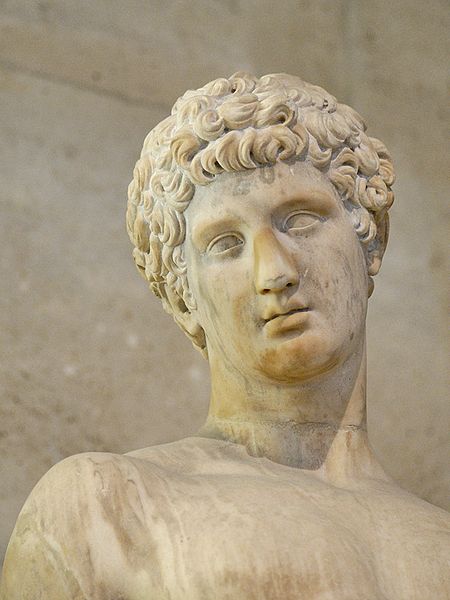
the Mazarin Adonis

Presently, Diana and Griffin came to the conservatory that served as a transition from the house to its parkland.

Lord Montgomery seemed to find something wanting.  “Where is the statuary?  Most great country houses have a room full of the stuff.”

“Are you a coinnosseur?” Diana asked.

Griffin opened the door for her to step through.  “It depends on the subject.”

He followed her to the railing of the flagstoned veranda overlooking an ornamental lake.  “I believe the dowager countess had an affinity for statues.  Northam Park would not be complete without a nude of your namesake, the goddess of the hunt.”

Griffin’s teasing was not without basis.  They had seen the virgin huntress executed in every conceivable media throughout their inspection of the estate.  Moreover, he was quite correct that her grandmother had been a patroness of the arts.   Lady Nellie, as she was affectionately called, once supported the noted painter and bluestocking Angelica Kauffman.

But her grand passion was for the unadorned figure, sculpted in the manner of classical antiquity.

Lord Montgomery would not be so bold if he knew what her grandmother’s collection consisted of.

Diana raised her eyebrows in pretended severity.  “We keep all the nudes in London.”

“A pity.”

Diana looked away from his interested stare as if embarrassed, her finger artlessly tracing an invisible line along the railing.

“Yes, it is,” she eventually replied.  “You see, Grandmama was in the habit of commissioning likenesses of young men she admired.  There are at least two male nudes that bear a striking resemblance to yourself.”

“Good God,” he exclaimed.  “You must be joking.”

“Really, my lord.  It was only your face Grandmama used, I’m persuaded.”

“You minx.”

This file is licensed under the Creative Commons Attribution-Share Alike 3.0 Unported license

Who can forget that marvelous scene in the 2005 movie adaptation of Jane Austen’s Pride and Prejudice featuring Pemberley’s sculpture gallery?  The gallery (pictured above) was filmed at Chatsworth, a real location Austen notes in her novel.  The scene is infused with the strong contemporary feel of the Regency and its desire for beauty.

The sculpture collection was assembled in large part by the sixth Duke of Devonshire, the Bachelor Duke.  He shared a passion for art with the Prince Regent.

Venus and Adonis – Antonio Canova (circa 1820)

In my book, Northam Park is in every way comparable to Chatsworth, except it does not have a sculpture gallery.  His Grace makes a couple of appearanced in Notorious Match as he and Diana are about the same age.  At one time, before Griffin returned to England, it was thought the heiress to Northam and the duke might make a match of it.  But it became clear they would not suit.

Griffin is the exact opposite of His Grace.  He has lost his own estate, Tremont, and has no fortune.  Moreover, he is a mere lord.

Yet he has the face of a sculpted Adonis.

There can be only one Diana

Presently they came to Northam Park’s vaunted Tapestry Room.   Its walls were entirely covered by specially commissioned tapestries from the Gobelins tapestry weavers of Paris.  Griffin seemed quite taken with one in particular.

Drowning of Britomartis – wool and silk tapestry (circa 1547)

“Oh, that bloody thing,” Diana swore under her breath.

Griffin’s excessive scrutiny of the woven masterpiece made her uncomfortable.  Not because the goddess of the hunt wore a short tunic, baring her legs, striding toward the sea to save her fellow virgin from the amorous king of Crete.   It was the memories of it that she had held as a girl, childishly imagining herself to be just like the huntress.  Free, independent and disdainful of mortal men.  How naive she had been.

A mischievous light came into Griffin’s eyes.  “It must be gratifying to have so many, er, exquisite renderings made of one’s namesake.”

Diana huffed.  “I had nothing to do with the inspiration.  If you must know, my grandfather purchased it at auction in Paris.  It had been commissioned by Diane de Poitiers.”

Griffin’s smile deepened.  “The mistress of the French king?”

The devil.

“Precisely so.”

To have a Gobelins tapestry, let alone a room full of them, was a mark of distinction in Regency home decor.  Gobelins Manufactory began as a group of Flemish weavers established by the first Bourbon king of France, Henry IV.  They set up shop in Paris in the environs used by a family of dyers from an earlier century called the Gobelins.  The name stuck and the Gobelins enterprise became the royal factory supplying the French monarchy until it was shut down in the Revolution.  The restored Bourbon dynasty revived production and today it is operated by the French Ministry of Culture.

Newby Hall has a marvelous tapestry room that is well-presented in the 2007 movie adaptation of Jane Austen’s Mansfield Park.  See this link for an excerpt from the movie.  The room is featured at 8:15.

Croome Court tapestry room

There is another tapestry room that used to reside in Croome Court, Worcestershire.  It was removed from the neo-Palladian country house by the owner, the ninth Earl of Coventry, and sold.  Note the lovely neoclassical ceiling designed by Robert Adam, executed in 1763 for the sixth Earl.  It has been reconstituted for display at the Metropolitan Museum of Art.

Today, Croome Court is most noted for its grounds, designed by Lancelot ‘Capability’ Brown.  The house itself had been owned by a succession of groups including a school and Hare Krishnas before it was finally acquired by the National Trust from the Hare Krishnas,  After extensive restoration work, it too became open to the public for the first time in 2009.

Taking the Plunge

Prior to, and on into the Regency, the idea of bathing was connected to its medicinal value.  It was particularly valued for the salutary effect it had on one’s health, and not for the sensibilities of one’s neighbors.  By the eighteenth century, cold bathing had become quite the vogue.

The Regency Cold Bath

“Mr. Porter, who is an apothecary, was talking of the cold bath and the service it had done him by making him of a more strong firm constitution than before.  He says it is extremely good against the headache, strengthens and enlivens the body, is good against the vapours and impotence, and that the pain is little.  I have almost determined to go in them myself.”

–Dudley Ryder, London attorney, 1715

And much cheaper than Viagra!

A large country house like my character’s estate would not have been complete without an open air cold bath.  I modelled the cold bath at Northam Park after the one at Wynnstay in Denbighshire, pictured above.  A extended discussion of this building’s historical value is here.

Capability Brown included one in his landscape design for the Earl of Northam, commissioning the architect James Wyatt (1746 – 1813).  Wyatt was already a rival to Robert Adam by this time and had not yet entered his Gothic period.  He designed a classical pavilion for Northam Park’s gardens, distinguishing it with a portico echoing that of the great house itself, and supported by ornate Corinthian columns.  It overlooked a rectangular pit lined with stone.  The cold bath was large enough for swimming, nevertheless the temperature discouraged extended sojourns in its icy waters.  Afterwards, one could retire to the pavilion and change.  To enhance one’s feeling of accomplishment, refreshments would be served.  Just the thing for warming up.

The Countess of Northam, the main character in Notorious Match, would entertain guests to her estate with at least one trip to the bath house.  It was something of an outing.  Both sexes would bathe together, appropriately attired of course.

Wimpole Hall, Cambridgeshire plunge bath – prior to restoration

More examples of cold baths built and used during the Georgian and Regency periods are to be found here along with some very pretty photos of examples made out of grottos and gothic pavilions.

The various baths pictured in Jane Austen’s World are instructional, saving the naughty bits.

Temple of Diana

The principal house featured in my manuscript Notorious Match, Northam Park, boasts a large parkland reaching upwards of one thousand acres.  Much of it was laid out by the eminent landscape architect Capability Brown (1716 – 1783).

A prophet is not without honour, save in his own country. Lancelot Brown is commended throughout the world as the master of the English landscape garden, but at home, he is frequently dismissed as a vandal who destroyed large numbers of illustrious formal gardens. 

–“Great British Garden-Makers:  Lancelot “Capability” Brown,” Country Life, Feb. 20, 2010

Brown’s new style of gardening design eschewed carefully trimmed hedges and formal flower gardens (think Hampton Court) for a more natural environment with grass-covered undulations leading down to carefully installed lakes and trees.  The effect was beautiful, providing a panoramic view from the great Palladian houses being built as country residences for the wealthy.

One of the charactertistics of this new landscaping style was the garden temple, an outdoor feature normally given a classical design although many favored a more Gothic bent with the rise of Romanticism.  These would be placed not far from the main house, but within the natural setting of these “gardenless” gardens.  From them, you could look across the estate through a long-viewer while keeping your eye on the children as they bowl on the manicured lawn nearby.
Many times these beautifully designed structures were simple rotundas, like the one pictured above from Beachborough House in Kent in a painting attributed to Edward Haytley, circa 1745.
Several, like the one at Northam Park, were much more grand and served a variety of functions–greenhouses, etc.
I particularly adore the lovely one used for the shooting party lunch in Robert Altman’s mystery Gosford Park (2001) at 1:40.  Clive Owen, anyone?  Yes, please.
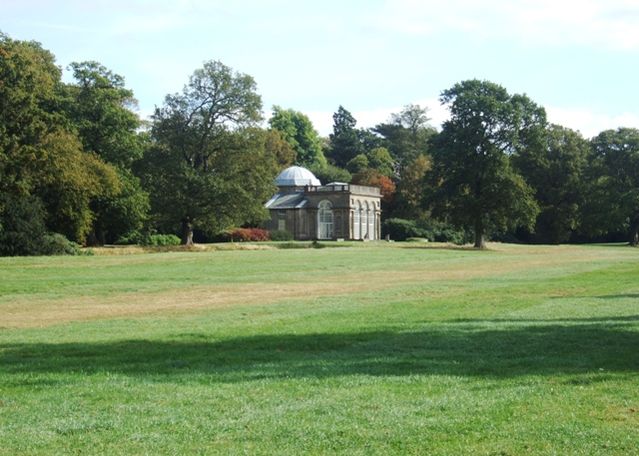
Northam Park’s landscape feature is called Diana’s Temple.  It is very similar to the one of the same name at Weston Park, pictured below.  For a wonderful view of the restored interior, with its remarkable plasterwork, see this exquisite photo from Country Life.  It looks just like a piece from someone’s blue Wedgewood collection.  This temple was designed by James Paine (1717-1789) who also designed the stables at Chatsworth House.

photo copyrighted and licensed by Simon Huguet

Regency stable

“This particular dress, Mr. Carson, is of the first stare,” Mugger insisted with clenched teeth.  “It has a rather daring stand-up collar along the back of the bodice and is the very latest design from France.  It requires her ladyship’s fitting immediately.”

“Stand-up collars are rubbish in my book, Mrs. Mugger,” Carson retorted.  “I’ve got the management of an estate.  Without Northam Park, you and your fripperies can go to perdition.”

Diana winced.  Her estate manager had sacrificed much for Northam Park in her absence.  She had yet to visit it since Vivien had married  but the thought of going there to stay alone in its brooding presence was insupportable.

Mister Carson,” Mugger replied, “you’ve been hounding my lady over that stable for nigh on six months.  Surely it can wait another day.”

“It could.  But you may be surprised to know that even my lord Montgomery agrees with my judgment.  It ought to be pulled down.”

Diana jerked her head up.   “What did you say?”

“Lord Montgomery agrees, my lady,” Carson explained eagerly.  “I spoke with his lordship about the matter the other morning, before you went for your ride.”

“You did?”

Carson visibly quailed.  “I beg your pardon, my lady, but it seemed only natural that I apply to him for an opinion on the matter, given his experience with horses and uh, estates.”

“May I remind you his experience with estates encompasses the loss of his own just this past year?”

“Yes, my lady.  It was merely a trifle—only—only in passing, I assure you.  My lord was kind enough to enquire—always solicitous my lord is,” Carson replied, his voice trailing off in misery.

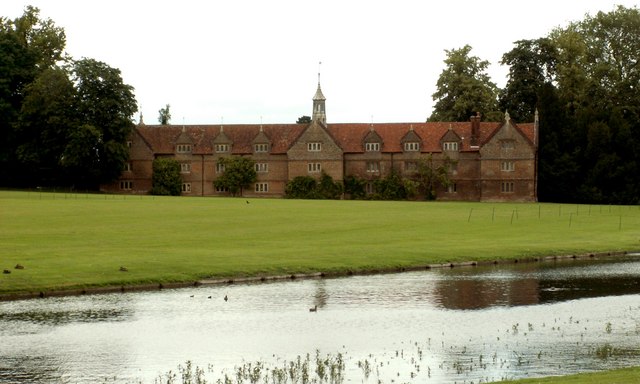
Diana’s country estate, Northam Park, has a large stable that was the centerpiece of her family’s horse racing enterprise.  The red brick Jacobean-style complex has since fallen into disuse.

Now the steeple that crowns its breeding barn has tumbled to the ground, frightening the gardeners and posing a continued hazard to Diana’s retainers who live and work on the estate.  Diana is reluctant to pull down this last reminder of her earldom’s former glory, but she must do something before anyone is hurt.

Audley End stable gives a fairly good picture of what Diana’s stable looks like.  It’s as fine as many lesser country houses.

Audley End Stables - © Copyright Robert Edwards and licensed for reuse under this Creative Commons Licence

Unlike Audley End’s stable, Northam’s is scheduled for demolition.  The horses for which it was built have died out, the last descendant having been stolen.  Thor was eventually recovered, but only after he had been gelded, an act as final as it was inexplicable.
The thieves would not have succeeded but for the terrible shock and distraction the estate had fallen under that night.  The night when its earl, Diana’s father, was found dead along a lane he must have driven over a hundred times before without incident.

Another Royal Wedding: House of Hohenzollern

Prince Georg Friedrich, Prince of Prussia and head of the House of Hohenzollern in Germany, celebrates his wedding today with Princess Sophie of Isenberg.

Georg and Sophie
The ceremony will take place in the Church of Peace.  This is near the Palace of Sansoucci just outside of Berlin.  They married privately in a civil service back in April but this will be a semi-public affair.  After a sleepy couple of decades for German royalty, this is a big deal.  Perhaps a nod to the extravaganza that was the nuptials of the Prince’s better-known relative in England earlier this summer.

Who cares?

Not many folks, I’ll wager.  Yet to some extent, this event is a link to the past which affected a whole lot of folks in the twentieth century.  Besides, on the whole, the history of Germany during its Imperial phase is mighty interesting stuff.

Kaiser Wilhelm II

We all are familiar with the Kaiser.  The prince looks just like him.

Fritz and Vicky

Bismark detested the Kaiser’s parents, Fritz and Vicky.  Vicky looks a lot like her mum, Queen Victoria. Fritz, Kaiser for 99 days, looks like no one in the family.  Which was a good thing—what a looker.

The church where Georg will marry contains a beautiful mausoleum that houses Fritz and Vicky’s crypt.

Uh, oh.  Got off topic.

Neues Palace, Potsdam

It’s hard not to draw links to the past.  Go to the Imperial complex in Potsdam and you’ll know what I mean.

Like any other lover of history who delights in finding traces of the past in the present, I think the House of Hohenzollern remains a powerful conduit of German heritage and not just because of its 900+ years of existence.  A legacy has been left to the current prince and the children he will hopefully have.  Not by the ancestor who he is famous for having, but the one who died before he could complete his destiny.

The Kaiser who tried to confer on Germany a liberality that might have averted her from a tragic course–Friedrich III – Fritz.

“He would have bridged a gap in the development of the Reich, which, as things turned out, proved a crucial one and has made itself felt right up to the present day.” – Erich Eyck, 1944

The Ha-Ha Revisited

Diana’s country estate of Northam Park has a ha-ha.  Somewhat like the dower house at Lavenham Court, in Georgette Heyer’s marvelous Talisman Ring:

I mentioned this landscape feature in an earlier post because it figures largely in the book preceding Diana’s story entitled Notorious Vow.You cannot jump one in a side-saddle.  Trust me on this.  If you have, please comment and share your experience.In Diana’s story, this barrier that separates the immediate grounds of the mansion from the outlying agricultural fields is not immediately apparent from the house.  The architect of the estate’s landscape features tried to incorporate the beauty that is Leicestershire into a working farm so that its master, the earl of Northam, could enjoy the glory of his property without being reminded that it was the rents collected from labor and cultivation that made it all possible.