Portrait of the Regency: Face to Face

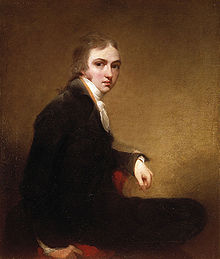
It’s been said Sir Thomas Lawrence’s legacy was left to “fashionable, virtuoso photography,” and not to the art of painting. His portrait exhibitions attracted large crowds, satisfying the Regency era’s appetite for more than just of glimpse of the rich and famous.

Now one could gaze as long as one liked, without appearing vulgar, on the visage of the Prince Regent, or on the bosom of Lady Blessington.

Exhibition room at Somerset House by Rowlandson and Pugin

In her recollections of Sir Thomas, Miss Elizabeth Croft describes the artist’s interest in physiognomy. After years of portraiture, he became convinced of the power a person’s facial characteristics exercised over their character, and their actions.

Once he rehired a servant he had formerly sacked. It seems the fellow was unable to find a new position, and Sir Thomas knew it was because of his chin:

“..an organ of destructiveness so strongly defined I fear he will never get another place.”

Miss Croft questioned his faith in such reasoning when he showed her a portrait he had sketched of the alleged murderer, John “Murphy” Williams. This was the man who’d been jailed, pending trial, for the notorious Ratcliff Highway murders which occurred near present-day Wapping, London, within a space of twelve days in December, 1811. Much struck by the villain’s pleasant features, she recalled:

This post-mortem sketch of John Williams might very well be by Lawrence

This post-mortem sketch of John Williams might very well be by the artist

I never saw a more beautiful head. The forehead, the finest one could see, hair light and curling, the eyes blue and only half-closed; the mouth singularly handsome, tho’ somewhat distorted, and the nose perfect.”

— Sir Thomas Lawrence’s Letter-bag, edited by George Somes Layard, 1906 (with recollections of the artist by Miss Elizabeth Croft)

How could Ratcliff Highway murderer have such a beautiful head, she asked, when he’d:

“…destroyed not only a father and mother..but an infant a few weeks old in its cradle–and all this for the purpose of rifling the till in a little haberdasher’s shop!”

Sir Thomas chastised her gently, drawing her attention to the similarity of Williams’ chin to that of Governor Wall, hung for acts of cruelty while in charge of a colony on the west coast of Africa. In sketching both, he noted:

“..the formation of the lower jaw was precisely the same–very square, with a peculiar shortness of the chin, and partaking more of the tiger than the human jaw.”

Of his own chin, he admitted:

“..there is some appearance of Fortitude, but wholly unconnected with Reason. Indeed, of that Philosophy which can mould wishes to circumstances and subdue the influences of Passion to those of Fortune, this Countenance has not a Vestige (!)”

He looks a bit sulky, I declare.

Yes, I do see the Fortitude. And Passion.


A Parthian Glance at Christmas

The following are excerpts from the December portion of an article entitled, “Annas Mirabilis, Or, a Parthian Glance at 1822.” These observations, often amusing, sometimes cynical, are snapshots of a Regency-era Christmas:

Sad sameness of Christmas dinners.

Every tablespoon in the house flaming with burnt brandy.

Growing civility of sweeps, dustmen and patrols: plainly denoting that the era of Christmas-boxes is at hand.

Grave papas, usually seen about without an accompaniment, were met dragging along children in couples, and occasionally stopping to peep into toy-shop windows.

Premature twelfth-cakes stealing behind confectioners’ counters.

Grimaldi and the new pantomime: front rows filled by urchins, who, at every knock-down-blow, fling back their flaxen polls, in delight, into the laps of their chuckling parents on the seat behind.

— The New Monthly Magazine and Literary Journal, Vol. VII, 1823

A glance at Christmas Past, albeit Parthian, as we speed on to the Christmases of tomorrow.

Season’s Greetings and Happy New Year!

This mulberry-coloured promenade dress looked decidedly festive with epaulettes and sleeves fashioned to look like leaves. The skirt is edged in chinchilla, matching the large muff. From Ackerman's Repository of Arts, Vol. 14, 1822

This mulberry-coloured promenade dress is decidedly festive with epaulettes and sleeves fashioned to look like leaves. The skirt is edged in chinchilla, matching the large muff. From Ackerman’s Repository of Arts, Vol. 14, 1822

Portrait of the Regency: A Nightmare

Henry Fuseli (1741-1825) was a Swiss painter unwelcome in his native country due to some political trouble. He eventually settled in England, where he became a stalwart at the Royal Academy and a master of Romantic painting.

In his spare time, he translated Homer for Cowper and Lavater’s work on physiognomy for England. He later declared, after Mrs. Fuseli had to bar his studio against an infatuated Mary Wollstonecraft:

“I hate clever women. They are only troublesome.”

Henry Fuseli by Northcote

Henry Fuseli by Northcote

Critics called his art, “Rubens in motion.” His figures writhe with violence, his incredible beasts glare fantastically. Regency era sensibilities were most particularly challenged by his painting, “The Nightmare.”

Naturally, Sir Thomas Lawrence couldn’t wait to tell Miss Croft just how timid a fellow this painter of supernatural visions really was.

Fuseli had been invited to spend an evening at a wealthy patron’s country house. After dinner, as the ladies retired to the drawing room, the artist got up from the table and left as well. The gentlemen wondered why the guest of honor had abandoned them but consoled themselves with the notion that foreigners disliked sitting after dinner.

When the ladies returned, without Fuseli, the host demanded of his lady where she’d put him. Remonstrances were exchanged while someone was dispatched to the artist’s room in the event he’d gone there to be sick.

He wasn’t there.

As is often the case with these country house mysteries, a breakthrough came by means of an unexpected observation from “below-stairs.” In this case, it was the lowly footman who found himself the subject of uncomfortable scrutiny when he admitted having directed Fuseli to the garden temple, a noted feature of the estate’s grounds, despite the gathering darkness.

The servant had tried to press upon him certain items for protection:

“What you bring that great big stick for?” asked Mr. Fuseli in his broken English.

“Why, Sir, our house dog is let loose after dark, and as he is rather fierce, you’d better take the stick.”

— — Sir Thomas Lawrence’s Letter-Bag, ed. by George Somes Layard, with recollections by Miss Elizabeth Croft (1906)

Fuseli refused to take either lantern or cudgel, and dismissed the footman upon arriving at the garden fixture. When his hosts at last discovered him, he was still inside, cowering in a state of considerable disorder.

It seems he’d heard loud sniffing at the door soon after he’d been left at the temple, which turned into blood-curdling snarls and growling. Unable and unwilling to leave the temple, and so far removed from the house no one could hear his cries, Fuseli became terrified at the prospect of spending the night in the pagan temple, at the mercy of a demonic dog.

The Nightmare, by Fuseli

The Nightmare, by Fuseli

It was an anecdote Miss Croft declared:

“I am almost ashamed to repeat.”

Thank goodness for lack of scruples.


Charles Lamb: Thanksgiving

“The most loveable figure in English literature,” Charles Lamb (1775 – 1834) was a member of the Lake poets group whose writings, however admired by the Regency-era public, were held in contempt by certain critics for their high-flown language.  He struggled with his personal life, having to care for a sister who murdered their mother and failing to win the heart of his beloved after years of courtship.

This blog has referenced him from time to time–on his adoration of Wordsworth‘s honesty, and his opinion that William Godwin’s new wife, the successor to Mary Wollenstonecraft, was a bitch.

Lawyers, he supposed, “were children once (!)” Charles Lamb by Hazlitt

With Thanksgiving upon us, his essay, “Grace Before Meat,” (1823)  seems an appropriate work to examine. One of several from his famed Essays of Elia, the piece attacks that long-lived ritual of saying grace before meals:

“Gluttony and surfeiting are no proper occasions for thanksgiving.”

Fustian, I say!

For Lamb, the matter was a serious one. He was preoccupied with the rising materialism of the age. He’d been known for remaining aloof of his countrymen’s increasing appetite for earthly pleasures. He read the New Testament and Psalms regularly. He despised organized religion.

Fellow Lake poet Robert Southey, he who “wooed Liberty as his mistress and married disreputable Legitimacy,” publicly condemned Lamb as irreligious.

But what is the point, Lamb asks?

I own that I am disposed to say grace upon twenty other occasions in the course of the day besides my dinner. I want a form for setting out upon a pleasant walk, for a moonlight ramble, for a friendly meeting, or a solved problem.

Such a  sentiment is completely inappropriate to the occasion…

When I have sate (a rarus hospes) at rich men’s tables, with the savoury soup and messes steaming up the nostrils…the ravenous orgasm upon you (!), it seems impertinent to interpose a religious sentiment.

…particularly as the occasion itself is rather hedonistic:

The heats of epicurism put out the gentle flame of devotion. The incense which rises round is pagan, and the belly-god intercepts it for his own.

..such that the one who has to say it is made to feel awkward:

I have observed this awkwardness felt, scarce consciously perhaps, by the good man who says the grace. I have seen it in clergymen and others — a sort of shame — a sense of the co-presence of circumstances which unhallow the blessing.

…and cannot be certain in knowing what to say:

A short form upon these occasions is felt to want reverence; a long one, I am afraid, cannot escape the charge of impertinence.

Borrowing an old joke from the playwright Sheridan*, Lamb suggests the following (tongue-in-cheek) for saying grace:

 “Is there no clergyman here?” — significantly adding, “thank G—.”

Blame it on the belly-god.

Even Charles Lamb could not quibble with this scene

*Lamb once said that the Irish playwright “ran through each mode of the lyre, and was master of all.”

Portrait of the Regency: “To Any Body, Any Where”

Returning to Miss Croft’s remarkable collection of anecdotes recorded of Sir Thomas Lawrence; the following story, while not precisely contemporaneous to the Regency, is nevertheless illuminating of the times.

It concerns the painter’s younger days when he enjoyed the patronage of Georgiana, Duchess of Devonshire. It was she who had engaged him at a young age to draw the portrait of her first child, later known as Lady Carlisle. He was frequently among the Devonshire set as he grew older. Miss Croft surmised that it was this period of his life by which he achieved his air of amusing urbanity.

Regrettably, among her many foibles, the Duchess was quite unable to turn down any application made to her for aid. She made promises she could not keep. She committed largesse she did not have.

One of the Duchess’ good friends was a Mr. Hare (surmised to be Francis Hare-Naylor, grandson of the Bishop of Chichester) a man who apparently knew Georgiana quite well, and was forever heartsick at the scrapes she found herself in. Many of these were of her own making, but few could admonish her like Mr. Hare:

“He had a peculiar talent for reproving a fault without giving offense to the party committing it.”

–Sir Thomas Lawrence’s Letter -bag, by Sir Thomas Lawrence, Elizabeth Croft

Her Grace's portrait by Sir Thomas Lawrence--when she was about 25 years of age

Georgiana, Duchess of Devonshire by Sir Thomas Lawrence when she was about 25 years of age

Sir Thomas had the opportunity to witness Mr. Hare’s skill in this regard one evening, when he was invited to Her Grace’s salon at Devonshire House. There, the painter joined by several great Whigs of the day, including Mr. Fox and Mr. Sheridan. Mr. Hare was there, too, and of course the Duchess was presiding. However, she jumped up to leave, having remembered she needed to write a letter.

Protestations were heard all round.  Mr. Hare declared he must write the letter in her stead, for her company was too dear to spare.

“.she laughingly inquired how that was possible, as he knew not her correspondent or her business.”

He proceeded to write a letter in full view of the company, full of voluminous expressions of admiration and a longing to serve, followed by a catalogue of many competing commitments to other friends similarly situated and the limitations on her ability to serve same, closing with “new professions of services at some future time.”

Her Grace admitted that the letter would serve her purpose very well, to everyone’s amusement. Even more amused were they as Mr. Hare signed the letter in the Duchess’ name.

But when she dared Mr. Hare to address it properly, the amusement ended.

“He very gravely folded and sealed it, and then wrote, to:

“Any Body, Any Where.”

Georgiana’s eyes filled with tears. It was some time before she could regain her composure, however, Mr. Hare remained in her good graces. Apparently she could not admonish one who knew her so well.

All that's left of Devonshire House--the gilt leopards on the gates

All that’s left of Devonshire House

Regency Apparition

During the Regency era, you were bad ton if you saw a ghost. You were queer in the attic if you admitted you had.

For example, Monk Lewis’ wildly popular play, The Castle Spectre, was still being criticized after years of successful productions for the “nonsense and absurdity” of its supernatural theme. The play’s “special effects” were deplored–the “spectre” condemned as a public nuisance for attracting large crowds of boisterous, lower class patrons clamoring to see it.
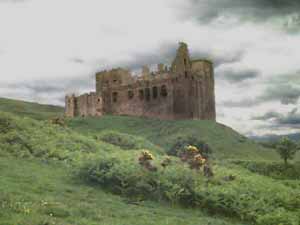
Can never get enough of old Crichton Castle

    Crichton is as spectral a castle as you’ll ever find

Works of fiction aside, efforts to prove the existence of ghosts met with even stronger disapprobation. However well-intentioned, Reverend C.C. Colton’s publicised investigation into the Sampford ghost was considered no more than an exercise in chicanery.  To dignify such paranormal experiences only encouraged more of the sightings, which were:

“..the growth of a species of superstition at once so disgraceful to the character of the age in which we live, so injurious to society in its probable effects on the minds of ignorant persons and young persons..”

— “A Full Account of the Conspiracy at Sampford Peverell, near Tiverton, containing the Particulars of the pretended Visitation of the Monster, etc.” Taunton Courier, 1810
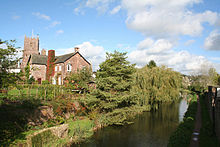
Sampford Peverell looks fairly peaceful now

     Sampford Peverell–at peace

When an account entitled “Starcross Apparition” appeared in the New Monthly Magazine, it was not surprising that the witness to it would not risk revealing his full identity. Instead, “H” risked a (tedious) exposition on the frailty of human senses–a plea for the Reader’s sympathy:

“Imposter and visionary, knave and fool, these are the alternate horns of the dilemma on which I shall be tossed with sneers of contempt or smiles of derision.”

— Account of an Apparition, New Monthly Magazine and Literary Journal, Vol. VIII, 1823

H’s account takes place in the Devonshire village of Starcross, beside the Exe estuary. Starcross is just south of Powderham Caste, seat of the Courtenay family, Dukes of Devon since the 14th century.

That summer had been especially stormy, beating into a swamp the leaves and flowers not yet ready to be cast aside for winter. He denied he was blue-devilled by the weather, that summer evening, but he did feel sufficient melancholy to send a written invitation to a friend for dinner, on account of Mr. Staples’ “contagion of laughter.”
retro owl--we had one of these growing up

retro owl–we had one of these hanging on the front door

The next day, sitting in an outdoor alcove to await Staples’ arrival, H perceived the sound of a death-watch, “that little insect of inauspicious augery.” He thought nothing of it, dismissing it just as he had the sudden shriek of a screech-owl. On his return to the house, however, he had reason to recollect these portents, for his servant handed him a black-sealed letter.

Mr. Staples was dead.

Sadly, H made his way to his library, accompanied by a faithful spaniel. Once in the chamber, however, the dog let out a horrified wail, peering with fright toward the back of the room. There was Staples, sitting motionless, upright, in a chair.

H beat a hasty retreat from the library:

“..astonishment and terror so far mastered all my faculties, that, without daring to cast a second glance toward the vision, I walked rapidly back into the garden, followed by the dog, who still testified the same agitation and alarm.”

It was the spaniel’s fault, H reasoned, for causing his master to quit the chamber in unseemly haste. Why else would the spaniel be in terror unless it was due to the supernatural, the beast having no such knowledge of ghosts and such? Nevertheless, H’s good sense finally prevailed and he returned to his library, only to find the image of Staples was still there, seated with his eyes closed.

H tried to dignify the situation by screwing himself up to speak with the ghost. (See the method for addressing specters as related in an earlier post here). Demanding the reason for its presence, H was rewarded by the following response:

The figure, slowly rising up, opening its eyes and stretching out its arms, replied, ‘A leg of mutton and caper-sauce, with a bottle of old prime port, such as you promised me.’

The devil! (Actually, H swore that other innocuous Regency oath, ‘Good God!’)

One can only imagine H’s chagrin when Staples, in high good humor, assured his friend he was not a ghost. Indeed, it was a namesake of his, living in Castle-street, who had died. Unfortunately, some “loud-mouthed fool” had spread the false news to Staples’ clerk, who then conveyed the misinformation to H.

Imagining his friend’s turmoil upon receiving such a bag of moonshine, Staples made haste to Starcross to rectify the error. He let himself in the side door of the house and sat down in the library to await his host with the good news he was very much alive. His motionless appearance was explained by reason he’d fallen asleep.

The dog’s reaction was simply a case of dislike for Staples, who had strongly chastised him on an earlier visit for killing a chicken.

The Author wisely refrains from commenting further on his own reaction, and leaves it to us to contemplate ours.

“Monsters are real, and ghosts are real, too. They live inside us, and sometimes they win.” — Stephen King
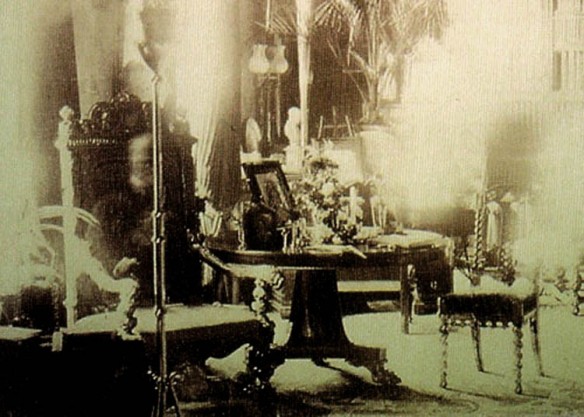
Viscount Combermere is thought to be sitting in his favorite chair in this photograph taken by his sister, during his funeral, while the house was empty

Viscount Combermere, investigator of the famous moving coffins in Barbados, was struck and killed by a carriage. During his funeral, this photograph was taken of his favorite chair, while the house was empty.

 

Portrait of the Regency – “A Miraculous Picture”

Much has been written of Sir Thomas Lawrence (1769 – 1830), self-taught prodigy and “Romantic Portraitist of the Regency.” These illustrations almost always mention Miss Elizabeth Croft, his close friend and supporter.

The days she spent with the Artist and his circle of intimate friends formed the best part of her life, she later declared. Her treasured memento was his acutely melancholic portrait of her dead half-brother (the famous suicide Sir Richard Croft, attending physician at Princess of Wales’ deathbed). Her legacy to us is the collection of anecdotes which Sir Thomas had passed on to her–a brilliant and intimate portrait of Regency society.

There was never anything lover-like between them, as far as anyone could tell. Indeed, Miss Croft served as something rather different to the Artist as she bustled about his studio. She was, as the saying goes, a managing female.

Those old Pan covers were marvelous.

Those old Pan covers were marvelous.

‘Oh, dear!” said Miss Merrivale, stricken. “And I took such pains not to appear to be a managing female!’

‘Are you one?’

‘Yes, but how could I help it?’

— Frederica, by Georgette Heyer

As Sir Thomas Lawrence was in such demand as Europe’s portrait painter, he frequently got behind in his work. Miss Croft was well aware others thought he was indolent and unproductive:

During all this period I can with truth report that he painted from sunrise to sunset, except in the hours that he devoted to the correction of engravings and those of his hurried meals..

— from “Recollections of the Artist,” by Miss Elizabeth Croft, SIR THOMAS LAWRENCE’S LETTER-BAG, Edited by George Somes Layard, 1906

Take Isabella Wolff’s portrait, twelve years in the making.  The sitter was the wife of a Danish official in London, Jens Wolff. She, along with her sisters, had been members of Miss Croft’s circle.  When one of Isabella’s sisters complained about the time it was taking to finish Isabella’s portrait, the artist, stung, promised to finish it as soon as the sitter could be persuaded to return to London.

This she did, but after only a few sittings she was off again, before the portrait could be completed. What remained was the most intricate part of the painting–executing the folds of Mrs. Wolff’s white satin dress. This last was accomplished by reason of Miss Croft donning the “drapery” and sitting for the remainder of the portrait.

Mrs. Jens Wolff by Lawrence

One can only imagine Miss Croft’s gentle impatience.

Right–I‘ll wear the bloody thing.

In the end, Miss Croft was justly proud of her participation, reporting how Mrs. Wolff’s portrait had been given a place of honor at an 1815 exhibition alongside those of Wellington, Blucher and Platoff. The newspapers, she recalled, all agreed that “the lady reading by the lamplight was indeed a miraculous picture.”


Nuptials of the Regency

And now for some various Regency-era nuptial announcements from La Belle Assemblée or, Bell’s Court and Fashionable Magazine Addressed Particularly to the Ladies .

From the March, 1817 issue of the aforesaid Magazine:

At Ringwood, Mr. T. Bloomfield, aged 70, to Mrs. Mooren, aged 40. So decrepit and helpless was the old man that it was with the greatest difficulty that he could be taken from the chaise which brought him from the church; and when in the church he was obliged to be drawn to the altar in a cart.”

Another singular notification appeared in the September issue of that same year:

At Rothwell Church, Mr. Thomas Craven, of the Leeds Pottery, to Miss Coultare, both of Leeds, after a tedious courtship of twenty-eight years, six months and six days.”

Leeds Pottery manufactured a popular Regency dinnerware known as creamware. Still in business today, their website informs:

“This was a new type of earthenware made from white Cornish clay Leeds creamware potterycombined with a translucent glaze to produce its characteristic pale cream colour…perfect for making the elegant and highly decorative tableware in demand in the Georgian age.”


Reverend N. Trefidder, by reason of his profession, had the right and duty to issue the banns of his own impending wedding to Miss Peggy Butterall. The Magazine noted this announcement in its January, 1818 issue, adding:

It is remarkable that a similar instance took place in the same parish about twenty years ago, when the minister married the clerk’s widow.

And finally, an example of the great Society wedding announcement, from May of 1818:

The Honorable Colonel Seymour to Lady Charlotte Cholmondeley, daughter of the Marquis of Cholmondeley; his Lordship on the happy occasion gave a grand entertainment to His Highness, the Prince Regent, and a large party of distinguished personages…The lovely bride’s dress was a white satin slip, covered with rich point lace; headdress feathers and diamonds.

Featured in Ackerman's Repository, June 1 1819, the costume consists of a white satin slip covered with white transparent gauze to fashion a round morning dress, courtesy of Miss Pierpoint, Dressmaker, No. 9 Henrietta Street in Covent Garden.

Featured in Ackerman’s Repository, June 1 1819, this costume consists of a white satin slip covered with white transparent gauze to fashion a round morning dress, courtesy of Miss Pierpoint, Dressmaker, No. 9 Henrietta Street in Covent Garden.

Regency’s “Sable Garb of Woe”

From the November, 1818 issue of La Belle Assemblée or, Bell’s Court and Fashionable Magazine Addressed Particularly to the Ladies, the following notice appears:

Our Cabinet of Taste is unavoidably closed at present: every European court will, no doubt, adopt the ‘sable garb of woe’ for Britain’s virtuous queen.

It was said by contemporaries that this Lawrence portrait of George III's Consort bore a remarkable likeness to her.

And with that, Adelaide’s adventures come to an end–or, at least, they are no longer reported. Presumably her frivolous ways were considered an affront to the Readership’s sensibilities in this time of mourning following Queen Charlotte’s death.

Instead, anecdotes of the Queen’s final moments were shared. Sir Henry Halford, physician to the Regency, was in attendance during her last illness. It was he who sent to Carlton House, summoning the Prince Regent in:

..a statement so alarming, that the Prince sent instantly for the Duke of York to accompany him to Kew.

The queen was reportedly lucid throughout the duration of her last day on earth, November 17th. She sat in her chair, surrounded by her children, the Prince Regent holding her hand. In keeping with the Magazine’s determined tone of solemnity and discretion, further illustration of the deathbed scene was limited:

The expiring scene–the heart-rending feelings of the Regent, and all present, it will be equally impossible and unbecoming to attempt to describe.

Inevitably, bombazine is the dress material of mourning. This illustration of a carriage dress suitable for mourning, from the Magazine's November issue, is liberally trimmed in black velvet, from spencer to hem.

Inevitably, bombazine is the dress material of mourning. This illustration of a carriage dress suitable for mourning, from the Magazine’s November issue, is liberally trimmed in black velvet, from spencer to hem.

Queen Charlotte served as Consort for fifty-seven years and seventy days.

Just this past week we’ve been reminded of another Consort’s lengthy service.

Elizabeth II and the Duke of Edinburgh - 1954

Elizabeth II and Prince Philip–is it him or the uniform that draws the admiring glance? I can’t decide.


Adelaide – A Regency Marriage

"Other men might envy Sir Nugent; they could not despise him, for his pedigree was impeccable, his fortune exceeded sixty thousand pounds a year." Sylvester, Heyer

Other men might envy Sir Nugent; they could not despise him, for his pedigree was impeccable, his fortune exceeded sixty thousand pounds a year.”

In Maria’s estimation, marriage served only to increase Adelaide’s extravagance.

“..(Adelaide) has wedded a man so wealthy, that Mexico and Peru seem to be at his command; so much the worse, perhaps, for her, for she is naturally extravagant, and will think his riches inexhaustible.”

— “Letter from a Young Married Lady to her Sister in the Country,” La Belle Assemblée, August, 1818

Surely Heyer’s Ianthe was based on Adelaide, and the preposterous Sir Nugent Fotherby on the man who could bail out entire nations–the Honorable Frederic Cleveland.

Nine years older than his teenage bride, Cleveland owned over thirty “blood” horses, possessed an extensive country estate and funds enough to support the staggeringly expensive habits of a sporting Corinthian:

“..he is fond as ever of his dogs and horses; he is a modern charioteer, a great encourager of pugilism,…most admirable skill in horseflesh.”

Maria marveled to her sister over the fashionable couple’s two (!) separate boxes at the Opera and the immense sums Adelaide pays for milliners’ wares–a continual stream of pelisses, bonnets, bronze half-dresses and furbelows–only to discard them almost at once. She doesn’t ask the price of the trimmings sent “enough for ten months at least,” only that the bills be sent to her husband, who had already proven himself indulgent on the matter of the “vulgar” white bridal dress.

Indeed, Adelaide thinks nothing of throwing down an expensive cashmere shawl for her lap dog or Cleveland’s pointers to rest upon.

Called by its French name "cachemire" in the Magazine, this draped shawl forms part of a walking dress ensemble. -- La Belle Assemblée, May, 1818

Called by its French name “cachemire” in the Magazine, this draped shawl forms part of a walking dress ensemble. — La Belle Assemblée, May, 1818

After observing this increased profligacy, even dashing aunt Lady Worthington was moved to reprove her niece:

“..Lose not your hours, my dear Adelaide, in fashionable follies: do not act like too many votaries of dissipation, as if youth and life were eternal.”