Portrait of the Regency – “A Miraculous Picture”

Much has been written of Sir Thomas Lawrence (1769 – 1830), self-taught prodigy and “Romantic Portraitist of the Regency.” These illustrations almost always mention Miss Elizabeth Croft, his close friend and supporter.

The days she spent with the Artist and his circle of intimate friends formed the best part of her life, she later declared. Her treasured memento was his acutely melancholic portrait of her dead half-brother (the famous suicide Sir Richard Croft, attending physician at Princess of Wales’ deathbed). Her legacy to us is the collection of anecdotes which Sir Thomas had passed on to her–a brilliant and intimate portrait of Regency society.

There was never anything lover-like between them, as far as anyone could tell. Indeed, Miss Croft served as something rather different to the Artist as she bustled about his studio. She was, as the saying goes, a managing female.

Those old Pan covers were marvelous.

Those old Pan covers were marvelous.

‘Oh, dear!” said Miss Merrivale, stricken. “And I took such pains not to appear to be a managing female!’

‘Are you one?’

‘Yes, but how could I help it?’

— Frederica, by Georgette Heyer

As Sir Thomas Lawrence was in such demand as Europe’s portrait painter, he frequently got behind in his work. Miss Croft was well aware others thought he was indolent and unproductive:

During all this period I can with truth report that he painted from sunrise to sunset, except in the hours that he devoted to the correction of engravings and those of his hurried meals..

— from “Recollections of the Artist,” by Miss Elizabeth Croft, SIR THOMAS LAWRENCE’S LETTER-BAG, Edited by George Somes Layard, 1906

Take Isabella Wolff’s portrait, twelve years in the making.  The sitter was the wife of a Danish official in London, Jens Wolff. She, along with her sisters, had been members of Miss Croft’s circle.  When one of Isabella’s sisters complained about the time it was taking to finish Isabella’s portrait, the artist, stung, promised to finish it as soon as the sitter could be persuaded to return to London.

This she did, but after only a few sittings she was off again, before the portrait could be completed. What remained was the most intricate part of the painting–executing the folds of Mrs. Wolff’s white satin dress. This last was accomplished by reason of Miss Croft donning the “drapery” and sitting for the remainder of the portrait.

Mrs. Jens Wolff by Lawrence

One can only imagine Miss Croft’s gentle impatience.

Right–I‘ll wear the bloody thing.

In the end, Miss Croft was justly proud of her participation, reporting how Mrs. Wolff’s portrait had been given a place of honor at an 1815 exhibition alongside those of Wellington, Blucher and Platoff. The newspapers, she recalled, all agreed that “the lady reading by the lamplight was indeed a miraculous picture.”


Nuptials of the Regency

And now for some various Regency-era nuptial announcements from La Belle Assemblée or, Bell’s Court and Fashionable Magazine Addressed Particularly to the Ladies .

From the March, 1817 issue of the aforesaid Magazine:

At Ringwood, Mr. T. Bloomfield, aged 70, to Mrs. Mooren, aged 40. So decrepit and helpless was the old man that it was with the greatest difficulty that he could be taken from the chaise which brought him from the church; and when in the church he was obliged to be drawn to the altar in a cart.”

Another singular notification appeared in the September issue of that same year:

At Rothwell Church, Mr. Thomas Craven, of the Leeds Pottery, to Miss Coultare, both of Leeds, after a tedious courtship of twenty-eight years, six months and six days.”

Leeds Pottery manufactured a popular Regency dinnerware known as creamware. Still in business today, their website informs:

“This was a new type of earthenware made from white Cornish clay Leeds creamware potterycombined with a translucent glaze to produce its characteristic pale cream colour…perfect for making the elegant and highly decorative tableware in demand in the Georgian age.”


Reverend N. Trefidder, by reason of his profession, had the right and duty to issue the banns of his own impending wedding to Miss Peggy Butterall. The Magazine noted this announcement in its January, 1818 issue, adding:

It is remarkable that a similar instance took place in the same parish about twenty years ago, when the minister married the clerk’s widow.

And finally, an example of the great Society wedding announcement, from May of 1818:

The Honorable Colonel Seymour to Lady Charlotte Cholmondeley, daughter of the Marquis of Cholmondeley; his Lordship on the happy occasion gave a grand entertainment to His Highness, the Prince Regent, and a large party of distinguished personages…The lovely bride’s dress was a white satin slip, covered with rich point lace; headdress feathers and diamonds.

Featured in Ackerman's Repository, June 1 1819, the costume consists of a white satin slip covered with white transparent gauze to fashion a round morning dress, courtesy of Miss Pierpoint, Dressmaker, No. 9 Henrietta Street in Covent Garden.

Featured in Ackerman’s Repository, June 1 1819, this costume consists of a white satin slip covered with white transparent gauze to fashion a round morning dress, courtesy of Miss Pierpoint, Dressmaker, No. 9 Henrietta Street in Covent Garden.

Regency’s “Sable Garb of Woe”

From the November, 1818 issue of La Belle Assemblée or, Bell’s Court and Fashionable Magazine Addressed Particularly to the Ladies, the following notice appears:

Our Cabinet of Taste is unavoidably closed at present: every European court will, no doubt, adopt the ‘sable garb of woe’ for Britain’s virtuous queen.

It was said by contemporaries that this Lawrence portrait of George III's Consort bore a remarkable likeness to her.

And with that, Adelaide’s adventures come to an end–or, at least, they are no longer reported. Presumably her frivolous ways were considered an affront to the Readership’s sensibilities in this time of mourning following Queen Charlotte’s death.

Instead, anecdotes of the Queen’s final moments were shared. Sir Henry Halford, physician to the Regency, was in attendance during her last illness. It was he who sent to Carlton House, summoning the Prince Regent in:

..a statement so alarming, that the Prince sent instantly for the Duke of York to accompany him to Kew.

The queen was reportedly lucid throughout the duration of her last day on earth, November 17th. She sat in her chair, surrounded by her children, the Prince Regent holding her hand. In keeping with the Magazine’s determined tone of solemnity and discretion, further illustration of the deathbed scene was limited:

The expiring scene–the heart-rending feelings of the Regent, and all present, it will be equally impossible and unbecoming to attempt to describe.

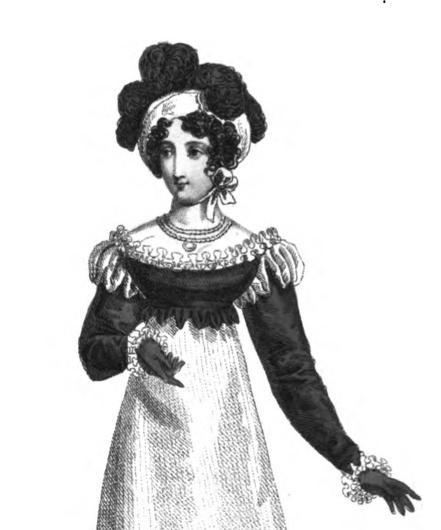
Inevitably, bombazine is the dress material of mourning. This illustration of a carriage dress suitable for mourning, from the Magazine's November issue, is liberally trimmed in black velvet, from spencer to hem.

Inevitably, bombazine is the dress material of mourning. This illustration of a carriage dress suitable for mourning, from the Magazine’s November issue, is liberally trimmed in black velvet, from spencer to hem.

Queen Charlotte served as Consort for fifty-seven years and seventy days.

Just this past week we’ve been reminded of another Consort’s lengthy service.

Elizabeth II and the Duke of Edinburgh - 1954

Elizabeth II and Prince Philip–is it him or the uniform that draws the admiring glance? I can’t decide.


Adelaide – A Regency Marriage

"Other men might envy Sir Nugent; they could not despise him, for his pedigree was impeccable, his fortune exceeded sixty thousand pounds a year." Sylvester, Heyer

Other men might envy Sir Nugent; they could not despise him, for his pedigree was impeccable, his fortune exceeded sixty thousand pounds a year.”

In Maria’s estimation, marriage served only to increase Adelaide’s extravagance.

“..(Adelaide) has wedded a man so wealthy, that Mexico and Peru seem to be at his command; so much the worse, perhaps, for her, for she is naturally extravagant, and will think his riches inexhaustible.”

— “Letter from a Young Married Lady to her Sister in the Country,” La Belle Assemblée, August, 1818

Surely Heyer’s Ianthe was based on Adelaide, and the preposterous Sir Nugent Fotherby on the man who could bail out entire nations–the Honorable Frederic Cleveland.

Nine years older than his teenage bride, Cleveland owned over thirty “blood” horses, possessed an extensive country estate and funds enough to support the staggeringly expensive habits of a sporting Corinthian:

“..he is fond as ever of his dogs and horses; he is a modern charioteer, a great encourager of pugilism,…most admirable skill in horseflesh.”

Maria marveled to her sister over the fashionable couple’s two (!) separate boxes at the Opera and the immense sums Adelaide pays for milliners’ wares–a continual stream of pelisses, bonnets, bronze half-dresses and furbelows–only to discard them almost at once. She doesn’t ask the price of the trimmings sent “enough for ten months at least,” only that the bills be sent to her husband, who had already proven himself indulgent on the matter of the “vulgar” white bridal dress.

Indeed, Adelaide thinks nothing of throwing down an expensive cashmere shawl for her lap dog or Cleveland’s pointers to rest upon.

Called by its French name "cachemire" in the Magazine, this draped shawl forms part of a walking dress ensemble. -- La Belle Assemblée, May, 1818

Called by its French name “cachemire” in the Magazine, this draped shawl forms part of a walking dress ensemble. — La Belle Assemblée, May, 1818

After observing this increased profligacy, even dashing aunt Lady Worthington was moved to reprove her niece:

“..Lose not your hours, my dear Adelaide, in fashionable follies: do not act like too many votaries of dissipation, as if youth and life were eternal.”


Adelaide — A Regency Wedding

The canezou is a type of spenser--this one is in black satin and part of a "fancy mourning dinner dress." From the December issue of La Belle Assemblée, 1818.

The canezou is a type of spenser–this one is in black satin and part of a “fancy mourning dinner dress.” From the December issue of La Belle Assemblée, 1818.

“You read in the papers, no doubt, the wedding of the dashing Adelaide Worthington, with the Hon. Frederic Cleveland..”

— Letter from a Young Married Lady to Her Sister in the Country

La Belle Assemblée; August, 1818

Having left the out-of-the-way society of her “good aunt Charlton,” Adelaide went to live with another aunt, as dashing as the former was dull. Lady Worthington was the sister-in-law of the gel’s father, and had a daughter of her own, “lovely and gentle.” Under the aegis of Lady Worthington, Adelaide soon received a very eligible offer of marriage.

Maria tells her sister that she’d been compelled to attend the wedding as Adelaide’s “bridewoman,” a duty that filled her with dread:

“I know you are eager to learn how we were attired on the wedding-day: we were dreadfully troubled to make the bride-elect attend to reason; it was so horrid vulgar to be dressed in white at a wedding.”

Glumly, Maria submitted to wearing lace and Bengal muslin, with a wreath of Mrs. Bell’s finest “full-blown white roses.” Her companion, Lady Worthington’s daughter, wore white spotted crepe fashioned into an Oriental robe, her dark loveliness set off beautifully in a net bonnet trimmed in small white roses.

Maria’s husband, Mr. Fitzosborn, was lucky enough to escape having to wear white. Instead, he wore a finely tailored coat in a grey-green sage color, his only nod to the bridal request to wear white being found in his waistcoat and silk stockings. He looked so well that many mistook him for the bridegroom.

As for the bridegroom himself, he seemed appeared in a rather odd choice for nuptial dress:

“..an American drab-coloured coat, with large and loose white trousers.”

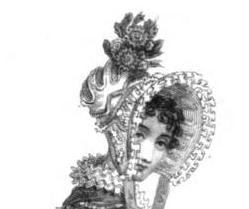
Here is a transparent bonnet of white net and lilac satin, "crowned with a bouquet of French double poppies." La Belle Assemblée, June 1818

Here is a transparent bonnet of white net and lilac satin, “crowned with a bouquet of French double poppies.” La Belle Assemblée, June 1818

Meanwhile, Adelaide, at her husband’s insistence, wore a French gown of the finest white Brussels lace over white Chinese silk. Her aunt protested that if Adelaide must wear white, at least let it be English white, but to no avail. Maria indicates this unfortunate choice of white over white might have been relieved by the canezou of satin the bride wore over her gown, although this seems unlikely as it too was in “vulgar” white. The bridal bonnet was transparent and trimmed in fine French blond with a large plume of feathers:

“It did not become her, but it was fashionable.”

In a grand departure worthy of Ianthe, that remarkably spoilt, impulsive character in Georgette Heyer’s Sylvester, Adelaide embarked on her wedding trip to the bridegroom’s country estate wearing a “celestial blue” pelisse of sarsnet. It was a pity the bride chose, as was her lamentable habit, a bonnet which quite hid her face–a Leghorn of immense proportions.

Adelaide — A Regency Mamma’s Folly

Adelaide’s mother, “gay and thoughtless,” had been dead two years by the time her daughter’s story appeared in La Belle Assemblée.  The gel’s guardians had placed her with “good aunt Charlton,” apparently hoping this lady and her dull, dutiful daughter would exercise some moderation upon the teenaged orphan.

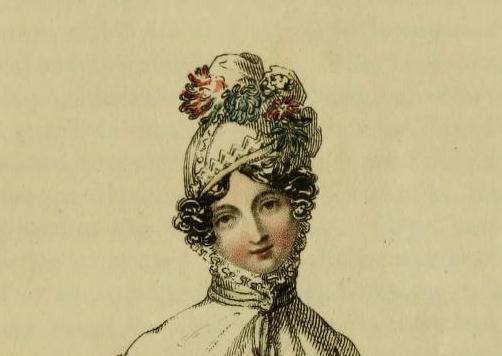
This toque is of the Pavilion style and part of an evening dress ensemble, appearing in the October, 1817 edition La Belle Assemblée; or, Bell's court and fashionable ... N.S. 15-16 (1817).

This toque is designed in the Pavilion style (note the plumes) and forms part of an evening dress ensemble, appearing in the October, 1817 edition La Belle Assemblée; or, Bell’s court and fashionable … N.S. 15-16 (1817).

Alas, the damage had already been done.

Adelaide’s parents were married when the bride was scarcely more than a girl herself. When Papa died, Daughter became Mamma’s bosom companion. Wherever the widow went, Adelaide was with her, whether riding in Hyde Park or driving their handsome curricle.

They appeared as siblings rather than parent and child. To promote this happy illusion, they wore exactly the same thing:

“..one dressing too young, the other too old.”

Innocent enough, perhaps, but for Mamma’s predilection for late-night parties.  After attending one crowded soiree on a “humid” December night, they both fell ill and the girl nearly died alongside her mother.

These circumstances are related in the fourth of Maria’s letters to Lucy, her sister in the country. Ostensibly to describe fashion in a clever and engaging way, these “letters” in the Magazine’s Cabinet of Taste also express the Regency’s preoccupation with character, and more particularly the formation of it.

It is never the done thing to dress without regard for one’s age and status. Worse, to treat a child as an adult has a most unhappy effect. Today, millions of dollars are spent studying the problem.

During the Regency, one needed only to observe what was worn:

“..at fifteen the youthful Adelaide’s beautiful tresses were concealed under a toque, loaded with plumes, the same as her mother’s; while diamonds, pearls and coral loaded her arms, her ears, her wrists and her fingers, because mamma had the same.”

Maria goes on to relate this to Adelaide’s perpetual dissatisfaction, concluding rather ominously that such a legacy might run its course like a chronic disease:

“..but though only eighteen, the beautiful Adelaide seems rapidly sinking into a consumption.”


Adelaide – Regency Era Fashionista

“And now for the fascinating Adelaide; the epitome of fashion, and the best specimen I can give you of the reigning mode..”

— Letter from a Young Married Lady to her Sister in the Country

La Belle Assemblee, January, 1818

Adelaide is a featured character in the Magazine’s Cabinet of Taste. She is the niece of Lady Charlton, who has, like a kind of “Lady Bountiful,”  taken in her dead sister’s  young “town-bred” daughter.  It helps immensely that Adelaide is an heiress.

Maria advises her sister that the cornette is in fashion: "It is composed of the finest Mechlin lace and net; it is lined with soft blush-coloured satin, and fastened under the chin with a quilling of fine lace...the hair is entirely concealed, except a few ringlets that are made to sport around the face." -- print from Ackerman's Repository, May 1818

Maria advises her sister that the cornette is in fashion: “It is composed of the finest Mechlin lace and net; it is lined with soft blush-coloured satin, and fastened under the chin with a quilling of fine lace…the hair is entirely concealed, except a few ringlets that are made to sport around the face.” — print from Ackerman’s Repository, May 1818

The letter-writer, Maria, describes her dashing new acquaintance in a series of letters to her sister Lucy. As a fascinated observer, she alternates between admiration of Adelaide’s determined pursuit of fashion and trepidation that the fashionista will  one day come to grief.

Writing from Brighton, Maria describes her first impression of Adelaide:

“Her fine long light hair is plaited, and then wound elegantly around her head; a Cashmere shawl, light as it is rich and superb, is carelessly thrown over her shoulders, which are, nevertheless, seen to be totally bare under the partial Oriental covering; and also, be it known, (and few who are who do not know it) they are as white as ivory.”

She is slim “as a Sylph” and makes such a grand spectacle at the harp without actually playing that one is really quite convinced she is as a good as a professional musician. But it is her pursuit of fashion that quite distinguishes her above all others.

She wears the perfume  Eau de Millefleurs (albeit “excessively so”) and her small, delicate features are usually hidden behind large hats to excite curiosity. At evening balls, her hair is decorated “with all kinds of flowers.”

Her favorite millinery is Magazin de Modes in St. James’ Square. She sends to them every week for new trimmings. These she drapes them in ecstasy over her harp for exacting inspection. Other tradesmen bring the latest articles of fashion on a frequent basis, necessarily purchased without seeing in order that she may be the first of her acquaintance to wear them.

Inevitably, some of the shawls and robes and half-dresses are so disappointing that she becomes blue-devilled. So great is her feeling of provocation that nothing will rouse her from this state—not even the latest piece of “sentimental trash” from the library, which she abuses in her fury by tearing out the third leaf from the book.

“She lays down on a sofa, complains of the headache, and declares she is the most wretched being in the world.”

Voyons (!)–we shall hear more of Adelaide, you can be sure.


Regency Hazards – A Squeeze

People have not done talking of the squeeze at Gloucester House, which was a most exact and daughter-like copy of the Drawing-room, both in numbers and quality.”

Freddy: "Much of a squeeze?" Willis: "No, Sir, we are a little thin of company, the season having begun."

Freddy: “Much of a squeeze?”
Willis: “No, Sir, we are a little thin of company, the season having just begun.”

— Letter from Lady Williams-Wynn to  the Hon. Mrs. Henry Williams-Wynn, May 18, 1818

A squeeze, as you know, is cant for a large number of persons crammed into a space too small to accommodate them.

A Regency hostess’ dream.

Purchased in 1806 by the 2nd Earl Grosvenor, Gloucester House became Grosvenor House, the new London residence of this vastly wealthy family. The squeeze Lady W.W. wrote of took place in the house as it was being enlarged and redecorated.

That evening, guests were ascending the great marble steps to the assembly rooms above, when:

“Mrs. Ross took a faint upon the stair-case, and in order to give her room and air, an Alarm was given that the whole was giving way..”

The panic that ensued was tremendous. Since renovations had been ongoing at the mansion, it must have seemed likely that the structure, including the staircase, had been weakened in some way:

Robert Grosvenor, 1st Marquess of Westminster--he looks good in red, too

Robert Grosvenor, 2nd Earl Grosvenor–he looks good in red, too


“..this sent every body flying, or rather pushing one over the other..”

The Duke of Wellington was also on the stairs when Mrs. Ross fainted.  I suspect she was the lady whom His Grace once called, “my friend Mrs. Ross,” and the wife of one of his officers Colonel (later Sir) Patrick Ross, of the 75th Regiment.

She was usually very obliging. At Wellington’s request, she kept an eye on a colleague’s adventurous son while all were abroad during the Napoleonic Wars.

Friend or otherwise, in the end she caused so much panic that the great Field Marshal was moved to declare:

“..he was never so much frightened in his life, and that it was too bad after all to come here to be taken in by a ‘ruse de guerre’ and that from Mrs. Ross!”


Regency Hazards – Pins

 “A young lady in France had the fatal habit of cleaning her ears with pins; a   trifling humour was the result, which terminated lately in a cancer. The brass and quicksilver used in the preparation of pins may easily account for this circumstance, and which render them so very pernicious to the teeth when used as tooth-picks.”

— La Belle Assemblee, Vols 17-18, Jan-Dec 1818

I shan’t say anything further on the matter. You’ve been warned.

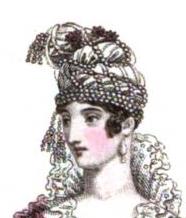
From the same issue of said Magazine--a detail of evening dress with white satin turban and pear-shaped pearl earrings.

From the same issue of said Magazine–a detail of evening dress with white satin turban and pear-shaped pearl earrings.


Regency Hazards – Oxen

Charlotte Grenville (1754-1830), Lady Williams Wynn, amassed a considerable amount of correspondence during the Regency.

In a January 1818 letter to her eldest daughter Fanny, she described the ball she’d given at Wynnstay, the family seat in Wales.

It was better than the best evening to be had at Almacks, despite the lack of Beauty:

“..3 Miss Dods at the Vicarage, Miss Lyster of Toft, & 2 very ugly Miss Allansons..& Emmy Brooke & Miss Parker divided the apple, which is not saying much.”

for there were Beaux aplenty and Lady Harriet, her daughter-in-law, who managed to turn out quite well in her diamonds and wedding gown (!)

There was also Lady W. W.’s good friend, Lord Bradford.

..he found a crooked sixpence against a crooked stile… from a vintage Mother Goose book

Orlando Bridgeman (1762 – 1825) was the first Earl of Bradford and married to Lucy Elizabeth Byng, daughter of the 4th Viscount Torrington. He arrived at Wynnstay ever so congenial since his new daughter-in-law was already pregnant. It was as if the coming baby were “his own.”

Being in such fine feather he admitted he was not opposed to his other son’s proposal of marriage to a Miss Chamberlayne, the daughter to the Consul in Brazil. The match “has nothing to recommend it,” but who could deny a “sailor-son” falling in love “the moment he came into port?”

The best part of Lord Bradford’s presence was the telling of his narrow escape from a ox.

He’d gone tramping the previous month at the Duke of Norfolk’s estate in Welbeck, which led him across fields separated by fences. One such fence had a stepped gate for crossing into the next field. With proper caution so as not to stumble, he felt his way over the stile and descended safely into an oxen pasture. Producing a scented handkerchief from his breast pocket, he proceeded to wipe his hands.

A bull, observing this nicety, became incensed and charged his lordship.

Regency bull

As there was very little about with which to protect himself, Lord Bradford could only escape back the way he’d come. However, scrambling over a stile in haste can be even more dangerous than a charging cow. The alternative was a hay rack nearby. This he grabbed and managed to pull himself up its high rungs, out of the maddened animal’s reach. It was a brief respite, for he fell down into the rack’s manger, there for catching leftovers or, in this case, a lord.

“Fortunately his cries brought assistance, and by the united exertion of six men the Animal was removed. (His lordship) was, of course, dreadfully bruised but not materially, and soon got well.”

Remonstrations were exchanged. To the extreme dissatisfaction of all concerned, the bull’s sudden violence seemed to have no warning or cause until someone thought to apply to a rustic expert for his opinion.

Nothing loth,

“The Cowman readily explained the cause of the misfortune by saying, ‘..the poor Cratur never could ‘boide a Stink(!)’ “