The Earl is Dead

In Notorious Match, heroine Diana Wace is strangely conflicted over the tragedy that made her Countess of Northam. 
On the one hand, she rebels against the tremendous wealth and property that are now hers.  She has no lack for suitors, many of them penniless fortune hunters, all of them eager to become the next Earl of Northam.

Diana also suffers from a terrible guilt that arose from the death of her father, the late Earl Reynold.  While he was alive, she was kept hidden away on his northern estate, forgotten and unloved.  With his death came her release from the prison that was Northam Park.

Since then, Diana avoids the estate, fancying it rebukes her still for that secret joy she felt when she was freed from its isolation.  One of the places there that she will never look upon is the abandoned lane where her father died in a borrowed carriage.  No one ventures there anymore, even if they must take an alternate route that goes around the estate.

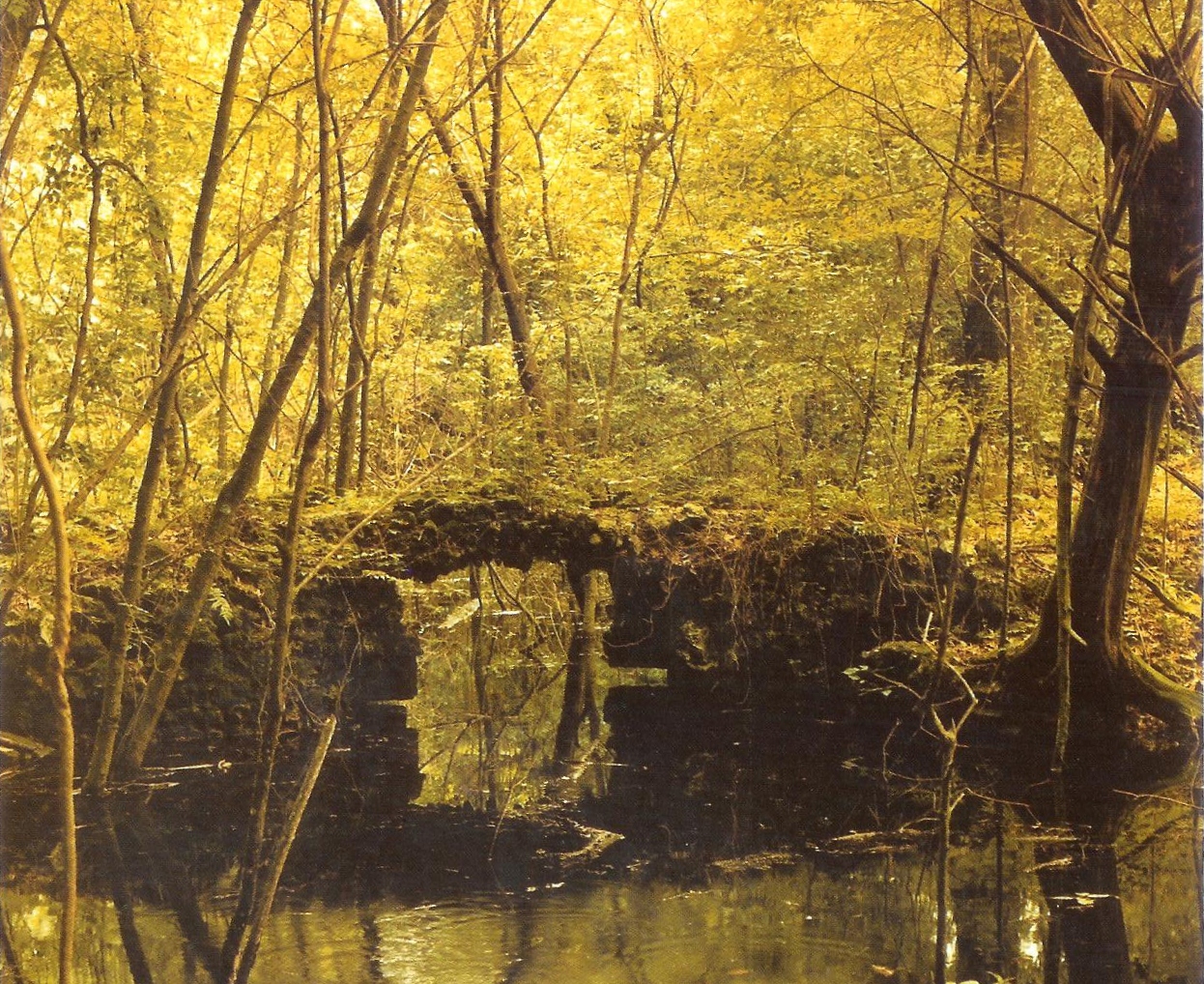
The lane is one of the most beautiful features of Northam Park.  It was designed and installed for a previous earl by that the great landscape architect, Capability Brown.  Note the picturesque bridge over a water feature the path follows.  If you drive your tillbury too fast along its shaded way, however, such beauty can be deadly.

Cast out of Olympus

In Notorious Match, Diana struggles against the memory of her lonely childhood.  Barbara Hutton Photo Gallery Page, Photo Album Page

She could so very easily have been the Barbara Hutton of the Regency.  You may recall the tragic life of the Woolworth heiress whose father was the wealthy co-founder of E. F. Hutton, a banking firm.  Remember those funny 80s commercials? “When E. F. Hutton talks, people listen.”

Not so funny–Barbara’s mother committed suicide and her father abandoned her.  She died after a string of broken marriages, a broken fortune and, some say, a broken heart.

Poor  little rich girl.

My heroine Diana spent most of her unhappy childhood at Northam Park, the seat of her family’s earldom in Leceistershire, England.  When she became countess in her own right, she travelled frequently to her estate but stayed only for a short periods of time.  Each visit she made served as a reminder she was unloved as a child.  In its own way, Northam Park insisted she never forgot.

The mansion at Northam Park was built in 1724 by the English master builder Francis Smith of Warwick for the 28th Earl (yes, you read that correctly–the earldom is at least as old as that of Arundel, held by the Howard family).  Northam Park’s architect designed the house very similarly to his creation of Sutton Scarsdale, built for the earl of that name.  Rivalling Chatsworth House in size and splendor, Northam Park was given a massive east front with nine bays of windows separated by Corinthian pillars.  Crowning the center was a large pediment, almost overwhelming in size and complexity when viewed up close and unmistakeable when spotted from afar.

But the earl of Northam did not want his coat of arms to decorate this central feature as was customary.  Desiring a neo-classical design, the Earl commanded that the pediment of the mansion’s front face depict a curious scene from Greek mythology–the casting out of Hephaestus by his own mother Hera.

The fall from Mount Olympus maimed the god of the forge forever.  What mother could do that to her child?

pediment from Sutton Scarsdale Hall

Whenever Diana is at Northam Park, her eyes are forever drawn to this terrible scene, wrought in sharp relief as clearly as any of the Elgin Marbles that were torn from the Parthenon.  The sight makes her shudder.  It reminds her that inside she is lame and unloveable.

Then a man comes to Northam Park.  The only one who can help her heal.  The only one who can love her for who she is.

Northam Park Revisited

Compton Verney – grounds laid out by landscape architect Capability Brown

“Northam Park is Diana’s now.  What she intends to do with it is, perhaps, a subject for a later book.”  Excerpt from my post Northam Park:  Sutton Scarsdale meets Chatsworth Park.

Having wrapped up the series on royal weddings, it’s time now to return to my work in progress–Diana’s story.  The above-referenced post is an introduction to her country estate and the seat of the earldom which she holds as countess in her own right.

Diana’s story is titled Notorious Match. 

For the next several weeks I shall explore the exterior features of Northam Park’s great house, an English country mansion on the grandest scale.  It is a Palladian home inspired by the great Inigo Jones with additions whose designs were wrought by Christopher Wren and Robert Adam.  The grounds of Northam Park were established and according to plans laid out by Capability Brown with numerous external features like the ha-ha, the enormous stable block and a Grecian temple.

Wingerworth Hall, photographed six years before its demolition in 1927 - photo via Wikipedia Commons

Wingerworth Hall, a Baroque creation, photographed six years before its demolition in 1927 – photo via Wikipedia Commons

Nor shall we neglect the great house’s interior.  Inside are rich decorative plaster work and carved staircases.  They favor reason over precedence–the greatest expression of the style we call neo-Classicism.

But we shall also see competing Regency styles in other country estates that are in the vicinity of Northam Park.  Godley Abbey, for instance, is a Gothic fantasy that Lord Byron had once visited and greatly esteemed.  Stansbury Vale is also nearby–a gawky Baroque creation that gives no hint of the beautifully elegant hall it contains.

Baroque, as you know, is unrestrained.  The celebration of ostentation.

I like it.

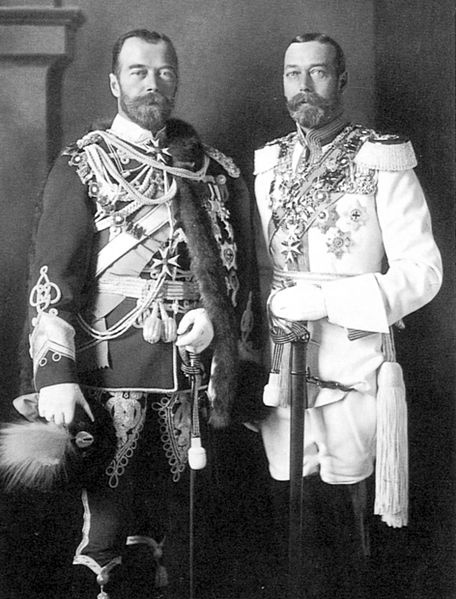
George V and Nicholas II

Just a random post that was inspired by Emma Westport’s “Imperial Mistress”  over at the Seduced by History blog here.

These two cousins looked exactly alike.  Their mothers were sisters, daughters of Christian IX of Denmark.

See what I mean?

Guess which is which.

Sometimes the families could not tell them apart when they were wearing each other’s uniforms, or in this case, Willy’s Prussian guard outfits.

Storm clouds were gathering on the horizon when this photo was taken.  And I don’t mean rain.

Hurly-burly princess

File:Charlotte and Leopold wedding.jpg

“She seems rather eager, does she not?” Diana whispered behind her fan.

Vivien refused to turn around and look.  She and Diana were among the very few privileged to witness the marriage of Princess Charlotte to His Highness of Saxe-Coburg.  And if she were to crane her neck at the approach of the Regent’s daughter, it would be noticed as vulgar and remarked upon.  Diana, being the taller, had only to turn her head very slightly to see above the heads of other countesses as they sat on cushioned chairs in Carlton House’s great drawing room.

Presently Her Highness came into view and Vivien realized the justice of Diana’s observation.  The princess had a favorable aspect, fair and well-formed, but instead of walking with an upright, measured tread on her bridegroom’s arm, she bustled forward down the aisle, her progress somewhat erratic.  The lovely metallic sparkle of her dress trembled as if irritated, revealing the bride’s almost unseemly pace as they approached the altar where the old Queen and the Regent were ranged alongside the Archbishop of Canterbury.

The heiress-presumptive was a hurly-burly miss.

Vivien noted with approval how Prince Leopold gently squeezed Her Highness’ arm, distracting the princess from her headlong pace.  She paused and looked up in his handsome face in an inquiring way.  Then her face broke into a happy grin as if she had recollected some word of advice. She paused, drawing herself up and proceeded at a decidedly slower pace, in keeping with the regal progress of one who would someday be Queen.

From all accounts, it appears that Princess Charlotte, hurly-burly as she might have been, had a happy marriage.  A wonderful example of how two very different persons together make a better union than if they were separate.  And we rightly suspect Kate and Wills will have the same success that often flows from the union of two very different people, from vastly different backgrounds.

Princess Charlotte of Wales had been largely kept “out of the way’ by her father, the Prince Regent, particularly when his marital discord had given him an unpopular reputation.  No doubt this isolation contributed to the princess’  lack of social grace. Hardly what one would expect from the daughter of the First Gentleman of Europe.

Prince Leopold, on the other hand, was well-traveled and a familiar face in European diplomatic circles, having spent time in the retinue of the Tsar.  With his continental background, Leopold would have immediately discerned Charlotte’s gauche demeanor.  He might have even been repelled by it.  But instead of turning away, witnesses describe Leopold as an affectionate husband who sought to guide his bride with loving advice.

A fair exchange, perhaps.  Her Highness reportedly giggled when the prince, a man as poor as a church mouse, vowed to endow her with all his worldly goods.

Nothing common about a tiara

similar in style: the 1934 Cartier tiara with lotus design


Oh, the tiara!  The most important thing that does so much to elevate one on the BIG DAY.

This site displays a nice array of illustrious figures wearing the 1936 Cartier Halo tiara which Kate wore on her wedding day.

Something borrowed:  the tiara is part of the Royal Collection.

It had belonged to the late Queen Mother, given to her by her husband, the Duke of York, later George VI.  See the trailer for The King’s Speech here.  No tiaras in the film, as I recall, but bloody good dialogue.

Prince William married a commoner.  So did George VI, his great-grandfather.   Yet Bertie’s wife was Lady Elizabeth Bowes-Lyon, no mere miss.  Interestingly, British law deems anyone a commoner who is not royalty or a peer. Whether they are the descendant of a coal miner or an earl.

Putting the law aside, one could argue the Queen Mother was someone not quite in the common way.

But we were discussing tiaras.  Princess Charlotte’s tiara was described as diamonds fashioned into a wreath of roses and leaves.  The detail of this crown is difficult to see in the old plate below.

Princess Charlotte and Prince Leopold wedding processional

The jeweller who made the princess’ tiara was Rundell, Bridge & Rundell.  The firm was subsequently commissioned to craft her father George IV’s state diadem that evoked similar motifs:  roses, thistles and shamrocks.  This famous crown was worn by Her Majesty for her coronation and gets trotted out for the opening of Parliament.

It is not inconceivable to imagine we see the remnants of Charlotte’s crown in her father’s:

The Diamond Diadem, 1820

“A writer is rarely so well inspired as when he talks about himself.”

This is my new blog about history, romance and my desire to write about both.  For the moment, I am content to share the above quote by Anatole France.  Later, there will be snippets of Regency romance, Anglo-Norman relations in the eleventh century, Bothwell’s Scotland, the Johnstown Flood, and other matters.