In the Garden of On-Dits and Blue Ruin – Lansdowne House

the Marquess of Hartington

Russell drove his tilbury at a rapid pace towards Berkeley Square.  His niece, Diana, fidgeted beside him.

“Dash it, darling, what the devil is the matter?”

She tossed her fire-blond hair, so like his and leaned out of the sporting carriage to catch the breeze like a hoyden.  “I hate London.”

“We’ve only just arrived,” he pointed out.  “I’m persuaded you will like this party we are going to.  Lansdowne House affairs are really quite the thing.  Besides, you probably know some of the girls from that school of yours who might be in attendance there.  Lady Louisa, for instance.  It is said she might get an offer from Lord Henry Petty, heir to Lansdowne.”

“Louisa is a bore,” Diana declared, pulling herself back in the tilbury with a sigh.  “There is a girl from school I should like to see–but she lives in Knightsbridge.”

The Marquess of Wimberley wisely restrained himself from responding.  It would be just like Diana to tease him, pretending she would rather befriend some merchant’s daughter from the City instead of an earl’s daughter.

The tilbury paused at a set of dark doors set in a high wall that ranged the entire length of Berkeley Square’s south side.  A porter emerged from an ivy-covered lodge set in the wall.  He bowed and opened the entrance so his lordship’s carriage could pass through.  Once inside, it was as if they had stepped into the countryside, although they were in the middle of London.  The sounds of traffic diminished to merely hoofbeats on a well-kept gravel drive. The fresh green lawn was so very nearly perfect it might have been brought up from the riverside moments before. Tall oaks towered over them, old enough to have been present when nearby Hay Hill was still a farm in Queen Anne’s day.

Solemn footmen with real powdered wigs appeared before the stately home’s portico to escort the pair inside.  Soon, Diana found herself in the company of the very girl her uncle desired her to accompany.

“What would you like to do?” Louisa asked.

Diana shrugged, gazing up at the exquisite ceiling of the Adam drawing room.  “Dashed if I know.  Shall we take a turn on the grounds?”

Shortly thereafter they were walking toward an ancient wall, the boundary of the Lansdowne garden.  There was a small ladder placed against it.

“What’s on the other side, I wonder?”

“Oh,” Louisa answered, in her diffident way, “‘Tis His Grace of Devonshire’s garden.”

Diana immediately went to the ladder and began to climb, taking care not to let her slippers get scuffed on the wooden rungs.  She ignored the remonstrations of her missish companion.

“I should like to see His Grace’s garden,” Diana declared.  “One can never tell what a duke’s cabbage looks like.”

Diana reached the top of the ladder.  Below her was a narrow, dark passage that opened below her like a crevasse.  Without warning, another person peered at her–from an opposing wall scarcely feet away, all ears and a wide grin.

“Hello,” he said.

“How did you get up there?” she demanded.

“I’ve got a ladder, same as yours.” He asked, “Who are you?”

“I am Diana.”

“Well, then,” he replied, triumphant.  “I’m Marquess of Hartington.  But you may call me Hart.”

“I shan’t call you anything,” Diana retorted.  “Because we have not been properly introduced.”

“Tell your uncle you’ve met the heir to the Duke of Devonshire and I’ll wager he’ll tell you we’re intimates.”

“How dare you!”

Berkeley Square south side – Lansdowne House Gardens
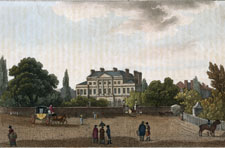
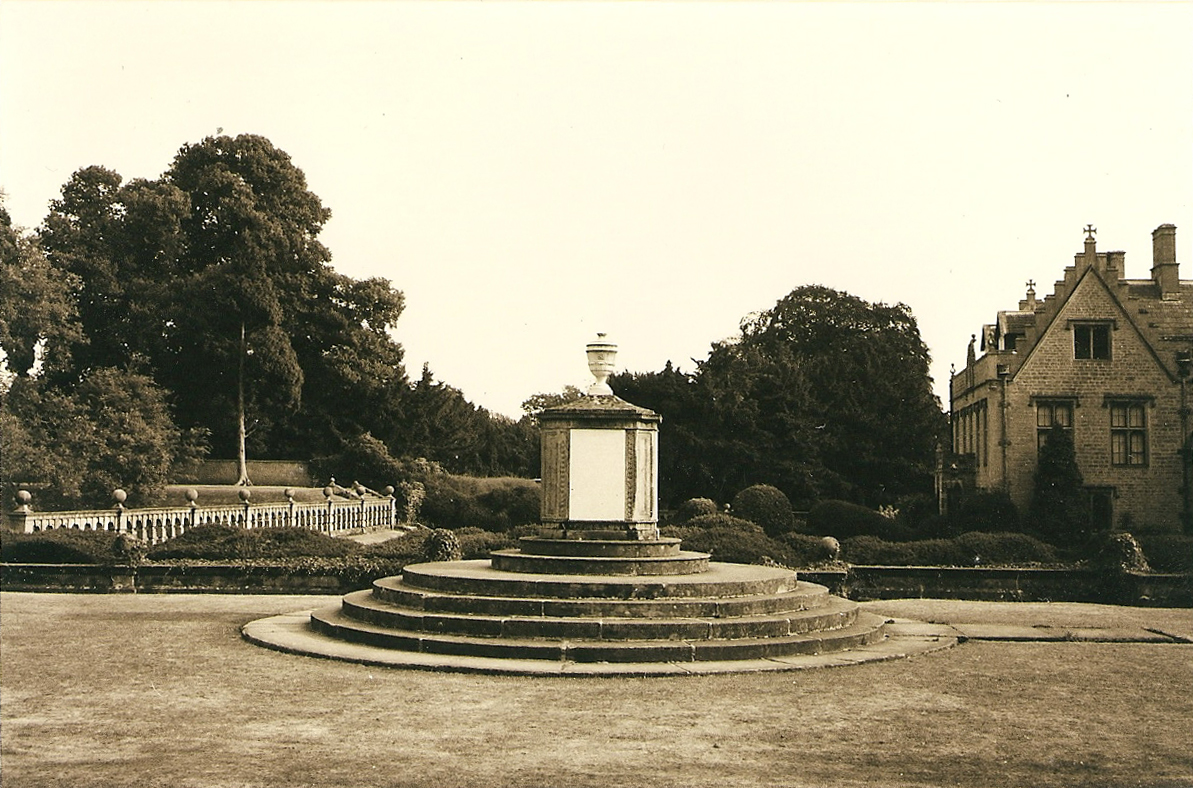
There’s not much more one can say about the Lansdowne House gardens.  The description of its environs came from Nash’s Pall Mall Magazine, Volume 31 by Ernest Jessop, published in 1903.  By then the massive area in front of the house had become rarified real estate in the middle of London and valued at a price that would just about cover a marquisate’s death duties–taxes that were the scourge of great houses in the early twentieth century.

The new death taxes were to become, as Giles Worsley titled his first chapter in England’s Lost Houses, a Gathering Storm.

Lansdowne House – Rape and Death in a Ballroom

“Do you mean to tell me you’ve another interesting display?”

Louisa cringed.  “Oh, I wish you would not tease me, Diana.  You cannot know how dreadful it is to have a husband who brings home everything that is dug up.  Why is it that the Romans had to conquer so many places and scatter their things about?  I vow they did this just to distract wives in decent society hundreds of years later.”

The offending art was located in the ballroom at Lansdowne House.

Louisa gestured to large fragment of Roman sculpture mounted on the wall, watching Diana’s reaction with trepidation.

“It’s called the Rape of Persephone.  And from a coffin, no less.  Lansdowne would have it mounted there, just in time for our first ball of the Season.  I declare he has done so for no other reason than to vex me.  And you know there will be any number of debutantes and their mamas in attendance.  They shall all think it terribly ill-bred, being forced to gaze upon the image of a young girl being carried off to suffer any number of indignities.”

“I shouldn’t worry about it, Louisa.”

“Really?  You amaze me.”

Diana turned to face her.  “It’s a metaphor for untimely death.  Not at all improper, I assure you.  The sarcophagus probably belonged to someone who died very young.  Snatched away by Death in the prime of her life.”

Louisa swallowed, just then remembering Northam’s tragedy.  “Diana, please forgive me.  I had no notion, otherwise I shouldn’t have–”

“Do not be distressed, Louisa.  My parents have been dead for so long that I can scarce remember them.”

Yet Louisa could not miss the strange glitter in Diana’s eyes.

She took Diana’s arm.  “Uh–come away, dear and see my latest watercolor.  I am persuaded you will enjoy il Signor Rossi’s technique.”

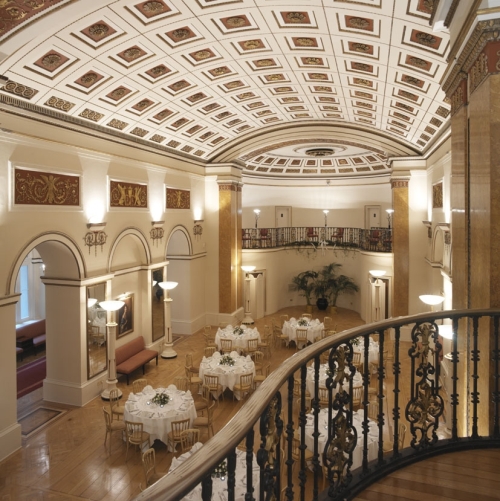
The ballroom at Lansdowne House is still extant, but without the decoration that made it famous.  The panel known as the Rape of Persephone was one of several Lansdowne marbles that were arranged in this room–originally intended to be a sculpture gallery.  In the 1930 photo, you can see them set in the wall.

And you thought only Elgin had them.

Originally the ballroom  was meant to be a music room by Lord Bute, the first owner of Lansdowne House.  The Earl of Shelburne, later Lord Lansdowne, had visited Italy after purchasing the house and was possibly inspired by the excursion to have a gallery for his sculpture.  He commissioned the Scottish painter Gavin Hamilton to convert the music room to a suitable space.  Hamilton lived most of his life in Rome and was considered a gifted neoclassical history painter, favoring Greek and Roman subjects.  He was also an art dealer and excavator of antiquities.  How convenient.

Eventually, however, the plans for the sculpture gallery were dropped and by the time of my story Notorious Match, the room assumed its present and final function.

The ballroom can still be seen today at the Lansdowne House Club (see below) which has a marvelous gallery of its own you can peruse here.

Lansdowne House Drawing Room

A drawing room was not just for drawing.  During the late Georgian period and beyond, when socializing was made easier with more efficient transportation, great houses utilized their spaces in new and creative ways to enhance the party experience.

Lansdowne House Rear Drawing Room – Philadelphia Museum of Art

And you thought your living room was just wasted space.

In Notorious Match, the Lansdowne Ball featured dancing and gaming.  After arriving, Diana found herself at a game of faro that was set up in the famous Adam drawing room.  Her luck at the game was indifferent at best.  The last time she played she lost her mother’s pearls.  To her disappointment, the banker refused to accept her voucher to play.  So she staked something else that Lord Harcourt would be unable to resist.  Irresponsible?  Perhaps.  Did she do it to provoke Griffin?  For once, no.

Unknown to anyone, she was desperate to extinguish a little girl’s anguish, enough to pledge something very dear.

Diana unclasped the heirloom about her neck and tossed them on the table toward Harcourt.  “For my mother’s pearls.”

Harcourt’s eyes fastened on the jewels.  “Those are the Northam emeralds, are they not?  You must be very certain of your luck to stake them.”  He lifted the necklace to the light.  “They’re worth ten times your mama’s baubles.”

“A sentimental whim,” she responded.  “Indulge me, my lord.”

Out of the corner of her eye, Diana saw Griffin fold his arms.  She suspected he was trying very hard to look unconcerned.  Serves him right for playing governess.  Griffin knew she did not like any hand on her bridle—whether her uncle’s or Vivien’s.  But least of all his.

“Be advised, my lady, that I shall not be lenient,” Harcourt warned.  “Not even your lord uncle will be able to redeem these from me.”

The emeralds were so fine they made the diamond setting holding them look insipid.  They were the dowry of some long ago heiress who brought them to Northam when she married its earl, one of many sets of jewels Diana had in her strongbox at herLondontown house.  Harcourt laid them beside bank notes, property titles and a variety of coins wagered by other players.  Seeing them in that light gave Diana pause.

They, like anything else belonging to Northam, were her responsibility.

“Deal the cards,” she commanded nevertheless, determined not to reveal her fear of losing them.

Robert Adam ceiling

The drawing room used for faro and baccarat games that evening was the famous Back Drawing Room, designed by Robert Adam in about 1763 along with the original plan commissioned by the 3rd Earl of Bute.  It is considered the most elaborately decorated of the entire suite of reception rooms in Lansdowne House before its mutilation in 1930.  Its primary feature is a great bay that was originally designed to contain Lord Bute’s elaborate mechanical organ.

The ceiling is Adam’s design but he used artists with special gifts to enrich the design, such as the great Italian painters Cipriani and Zucchi, the latter the husband of the famous bluestocking painter, Angelica Kauffman.  From the 1903 edition of Nash’s Pall Mall Magazine, volume 31, we have a description of the room filled with an incredible array of treasures, all long since dispersed:

“…some lovely old Sevres, in yet another a very beautiful pair of rose-coloured marble vases mounted in ormolu of the finest workmanship, while around all in serene beauty hang the works of Reynolds, Romney, Van der Helst and others of the greatest.”

It took nearly twelve years to install the room at the Philadelphia Museum of Art, once it was removed just prior to demolition at Lansdowne House.  Funding was short in the thirties and forties and it took time to amass enough funds to present the Adam room in its new location.  The museum’s director at the time, Fiske Kimball, remarked that the new exhibit, christened the Lansdowne Room:
 “crowns the series, coming as it does from the moment when England, fresh from her greatest conquests, seized for a moment also the artistic mastery of the world.”

Lansdowne House – dining with a nude

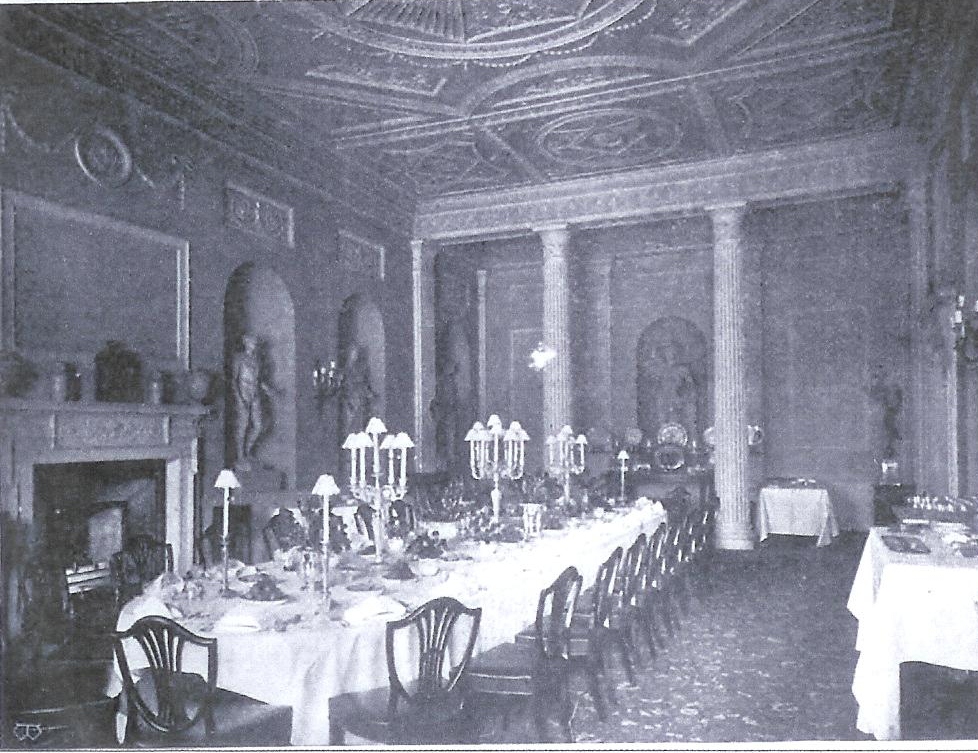
Lansdowne House Dining Room pre-demolition

“I wish you would not go in there.”

“Whyever not?” Diana asked.  “I’ve heard all about Lansdowne House’s new acquisition and would like to have a look.”

Louisa, Lady Lansdowne, was mortified.  Her husband’s new Canova sculpture was the talk of London.  “Ever since that dreadful Payne Knight was here for dinner everyone wants to look at it.”

“Good heavens,” Diana exclaimed.  “You had that man over for dinner?  The one who wrote A Discourse on the Worship of Priapus?”

“The very one.  But I am persuaded he is exaggerating.”  Louisa felt herself flush under Diana’s amused glance.  “She is not at all what they say she is.”

“Then there can be no objection to having a look.  Just to be sure.”

Reluctantly, Louisa followed the countess into the famous Adam dining room.  Grim grey statues in their wall-bound niches stared down in disapproval at the female nude who reclined, in all white marble, on her couch.

Louisa grew alarmed at Diana’s prolonged inspection.  “This is all so very distressing.  Do tell me she is not an, er, hermaphrodite?”

Diana folded her arms.  “That fellow Knight may have to reexamine his theory of pagan culture.  Your naiad is missing a most important piece if she’s to be what he says she is.”

Louisa nearly sagged against the sculpture’s buttocks in relief.  Then she caught a gleam of mischief in Diana’s glance.

“Stay–did you say a naiad?  Is that bad?”

Diana shrugged.  “Oh, most decidedly.”

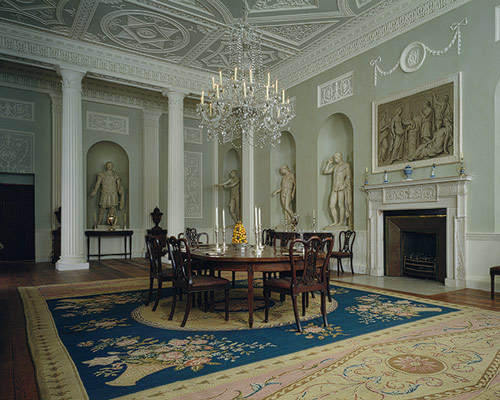
Metropolitan Museum of Art - Lansdowne Dining Room

The dining room at Lansdowne House was executed under the brilliant design of the great Scottish architect Robert Adam.  His neoclassical creation was located in a part of the house that was demolished to make way for a street and additional buildings today known as Fitzmaurice Place.  This mutilation deprived the house of its historic design.  A design that gave the great London mansion “movement.”

The dining room was a part of the south wing–to the left of the old photograph in last week’s post.

Word got round in 1930 that the sculptures and other contents of Lansdowne House were to be put up for sale.  This was to be followed by demolition of the two wings.  Fisk Kimball, director of the Philadelphia Museum of Art, was very interested in the house’s role as the venue for the negotiations of a Nation’s independence.  He tipped off the Metropolitan Museum of Art in New York of the pending destruction and the institution was emboldened to Act.

The dining room was dismantled and shipped over the Atlantic to its new home where it can be seen today, sans the Canova.  From the Met’s website, we have this marvelous description:

…the design of the ceiling…was carried out in plaster by Joseph Rose. The carving for the wooden doors and door frames, shutters and window frames, columns, baseboard, and chair rail, executed by John Gilbert, was finished in December 1768. The marble chimneypiece was supplied by John Devall & Co., chief masons for the royal palaces, the Tower of London, and the Royal Mews. The oak floor of the room is original. The niches originally held nine ancient marble statues acquired by Lord Shelburne in Italy from the artist Gavin Hamilton, which were dispersed at the Lansdowne sale of 1930. Now, the niches have been filled with plaster casts.  The original furniture, designed by Robert Adam and executed by John Linnell, no longer survives.

Thanks to this reconstruction, we can note several prominent features that would not be out of place in any Regency gathering.  Celadon green is the term for a particular jade coloring that is an enduring part of neoclassical design.  The fireplace is white marble, matching the large frame above it which often stood empty back in its London home.  The Lansdowne family had a vast collection of paintings, but no one individual work was large enough to fill the space Adam designed for it.

Sleeping Nymph - Antonio Canova

What of the reclining nude?  She is now in London’s Victoria and Albert Museum.  Lord Lansdowne commissioned her in 1820 from the great Italian sculptor, Antonio Canova.  An earlier post describes his work, but in the case of the reclining naiad, the sculptor had died before her completion and his assistants were relied upon to finish it.

Canova is thought to have been greatly influenced by a famous “marble” unearthed in Italy and presented to the Cardinal Borghese in the seventeenth century.   Known as the Borghese Hermaphroditus, the discovery electrified Western Europe.

Many copies were made of this reclining figure who lay on his (her?) stomach, not quite concealing the object of such amazement.

No one likes Twelfth Night cake

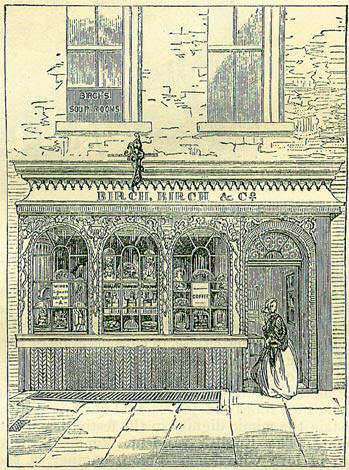
Birch & Birch, London Confectioners

Vivien climbed the great Adams staircase at Northam House.  She had scarcely reached the top step when she met Diana, preparing to descend.  She was pulling on her York tan gloves with something like irritation, her bonnet jammed onto her curls as if it were to blame for some upset.  Margaret was behind her, trying to coax her mistress into putting on a pelisse.

Diana obliged, hunching down to accept her dresser’s assistance.  The shoulders and armholes of the garment had been carefully tailored by her modiste to fit the countess closely.  The modish pelisse was difficult to put on but the end result was worth it—the sleeves clung to Diana’s slim arms with no wrinkling, the back setting off her elegant shoulders to perfection.

“Surely you’re not thinking of going out,” Vivien remonstrated.

“I’m off to Cornhill,” Diana said, nodding her thanks to the maid.  Her green eyes dared Vivien to gainsay her.  “To get a Twelfth Night cake.  Birch’s makes the best in London, I’m told.”

Vivien quirked an eyebrow.  “You hate Twelfth Night cakes.  You never eat them at other people’s parties and you give your servants a week’s wages instead of their customary slice so you don’t have to bring one in the house.”

“Quite.  I despise the nasty things they put in them.”  Diana passed her, going down the stairs rapidly.  “But it’s not for me,” she called over her shoulder.  “It’s for Griffin.”

Vivien followed, her slippered feet making what sounded like a silly patter on the stone steps, hastening after the sound of Diana’s leather half boots.  She tried to keep her voice even although it echoed in the stairwell chasm topped by a decorative dome high above.

“You amaze me,” she said to Diana’s back that was by now far below.  “I’m his cousin and have never known him to have a penchant for it.”

The sound of male laughter rose from the foyer at the bottom of the stairway and filled its monumental space.  Vivien could see that Diana had stopped at the landing where she was confronted by her uncle and Griffin.  As she came to stand beside her friend, Vivien noted the exceptionally large box they had, bearing the stamp of Birch & Birch, Confectioners.

“Go ahead, my dear,” Russell said to Diana, winking at Vivien.  “See what Griffin has brought you.”

Diana opened the box and even Ingle, the housekeeper, was moved to express her astonishment.  Inside was a confection exquisitely decorated with delicate icing that was sculpted into swags and bunches of fruit.  In the center, there was no coat of arms nor earl’s coronet as one might expect would crown an offering for a countess.

The Twelfth Night cake was topped, very simply, with the name DIANA.

Griffin cleared his throat in the awkward silence.  “I don’t care for Twelfth Night cakes myself, but I was persuaded you might like this one.”

Vivien, not knowing whether he would receive thanks or a face full of iced confection, stepped into the breach.  “How very thoughtful of you, Griffin.”

She should have known Russell had no such compunction.

“Well, Niece,” he teased, “will you despise this Twelfth Night cake as you have all the others I’ve tried to bring home?”

“I think not.” Diana replied, looking directly at Griffin.  “Thank you for the cake, Sir.”

Vivien wondered at the undefined warmth filling the cold foyer.

Wedding cake of HRH Diana, Princess of Wales

The Chambers’ Book of Days of 1869 reports that Birch’s is one of London’s most celebrated confectioners–the shop being quite old by the the time its proprieter, Samuel Birch, served as Lord Mayor in 1815, the year of Griffin’s gift to Diana.  The shop was in Cornhill, a part of London’s City Center that crowns one of that metropolis’ three hills, the others being Tower Hill and Ludgate Hill.

The picture of another “Diana” cake seemed appropriate.  A slice given by the Queen Mother to her servant sold recently for almost two thousand pounds sterling.  Quite a bit more than a week’s wages, I’ll warrant.

Calennig – A Welsh New Year

Vivien peered into the grand salon, sometimes called the saloon, at Northam Park.  The riotous interior that was a masterpiece of Rococco decoration was clearly at odds with its lone occupant.  The Countess of Northam stood pale and solitary, her tall figure slim as ever, outlined in sharp relief against a soaring Palladian window.  She sifted rapidly, as though unseeing, through a trove of invitations to attend various country pursuits afternoon teas, shooting lunches and hunting balls.

Diana was grieving.

HM Queen Elizabeth's mare Burmese

Vivien knew this because they had been bosom bows for over twenty years.  In that time she had come to recognize the signs of emotional turmoil in her beloved friend.  Signs that included a brittle laugh, sparkling green eyes, fluid, quicksilver movements.

Yet the mistress of Northam Park exhibited none of these now.  The only thing that betrayed her grief was the manner in which her long, elegant fingers rapidly sorted through the embossed cards, as if each one represented an irritation.

Diana looked up.  “Oh, my dear.  How good of you to come and relieve the tedium of my company.”

“I’ve come to give you a gift.”

“Good God.  I’ve been saving mine to give to you on Twelfth Night.  ‘Tis only New Year’s.”

“You’re forgetting I’m Welsh.”  Vivien joined her at the window and offered a polished wooden box.  “This is your Calennig, my dear.”

Diana put the cards down.  She took the box, her long, elegant fingers moving over the gift before opening it.

Inside was a highly polished, copper bit.

Diana snapped the box shut, a violent, angry motion.

“You’ve grieved long enough,” Vivien said, her own voice unexpectedly angry.  “Garnet has been gone for months.”

Diana met her eyes and looked away quickly, her mouth lifted up in one corner as if self-revulsion.  Vivien knew she despised showing any sign of weakness.

“How was the Boxing Day hunt?” she asked, her voice derisive.  “Did your new nag refuse any of the fences?”

“It would never occur to Bandula that she might ever refuse a fence,” Vivien replied.  “She’s as close to being my dear Thor reincarnated as I should ever like to see.  Even down to her grey coat.”

Diana set the box down on the window’s marble sill.  She crossed her arms over her chest, her long fingers clenching against the expensive silk that made up her sleeves.  “Do not bother to cozen me, Vivien.  I’m blue-devilled and shall be miserable company for anyone.  For a long time.”

“It’s the New Year.  What better time to look about for a new horse?”  Vivien insisted.

“Aye, you hardly gave a thought to poor old Thor, so fast did you seize upon your new pet. ”

It was a wounding thing to say, but Vivien did not mind.  She knew that it must come from a pain so terrible that it was positively eating Diana alive.   And so she leaned against her friend, even though her own head scarcely reached Diana’s shoulder.

“Oh, Vivien,” Diana groaned, her words wracked by the suspicion of a sniff, “I can’t seem to right myself.  Garnet must have been the most wretched mare alive.  I think she must have thrown me a dozen times or more.  Griffin never liked her, although I used to catch him giving her scraps from the kitchen.  Good God, she would eat anything, even roast beef if you offered it to her.  And do you remember the time, Vivien, when we first met and Thor put her in her place with that well-bred glance of his?”

Their glances locked, each remembering their horses now gone.  Predictably, Vivien felt her face crumple in a sob and it was Diana who was holding her close for comfort.

“I think I needed to see you grieve, Vivien, in order for me to get over mine.”

“You wretched creature,” Vivien replied, hugging her friend even closer.

The Calennig is the Welsh New Year’s gift.  Vivien, a marchioness, chose to give the Countess of Northam something rather more meaningful than jewels or fabric to demonstrate her love for her old friend.  A copper bit, brand new, was a gentle reminder we must all move on from the pain of the past year.

Vivien’s mother was born in Wales and converted to Methodism.  She had always schooled her daughter with a tenet remembered from a long remembered preacher.  “You must forgive the past year to live in the new.”

Christmas at Windsor Castle

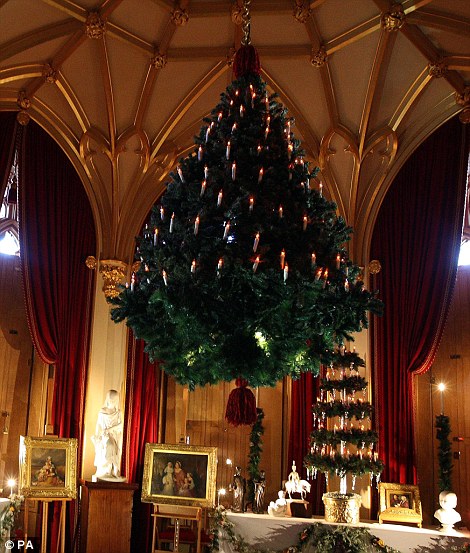
Lighted Christmas Tree - Octagon Dining Room at Windsor Castle

In 1844, long after the events in Notorious Vow and Notorious Match, Diana and Vivien attended the young Queen Victoria and her husband, Prince Albert, at Windsor Castle.  The countess and marchioness were astonished to see a tree suspended from the ceiling of the Octagon Dining Room, where the chandelier is normally hung.

A Christmas tree, the Prince Consort explained.

This is from the Royal Collection’s website at :

In the German tradition, Queen Victoria and Prince Albert exchanged gifts on Christmas Eve and presents were laid out on tables, each of which had a Christmas tree at its centre.  Two gift tables will be recreated with presents exchanged by Victoria and Albert.  Among the highlights is a painting by Sir Charles Eastlake commissioned by Victoria in 1844 as a gift for Albert, and a sculpture of Princess Beatrice as a baby lying in a shell, given to the Queen by Prince Albert for Christmas 1858.

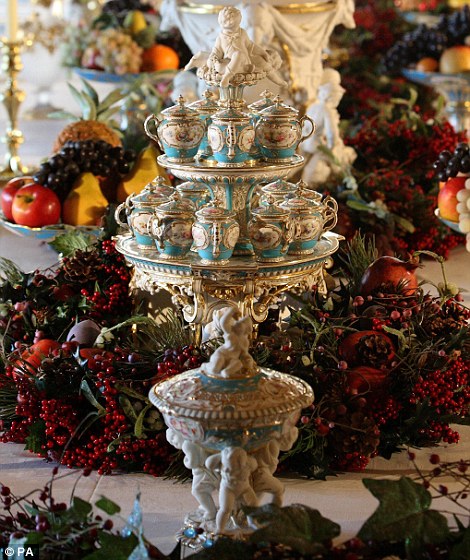
In the Castle’s State Dining Room, the table will be laid for a Victorian Christmas feast with a magnificent porcelain dessert service by Minton of Staffordshire.  Known as the Victoria Service, the set was purchased by the Queen at the Great Exhibition in 1851 and includes four porcelain figures of the four seasons, ice pails, cream and bon-bon dishes, and a pair of silver-gilt sauceboats shaped like sleighs.

This special display has been recreated for the public’s viewing and ends on January 8th.

Porcelain Dessert Service - State Dining Room at Windsor Castle

Sweet Science

           “Move aside, you fools,” Nigel shouted.

Diana jolted awake.  A cacophony of shouts and neighs sounded just outside the coach, made by what must be an inordinate amount of horses and men calling their greetings to one another.  The coach had stopped, presumably in the ostlers’ yard at the Maiden’s Crown, but the racketing around by jingling harnesses and stomping hooves did not call to mind the exclusive inn’s normally quiet order.

Diana told Selby and Margaret to remain where they were while she investigated.  As soon as she stepped outside, it seemed as though she were the only female left on earth amid males of every description from country yokels to London dandies.  Nigel had all six sets of reins bunched in one fist while directing the Northam outriders to hold the excited team.

Nigel called to her from his box.   “’Tis a blasted—begging your pardon, my lady—there’s a mill going on between the Black and Quentin Fosonby less than a mile from here.  Every inn and hostelry is crammed full with gawkers to watch the match.”

Selby and Margaret alighted, the former fixing an icy stare on one unfortunate  who gaped at them with a straw hanging out of his mouth.  At the dresser’s glare, the man took himself off.

“No matter,” Diana replied, “our rooms were bespoken in advance.  Have the horses seen too and I shall sort this out.”

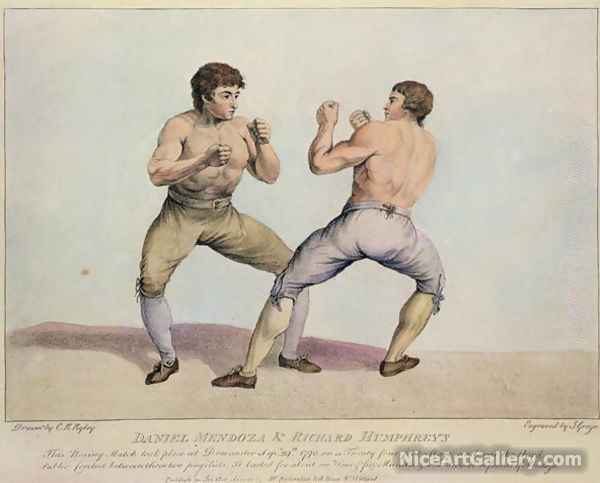
She thought briefly of Griffin.  If he were here, it would be his province to deal with travelling upsets.  But as he was not, she would.  God knows she had enough experience.  She briefly wondered if he might have stopped to watch the boxing match, leaving his horses with some boy to look after for a guinea.  Men liked that sort of thing, the blood and violence of a good fistfight.  They also liked to ride their horses or curricles on the open road, without female companionship.

Poor Diana, my heroine in Notorious Match, had run smack-dab into the middle of a sport that was all the rage in the Regency.  Called the “sweet science” by noted sportswriter Pierce Egan, pugilism seemed a Godsend to males everywhere in the early nineteenth century.  .

The Jane Austen Centre does a lovely overview of the sport as it is confined to the early eighteenth century, including a nice excerpt from the movie Becoming Jane.

More specifically, pugilism, along with men’s only clubs, are examples of male homosociality during the Regency.

Homosociality.  Like the more recent term bromance.  A distinction, mind you, from those relationships that are of a romantic, or sexual nature.

One of the things my heroine wrestles with is the prodigious desire on the part of men to socialize with other men.

Why should it matter that men do things together?

Because Diana was curious.  As am I.

Regency Cicisbeo

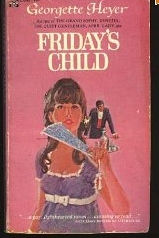
love that 60's cover!

When Hero “Kitten” Wantage enters the ballroom at Almack’s on the arm of Lord George Wrotham, a man who is decidedly not her husband, Miss Milborne finds this circumstance positively lowering.

You see, George was her beau.  Yet he was on the arm of a married woman.

 “The dreadful suspicion that the passion her admirers declared themselves to feel for her was nothing more than an evanescent emotion, soon recovered from, could not be stifled, and made Miss Milborne wretched indeed.  She waited for George to come across the room to her side, which he would surely do as soon as another man relieved him of the charge of Hero.  Hero was led on to the floor by Marmaduke Fakenham to dance the waltz; George strolled away to exchange greetings with a group of his friends.  Miss Milborne, too mortified to remember that she had refused to receive him when he had called to pay her a morning visit, could only suppose that his passion for her had burnt itself out…

‘I observe,’ said Mrs. Milborne on the way home, ‘that our little friend (Hero) has lost no time in acquiring a cicisbeo!  Well!  I wish her joy of young Wrotham!  He seemed to me to be quite epris in that direction….’

Friday’s Child, Georgette Heyer

What is a cicisbeo?

They are sometimes called cavalier servente.  That is, a gallant servant.

The Archetype of a Cavalier

Hmmm.  I quite like the boots.  Are they expensive?

The first usage of the term cicisbeo was found in some correspondence from the British ambassador’s wife during her travels.  In 1749, Lady Mary Wortley Montagu wrote to Lady Pomfret (which is also the term for a species of fish) of an unknown lady and her escort, an abbot from Genoa.  He was both witty and learned “in a very ugly form.”  Not quite the compliment one initially expects but there is much worse to come:

“I hear (he is) declared her cicisbeo in all forms, poor man!  He must be in the same situation with Mr. Southcote, when my Lady Townshend figured him in the body of old Cleveland, like Van Trump, lost in an ocean neither side nor bottom!”

Good heavens.  I daresay her ladyship of Pomfret was confounded by the ambiguous nature of this correspondence.  I know I was.

After some study, I divined the following meaning:  cicisbeo is the male attendant of a female who stands in the place of her husband.  The man of the cloth was considered more than just the unknown lady’s acquaintance.  And Southcote was apparently Lady Townshend’s man while in public, hence the term “in the body” of her living husband, the second duke of Cleveland.

Leaving aside further speculation on that particular emphasis on body, we can also deduce that this occupation was rather frustrating.  For the man.

Indeed, what can be more pointless or exhausting than being lost in a body of water that has no bottom or end?

I find it ironic that the romantic poet Byron should hate the notion of the cicisbeo.  Yet apparently he had experience in the matter.  He was cicisbeo to an Italian contessa.

This is an excerpt on the matter from his poem Beppo.

Besides, within the Alps, to every woman, ( Although, God knows, it is a grievous sin, )

‘Tis, I may say, permitted to have two men; I can’t tell who first brought the custom in,

But “Cavalier Serventes” are quite common, And no one notices nor cares a pin;

And we may call this ( not to say the worst ) A second marriage which corrupts the first.

Two men at once.  The very idea!  Dashed bad ton, you may be sure.

Regency dogs

Jane Austen’s World and Regency Ramble both give comprehensive discussions on dogs of the early nineteenth century.

In this post, however, I would like to draw attention to the changing nature of how persons viewed their dogs during the Regency.

Of course one valued his canine friend for his practical traits which aided such pursuits like hunting.  But the dog was also becoming prized for those qualities that were lauded in the romantic literature of the period–noble characteristics that were always evident in Man’s best friend, but never appreciated fully until now:  bravery, loyalty, humility, etc.

Boatwain’s Monument – licensed by Johnson Camerface

Byron wrote a poem eulogizing his own Newfoundland, which had contracted rabies and died in 1808.  The poet nursed his dog throughout the illness, never minding that he himself might contract the disease.  Boatswain was buried on his lordship’s estate at Newstead Abbey.  His monument is larger than that of his owner.

The last line of the Epitaph for a Dog are particularly affecting:

“To mark a friend’s remains these stones arise; I never knew but one – and here he lies.”

Regency owners also saw their dogs as an extension of their own personality and their tastes in the exotic.  It became particularly fashionable among the ton to own a dog with a background that inspires one to think of faraway places in the Orient.

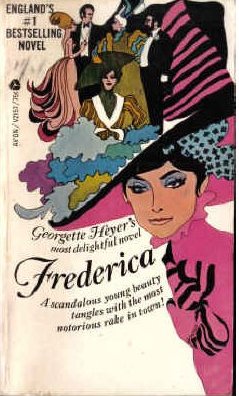
The author Georgette Heyer demonstrated just this very aspect in her delightful Frederica.

In this novel, the jaded hero makes an elaborate representation to an irate cowman, two park-rangers and one hatchet-faced lady that the heroine’s family pet, which had caused some riot and rumpus, is actually a rare speciman from Asia.  He succeeded in fooling me as well.  There is no such thing as a Baluchistan hound.  What manner of breed Lufra was is up to conjecture, but the Marquis of Alverstoke demonstrates an insightful perspective into Man’s best friend in the early nineteenth century.

1967 Edition -- blame the gay nineties look on Avon!

1967 Edition — blame the gay nineties look on Avon!

You see, all except for the hatchet-faced lady were only too ready to believe that a nobleman had taken a fancy to owning an exotic dog.  In the Regency, anything attached to one’s person that spoke of the Orient gave a fellow distinction.

I also was unaware that persons under royal license were allowed to graze cattle in London’s Green Park.  That famous Regency denizan Beau Brummel had the distinction of being related to two aunts who held such a license to graze their milch cows in the park.

I love dogs and I love Regency romance.  This passage combines the best of both:

“Really, Cousin, you are too shatterbrained.  He is a hound, not a collie; and what I told you was not Barcelona, but Baluchistan!  Baluchistan, Frederica!”

“Oh, dear!  So you did.  How–how stupid of me!” she replied unsteadily.

Neither of the park-keepers seemed to find his lordship’s explanation unacceptable.  The elder said wisely that that would account for it; and the younger reminded the company that he had known all along that the dog wasn’t Spanish.  But the cowman was plainly dissatisfied; and the hatchet-faced lady said sharply:  “I don’t believe there is such a place!”

“Oh, yes!” replied his lordship, walking towards the window and giving one of the two globes which stood there a twist.  “Come and see for youself!”

Everyone obeyed this invitation; and Frederica said reproachfully:  “If you had only told me it was in Asia, Cousin!”

“Oh, Asia!” said the elder park-keeper, glad to be enlightened.  “A kind of Indian dog, I daresay.”

“Well, not precisely,” said Frederica.  “At least, I don’t think so.  It’s this bit, you see.  It’s a very wild place, and the dog had to be smuggled out, because the natives are hostile.  And that’s why I said he was very rare.  Indeed, he is the only Baluchistan dog in this country, isn’t he, Cousin?”

“I devoutly hope he may be,” returned his lordship dryly.

“Well, all I have to say it that it makes it so much the worse!” declared the hatchet-faced lady.  “The idea of bringing wild foreign animals into the park!  Smuggled, too!  I don’t scruple to tell you, my lord, that I very much disapprove of such practices and I have a very good mind to report it to the Customs!…I am speaking of the English Customs, my lord!” she said, glaring at him.

“Oh, that wouldn’t be of the least use!  I didn’t smuggle the dog into the country; I mrerely caused him to be smuggled out of Baluchistan.”