Regency Domesticity: The Vacation Home

From Ackermann’s Repository, October 1st, 1816, Volume II, the Tattler shares correspondence from a reader who is married to a Temple Bar shopkeeper.

The matron relates that business was profitable and in such a climate of prosperity her husband began to notice the fashion among other shopkeepers for keeping a second house in the country–a place away from the bustle and grime of London, for relaxation and recharging.

Appalled with the notion, she writes:

“It was in vain that I remonstrated on the inconveniences which it would inevitably produce, the probable neglect of business it might occasion, and the additional expense it certainly would produce.”

In spite of her arguments, the spirit of rivalry remained strong in the tradesman. He went so far as to hold up the example of Spangle, the laceman, who took a lease on a marvelous country home in Edmonton. Moreover, her husband had the effrontery to rely on the well-known principle that to appear to have a fortune is an easy means by which to acquire it. A summer residence is the very thing, he exclaimed, and did I not buy that handsome winter pelisse for you when you told me that keeping up appearances was critical to the status of a shopkeeper’s wife?

The result: they took out a lease on a very genteel home along a major coaching road from London, and not above four miles from the Exchange.

It was not long before the novelty of the summer house began to wear thin. The nearby turnpike rendered the environs dusty, so that the windows must be kept shut even in summer. The garden at the back, beautifully arranged with twining honeysuckles and jessamine, was nevertheless made unpleasant by the sounds and smells of the neighbor’s hog farm situated at the back of it.

The worst, however, was the continual plague of acquaintances from town. Full of excitement over the new acquisition of the “villa,” and with the easy manners of familiarity, these so-called friends of the tradesman began to make it their custom to ride out into the country for a visit, and of course, ask his long-suffering wife if they could take their Sunday’s “mutton” while there.

She relates:

“I was obliged to affect the appearance of satisfaction, and to use the language of hearty welcome, to the very people whom I wished in a horse-pond, or should have been glad to have scolded out of the house.”

In 1815, keeping a country house was not only a burden in time and inconvenience, it was a dashed expensive extravagance. The following is a list of the summer house accounts for that year, in pounds sterling:

rent – 60

taxes – 12

additional servants’ wages, board – 30

interest for money expended in furniture – 25

accidents and repairs – 10

coach-hire backwards and forwards – 10

extra entertainments – 30

“We have three children and this confounded country house,” the correspondent concludes, railing that the latter was far more expensive than maintaining and educating a dozen of the former!

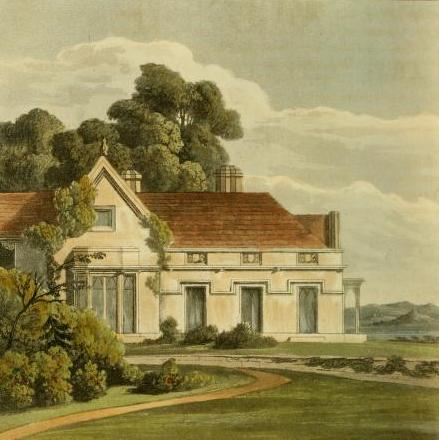
A vicarage-house: "..purposed to be erected in a situation where the scenery is both rural and romantic.."

A vicarage-house: “..purposed to be erected in a situation where the scenery is both rural and romantic..” from the Magazine

Regency Domesticity: the Termagant

Like La Belle Assemblée , Ackermann’s Repository had its own resident “Dear Abby.” Letters from Readers addressed to the Female Tattler poured forth troubles seeking advice, and sometimes advice seeking trouble.

These columns  are little vignettes of Regency life.

Humphrey Sneak’s letter to “Madam” appears in the January, 1818 issue. His trouble was his wife, to whom he had been married not above three years. A termagant, she had plenty of practice at being a shrew; she being, by her own account, forty-two years of age since the year 1804.

To begin with, her voice is shrill, and echoes throughout, notwithstanding her husband’s pleas to let their domicile be as silent at noon as it is at midnight.

She is a know-it-all–only her opinion is right, and everyone else’s, most particularly her husband’s, is wrong.

She is continually dissatisfied with the maidservants. Invariably the last one hired is always the worst she’s ever seen. As a consequence, she runs through as many as a couple of dozen a year:

“Indeed, to say the truth, very few of them stay to be discharged, for she does so tease, harass and abuse them, that they generally discharge themselves.

— The Repository of arts, literature, commerce, manufactures, fashions and politics (Ackermann’s); Vol. V, January 1, 1818

The one maid that did stay on (upwards of seven months) was hard of hearing. When she recovered this faculty, she left after seven days.

As for the neighbors, they “return the compliment” when she is rude to them, and avoid her company entirely. She complains she has “no society abroad.” Even worse, she has no companionship at home, for her husband is so ill-natured as to point out she has only herself to blame.

For solace in this marital tumult, he thinks of two possibilities. One is the notion that his wife might someday break a vital artery in one of her “violent passions.”

The other is suicide:

“..hang myself on the lamp-iron in the hall, and present myself to her some morning as she comes downstairs to breakfast, dangling at the end of a rope, and freed from all my present miseries.”

He concludes his letter to the Female Tattler in some haste, for he hears the termagant now–“coming down the stairs (!)”

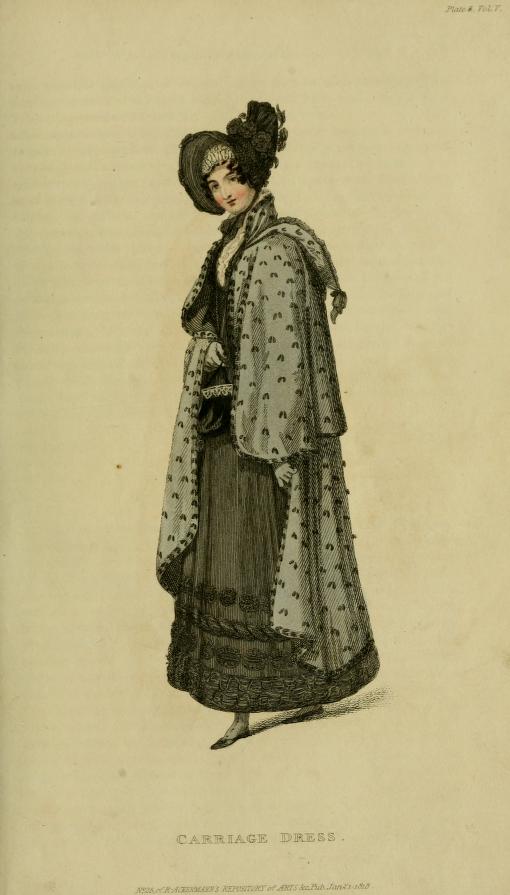
This carriage dress, courtesy of Miss McDonald, no. 84 Wells-street,  is made of bombazine. The wrapping-cloak is Russian "novel and striking." The little purse, called a ridicule, is of black velvet.

This carriage dress, courtesy of Miss McDonald, no. 84 Wells-street, is made of bombazine. The wrapping-cloak is Russian “novel and striking.” The little purse, called a ridicule, is of black velvet.


Portrait of the Regency: An Artist’s Love Story

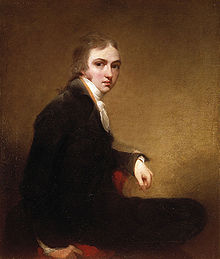
Sir Thomas Lawrence was handsome (the artist William Hoare thought he would make a splendid model for Christ’s portrait) and possessed of an ability to fascinate (no one could concentrate on an individual as he could). The great actress of the late eighteenth century, Sarah Siddons, frequently invited him to her home and he became quite a fixture in her circle of artists and friends.

For a century after his death, his romantic entanglement with her two daughters was blamed for their untimely deaths.

His biographers were a little more charitable, calling him an old flirt.
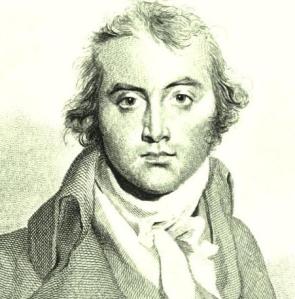
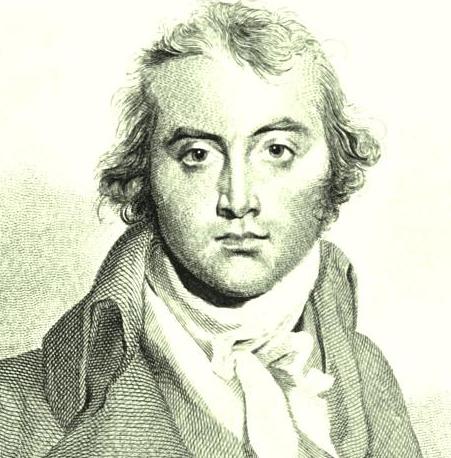
Sir Thomas Lawrence, engraving by Cousins from the Artist's self-portrait

Sir Thomas Lawrence, engraving by Cousins from the Artist’s self-portrait

Then, a century after these events, correspondence written by Mrs. Siddons and her daughters to intimate friends of theirs was published, throwing new light on the Artist’s alleged double-desertion. Letters from Mrs. Siddons reveal her anguish over her daughters’ ill health, along with her great admiration for Thomas Lawrence. There, too, are the girls’ great affection for “Mr. Tom.”

"(Sarah Siddons) was tragedy personified." -- Hazlitt

“(Sarah Siddons) was tragedy personified.” — Hazlitt

It is not clear when Lawrence made his acquaintance with Mrs. Siddons’ two daughters. Perhaps it was the elder daughter Sally who first enjoyed his attentions, as many used to think.
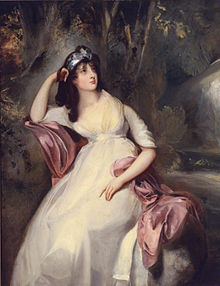
"..she was not strictly beautiful, but her countenance was like her mother's, with brilliant eyes, and a remarkable mixture of frankness and sweetness.." Thomas Campbell, Sarah Siddons' biographer

“..she was not strictly beautiful, but her countenance was like her mother’s, with brilliant eyes, and a remarkable mixture of frankness and sweetness..” Thomas Campbell, Sarah Siddons’ biographer on her daughter, Sally Siddons

From Mrs. Siddons’ correspondence, however, it is clear that Lawrence first sought the hand of her younger daughter, Maria.
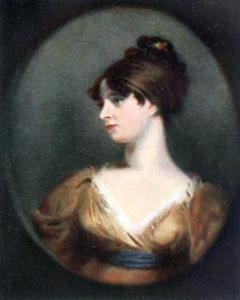
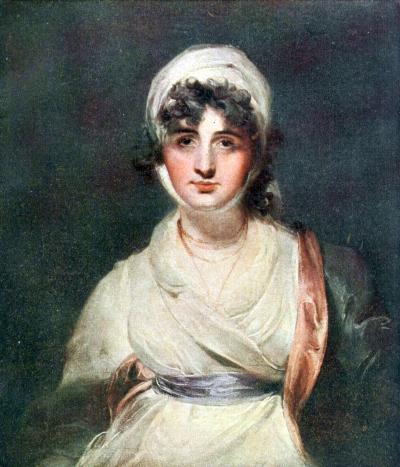
"..more beautiful than her mother." Maria Siddons by Lawrence

“..more beautiful than her mother.” Maria Siddons by Lawrence

His suit was denied, for Maria’s parents believed she was too immature to contemplate such a step as marriage. Mr. Siddons, in particular, thought a man who couldn’t manage his funds shouldn’t be trying to get leg-shackled. Further courtship therefore had to be made clandestinely, in the Artist’s studio in Greek street, through the assistance of one Miss Bird.

Sounds like a Heyer set-up, huh?

Both girls had always suffered from respiratory ailments, perhaps caught from a trip to the Continent when they were younger. Maria in particular would suffer attacks that left her bed-ridden. When the doctor believed her condition quite grave, her pulse “galloping,” and could not assure her survival, Mrs. Siddons agreed to the marriage. Mr. Siddons agreed to relieve the Artist of his debts.

Far from sounding unhappy, Sally wrote to Miss Bird to tell her the news:

“I think Maria has as fair a prospect of happiness as any mortal can desire.”

— Sally Siddons to Miss Bird, January 5, 1798

An Artist’s Love Story, told in the Letters of Sir Thomas Lawrence, Mrs. Siddons, and her Daughters; Edited by Oswald Knapp (1904)

If illness was not working its evil way to thwart romance, certainly the methods to combat consumption were. Maria’s doctor was convinced that confinement was the best remedy, away from others, in their London house, at the very least until April. One acquaintance prophetically noted that “shutting a young half-consumptive girl up in one unchanged air for three or four months would make anyone of them ill, and ill-humoured too, I should think. ”

And then–

“Mr. Lawrence has found that he was mistaken in (Maria’s) character, his behavior has evidently been altered towards her, as I told you..”

— Mrs. Siddons to Miss Bird, March 5, 1798

The Artist was released from his promise to Maria, in the most quiet and discreet manner possible. Maria was eventually released from confinement and the family left for Bath, where she was left in the care of one Mrs. Pennington*, a devoted friend of Mrs. Siddons, so that the latter could resume her acting tour, as she did every summer, accompanied by Sally.

When Maria took a turn for the worse, Sally returned to her sister’s side, just missing a visit by “Mr. L.,” whose sister lived in Birmingham. The young man then sought an audience with her mother, seeking permission to pay his addresses to Sally, but Mrs. Siddons was not exactly encouraging.

The Artist did not take this well and, to her great consternation, Mrs. Siddons next reports to Mrs. P that he had disappeared. She warned that good lady he might very well be on his way to visit her and the girls:

“I pray God that his phrenzy may not impel him to some desperate action!”

Sure enough, the Artist, newly arrived under an assumed name, presented himself to Mrs. P at her very doorstep and announced his love for Sally:

“My name is Lawrence, and you, then, know that I stand in the most afflicting situation possible! A man charg’d (I trust untruly in their lasting effect) with having inflicted pangs on one lovely Creature which, in their bitterest extent, he himself now suffers from her sister!”

Mrs. P was all cordiality and firmness,  notwithstanding his threats to run off to Switzerland and/or commit suicide (!) Still, she was well aware of Mrs. S’s profound fear of scandal and allowed the Artist to see Sally briefly, and by these means induced him to leave the vicinity.

Get over it, she later wrote to him. His response was predictable:

“Have you ever lov’d and are ignorant that one BASE ACTION in a moment root out esteem, while love’s fibres, tenacious of their hold, take many, and days, and months, and longer, to tear from the fond heart?”

— Lawrence to Mrs. P, Sept. 8, 1798

Meanwhile, Sally wrote ominously to Miss Bird that Maria was dying, and that the invalid was adamant that Mr. L is “our common enemy.” It seems Maria had become obsessed with a novel wherein the hero had fallen in love with his patron’s two daughters, had used them both cruelly, and with Tragic Consequences.

When Maria finally succumbed to her illness, Mrs. P. related the deathbed scene to Mr. L in a way that was not calculated to soothe a man of his passion. She spared no detail, and dwelt particularly upon the promise Maria had extracted from her sister, to never marry “that man.”

“If you can sanctify passion into friendship, still you may be dear to their hearts…I think Sally will not lightly, or easily, make another election; but YOURS she never can, NEVER WILL BE.”

Mrs. P to Mr. L., Oct. 8, 1798

The Artist’s reply, in bold and furious handwriting:
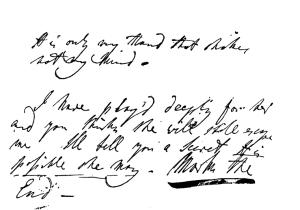
"I have played deeply for her, and you think she will still escape me. I'll tell you a Secret. It is possible she may. Mark the End.

“I have played deeply for her, and you think she will still escape me. I’ll tell you a Secret. It is possible she may. Mark the End.”

Mrs. P, much affronted, replied for the last time that this latest and “unmanly” threat of suicide shall not be regarded and vowed that his letters should be returned unopened.

His reply:

“My mind..is so far quieted by your intelligence, that Remorse is no longer its inhabitant. My crime, I thought, was to Tenderness–I cannot give its expiation to Revenge.

This strange apology did little to soothe Mrs. P, by now so thoroughly aroused that she vented her hurt feelings upon the already distressed Mrs. Siddons, warning the harassed mother that scandal may still pursue them. Sally dutifully responded to Mr. L’s correspondence, assuring him that her decision against their continued relationship was final, and asked for the return of all the letters she’d written to him.

She assured Mrs. P:

“I do not think I shall ever love as I have lov’d that man, but this is certain, I LOVE HIM NO LONGER.”

— Miss Siddons to Mrs. P, Wednesday, Nov. 7

As the years went by, Mrs. P faded from her correspondence. It was to Miss Bird that Sally continued to write of Mr. L. It pained her to see him at parties, she confessed, when meeting his glance was “like an electric stroke to me.” She could scarce pass his house on Greek Street, for “my heart sank within me.” On one occasion, she bowed in his direction several times, but he ignored her.

When Mr. L finally replied to Sally’s demand for her letters, he refused to return them. Until he married, he declared, they would remain in his possession.

He never married and she died in 1803.


*To find humor in love, we must rely upon Mr. Pennington.  “Billy,” as he was then known in Bath circles, had tried to kiss one Miss Linton who promptly bit him on the lip. A Mrs. Leever saw the whole, criticizing the young man for his conduct, especially after he had spit blood on the young lady’s cap and burnt it. Billy proceeded to tell Mr. Leever that his old hag of a wife ought to mind her own business. Servants were called to throw the young man out of the Leever residence after he had followed the couple there, slapping the older man and pocketing his wig.

Portrait of the Regency: Vanity and Good Taste

On the eve of the Regency, Miss Eliza Farren was accounted one of the finest actresses of her day. From her first role as Miss Hardcastle in She Stoops to Conquer, to her appearance as Nimeney Pimeney in The Heiress, her skill at playing a variety of characters was like Sir Thomas Lawrence’s in painting them.

Hazlitt speaks of "Miss Farren, with her fine-lady airs and graces, with that elegant turn of her head and motion of her fan and tripping of her tongue." Sir Thomas has captured her winsome nature perfectly.

“Miss Farren, with her fine-lady airs and graces, with that elegant turn of her head and motion of her fan and tripping of her tongue.” — Hazlitt

Around 1790, he painted her portrait, wrapping her elegant figure, tall and slim, in a fur trimmed “john-coat.” Some critics disapproved of this raiment, so at odds with the subject’s summery surroundings. Comments such as these did not concern Sir Thomas. After all, he was the artist.

When the portrait was presented to the Royal Academy, simply entitled “The Actress,” Sir Thomas was roundly attacked for addressing the glorious Miss Farren as a mere hireling on the stage. This criticism needled him, for it was not his art that was at fault, but his taste!

He wrote at once to Miss Farren, knowing one word from her would dispel any criticism by her beloved fans. He apologized for the clumsy way he meant to convey his own admiration for her art, which sprang

“..from the wish that he had that it should be known to be her from the likeness alone, unaided by professional character.”

— Sir Thomas Lawrence’s Letter-Bag, edited by George Somes Layard, with recollections of the artist by Miss Elizabeth Croft (1906)

Two years later, the unsold portrait and its subject had caught the eye of Lord Derby. Edward Smith-Stanley, 12th Earl of Derby, was still married to his first wife, but they were separated on account of her affair with the Duke of Dorset. His lordship, through the offices of Miss Farren, offered to buy the painting.

Sir Thomas informed Miss Farren he was willing to sell it, but the price for her portrait was now one-hundred and twenty guineas. She wrote back, expressing her astonishment and chastising him for having forgotten the original quote of sixty guineas. In the end, the besotted Lord Derby possessed himself of the portrait, if not the sitter, for a princely sum of one hundred guineas.

Unfortunately, the picture continued to plague Sir Thomas even after it was delivered. Apologizing for being so “troublesome,” Miss Farren wrote to him of additional criticisms, and would he pretty please alter the picture?

He reminds me of another earl. Or perhaps its because Downton is on.

From this angle, Derby looks a bit like Downton, I daresay.

“One says it is so thin in the figure, that you might blow it away–another that it looks broke off in the middle: in short, you must make it a little fatter, at all events, diminish the bend you are so attached to, even if it makes the picture look ill; for the owner of it is quite distressed about it at present.”

We don’t know if Sir Thomas complied, but in 1797, Miss Farren married her earl, and

“exchanged the tinsel crown of the stage for the very substantial coronet of a countess.”


Portrait of the Regency: Face to Face

It’s been said Sir Thomas Lawrence’s legacy was left to “fashionable, virtuoso photography,” and not to the art of painting. His portrait exhibitions attracted large crowds, satisfying the Regency era’s appetite for more than just of glimpse of the rich and famous.

Now one could gaze as long as one liked, without appearing vulgar, on the visage of the Prince Regent, or on the bosom of Lady Blessington.

Exhibition room at Somerset House by Rowlandson and Pugin

In her recollections of Sir Thomas, Miss Elizabeth Croft describes the artist’s interest in physiognomy. After years of portraiture, he became convinced of the power a person’s facial characteristics exercised over their character, and their actions.

Once he rehired a servant he had formerly sacked. It seems the fellow was unable to find a new position, and Sir Thomas knew it was because of his chin:

“..an organ of destructiveness so strongly defined I fear he will never get another place.”

Miss Croft questioned his faith in such reasoning when he showed her a portrait he had sketched of the alleged murderer, John “Murphy” Williams. This was the man who’d been jailed, pending trial, for the notorious Ratcliff Highway murders which occurred near present-day Wapping, London, within a space of twelve days in December, 1811. Much struck by the villain’s pleasant features, she recalled:

This post-mortem sketch of John Williams might very well be by Lawrence

This post-mortem sketch of John Williams might very well be by the artist

I never saw a more beautiful head. The forehead, the finest one could see, hair light and curling, the eyes blue and only half-closed; the mouth singularly handsome, tho’ somewhat distorted, and the nose perfect.”

— Sir Thomas Lawrence’s Letter-bag, edited by George Somes Layard, 1906 (with recollections of the artist by Miss Elizabeth Croft)

How could Ratcliff Highway murderer have such a beautiful head, she asked, when he’d:

“…destroyed not only a father and mother..but an infant a few weeks old in its cradle–and all this for the purpose of rifling the till in a little haberdasher’s shop!”

Sir Thomas chastised her gently, drawing her attention to the similarity of Williams’ chin to that of Governor Wall, hung for acts of cruelty while in charge of a colony on the west coast of Africa. In sketching both, he noted:

“..the formation of the lower jaw was precisely the same–very square, with a peculiar shortness of the chin, and partaking more of the tiger than the human jaw.”

Of his own chin, he admitted:

“..there is some appearance of Fortitude, but wholly unconnected with Reason. Indeed, of that Philosophy which can mould wishes to circumstances and subdue the influences of Passion to those of Fortune, this Countenance has not a Vestige (!)”

He looks a bit sulky, I declare.

Yes, I do see the Fortitude. And Passion.


A Parthian Glance at Christmas

The following are excerpts from the December portion of an article entitled, “Annas Mirabilis, Or, a Parthian Glance at 1822.” These observations, often amusing, sometimes cynical, are snapshots of a Regency-era Christmas:

Sad sameness of Christmas dinners.

Every tablespoon in the house flaming with burnt brandy.

Growing civility of sweeps, dustmen and patrols: plainly denoting that the era of Christmas-boxes is at hand.

Grave papas, usually seen about without an accompaniment, were met dragging along children in couples, and occasionally stopping to peep into toy-shop windows.

Premature twelfth-cakes stealing behind confectioners’ counters.

Grimaldi and the new pantomime: front rows filled by urchins, who, at every knock-down-blow, fling back their flaxen polls, in delight, into the laps of their chuckling parents on the seat behind.

— The New Monthly Magazine and Literary Journal, Vol. VII, 1823

A glance at Christmas Past, albeit Parthian, as we speed on to the Christmases of tomorrow.

Season’s Greetings and Happy New Year!

This mulberry-coloured promenade dress looked decidedly festive with epaulettes and sleeves fashioned to look like leaves. The skirt is edged in chinchilla, matching the large muff. From Ackerman's Repository of Arts, Vol. 14, 1822

This mulberry-coloured promenade dress is decidedly festive with epaulettes and sleeves fashioned to look like leaves. The skirt is edged in chinchilla, matching the large muff. From Ackerman’s Repository of Arts, Vol. 14, 1822

Portrait of the Regency: A Nightmare

Henry Fuseli (1741-1825) was a Swiss painter unwelcome in his native country due to some political trouble. He eventually settled in England, where he became a stalwart at the Royal Academy and a master of Romantic painting.

In his spare time, he translated Homer for Cowper and Lavater’s work on physiognomy for England. He later declared, after Mrs. Fuseli had to bar his studio against an infatuated Mary Wollstonecraft:

“I hate clever women. They are only troublesome.”

Henry Fuseli by Northcote

Henry Fuseli by Northcote

Critics called his art, “Rubens in motion.” His figures writhe with violence, his incredible beasts glare fantastically. Regency era sensibilities were most particularly challenged by his painting, “The Nightmare.”

Naturally, Sir Thomas Lawrence couldn’t wait to tell Miss Croft just how timid a fellow this painter of supernatural visions really was.

Fuseli had been invited to spend an evening at a wealthy patron’s country house. After dinner, as the ladies retired to the drawing room, the artist got up from the table and left as well. The gentlemen wondered why the guest of honor had abandoned them but consoled themselves with the notion that foreigners disliked sitting after dinner.

When the ladies returned, without Fuseli, the host demanded of his lady where she’d put him. Remonstrances were exchanged while someone was dispatched to the artist’s room in the event he’d gone there to be sick.

He wasn’t there.

As is often the case with these country house mysteries, a breakthrough came by means of an unexpected observation from “below-stairs.” In this case, it was the lowly footman who found himself the subject of uncomfortable scrutiny when he admitted having directed Fuseli to the garden temple, a noted feature of the estate’s grounds, despite the gathering darkness.

The servant had tried to press upon him certain items for protection:

“What you bring that great big stick for?” asked Mr. Fuseli in his broken English.

“Why, Sir, our house dog is let loose after dark, and as he is rather fierce, you’d better take the stick.”

— — Sir Thomas Lawrence’s Letter-Bag, ed. by George Somes Layard, with recollections by Miss Elizabeth Croft (1906)

Fuseli refused to take either lantern or cudgel, and dismissed the footman upon arriving at the garden fixture. When his hosts at last discovered him, he was still inside, cowering in a state of considerable disorder.

It seems he’d heard loud sniffing at the door soon after he’d been left at the temple, which turned into blood-curdling snarls and growling. Unable and unwilling to leave the temple, and so far removed from the house no one could hear his cries, Fuseli became terrified at the prospect of spending the night in the pagan temple, at the mercy of a demonic dog.

The Nightmare, by Fuseli

The Nightmare, by Fuseli

It was an anecdote Miss Croft declared:

“I am almost ashamed to repeat.”

Thank goodness for lack of scruples.


Charles Lamb: Thanksgiving

“The most loveable figure in English literature,” Charles Lamb (1775 – 1834) was a member of the Lake poets group whose writings, however admired by the Regency-era public, were held in contempt by certain critics for their high-flown language.  He struggled with his personal life, having to care for a sister who murdered their mother and failing to win the heart of his beloved after years of courtship.

This blog has referenced him from time to time–on his adoration of Wordsworth‘s honesty, and his opinion that William Godwin’s new wife, the successor to Mary Wollenstonecraft, was a bitch.

Lawyers, he supposed, “were children once (!)” Charles Lamb by Hazlitt

With Thanksgiving upon us, his essay, “Grace Before Meat,” (1823)  seems an appropriate work to examine. One of several from his famed Essays of Elia, the piece attacks that long-lived ritual of saying grace before meals:

“Gluttony and surfeiting are no proper occasions for thanksgiving.”

Fustian, I say!

For Lamb, the matter was a serious one. He was preoccupied with the rising materialism of the age. He’d been known for remaining aloof of his countrymen’s increasing appetite for earthly pleasures. He read the New Testament and Psalms regularly. He despised organized religion.

Fellow Lake poet Robert Southey, he who “wooed Liberty as his mistress and married disreputable Legitimacy,” publicly condemned Lamb as irreligious.

But what is the point, Lamb asks?

I own that I am disposed to say grace upon twenty other occasions in the course of the day besides my dinner. I want a form for setting out upon a pleasant walk, for a moonlight ramble, for a friendly meeting, or a solved problem.

Such a  sentiment is completely inappropriate to the occasion…

When I have sate (a rarus hospes) at rich men’s tables, with the savoury soup and messes steaming up the nostrils…the ravenous orgasm upon you (!), it seems impertinent to interpose a religious sentiment.

…particularly as the occasion itself is rather hedonistic:

The heats of epicurism put out the gentle flame of devotion. The incense which rises round is pagan, and the belly-god intercepts it for his own.

..such that the one who has to say it is made to feel awkward:

I have observed this awkwardness felt, scarce consciously perhaps, by the good man who says the grace. I have seen it in clergymen and others — a sort of shame — a sense of the co-presence of circumstances which unhallow the blessing.

…and cannot be certain in knowing what to say:

A short form upon these occasions is felt to want reverence; a long one, I am afraid, cannot escape the charge of impertinence.

Borrowing an old joke from the playwright Sheridan*, Lamb suggests the following (tongue-in-cheek) for saying grace:

 “Is there no clergyman here?” — significantly adding, “thank G—.”

Blame it on the belly-god.

Even Charles Lamb could not quibble with this scene

*Lamb once said that the Irish playwright “ran through each mode of the lyre, and was master of all.”

Portrait of the Regency: “To Any Body, Any Where”

Returning to Miss Croft’s remarkable collection of anecdotes recorded of Sir Thomas Lawrence; the following story, while not precisely contemporaneous to the Regency, is nevertheless illuminating of the times.

It concerns the painter’s younger days when he enjoyed the patronage of Georgiana, Duchess of Devonshire. It was she who had engaged him at a young age to draw the portrait of her first child, later known as Lady Carlisle. He was frequently among the Devonshire set as he grew older. Miss Croft surmised that it was this period of his life by which he achieved his air of amusing urbanity.

Regrettably, among her many foibles, the Duchess was quite unable to turn down any application made to her for aid. She made promises she could not keep. She committed largesse she did not have.

One of the Duchess’ good friends was a Mr. Hare (surmised to be Francis Hare-Naylor, grandson of the Bishop of Chichester) a man who apparently knew Georgiana quite well, and was forever heartsick at the scrapes she found herself in. Many of these were of her own making, but few could admonish her like Mr. Hare:

“He had a peculiar talent for reproving a fault without giving offense to the party committing it.”

–Sir Thomas Lawrence’s Letter -bag, by Sir Thomas Lawrence, Elizabeth Croft

Her Grace's portrait by Sir Thomas Lawrence--when she was about 25 years of age

Georgiana, Duchess of Devonshire by Sir Thomas Lawrence when she was about 25 years of age

Sir Thomas had the opportunity to witness Mr. Hare’s skill in this regard one evening, when he was invited to Her Grace’s salon at Devonshire House. There, the painter joined by several great Whigs of the day, including Mr. Fox and Mr. Sheridan. Mr. Hare was there, too, and of course the Duchess was presiding. However, she jumped up to leave, having remembered she needed to write a letter.

Protestations were heard all round.  Mr. Hare declared he must write the letter in her stead, for her company was too dear to spare.

“.she laughingly inquired how that was possible, as he knew not her correspondent or her business.”

He proceeded to write a letter in full view of the company, full of voluminous expressions of admiration and a longing to serve, followed by a catalogue of many competing commitments to other friends similarly situated and the limitations on her ability to serve same, closing with “new professions of services at some future time.”

Her Grace admitted that the letter would serve her purpose very well, to everyone’s amusement. Even more amused were they as Mr. Hare signed the letter in the Duchess’ name.

But when she dared Mr. Hare to address it properly, the amusement ended.

“He very gravely folded and sealed it, and then wrote, to:

“Any Body, Any Where.”

Georgiana’s eyes filled with tears. It was some time before she could regain her composure, however, Mr. Hare remained in her good graces. Apparently she could not admonish one who knew her so well.

All that's left of Devonshire House--the gilt leopards on the gates

All that’s left of Devonshire House

Regency Apparition

During the Regency era, you were bad ton if you saw a ghost. You were queer in the attic if you admitted you had.

For example, Monk Lewis’ wildly popular play, The Castle Spectre, was still being criticized after years of successful productions for the “nonsense and absurdity” of its supernatural theme. The play’s “special effects” were deplored–the “spectre” condemned as a public nuisance for attracting large crowds of boisterous, lower class patrons clamoring to see it.

Can never get enough of old Crichton Castle

    Crichton is as spectral a castle as you’ll ever find

Works of fiction aside, efforts to prove the existence of ghosts met with even stronger disapprobation. However well-intentioned, Reverend C.C. Colton’s publicised investigation into the Sampford ghost was considered no more than an exercise in chicanery.  To dignify such paranormal experiences only encouraged more of the sightings, which were:

“..the growth of a species of superstition at once so disgraceful to the character of the age in which we live, so injurious to society in its probable effects on the minds of ignorant persons and young persons..”

— “A Full Account of the Conspiracy at Sampford Peverell, near Tiverton, containing the Particulars of the pretended Visitation of the Monster, etc.” Taunton Courier, 1810

Sampford Peverell looks fairly peaceful now

     Sampford Peverell–at peace

When an account entitled “Starcross Apparition” appeared in the New Monthly Magazine, it was not surprising that the witness to it would not risk revealing his full identity. Instead, “H” risked a (tedious) exposition on the frailty of human senses–a plea for the Reader’s sympathy:

“Imposter and visionary, knave and fool, these are the alternate horns of the dilemma on which I shall be tossed with sneers of contempt or smiles of derision.”

— Account of an Apparition, New Monthly Magazine and Literary Journal, Vol. VIII, 1823

H’s account takes place in the Devonshire village of Starcross, beside the Exe estuary. Starcross is just south of Powderham Caste, seat of the Courtenay family, Dukes of Devon since the 14th century.

That summer had been especially stormy, beating into a swamp the leaves and flowers not yet ready to be cast aside for winter. He denied he was blue-devilled by the weather, that summer evening, but he did feel sufficient melancholy to send a written invitation to a friend for dinner, on account of Mr. Staples’ “contagion of laughter.”

retro owl--we had one of these growing up

retro owl–we had one of these hanging on the front door

The next day, sitting in an outdoor alcove to await Staples’ arrival, H perceived the sound of a death-watch, “that little insect of inauspicious augery.” He thought nothing of it, dismissing it just as he had the sudden shriek of a screech-owl. On his return to the house, however, he had reason to recollect these portents, for his servant handed him a black-sealed letter.

Mr. Staples was dead.

Sadly, H made his way to his library, accompanied by a faithful spaniel. Once in the chamber, however, the dog let out a horrified wail, peering with fright toward the back of the room. There was Staples, sitting motionless, upright, in a chair.

H beat a hasty retreat from the library:

“..astonishment and terror so far mastered all my faculties, that, without daring to cast a second glance toward the vision, I walked rapidly back into the garden, followed by the dog, who still testified the same agitation and alarm.”

It was the spaniel’s fault, H reasoned, for causing his master to quit the chamber in unseemly haste. Why else would the spaniel be in terror unless it was due to the supernatural, the beast having no such knowledge of ghosts and such? Nevertheless, H’s good sense finally prevailed and he returned to his library, only to find the image of Staples was still there, seated with his eyes closed.

H tried to dignify the situation by screwing himself up to speak with the ghost. (See the method for addressing specters as related in an earlier post here). Demanding the reason for its presence, H was rewarded by the following response:

The figure, slowly rising up, opening its eyes and stretching out its arms, replied, ‘A leg of mutton and caper-sauce, with a bottle of old prime port, such as you promised me.’

The devil! (Actually, H swore that other innocuous Regency oath, ‘Good God!’)

One can only imagine H’s chagrin when Staples, in high good humor, assured his friend he was not a ghost. Indeed, it was a namesake of his, living in Castle-street, who had died. Unfortunately, some “loud-mouthed fool” had spread the false news to Staples’ clerk, who then conveyed the misinformation to H.

Imagining his friend’s turmoil upon receiving such a bag of moonshine, Staples made haste to Starcross to rectify the error. He let himself in the side door of the house and sat down in the library to await his host with the good news he was very much alive. His motionless appearance was explained by reason he’d fallen asleep.

The dog’s reaction was simply a case of dislike for Staples, who had strongly chastised him on an earlier visit for killing a chicken.

The Author wisely refrains from commenting further on his own reaction, and leaves it to us to contemplate ours.

“Monsters are real, and ghosts are real, too. They live inside us, and sometimes they win.” — Stephen King

Viscount Combermere is thought to be sitting in his favorite chair in this photograph taken by his sister, during his funeral, while the house was empty

Viscount Combermere, investigator of the famous moving coffins in Barbados, was struck and killed by a carriage. During his funeral, this photograph was taken of his favorite chair, while the house was empty.