They Wrote History ~ Regency’s Horses Part I

There are many blogs out there that do a remarkable job of recreating what we know of the equine’s contributions to Regency-era history. Some are overviews of breeds, others concern themselves with riding and driving techniques of the time.

This series of posts is devoted to various reports of equine personalities during the late Georgian era. Did horses then differ much in attitude from today’s Thoroughbreds, Quarter Horses, Holsteiners, among others?

Perhaps not much, but combing through the Regency’s magazines and sporting manuals, it becomes clear a good story is even better when the horse is a character.

“Come, gentlemen sportsmen, I’ll sing you a song,

Of Marcia’s Son, who can run the day long.

Otho, they call him, and he got his name

After conquering Merlin, that racer of fame.”

— Sporting Magazine, Rogerson and Tuxford, Volume 5 (1820)

In the waning years of George III’s reign, the enthusiasm for the sport of horse racing was only growing. What was recorded included a good deal of individual racers themselves, their temperaments, their good qualities, and their vices.
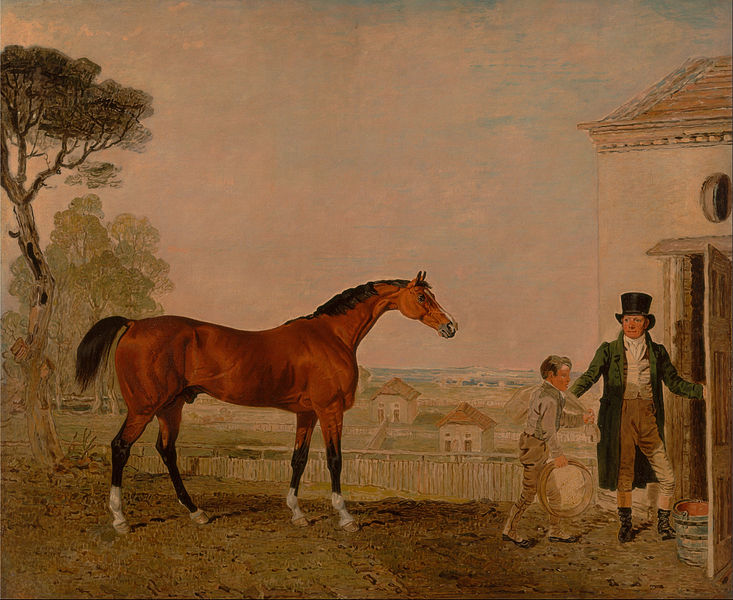
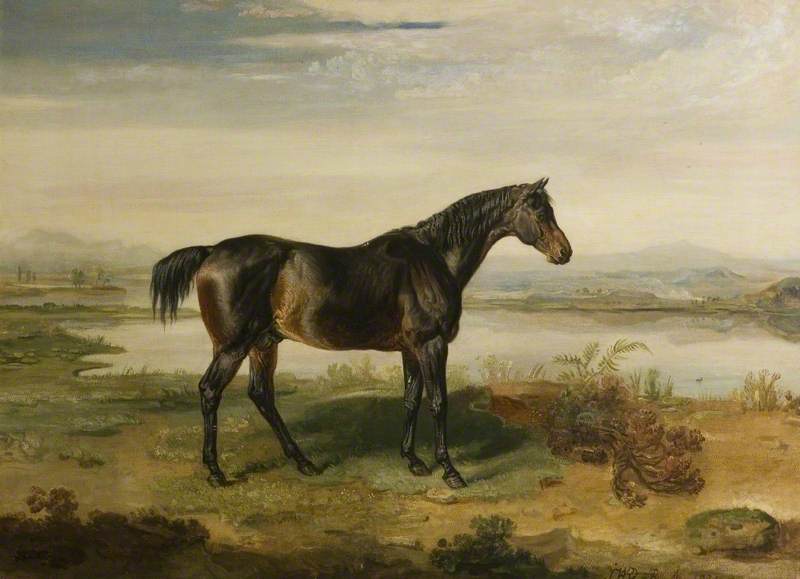
Sultan–a Regency-era horse, successful at racing and at stud. He suffered chronic pain in his legs, and the editors of1820’s Sporting Magazine worried he might have to “undergo the iron,” referring to pin-firing therapy. The method is still used today, under anesthesia.

The names given to Georgian era racehorses–instructive of the time–said less about the nags and more about their owners.  Apparently the more vulgar the name, the better the horse performed, or so the thinking went. As the Regency approached, demand for civility increased at sporting events. To get around this stricture, and still preserve the expectation of winning, the christening could be drawn from a foreign language–preferably dead or French, in that order.

From Horse Racing in England–a Synoptical Review by Robert Black, 1893, the following examples:

Pudenda, Filho de Puta and Melampygus.*

Not necessarily vulgar, but to amuse spectators and confound bookmakers:

Abomelique, Foxhuntoribus, Fal-de-ral-tit, Ploughator and Pot-8-Os (a la OU812).

Racehorses more often than not were lauded for perseverance in difficult circumstances.  Take, for instance, Dr. Syntax, a rather small, mousy-colored colt who had a long career that ended in paralysis, for which he was put down behind the racing barn at Newmarket in the sad presence of many trainers and jockeys.

“He would not brook either whip or spur..and yet, by simple stroking and talking and an occasional hiss, he could always be made to do his best.”

Horse Racing in England–a Synoptical Review by Robert Black, 1893

Dr. Syntax sired a racemare, Beeswing, so beloved they called her the Pride of Northumberland, and several villages renamed themselves in her honor.
It is possible that the skeleton revealed during excavation at Newmarket in 2014 is that of Dr. Syntax — the corpse was carefully buried and there was ‘substantial wear and tear’ on the legs

In Lawrence’s 1820 British Field Sports Guide there is an entire chapter devoted to abuse by whip and spur. The point of the passage is concerned less with cruelty, however, and more with the opposite result such treatment tended to bring about.

In short, horses did, and still do, have minds of their own:

“..the old Duke of Cumberland had a winning horse brought to a dead stop –within half a distance of the Ending Post—by a stroke upon a delicate part, under the flank.”

George Lane Fox (1793-1848), known in Regency circles as (and this is saying a lot) ‘the Gambler,’ was a Whig with a ‘stumbling oratory style.’ He had dissipated most of his fortune, separated from his wife, unsuccessfully tried to reconcile with her, lost his home in a fire, and refused to provide villagers with a beast for bull-baiting, because he hated the cruelty of the sport.

Black’s Review reports Fox pitted his racing colt Merlin in a match against the Earl of Portland’s Tiresias in 1820. During the race, the former broke his leg. All efforts were exerted to save the horse, but he struggled against the slings that would mend the break, frustrated and insensible of his owner’s good intentions. The result was that Merlin

“..became one of the worst ‘savages’ ever known, and murdered his groom with most ghastly accessories.”

“Grunting, Henry replied, ‘He’s as cunning as he is vicious.’ ” Satan, an unforgettable equine character, since 1947.


*I left out some of the more colorful examples listed in Black’s Review. Look them up, if you wish, but don’t tell him I sent you.


Publisher to the Regency

The Publisher to the Regency began as a ‘piratical intruder upon the profession of a bookseller.’ *  In spite of this early criticism, the efforts of John Bell (1745-1831) during the Georgian Age made possible the widespread dissemination of art and literature during the Regency.

As a twenty-something bookseller in the Strand, Bell started printing the Morning Post, a popular Whig publication, in concert with two reverend parsonical banditti (!) While the paper acquired the distinction of spreading “fake news,” (quoting NYR Daily) it answered increased demand for printed material, fueled by the growth of a literate population eager to read.

Bell realized he had tapped into an opportunity for mass press and began to publish English works that were affordable for the ordinary citizen to purchase. His series on Shakespeare and British Theatre, joined later by Poets of Great Britain from Chaucer to Churchill, were highly successful. This was in part due to the use of smaller fonts, which did away with hanging characters and the elongated S, and progressively improving printing methods.

Alarmed, established publishers attacked his papers and his character in their publication.

Bell relished his new-found notoriety and put it to work at other endeavors.  He opened a lending library called the British Library and published another newspaper, the English Chronicle, featuring sports news, mostly from the boxing ring. By 1788, he had become Bookseller to the Prince of Wales, enjoying the honor of hosting HRH at his residence.  Publication of  La Belle Assemblée or, Bell’s Court and Fashionable Magazine Addressed Particularly to the Ladies, sealed his reputation.

Another of the prints we like to decorate our Regency blogs with–thank you, Mr. Bell–which features a French court dress, with the court lace lappets suspended from a tiara of gold and pearls. La Belle Assemblée, Vol. 17 & 18, Jan-Dec 1818

However, he continued to be plagued with lawsuits filed against him by jealous rivals.

It was revenue from La Belle Assemblée that sustained him, through the clever use of beautiful engravings in color and paid advertising. One of the services advertised was the Westminster Central Mart, an office he owned which served as a central information board for domestic servants as well as a repository for the references such persons needed for employment. A nominal fee was charged to register with the Mart, and prospective employers could meet there with prospective employees for interviews. It could not have made much money for Bell, for the operation required a good deal of clerical effort to keep things sorted. Some have speculated that the whole thing was got up as an occupation for a needy acquaintance.

This “Puck” of booksellers was in the distribution of information for more than just money.

He died at the ripe age of 86, and his obituary recalled not only his fine publications twinned with artistic style, but  his encouragement and support to those around him: innovative typographers, striking employees bailed out of jail, and sponsorship of young, starving poets.

We are indebted to one of the latter, Leigh Hunt, for providing us with the following contrasts of a man who made reading to the masses possible:

“He had no acquirements, perhaps not even grammar, but his taste in putting forth a publication, and getting the best artists to adorn it, was new in those times, and may be admired in many.”

— Leigh Hunt in his Autobiography (1903 edition)


*this and other excellent anecdotes are from the publisher’s biography: John Bell, 1745-1831: A Memoir, by Stanley Morison (1930) and an impressive catalog of art featured in his publications: John Bell, Patron of British Theatrical Portraiture: a Catalog of the Theatrical Portraits in His Editions of Bell’s Shakespeare and Bell’s British Theatre, by Burnim and Highfill (1998)

There Must be No Children

When on holiday, it is a good thing to pass the time with friends.

Prime Minister William Pitt the Younger (1759 – 1806) achieved his political fame at a very early age. Thus, his circle of friends and allies was comprised of generally young men–former schoolmates and up-and-coming politicians.  As comforting as loyal company was, however, Pitt occasionally needed a break from it all.

The following video illustrates the tumult of No. 10 Downing Street rather well:

When Pitt sought relief in the country,  he not only enjoyed the change of scenery, but the change of company as well. There was riding, dogs and dining with the large families of the district. Laddishness was exchanged for domestic tranquility.

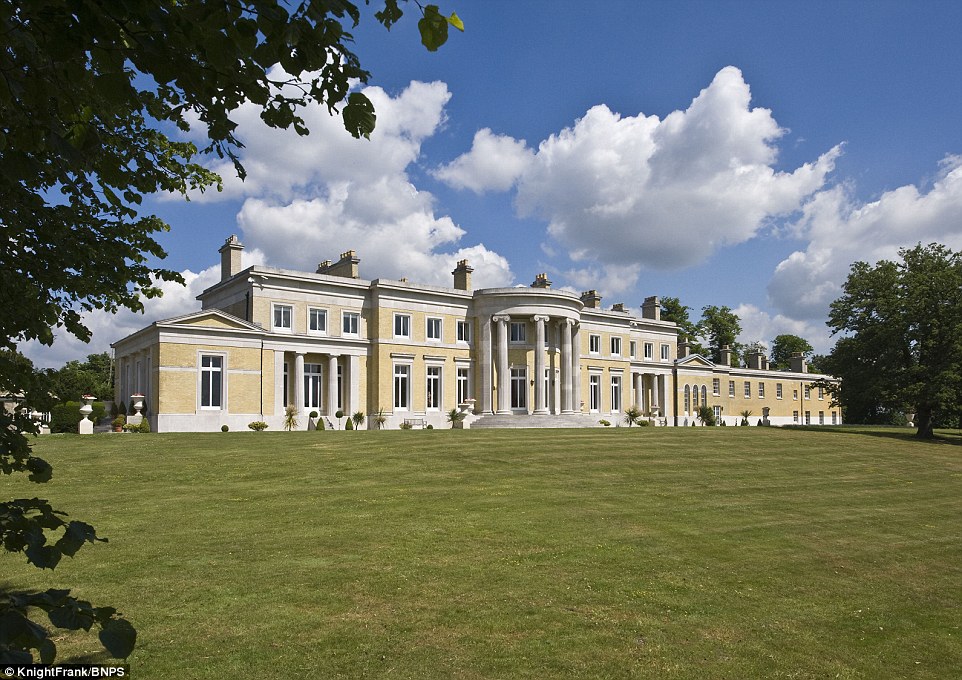
Holwood, Pitt’s country estate, is about fourteen and a half miles from London Bridge down to Keston, the nearest village. In his time, the road used to pass a Roman encampment called Caesar’s Camp which the prime minister eventually had enclosed in his property there.

As an aside, many remarkable objects had been retrieved from the site over the years–tiles, broken bits of pottery and coins–inspiring a group of enthusiasts to formally get together to try to preserve it.

‘We have not heard much of the results from them beyond some agreeable meetings.’ — Handbook to the Environs of London,  Murray (1876)

Agreeable meetings can sometimes make up for lack of progress. My own experience is proof of that.

Holwood House was for sale in 2015 for £12 million. http://dailym.ai/1w9Vpys

Also in the neighborhood of Holwood were other country estates, such as historic Breckenham, once the home of Henry VIII’s boon companion, Charles Brandon, Duke of Suffolk. Nearer was Eden Farm, a manor set a park of 130 acres. This estate was sort of a stopover for many dignitaries and other famous persons transiting the country, for Lord Aukland, the owner, was a member of the influential Eden family. Pitt would often take his dinner there, spending the night afterwards, even though his own house was close by.

One of Pitt’s protégés, George Canning, (whose supernatural exploits have been previously addressed in this blog), was not content to remain in London, cooling his heels and waiting for the return of his master.  Upon visiting Holwood, he made a startling discovery:

“… a rare development in Pitt’s life–an apparently close friendship with a woman.”

— William Pitt the Younger, by William Hague( (2004)

The lady in question was Lord Aukland’s daughter, Eleanor Agnes.  Pitt’s sojourns to the country took on an entirely different meaning, touching off all kinds of rumors and disquiet, particularly among those left behind in London.

Pitt made a point to deny a serious attachment, to his laddish friends as well as to the outraged father.  Indeed, he seemed more horrified than the poor girl, snuffing out their friendship as if he’d  been caught doing something forbidden.

Writing to her father, he was unable to repeat her very name:

“It can hardly, I think, be necessary to say that the time I have passed among your family has led to my forming sentiments of very real attachment towards them all, and of much more than attachment towards one whom I need not name…”

— Wiliiam Pitt the Younger, to Lord Aukland, 20 January 1797

Of course, the abrupt nature of Pitt’s action, ending the connection, led to increased speculation. He only added fuel to the fire when he stated that continuing the connection was made quite impossible by “insurmountable obstacles.”

“He never touched a woman,” one of his cronies said, that rascal Dundas.

It was an awkward, blundering action by one who was erudite and masterful in his dealings with others. The ax he let fall between himself and Eleanor points to a troubled past–one he could not allow another to be made to suffer by it.

ITV’s television series, Number 10, starring the incomparable Jeremy Brett as William Pitt, the Younger, explains:

“There must be no children.”


A Fashionable New Year

At the beginning of the New Year, the climate in London was unseasonably mild, throwing fashion expectations in disarray. Indeed, the “mountain wrap was rendered too warm, and the Venetian cloak to be preferred.” — La Belle Assemblee, January, 1825.

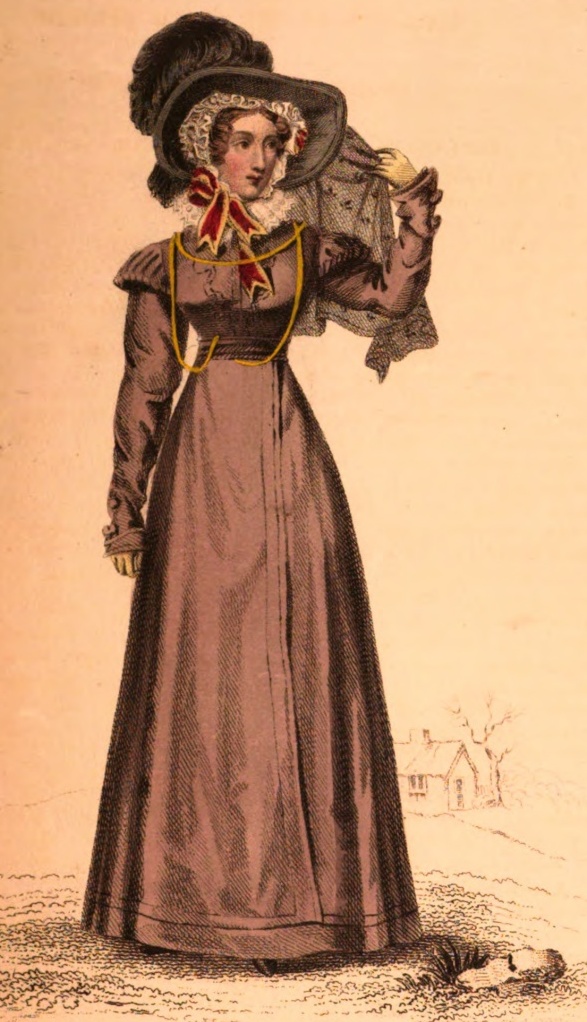
When the weather permits, walking is preferred. Cloaks can be awkward, because the armholes catch a chill breeze so that they are “quite exploded.” Pelisses are more comfortable, but are thick and heavy, generally lined with fur, particularly at the bottom of the skirt to keep out drafts, “in the German fashion.” New pelisses feature a lighter fabric–made of Gros de Naples, a stout and yet finely woven silk–heavy enough for a windbreak, yet holding a luxurious feel.

Happy New Year!


“Pelisse of gros de Naples, of a tourterelle colour.”

Christmas with a “K”

“For Christmas that year Princess Augusta, known to Victoria and Albert’s children as ‘Aunt Prussia,’ sent Vicky four miniature fruit and vegetable shops just like those in Berlin, and to brother Bertie, five cartons of Prussian toy soldiers in wood and lead.”

— An Uncommon Woman, by Hannah Pakula (1997)

In exchange, the Princess Royal’s mother, Queen Victoria, sent a Scottish kilt to Germany, as a present to Fritz, the fifteen-year-old prince.

Aunt Prussia  forced the poor lad to wear it for a State dinner.

Set of World War I toy German soldiers.

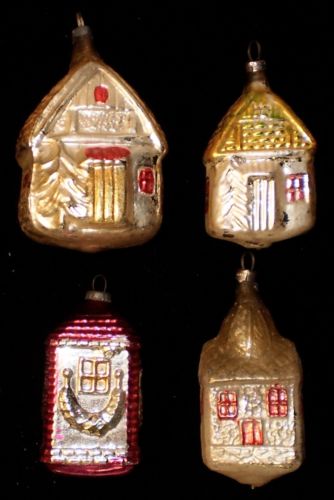
I love vintage German ornaments. The reproductions are quite nice, too. They remind me that a lot of Christmas as we know it came from Germany.

German “putz” houses

glass tree ornaments


German Christmas customs have become so embedded it’s easy to forget their origin. The Advent wreath, for instance, marks the Sundays of Advent. On each one I pray that the combination of so much greenery adjacent to an open flame does not burn the church down.  Weihnachtsmarkte, the Christmas market, makes a great fundraiser for any group, be it a historical society or a soccer booster club. Der Adventskalender, or Advent calendar, is meant to provide order to the wild anticipation children experience with the coming of Christmas.

This is entirely theoretical, of course.

A 1970s Advent Calendar — from Cold War West Germany


They even say der Weihnachtsmann, or Christmas man,  resembles Santa Claus. Scholars would have us believe this mythical figure is derived from Thor.

A Santa worth waiting up for.

Merry Christmas!

The Regency Christmas Table

“At [the tables of the rich] the refinements of foreign invention are for once superseded by the simpler products of old English cookery…”

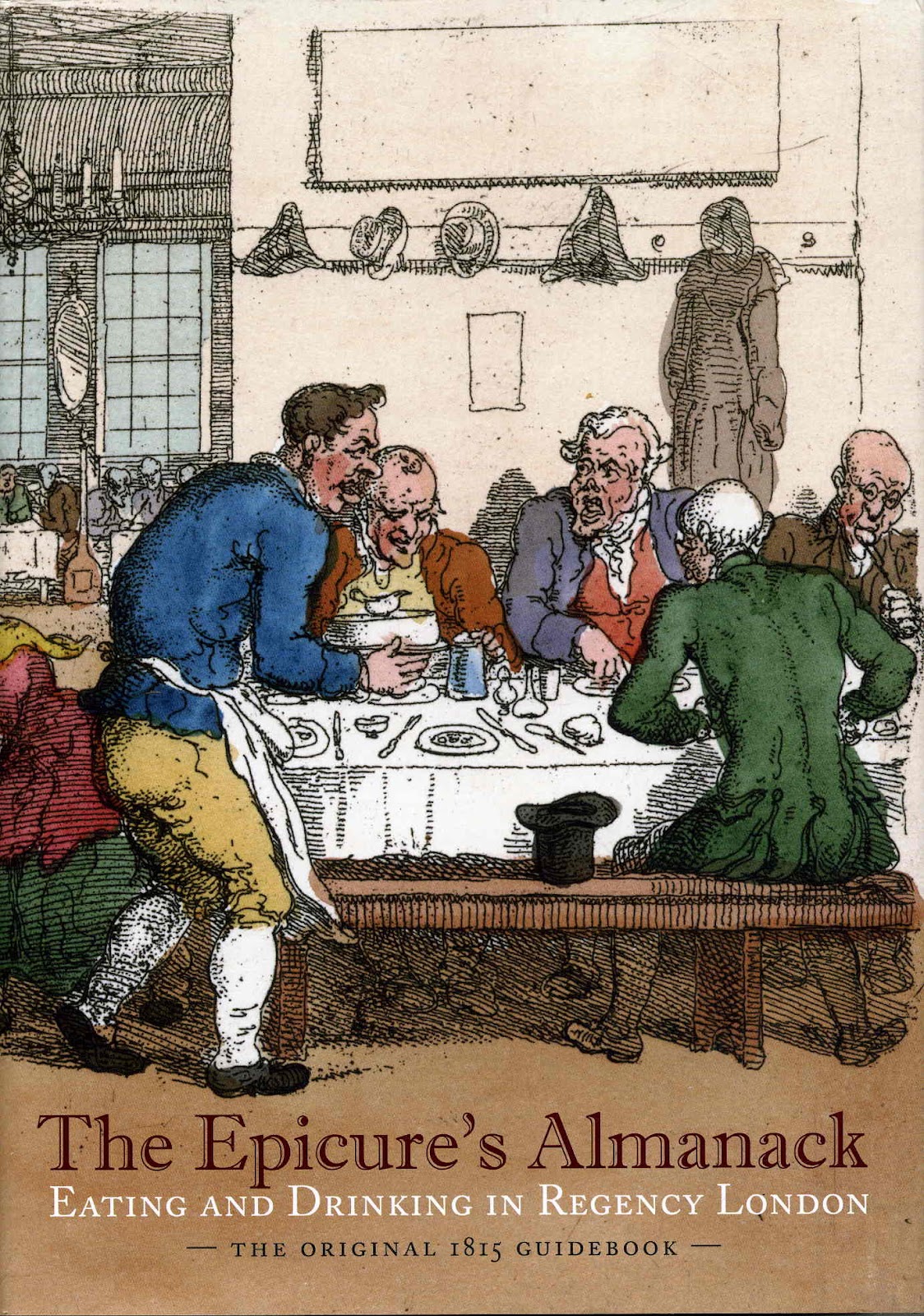
the Epicure’s Almanack by Ralph Rylance, edited by Janet Freeman (2013)

The foregoing is found in the conclusion of this remarkable historical document, the “first London good food guide.” It is a description of the Regency Christmas table, and is contained in the December appendix.  Rylance noted in his 1815 guidebook that various meats and specialties, including “mince-pye,” are presented on fashionable tables during the holiday. They were also distributed to those who were dependents, like servants and tenants, and to the poor.

The result was that nearly everyone shared the same “established national dishes” at Christmas. Many might not have been accustomed to such rich fare, and thus the author noted that particular care had to be taken to aid the digestion. Rylance refers to ripe port and mellow October–thanks to the editor for defining the latter as a “strong ale typically brewed in October.”

At the end of the year, in anticipation of the Season, larger shipments than normal of bulk food would be sent to the London markets. Rylance makes special reference to brawn from Canterbury and parts around Oxford, and he did not mean good-looking, muscular men:

“..manufactured from the flesh of large boars, which are suffered to live in a half wild state, and when put up to fatten, are strapped and belted tight round the principal parts of the case, in order that their flesh may become dense and brawny.”

Good God!

Today’s Christmas brawn served in the UK–with pig’s head, trotters, herbs and spices. From http://ow.ly/1cXT30he5AU

By the time of the Regency, horticulturists had developed facilities, called forcing-houses, to supply the metropolis with fresh vegetables in mid-winter. Fresh spring vegetables were grown under frames and transported to the markets stands of Covent Garden, where they would join potatoes, turnips, carrots and onions  brought out of storage.

Thus, the Regency Christmas table was able to enjoy “forced small sallads,” asparagus and green-peas, the latter:

“welcomed with more general satisfaction than any other vegetable that comes to the table. “

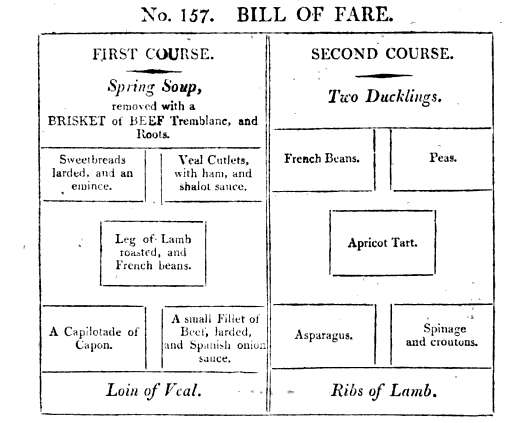
One could enjoy them cold, as in a salad.* Or, as noted in “A Complete System of Cookery,” they make a fine addition to the second course of dinner. The recipe is simple–cook in boiling water with a little salt and sugar. The peas can be served separately or poured over the top of stewed meat, such as duckling.

From: A Complete System of Cookery: On a Plan Entirely New; Consisting of Every Thing Requisite for Cooks to Know in Their Departments … by John Simpson (1813)

*note: the author’s father detested that dish generally contributed by little old ladies to Christmas pot-luck suppers–the pea salad.

The Lord be Thanket!

The following is my translation of the Selkirk Grace:

“Some Folks have meat and cannot eat,  and some have meat that want it;

But we have meat and we can eat, and so the Lord be thankit!”

Many other forms exist, from the picturesque Scots to Gaelic.

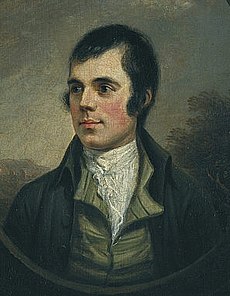
   Robert Burns — voted greatest Scot

The Grace has long been attributed to Robert Burns, the Scottish herald of the Romantic movement. Burns was a popular guest among the nobility, who were charmed by his command of the rustic tongue and his ability to entertain with stories and song.

He was a guest at the Earl of Selkirk’s country seat in the Isle of St. Mary’s, when he paid this tribute, off the cuff as it were, before dining at Lord Daer’s table, son of the 4th Earl.


There is some dispute about the authorship of the prayer.  One Robert Chambers*, relying upon an unnamed correspondent, alleges the Grace was said by Covenanters in the south-west of Scotland in the seventeenth century, where it was apparently known as the Galloway Grace.

Doubtful it would be remembered today had it not been taken up by the Ploughman’s Poet.

“I didn’t understand a word of that!”

Happy Thanksgiving!

*see Select Writings of Robert Chambers, Volume VII, (1847)


A Place to Live a Thousand Lives

“In reading, attention is also to be paid to the How, as well as to the What.”

— The Brief Remarker on the Ways of Man, etc.. by Ezra Sampson (1823)

By the nineteenth century, reading as a pleasurable pastime was flourishing on both sides of the Atlantic. The author of the above quote viewed this development with ambivalence, lamenting that reading has become so commonly fashionable anyone could read anything and anywhere, even in the toilet(!)

Indeed, as a young reader, I had no specific place to read. A monkey swing would do. Or the diving board of a kidney-shaped swimming pool.  Reading was just reading–to be devoured and half-digested and forgotten midway through the next book.

Entering higher education, however, the act of reading becomes a necessarily serious business. College libraries are generally constructed to reflect that. An excellent example is the Mary Helen Cochran Library at Sweet Briar College.

Often compared to the Banqueting House at Whitehall,  the Cochran Library bears the legacy of Inigo Jones–Corinthian pilasters, horizontal cornices, and an elegant balustrade.

It was built in 1929, to the design of Ralph Adams Cram (1863-1942), eminent American architect heavily influenced by Regency-era European building design. He is best remembered for his execution of the Gothic Revival in ecclesiastical (NYC’s Cathedral of St. John the Divine) and academic (West Point) buildings.

Cram was also a prolific author–his little horror short story, The Dead Valley, is a gem for Halloween reading.

For the red-brick library and other buildings at the fledgling college for women, Cram chose Georgian Revival, reflecting what was traditional and architecturally pleasing in the Virginia Piedmont.

Cram’s little gem is now on the National Register of Historic Places and is featured in a Library Journal walking tour as well as the American Libraries Library Design Showcase.

There are two spaces in the Cochran which are devoted to reading. The first is the Reading Room, a soaring space flanked by dark wood bookcases, illuminated by light streaming in through the Palladian windows high above. The ceiling is quite fine, its plaster-work sporting ribbon, fruit and flowers.

The Reading Room in 1935. It is essentially unchanged.

Just beyond the Reading Room is the place where I first discovered the pleasure of having a specific place to read–where the how of reading began to influence what I was reading. Paneled in dark cypress, the Browsing Room resembles the private library of an Edwardian country estate, with a fireplace that only needs a Clumber spaniel sleeping before it, the mantel carrying the portrait of donor’s mother for whom the library is named.  The bookshelves are beautifully carved with a deep red color backing in Pompeiian red. They are custom made for the room.

Over seventy years later, the Browsing Room is unchanged (the portrait removed to protect it from nearby renovations).

In 1935, the Browsing Room was presided over by the portrait of Mary Cochran.


It is a space that is permanent–the best in the world “for living a thousand lives,” to quote author George R. R. Martin.

Since college days, I’ve had many places to read, and they all resemble the Browsing Room in one way or another. My reading spaces are sanctuaries, steady, serene and immovable, even as my reading tastes have changed from time to time.

Sweet Briar College, as seen from the gate leading from Daisy’s grave. Thanks to the valiant efforts of alumnae, the gates of this institution dedicated to the liberal education of women will remain open, and one hopes permanently.

I was recently asked what my dream reading space would look like and was introduced to Arhaus.com. I’ve got my eye on their Portsmouth settee and they have many other unique living room pieces great for a personal library.


The Regency’s Haunted Attraction

Full many a traveller oft hath sigh’d,
And pensive wept the Countess’ fall,
As wand’ring onward they’ve espied
The haunted towers of Cumnor Hall.

— Cumnor Hall (the Ballad of) by William Julius Mickle, (1784)

Cumnor Place, sometimes called Hall, was at one time the abbot’s residence at the monastery of Abingdon. Amy Robsart died there in 1560, falling down stairs while the servants were away. Tudor enthusiasts know her as the first wife of Robert Dudley, courtier of Elizabeth I.

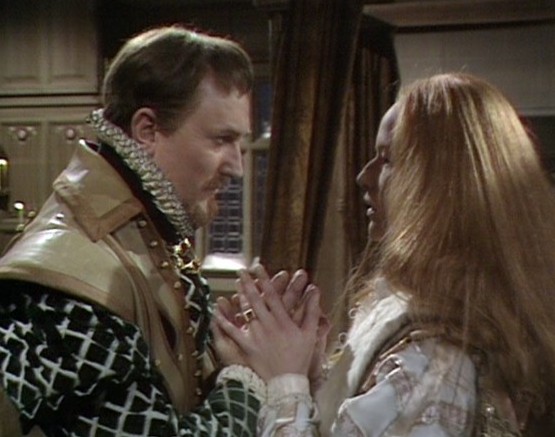
Although an extensive inquiry cleared “sweet Robin” of the crime, suspicion remained, as Amy’s death had occurred so very opportunely for a man who made no secret of his desire to wed the queen. As an aside, 1971’s Elizabeth R is my very favorite portrayal of the Queen and her times. Leicester was played by Robert Hardy, a marvelous actor who passed away just this last August.


“Oh, I burn!”

For centuries afterwards, the village of Cumnor and its Hall remained obscure, excepting the aforementioned ballad by Mickle, which came to the notice of that poet’s fellow Scotsman, Sir Walter Scott. He was inspired to write a historical novel–a collection of fanciful events culminating in Lady Dudley’s death at the hands of Lord Dudley’s evil steward.

Assisting in this endeavor was the wife of the Reverend Dr. Thomas Hughes, Rector of nearby Uffington. She was a bustling sort who was only too delighted to gather local lore for his research, whether it be helpful or not.

“My dear Mrs. Hughes, a thousand thanks for all your kindness about Kenilworth..Cumnor Hall, & other particulars. I am not sure how far they may be all useful..”

— Letters and Recollections of Sir Walter Scott, by Mrs. Mary Ann Watts Hughes and collected by W. H. Hughes (1904)

Undoubtedly it was these very particulars which made Kenilworth an enormous success in 1821, when it was first published.

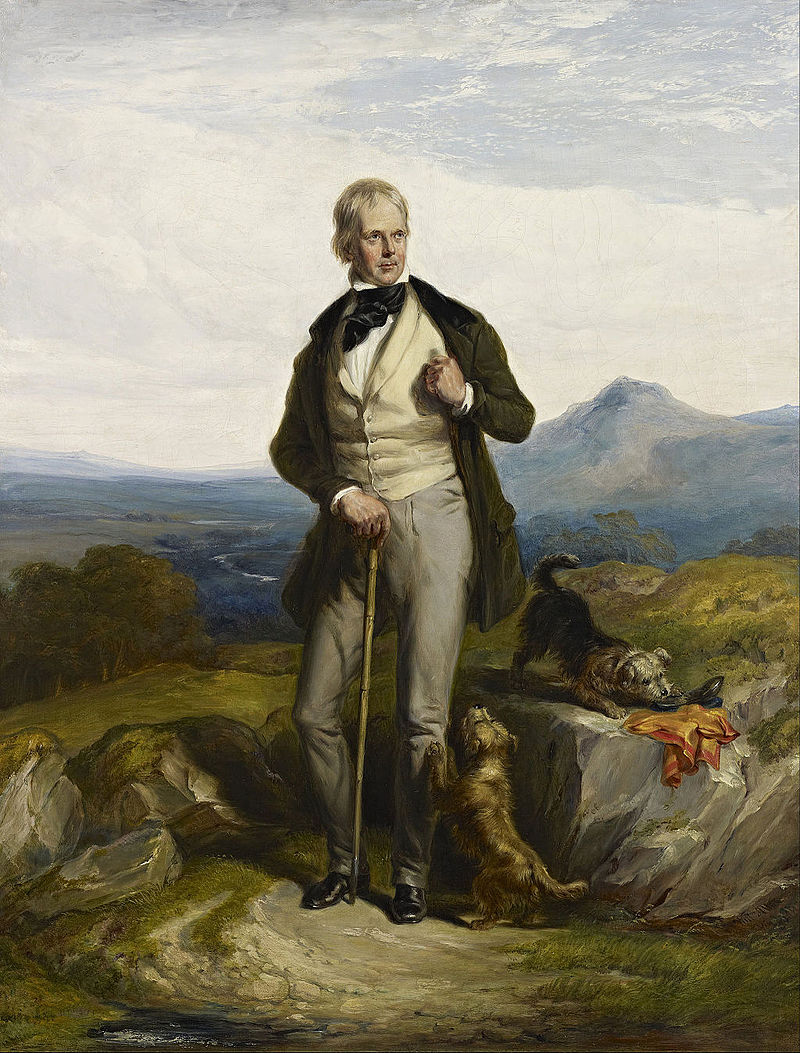
The Wizard of the North — Sir Walter Scott by Sir William Allan.

So stirring was the novel that many travelled to Cumnor to see the hall and its environs where Kenilworth’s tragic events took place, convinced the whole must be haunted. The fact that the old hall had already been demolished by the Earl of Abingdon, Montagu Bertie, caused much dissatisfaction all ’round.

“The disappointment was felt by everybody, for it was said that all the world had hastened to the site of the tragedy so graphically described by Scott, only to find they were too late(!)”

— The Antiquary: A Magazine Devoted to the Study of the Past, edited by E. Walford and G. L. Apperson (1889)

Lord Abingdon came face to face with his iniquity when he reportedly drove guests from his country estate in Wytham over to Cumnor to see the ruins, apparently having forgotten he’d pulled down the main walls years before.  Mrs. Hughes reported to Scott that his lordship was so ashamed and filled with regret, he was very ready to “hang himself for flinging away” what all the Regency was clamoring to see.

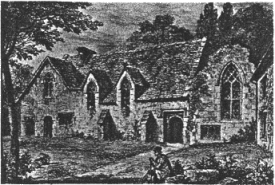
Cumnor Place, before demolition. Parts of it were incorporated in the reconstruction of Wytham Church

Enterprising persons soon turned the sleepy village of Cumnor into the Regency’s most popular haunted attraction. The vicar, who had knowledge of the hall prior to its destruction, collected fees for pointing out the location of the treacherous stairs and conducting tours of the rubble. The proprietor of the Red Lion changed the name of his establishment to the Black Bear, the name of the inn in the novel. Villagers recounted the exorcism of Lady Dudley’s ghost in the previous century, insisting she was “laid down” in the village pond by no less than nine parsons, with the consequence that its waters never froze again.

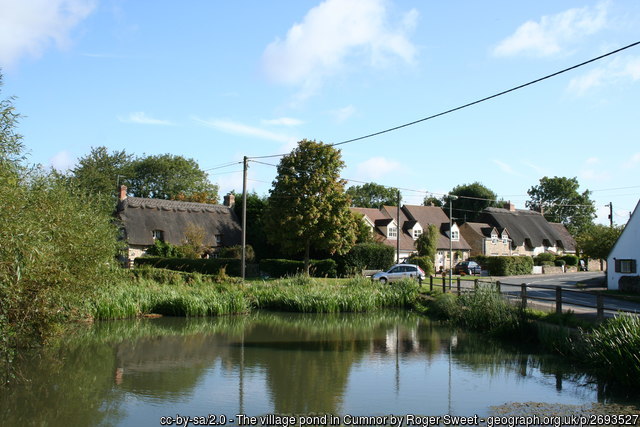
Cumnor pond today–quaint and serene

Scott, now grateful to Mrs. Hughes, wrote to congratulate her on these efforts:

“..I am not the less amused with the hasty dexterity of the good folks of Cumnor and its vicinity getting all their traditionary lore into such order as to meet the taste of the public.”

Historians were not so appreciative and hastened to correct the public’s perception of the matter by conducting inquiries and holding lectures. Some of these worthies condemned Scott and others for “exercising the minds of the vulgar” and fueling a resurgent belief in ghosts.

One indignant antiquarian wrote:

“The narrative is absolutely current in this day; and I have received a drawing of the pond in which the disturbed spirit of the unfortunate lady is said to have at length obtained quiet and repose(!)”

— An Inquiry with Regard to the Particulars Connected with the Death of Amy Robsart (Lady Dudley) at Cumnor Place.. by Thomas Joseph Pettigrew (1859)

Despite these remonstrations, the ghost of Cumnor had become something of a commodity for the place. At least, the expectation was there when a later Lord Abingdon sold Cumnor Place to one Rev. W. E. Scott-Hall. Buyer’s remorse set in when it was discovered there was no ghost anywhere in Cumnor. Scott-Hall sued the earl to rescind the contract of sale since the ghost was missing.

Legal scholars chortled over the implication a ghost should be part of a property conveyance.

“Is a family ghost, like a villein, an incorporeal heriditament? Or is it in the nature of a family heirloom? Can one have seisin of a ghost, and how?”

— The Law Quarterly, Stevens and Sons (1894)

Happy Halloween!

The last Regency Remnant

Today’s post was inspired by a visit to the now-closed St. James Gardens in London, illustrated in the remarkable blog , A London Inheritance.  It is estimated that tens of thousands of bodies are buried in the Gardens–the remnants of those who lived during the flower of the Regency. They are buried under the footpaths and grassy flats which will soon become the busy hub for the Hs2 high-speed train.

The Gardens was originally established in 1788 as a secondary burial ground for St. James Church in Piccadilly. A so-called chapel of ease was built in the churchyard to allow parishioners to attend services there, particularly as the journey to the mother church in Westminster might prove difficult or inconvenient. In 1793, amid expanding urbanization of the St. Pancras area of London, the chapel of St. James became an independent parish church.

The Christie auctioneer family memorial is in the gardens. The National Temperance Hospital in the background is also set to be demolished (if it hasn’t already) to make way for the station.

Strangely enough, one of those interred was Lord George Gordon (1751 – 1793). He had famously converted to Judaism, and one would think a Christian burial was not what he had in mind. Then again, his wishes must have been easy to disregard in the wake of the destruction wrought by his eloquence. One of the houses destroyed in the riots which bore his name belonged to the Lord Chief Justice, William Murray, 1st Earl Mansfield (1705 – 1793), featured in this blog. Rioting was a serious issue during the Regency, for who could have foreseen a crowd being convinced Catholic relief legislation would lead to a renewal of the Inquisition?

Matthew Flinders (1774-1814) is also buried in the Gardens–a captain in His Majesty’s Navy who tradition says christened Australia, is immortalized on countless statues, shilling notes and geographical points, and lives on in the 1940s best seller, Love Must Wait.  During his voyage to the continent that made him famous, Captain Flinders was captured by the French and imprisoned for many years.  Perhaps it was some consolation the Admiralty had refused to permit his new wife to accompany him, else she would have suffered the same fate. In the end,  the joy of reuniting with his childhood sweetheart was tragically cut short, for he died upon returning to England from the illness he contracted during his confinement.

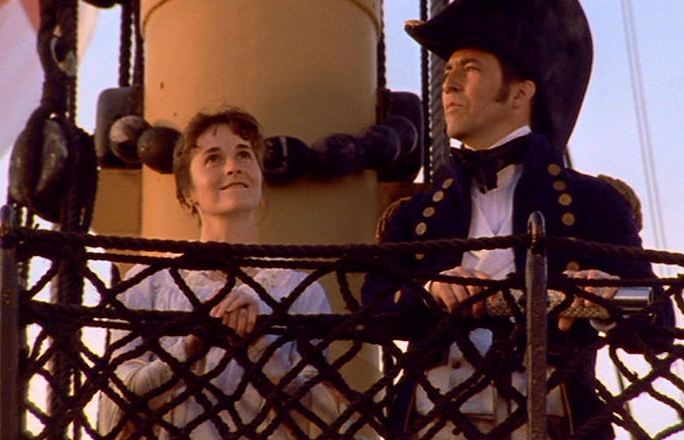
Anne and Captain Wentworth’s happy ending  was denied to Ann and Captain Flinders

The last resting place of an Irish nobleman is also in the Gardens–Laurence Harmon Parsons, 1st Earl of Rosse, (1749 – 1807). As Sir Lawrence Parsons and parliamentarian, he published the book Thoughts on Liberty and Equality. That was in 1793, when pretty much everyone’s thoughts ran along those lines, for the Reign of Terror had just begun across the Channel. The Parsons family was notable for their interest in astronomy and photography, bequeathing their passion to the young son of sixth Earl’s countess–photographer and later Lord Snowden, husband of Princess Margaret.

Lord Snowden and Princess Margaret on a visit with  LBJ and Lady Bird. What a world we live in! (or used to)

By virtue of Burial Act of 1852, which dealt with (literally) overflowing London burial grounds, the St. James cemetery was closed to future interments and made into a garden. In a slow but sure progression of decay, by 1964 only remnants of the Regency existed at the site. Most of the memorials had been removed and the church was demolished. From a BHO description of the chapel, it is interesting to note that the Ten Commandments prominently displayed behind the pulpit had been covered up.

Thou hast outliv’d thy popularity and art become

(unless verse rescue thee awhile) a thing forgotten,

as the foliage of thy youth.

–from The Yardley Oak by William Cowper