Adelaide – Regency Era Fashionista

“And now for the fascinating Adelaide; the epitome of fashion, and the best specimen I can give you of the reigning mode..”

— Letter from a Young Married Lady to her Sister in the Country

La Belle Assemblee, January, 1818

Adelaide is a featured character in the Magazine’s Cabinet of Taste. She is the niece of Lady Charlton, who has, like a kind of “Lady Bountiful,”  taken in her dead sister’s  young “town-bred” daughter.  It helps immensely that Adelaide is an heiress.
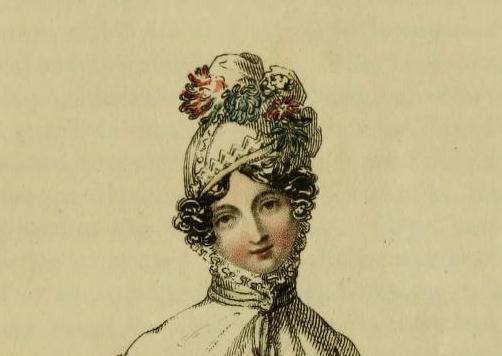
Maria advises her sister that the cornette is in fashion: "It is composed of the finest Mechlin lace and net; it is lined with soft blush-coloured satin, and fastened under the chin with a quilling of fine lace...the hair is entirely concealed, except a few ringlets that are made to sport around the face." -- print from Ackerman's Repository, May 1818

Maria advises her sister that the cornette is in fashion: “It is composed of the finest Mechlin lace and net; it is lined with soft blush-coloured satin, and fastened under the chin with a quilling of fine lace…the hair is entirely concealed, except a few ringlets that are made to sport around the face.” — print from Ackerman’s Repository, May 1818

The letter-writer, Maria, describes her dashing new acquaintance in a series of letters to her sister Lucy. As a fascinated observer, she alternates between admiration of Adelaide’s determined pursuit of fashion and trepidation that the fashionista will  one day come to grief.

Writing from Brighton, Maria describes her first impression of Adelaide:

“Her fine long light hair is plaited, and then wound elegantly around her head; a Cashmere shawl, light as it is rich and superb, is carelessly thrown over her shoulders, which are, nevertheless, seen to be totally bare under the partial Oriental covering; and also, be it known, (and few who are who do not know it) they are as white as ivory.”

She is slim “as a Sylph” and makes such a grand spectacle at the harp without actually playing that one is really quite convinced she is as a good as a professional musician. But it is her pursuit of fashion that quite distinguishes her above all others.

She wears the perfume  Eau de Millefleurs (albeit “excessively so”) and her small, delicate features are usually hidden behind large hats to excite curiosity. At evening balls, her hair is decorated “with all kinds of flowers.”

Her favorite millinery is Magazin de Modes in St. James’ Square. She sends to them every week for new trimmings. These she drapes them in ecstasy over her harp for exacting inspection. Other tradesmen bring the latest articles of fashion on a frequent basis, necessarily purchased without seeing in order that she may be the first of her acquaintance to wear them.

Inevitably, some of the shawls and robes and half-dresses are so disappointing that she becomes blue-devilled. So great is her feeling of provocation that nothing will rouse her from this state—not even the latest piece of “sentimental trash” from the library, which she abuses in her fury by tearing out the third leaf from the book.

“She lays down on a sofa, complains of the headache, and declares she is the most wretched being in the world.”

Voyons (!)–we shall hear more of Adelaide, you can be sure.


Regency Hazards – A Squeeze

People have not done talking of the squeeze at Gloucester House, which was a most exact and daughter-like copy of the Drawing-room, both in numbers and quality.”

Freddy: "Much of a squeeze?" Willis: "No, Sir, we are a little thin of company, the season having begun."

Freddy: “Much of a squeeze?”
Willis: “No, Sir, we are a little thin of company, the season having just begun.”

— Letter from Lady Williams-Wynn to  the Hon. Mrs. Henry Williams-Wynn, May 18, 1818

A squeeze, as you know, is cant for a large number of persons crammed into a space too small to accommodate them.

A Regency hostess’ dream.

Purchased in 1806 by the 2nd Earl Grosvenor, Gloucester House became Grosvenor House, the new London residence of this vastly wealthy family. The squeeze Lady W.W. wrote of took place in the house as it was being enlarged and redecorated.

That evening, guests were ascending the great marble steps to the assembly rooms above, when:

“Mrs. Ross took a faint upon the stair-case, and in order to give her room and air, an Alarm was given that the whole was giving way..”

The panic that ensued was tremendous. Since renovations had been ongoing at the mansion, it must have seemed likely that the structure, including the staircase, had been weakened in some way:

Robert Grosvenor, 1st Marquess of Westminster--he looks good in red, too

Robert Grosvenor, 2nd Earl Grosvenor–he looks good in red, too


“..this sent every body flying, or rather pushing one over the other..”

The Duke of Wellington was also on the stairs when Mrs. Ross fainted.  I suspect she was the lady whom His Grace once called, “my friend Mrs. Ross,” and the wife of one of his officers Colonel (later Sir) Patrick Ross, of the 75th Regiment.

She was usually very obliging. At Wellington’s request, she kept an eye on a colleague’s adventurous son while all were abroad during the Napoleonic Wars.

Friend or otherwise, in the end she caused so much panic that the great Field Marshal was moved to declare:

“..he was never so much frightened in his life, and that it was too bad after all to come here to be taken in by a ‘ruse de guerre’ and that from Mrs. Ross!”


Regency Hazards – Pins

 “A young lady in France had the fatal habit of cleaning her ears with pins; a   trifling humour was the result, which terminated lately in a cancer. The brass and quicksilver used in the preparation of pins may easily account for this circumstance, and which render them so very pernicious to the teeth when used as tooth-picks.”

— La Belle Assemblee, Vols 17-18, Jan-Dec 1818

I shan’t say anything further on the matter. You’ve been warned.

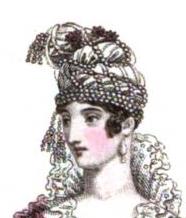
From the same issue of said Magazine--a detail of evening dress with white satin turban and pear-shaped pearl earrings.

From the same issue of said Magazine–a detail of evening dress with white satin turban and pear-shaped pearl earrings.


Regency Hazards – Oxen

Charlotte Grenville (1754-1830), Lady Williams Wynn, amassed a considerable amount of correspondence during the Regency.

In a January 1818 letter to her eldest daughter Fanny, she described the ball she’d given at Wynnstay, the family seat in Wales.

It was better than the best evening to be had at Almacks, despite the lack of Beauty:

“..3 Miss Dods at the Vicarage, Miss Lyster of Toft, & 2 very ugly Miss Allansons..& Emmy Brooke & Miss Parker divided the apple, which is not saying much.”

for there were Beaux aplenty and Lady Harriet, her daughter-in-law, who managed to turn out quite well in her diamonds and wedding gown (!)

There was also Lady W. W.’s good friend, Lord Bradford.

..he found a crooked sixpence against a crooked stile… from a vintage Mother Goose book

Orlando Bridgeman (1762 – 1825) was the first Earl of Bradford and married to Lucy Elizabeth Byng, daughter of the 4th Viscount Torrington. He arrived at Wynnstay ever so congenial since his new daughter-in-law was already pregnant. It was as if the coming baby were “his own.”

Being in such fine feather he admitted he was not opposed to his other son’s proposal of marriage to a Miss Chamberlayne, the daughter to the Consul in Brazil. The match “has nothing to recommend it,” but who could deny a “sailor-son” falling in love “the moment he came into port?”

The best part of Lord Bradford’s presence was the telling of his narrow escape from a ox.

He’d gone tramping the previous month at the Duke of Norfolk’s estate in Welbeck, which led him across fields separated by fences. One such fence had a stepped gate for crossing into the next field. With proper caution so as not to stumble, he felt his way over the stile and descended safely into an oxen pasture. Producing a scented handkerchief from his breast pocket, he proceeded to wipe his hands.

A bull, observing this nicety, became incensed and charged his lordship.

Regency bull

As there was very little about with which to protect himself, Lord Bradford could only escape back the way he’d come. However, scrambling over a stile in haste can be even more dangerous than a charging cow. The alternative was a hay rack nearby. This he grabbed and managed to pull himself up its high rungs, out of the maddened animal’s reach. It was a brief respite, for he fell down into the rack’s manger, there for catching leftovers or, in this case, a lord.

“Fortunately his cries brought assistance, and by the united exertion of six men the Animal was removed. (His lordship) was, of course, dreadfully bruised but not materially, and soon got well.”

Remonstrations were exchanged. To the extreme dissatisfaction of all concerned, the bull’s sudden violence seemed to have no warning or cause until someone thought to apply to a rustic expert for his opinion.

Nothing loth,

“The Cowman readily explained the cause of the misfortune by saying, ‘..the poor Cratur never could ‘boide a Stink(!)’ “


Regency Trolls

In the August 1818 volume of La Belle Assemblee, the Listener, who never revealed his true identity, nevertheless admits:

“I have ever regarded the anonymous letter-writer in the same light as I do an assassin who stabs in the dark.”

Nevertheless, he addresses himself almost always to anonymous writers.

English walking dress featured in La Belle Assemblee, October 1818: "Garter purple poplin pelisse, ornamented with black velvet. Mary Scot bonnet and Waterloo half boots.

English walking dress featured in La Belle Assemblee, October 1818: “Garter purple poplin pelisse, ornamented with black velvet. Mary Scot bonnet and Waterloo half boots.

These supplicants, he explains, are very different. They cringe from identifying themselves because of the trouble they find themselves in. They:

“..are a far more different temperament from those miserable beings to whom I allude. They write to me for advice, they lash, in a good-humoured way…”

What of  those  critics who adopted obvious pseudonyms in Regency-era literary reviews? The Leopard and the Scorpion, for instance, who’ve been subjects of this blog in the past?

They were assassins, too, but they stabbed in broad daylight.

No, it is the anonymous writer who deliberately seeks out publicity with the sole  intent to wound that the Listener despises. This malcontent “vents his spleen” and “pours forth her venom” in order to make mischief and sow discord.

“Anonymous” in this regard criticizes an artist’s character (rather than his work) , wrecks marriages, breaks up romantic engagements and sets children against their parents.

The signature of this troll, whether it be Incognito or Ivan the Terrible, is a “dirty mantle.”

“Beware my sting, I inflict it unseen; for Cowardice and Malignancy are my parents; and Envy my instructress and nurse!”


The Regency Hostess

“Tell me your company, and I will tell you who you are.” — old proverb

Many times this blog has addressed that fascinating character of Regency society–the hostess. She may be one of the ‘best women in the world,’ or from hell. She might be cold as her unheated country house in winter, an accommodating peeress in her own right, an Irish nobody, or a royal eccentric.

The Regency confessor heard from one Hypolotis, who wrote of his experience with a particular hostess who turned out to be quite cunning.

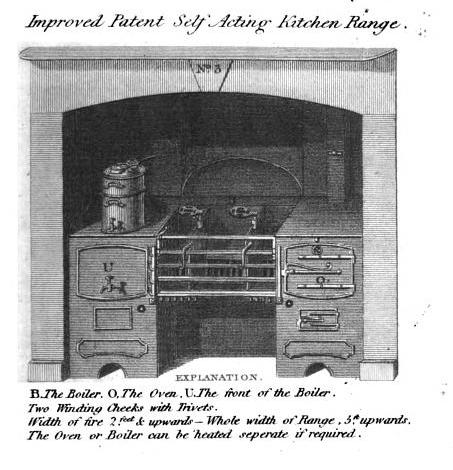
New Self-Acting Kitchen Range -- La Belle Assemblee, August, 1818 "To every family, more especially for Large Establishments, a constant supply of pure hot Water and Steam, must be a valuable acquisition"

La Belle Assemblee, July, 1818 “To every family, more especially for Large Establishments, a constant supply of pure hot Water and Steam, must be a valuable acquisition” — no Regency hostess would be without one!


The correspondent’s story begins after a brief accounting of his travels, in which he asserts his congeniality:

“My character is naturally frank and open, and this procures me the friendship of all classes.”

— “Acquaintances,” by the Listener in La Belle Assemblee, July, 1816

In Green Park, he gains admirers among the children when he bestows upon them “balls, tops or cakes.” At the theatre, he is complimented by gentlemen on the “fineness of his linen and the elegant cut of his clothes, and in particular, the lustre of the brilliant on his finger.”

Acquaintances among the latter he tended to form rather easily, he relates, and on one occasion a “man of fashion” hailed him outside of St. James’ Coffee-house. Upon being asked of his plans for the evening, Hypolotis disclosed he’s been invited to an exclusive faro party in Hanover Square. With surprising presumption, the newcomer begged to be included.

Of course, one’s companion might be welcome to a party, but  Hypolotis scarcely knew this fellow. If it were up to him, he’d not deny the request, but he must think of his hostess, for Society jealously guarded the boundaries of her circle. Suitable birth and fortune were just as important in Hanover Square as they were in St. James’.

“What signifies that?” his odious, pushing companion retorted. “Surely one man of fashion may introduce another.”

In the end, congeniality won over good sense and both presented themselves at the faro-party that evening. Their hostess, whose name the correspondent sensibly abbreviates to Mrs. R., admitted both very graciously so that the two men proceeded to play faro and “gallantly” lose to “fair adversaries”–mingling as “two charming young men of fashion and of the most elegant manners.”

However, once separated from his companion, Hypolotis was confronted by Mrs. R’s whisper, desiring that he repeat the name of his particular friend.

“His name?” He is, I assure you, a man of fashion and fortune, and of very good family.”

“But what is his name?”

“(Er) Edmonds.”

Alerted to Hypolotis’ awkward response, she set about unveiling the true identity of the interloper in her ballroom. Moments later, her footman announced that a message was awaiting “Mr. Edmonds” and would he please step into the foyer?

No one came.

Mrs. R. bided her time until her company gathered to leave, when she quietly reprimanded Hypolotis for playing such a trick on her. His friend was no more Mr. Edmonds than she was. Showing even more cunning and discretion, she advised him to find out who his friend really is. If he’s “of family,” she would be happy to host them both again.

Hypolotis did as she requested. To his relief, his rude and inconsiderate acquaintance actually ranked very high in polite society. However,

“… had he been deficient in the former qualifications I could never have shown my face again amongst those who I am continually accustomed to meet in the elegant circles of my honourable female friend.”


The Regency Traveller

Another cautionary tale shared by the Listener at La Belle Assemblee, lamenting the fashion during the Regency of travelling abroad:

“Engaged in a continual tumult, he calls that living which is only wandering through the wilderness of existence.”

— La Belle Assemblee, February, 1818

From the October 1818 edition, La Belle Assemblee, we have the Parisian promenade dress made of cambric muslin and trimmed in muslin medallion puffs which are separated by rich embroidery, topped by a bonnet of white crape trimmed with blond and purple poppies on the side

From the October 1818 edition, La Belle Assemblee, we have the Parisian promenade dress made of cambric muslin and trimmed in muslin medallion puffs which are separated by rich embroidery, topped by a bonnet of white crape trimmed with blond and purple poppies on the side

The writer, simply named Alfred, relates that travel used to be extremely arduous, even dangerous, and undertaken only in matters of urgent business, like claiming an inheritance or filing a lawsuit.

The traveller would be male, well-matured and careful to put his affairs in order before setting out, even if it meant updating his will.

His departure was attended with tears and ardent prayers for his safe return.

Nowadays, he writes, travelling is undertaken not so much to accomplish anything, but for pleasure alone:

Irishmen come to England and Englishmen go to Ireland. The natives of Somersetshire come to London, and the Londoners flock to Bath.

It has become common for families to be divided by great distance, and, more sadly, by time, spanning as much as thirty years. The traveller nevertheless is content, and eventually forgets “his dearest friends and brethren.”

Still, he cannot escape the dissatisfaction of a prodigal son, finding few he can call truly friend and surrounded by “men who seek to deceive us, and women who beguile us.”

Truly unfortunate is the one who realizes, when he finally returns home, that Death has taken the place of the one–

“..whom he had ardently desired to have embraced once more, or to have had the pious gratification of catching their last sigh, and closing those eyes that were shut forever from the light of day!


On Regency Wealth

Not limited to the role of confessor, the Listener (whose real name, it should be repeated, is Timothy Hearwell) heard cautionary tales of advice to Regency-era readers.

The following letter he received from “Prosper” on the “vexations attendant on wealth:”

From the October 1818 issue of the Magazine--a round dress of fine cambric with muslin flounces richly embroidered in Clarence blue.  A Clarence bonnet trimmed with larkspur flowers and a Clarence spencer besides, with lapels of white satin.

From the October 1818 issue of the Magazine–a round half-dress of fine cambric with muslin flounces richly embroidered in Clarence blue. A Clarence bonnet trimmed with larkspur flowers and a Clarence spencer besides, with lapels of white satin.

“..after having ardently desired riches and honour, I am almost tempted to curse the chance that led to them.”

— La Belle Assemblee, January, 1818

What follows is a detailed explanation on the bother and mind-numbing exhaustion that comes from being wealthy in the Regency, particularly when one is not accustomed it.

For instance, one rolls about town in an elegant carriage, foregoing the exercise of walking that had been of such benefit to the constitution. At home, the valet (or one’s “gentleman” as the out-and-outers say ) will hardly allow a man to take off his own shirt. In his study, the secretary commandeers his signature and the steward his accounts.

There’s nothing to do, Prosper complains, but loll on the couch “in the fashionable half-daylight that illumines my apartment, injures my sight and makes me gloomy.”

And yet having cast him into sloth, wealth keeps busy, attracting the noble and the notable. They come for a visit, to gape at his “opulence,” and still others come for a four-course dinner at his board, dishing out “fulsome flattery” on the food served, the plate and even the candles themselves.

Efforts to find some enlivening companionship away from home are met with disappointment. Having been assured that all one needs is “good company,” Prosper fixes his attention upon a lady who has been recommended to him because she dresses well and “has written a stupid romance.”

Once they are at the Opera, he comes to regret their association,

“According to her ideas I should be like a fellow just come from the country if I listen to the performance..if I elevate my eye-glass to look at the actresses, I have vile taste.”

Prosper sighs, longing for the comfort of a few key friends and the two-shilling gallery at the Cock-Pit or Covent Garden.


Regency Confessor: Rusticus Returns (part two)

The report on Rusticus’ return to Regency Society continued upon his arrival at the second party to which he’d been invited. This was a celebration of a young matron’s birthday, and invitees were obliged to offer natal congratulations in the form of a literary device.

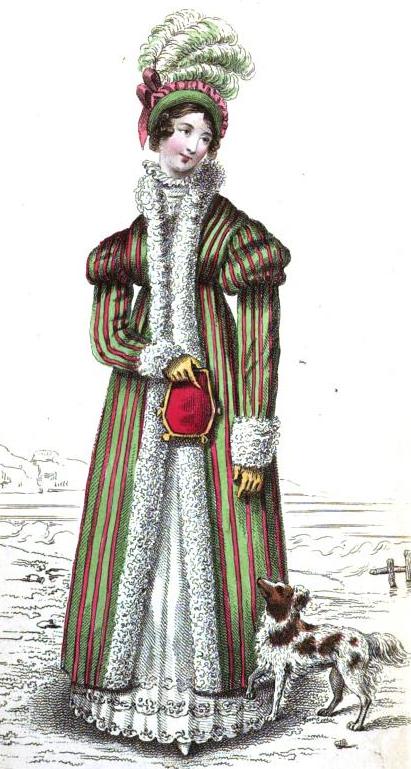
The English Winter Carriage Costume, from the Magazine's March 1818 edition: "round dress of fine cambric muslin, superbly embroidered round the border in three distinct rows. Pelisse of rich Tobine silk striped, of Christmas holly-berry colour, and bright grass green, trimmed round collar, cuffs and down the front with very broad swansdown."

The English Winter Carriage Costume, from the Magazine’s March 1818 edition: “round dress of fine cambric muslin, superbly embroidered round the border in three distinct rows. Pelisse of rich Tobine silk striped, of Christmas holly-berry colour, and bright grass green, trimmed round collar, cuffs and down the front with very broad swansdown.”

One of those in attendance was a celebrated poet, but ostensibly complaining of the head-ache, his offering only served to confirm (in the opinion of our hero) that the poor man might indeed be suffering from “a disorder in his brain.”

Emboldened by his fellow party-goer’s failing, Rusticus eagerly offered his own ditty, which was based upon a polonaise taken from the comic opera The Cabinet, popular at the time. Despite careful preparation of the selection:

“There were three verses; and I declare I knew not of one indecorous word or meaning they contained; but such is the delicacy of modern ears, and the quickness of modern conceptions, that at the first verse the ladies blushed up to their eyes, at the second the mammas began to shrug their shoulders and find their seats uneasy, and at the third there was not a papa but what turned his back upon me.”

— from the Listener’s “A Second Letter from Rusticus,” La Belle Assemblee, November 1816

Somehow, he’d made a mull of it.

Better received at the party was a singular young lady who’d been implored to Catalanize to the company–that is, to sing in the style of the great opera singer of the time, Madame Catalani. Apparently, opera wasn’t objectionable to the company, just the person who performed it.

Rusticus, still smarting from being rebuffed, acidly noted:

“..the cruel virtuoso deprived us of the pleasure of hearing any more than two or three notes…(it seems) a young person is not to learn to sing to be called upon every occasion; formerly, when they had only one singing master, they were more obliging; now they have ten music-masters, and never sing when they are first asked.”

Presently a waltz played and Rusticus was determined to dance. He chose a lady who demonstrated some skill, but instead of becoming her dance partner, he became her “victim,” managing to bump into every other couple in the room and knock over a group of spectators standing by, which led him to become “totally disconcerted.”

By now it was two in the morning. Taking an embarrassed leave from the birthday party, Rusticus went to a faro-party being given by an older female relative. Unfortunately, he arrived only in time to discover a “German Baron” had made off with all the winnings, which put all the ladies sadly out of countenance. Too late to retreat, Rusticus found himself obliged to escort home one “pretty gambler” who’d lost her last shilling and was consequently without a feather to fly. This task was made miserable for two reasons–the lady was in high ill-humor for having lost all her money and the manner of conveyance was another hackney carriage, just as wretchedly slow as the last one.

“Now what have I gained by my journey to town but fatigue and crosses? Ah! my dear friend, say no more against the comforts of my dear fire-side in the country, where I can enjoy my Homer and my Plutarch without molestation.”

Wasn’t it Homer who said, “it is equally offensive to speed a guest who would like to stay and to detain one who is anxious to leave..”?

London need not weep for Rusticus.

Regency Confessor: Rusticus Returns (Part One)

Rusticus, that erstwhile town buck now turned country gentleman, obliged the Listener (and his readers) and returned to London, for the purpose of recording what it is like to re-enter Society. This he did, detailing a progression of experiences during one night on the town which tended to arouse discomfort in others and disgust in himself.

Self-conscious of the figure he would cut, Rusticus began his preparations at 3 o’clock in the afternoon. It was a good thing, too, that he began these early, as he encountered considerable difficulties making his person presentable.

Summer recess ball dress: frock of white crape, Venetian gauze, richly embellished at the border with small double Indian roses of a beautiful pink colour, and mingled with leaves of crape and pearls...the headdress consists of a double wreath of Indian roses...white satin shoes and white kid gloves.

Summer recess ball dress: frock of white crape, Venetian gauze, richly embellished at the border with small double Indian roses of a beautiful pink colour, and mingled with leaves of crape and pearls…the headdress consists of a double wreath of Indian roses…white satin shoes and white kid gloves.

For instance, his hairdresser took entirely too long to “turn” the curls on the top of his head,  by reason that his hair had become “as straight as a candle and stubborn as the bristles on a hog’s back.”

Meanwhile, articles of the latest in London fashion had arrived. From the great English bootmaker Hoby–six pairs of dress shoes, none of which fitted very well. Indeed, “the pair I kept were so short and tight round the heel that they took my skin off.” His tailor fared no better, and our returning hero was obliged to wear an overly large pair of cream Kerseymere short clothes, “for the fear of the consequences of having (the black satin ones) too tight.” It was not until 5 o’clock that his brand-new shirts, “frilled in the finest French cambric,” returned from the laundress, imperfectly pleated and still damp to the touch.

In retrospect, it would have been a good thing had he ordered the carriage early as well. The hackney coach Rusticus hired to take him to the first of three parties to which he’d been invited had only to cross the square and navigate two short streets. Still, it took the coachman such a long time to get there that it seemed he must have expected to be paid by the hour. The consequences of this dilatory progress made Rusticus late to dinner, a circumstance that was thoroughly embarrassing:

“..the servants looked very angry at seeing me arrive so late; I was desirous of taking my seat without deranging anyone, but I deranged every body.” — La Belle Assemblee, July 1816

Between his teeth, the butler said something naughty as he admitted Mr. Rusticus to the dining room and the diner at the foot of the table made plain his displeasure at the door opening against his chair. Moreover, a “handsome Viscount” was furious that his witty observation to a lady had been interrupted:

“..he was on the right of the lady and I was placed on her left, and she very obligingly half turned her back on me all dinner time.”

Rescue came in the form of that consummate artist of Good Taste and Sense–the Regency hostess:

“..she is one of the best women in the world, and she continually addressed to me that kind and polite conversation which could not fail to console me in the midst of tortures.”

Torture indeed, for the night was only just beginning!