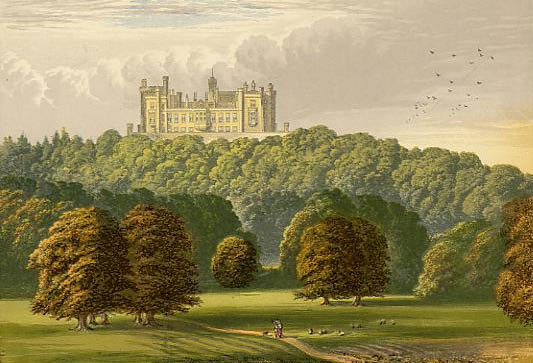
The Smock-Race of a Regency Easter

“Some years ago I saw a female race’;

the prize, a shift–a Holland shift, I ween:

Ten Damsels, nearly all in naked grace,

Rush’d for the precious Prize along the Green.

— The Works of Peter Pindar, 1812

It’s almost Easter and Popular Pastimes (1816) advises one can readily find a smock-race in “country places” this time of the year.

Word Wenches has an excellent description of the custom here. This post is a little like adding some color to the custom.

The smock race was merely one of several spectacles at spring festivals and fairs. James Birchall (England Under the Revolution and the House of Hanover 1688 to 1820, 1876) relates that smock races were held in Pall Mall through the eighteenth century, along with other amusements like “prize fights, bull-baiting and the Cock-pit, and (goodness me!) an execution at Tyburn.”

I suspect that spring, for a country lass, was not only an excellent time to acquire a new frock, it was imperative. The weather was warming, making one’s winter smock sadly out of fashion as well as unsuitable for the changing season’s temperature. The condition of last year’s summer smock, by virtue of the fact it saw a great deal more outside activity than winter’s raiment, was beyond help, being hopelessly stained and mended many times over.

Not every female had the luxury of heedless excursions in the rain. The want of sense. A surfeit of sensibility.

Easter was a holiday (along with Whitsun and Ascension Day) which provided time off from one’s labor to see about the getting of a new smock. The smock race coincided with such holidays–by design, no doubt.

The smock race featured a well-made prize. The smock (or chemise) was generally executed from fine Holland cloth, which may have been more practical than fine India muslin, but for me has the melancholy connection with the shutting up of houses and retrenching. So it was brightened up with ribbons and special poppy-colored bows attached to the frock, called coquelicot.

Darling Anne Elliot was not unacquainted with Holland cloth and retrenchment.

Hoisted on a standard for display,  the smock lured young females to indulge in unladylike pursuits, like running full-tilt in full view of interested onlookers. There seemed to be no lack of participants, so the garment must have been a seductive prize, indeed.

The custom acquired a notorious reputation when some races required competitive attire to be limited to an, er, smock.

The circumstances of feminine rustics being made to entertain was alternately celebrated and deplored. Favorable reviews came from those spectators that were generally squires, apprentices and sporting dandies in search of amusement. They brushed aside any disapproval, insisting the whole affair was a “very pretty and merry sight.”

Good for the lungs, what–what?

The remarkable painter George Morland, to whom we owe a great debt in the rendering of rural Georgian England, might have given us a good deal more to see of the period, but for his frequent habit of taking

“..a ride into the country to a smock-race or a grinning-match (!), a jolly dinner and a drinking-bout after it; a mad scamper home with a flounce into the mud.” — The New Wonderful Museum and Extraordinary Magazine (1805)
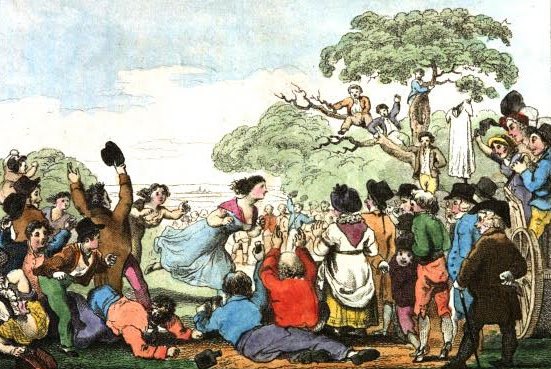
 

The specter of a mock-race called to mind licentiousness. It was ill-bred to indulge in it, both as a participant and observer. The lower classes were free to entertain themselves in such a manner, for that was the condition to which they were born to. For the upper classes, the smock race provided an excellent vehicle by which to pass judgment on others.

Consider, for a moment, a miss just arriving at church red-faced and wind-blown. Her appearance alone brings censure. Sitting down in the pew, she cannot but help overhear whispers behind her. The derision is almost palpable, the hushed tones impossible to ignore, speculating out loud that perhaps she looked that way because she’d just run a smock-race.

Happy Easter!
The Regency Maid-Servant – Part two

Continuing the Regency maid-servant’s “sketch of character,” we find she must suffer irritations all day, and without complaint.

In 2001’s Gosford Park, Lady Sylvia McCordle is the mistress of a great country house. The head house maid is Elsie. One evening, while entertaining a host of guests, her ladyship finds the temerity to interrupt dinnertime in the servants’ hall to inquire about a vegetarian meal for a tiresome American guest.

Cook pointedly turns her back on her. The housekeeper then assists, receiving a wealth of thanks and relief.

Elsie is an Edwardian-era maid-servant. But for purposes of illustration, she is timeless.

Elsie is an Edwardian-era maid-servant. But for purposes of illustration, she is timeless.

For the maid, there is no such luxury of ignoring a request nor expecting thanks for fulfilling it. She must obey the summons, whenever they come, even to the point of interrupting her meal. How she handles these annoyances without complaint, suppressing the very human reaction of irritation, makes her a far more interesting character than Cook, and even the housekeeper. Her position in the “down-stairs” hierarchy affords her no cushion.

She can’t always be successful, however, and:

“..she gets into little heats when a stranger is over saucy, or when she is told not to go down stairs so heavily, or when some unthinking person goes up her stairs with dirty shoes..”

— La Belle Assemblée; or, Bell’s court and fashionable … N.S. 15-16 (1817).

gosford-park-dancing

“..if there is a ball given that night, they throw open all the doors, and make use of the music up the stairs to dance by.

There are distractions. One of these might be a fellow servant singing a new song. If in town, she might espy a neighboring house’s maid through an open window, and enjoy an impromptu chat. Even better, a troop of soldiers might be going by.

And after the day’s work is done, and dinner is finished, interrupted or not, there is a bit of a candid discussion of the day’s events with the others in service, without regard to hierarchy. Surprisingly, she might play a game called hot cockles, which obliges her to kneel, blindfolded, her head on the lap of another, her hand palm-up on her back, all to guess the identity of whoever walks by and smacks it.

How others treat the Regency maid-servant is even more instructive. Tradesmen stop in at all times of the day, delivering their goods to the house. “Come, pretty maids,” says the milkman, followed by the butcher, the baker and the–well, you know the drill:

“…all with their several smirks and little loiterings.”

And if she is dispatched to pick up a bit of butter, the grocer makes a big deal out of it:

“For her, the cheese-monger weighs his butter with half a glance, cherishes it round about with his patties, and dabs the little piece on it to make up, with a graceful jerk.”

Along with the sailor and the schoolboy, we are told, the maid-servant is “a creature of sheer enjoyment,” and relishes the holiday more than “the rest of the world.” If in London, she’ll have been to Vauxhall, and the Tower with its beasties, and viewed all the tragedies at the playhouse, for they are far more to her liking than comedies.

If country-bred, the fair is her favorite, for it is there she can truly forget her place in the world, and be treated much as they are up-stairs.

“Here she is invited in by courteous, well-dressed people as if she were the mistress..(they) call her Ma’am..and says..Be good enough, Sir, to hand the card to the lady.”


The Regency Maid-Servant – Part One

A sketch of the female domestic servant during the Regency period is summed up thus:

“..her own character and condition overcome all sophistications…her shape, fortified by the mop and scrubbing-brush, will make its way; and exercise keeps her healthy and cheerful. Through the same cause her temper is good..”

La Belle Assemblée; or, Bell’s court and fashionable … N.S. 15-16 (1817)

Of course, if the maidservant be “dirty always,” like the nature of her labor, there is little to be interested in. But if the maid is otherwise “snug and neat at all times,” and if she always has a pin to give you, that is something remarkable, and therefore worth examining.

In the “ordinary room,” which is usually the kitchen, the maidservant has a drawer assigned to her. It might be in the great trestle table, or among the zillions of drawers in the large wall-cupboard. Inside it she keeps her thimble, thread-case and a piece of looking glass to check her appearance.

The restored kitchen at Ickworth House in Suffolk and all those drawers

                       The restored kitchen at Ickworth House in Suffolk

In the garret, where she sleeps:

“a good looking-glass on the table; and in the window a Bible, a comb and a piece of soap…and, under lock-and-key, the mighty mystery–the box.

The writer of this character sketch must have once been the child of a family who employed such a maid. Perhaps he or she had been the young master of a great house in the country, or the pampered daughter of a grand Mayfair townhouse.

Only a child could be curious enough to know of the box and be completely obsessed with what it contained.

When it was opened, no doubt after much cajolery, the contents did not disappoint. Inside were the clothes the maid had stood up in upon her arrival at the house, during her interview of employment, to be stored away while she was in uniform. There were also song-books, tragedies costing a half-penny per sheet, little enamel boxes and other fripperies from the local fair, along with correspondence from home, penned in letters without regard to capitalization.

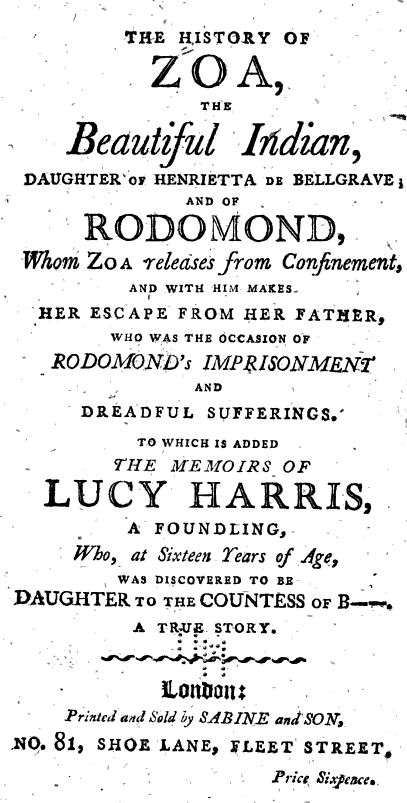
This popular tragedy was published in 1800.

This popular tragedy was published in 1800.

There, too, were coins, fascinating beyond their purchase power. They were evidence of the maid’s excursions beyond the gatehouse or the Mayfair square:

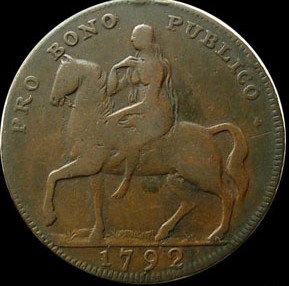
“…pieces of country money, with the Countess of Coventry on one of them riding naked on the horse; a silver penny wrapped up in cotton by itself, and a crooked sixpence.”

the Coventry half-penny

                    the Coventry half-penny

They lay beside the maid’s wages paid in half-crowns, nestled in a purse, the only thing that stood against her and an uncertain future were she to be turned off–without a character.


A Merry Regency Christmas

The poet Robert Southey, in the guise of a Spaniard travelling to England, remarked upon the great number of large sugared plum cakes to be had at Christmas in London. However, he concluded sourly that not much else was celebrated during the holiday.

“This is the only way in which these festivals are celebrated, and if the children had not an interest in keeping them up, even this would be disused.”

— Letters from England by don Manual Alvarez Espriella, Volume 3, By Robert Southey 1803

Twelfth cake-- historicfood.com

Twelfth cake– historicfood.com

The great festival of Christmas had been on the wane in Protestant England for some time, in danger of falling by the wayside like many other religious festivals of the old faith. Still, plenty of merriment went on during the holiday.

Take the battlefield, where a plan to march soldiers to another location to prevent excessive drinking was scarcely successful, for it was only a:

“.. change of scene and not of situation, for they got so drunk Christmas night that the grenadiers set fire to one of their tents…”
–Royal Military Panorama, Or, Officers’ Companion, Volume 3, 1813
 And who could forget the merriment in the Loveden household when a lady’s maid could recall, under oath, the circumstances of her mistress’ improper behavior:
A: “I had reason to know Mr. Barker paid particular attention to Mrs. Loveden, and she always made a Point of Dressing more upon those Occasions when he visited at the House.”
Q: “By Attentions, do you mean improper Attentions, that you thought their Attentions to each other were of an Improper nature?
A:”Yes.”
–Journals of the House of Lords, Volume 48
via the Royal Collection Trust

          via the Royal Collection Trust

Southey could not know that Christmas would soon regain new prominence in the Victorian era when it would take on a many-mantled cloak of new traditions. In the meantime, he and other Regency romantics had to remain content with what Christmas offered then: a moment of reflection, by which the entirety of the year could still be measured:

“From you the play’rs enjoy it and feel it here,
the Merry Christmas and the Happy Year,
There is a good old saying–pray attend it:
As you begin the year, surely you’ll end it.”
–from the Prologue of Cymon, A Dramatic Romance by David Garrick
The London Theatre: A Collection of the Most Celebrated Dramatic (Vol III) by Thomas Dibdin (1815)

A Mild Regency Winter

It is reported that the winter of 1807 in the British Isles was one of the mildest on record, up to that time.

“..the heat of the weather was exactly the same the 24th of June last as the 24th of December; on both those days the thermometer being nearly 60.”

— The Annual Register, or a View of History, Politics, and Literature for the Year 1807


Honeysuckle woodbine

                                    Honeysuckle woodbine

Throughout the land, gardeners were noting how their winter plots were full of flowers in full bloom–carnations, roses, woodbines and violets. A rose in full bloom was found growing in Sir Gabriel Powell’s shrubbery near Swansea. Even in common areas that received desultory treatment at that time of the year one could find:

“…double yellow and double purple primrose, the double purple stock, the purple campanula, the rue-leaved coronilla, ..all in high beauty.”


purple-campanula

                                                 purple campanula

Even the unexpected harvesting of wild plants for the table was remarkable, from two mushrooms in Stoney Knolls, to strawberries and a dish of green peas served to a gentleman in Wellesbourne on Christmas Day (!)

Nature’s animals were also found hard at labor. In Derbyshire, a hedge-sparrow’s nest had four eggs inside it, and in Warwickshire, two eggs were contained in a green linnet’s nest.

green linnet, also known as a greenfinch

     green linnet, also known as a greenfinch

As remarkable as these instances might be, still more confounding is the painstaking notations taken of them, in an age before the most minute recordings of climate change.

Thanksgiving in High Dudgeon

The following are notable complaints from the Regency era about the bounty that we celebrate today, known as  Thanksgiving:

“It is commonly reported that there is no season in the year in which so much wickedness and drunkenness prevail among the farmers, as in that of bringing the harvest home.”

— Cheap (!) Repository for Moral and Religious Tracts, 1810

Indeed, it appears that the juvenile crime of stealing from orchards tended to be more frequent during the harvest period, and particularly on Sundays:

“..for it is always remarked those depredations are committed by them on those days..The other days in the week, when fruit is ripe, boys are generally employed in the field, driving carts, or at harvest.”

— Gentleman’s Magazine and Historical Chronicle (July – December, 1819)

The same edition of the Magazine reports that even a bountiful harvest suffers from the problems of an economy plagued by stagnant labor, for few that have left the fields for manufacturing jobs desire to return:

“..during the last harvest, men could not be obtained in sufficient numbers, in the agricultural counties, to get in the crops as fast as they were ready.”

Things are generally at sixes and sevens during this time of the year, and in particular for one lady in Sunderland who became quite ill. Her stomach behaved as if she had swallowed something that was alive; and later, after two swallows of brandy, she discovered that was indeed the case, for she expelled an animal that had all the appearance of a small dog-fish:

“The patient supposes that this may have resulted from drinking ditch-water in the last harvest; and she still remains ill, under the apprehension that more of the same kind may yet remain in her stomach.”

— The Annual Register, with a View on History, Politics and Literature for the Year 1827

thanksgiving


Leg-Shackled by an Apparition

This post is a temporary departure from our discourse on writs. It is, after all, Halloween!

The following is a tale of a haunted bedroom, and reads a little like a Regency romance:

A young buck of the ton quit London to join a weekend house party in the south of England. His host, an older gentleman and quite worthy, owned a considerable country estate there. By reason of a wedding, the house was completely full of overnight guests, so that only one bedroom was vacant.

It was allegedly haunted.

Up to every rig and row, our hero was not above enjoying an overnight lark with an apparition and readily agreed to sleep in the disturbed room:

“Sir, you will oblige me by letting me lie there; for I have often coveted to be in a place that was haunted.”

Apparitions; or, the Mysteries of Ghosts, Hobgoblins, and Haunted Houses by Joseph Taylor (1815)

That night, the intrepid young man committed himself to sleep, for the room was comfortably furnished and the fire had been generously built up. At three o’clock in the morning he woke, for someone had entered the room. He could not see who it was for his candle was extinguished.

Fortunately, the intruder revived the fire with a poker, the brightening glow revealing the apparition to be a young woman in naught but her shift, She was so pale as to be indistinguishable from a wraith.

It was not until she got into bed with the astonished young man that he perceived the apparition to be flesh and blood. Only the living breathe while asleep. Her hand, which he clasped, was warm.

Finding she had a ring on her finger, he took it off unperceived.

Presently, his fair bed fellow rose and left the room. Clutching the evidence of her visitation in his hand, the young man locked the door against further incursions and went to sleep.

As is the case with country house mysteries, the guests greatly anticipated the outcome of a night spent in a haunted bedroom. Indeed, everyone appeared well before nuncheon so as not to miss the opportunity to find out how the young man, so clearly awake on every suit, had passed the night before.

Before he would gratify their curiosity, however, the bachelor required the females assembled to identify the ring he held up. The daughter of the house very prettily claimed it, declaring she had lost it somehow during the night and had despaired of its recovery.

She was thrown into an even prettier state of confusion when the handsome guest took her by the hand and brought her before the master of the house, her papa, announcing:

“This is the lovely spirit by which your chamber is haunted.”

Amid the company’s good-natured laughter, the worthy host begged his weekend-guest to become a tenant for life, and offered his daughter for marriage, along with a large dowry.

This generous offer was so advantageous to the young gentleman, that he could by no means refuse it; and his late bed-fellow, hearing what her father had said, was easily prevailed upon to accept him as her husband.”

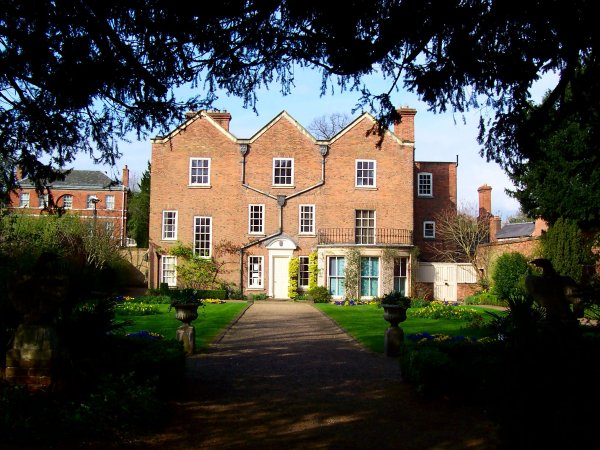
Belgrave Hall - supposedly haunted by a former owner's seven daughters. Photo by Roger Hutchinson via Wikicommons

Belgrave Hall – supposedly haunted by a former owner’s seven daughters.
Photo by Roger Hutchinson via Wikicommons

A Regency Title: by Writ

“..for where an ancient baron, holding a baronial estate, that is, a castle or a manor held of the king ‘in capite per baroniam,’ was summoned to Parliament, his title did not arise by writ of summons, but from his barony, and he became a baron by tenure.”

— A Treatise on the Origin and Nature of Dignities, or Titles of Honor; by William Cruise (1823)

So summed up the Duke of Rutland’s opposition to Lady Henry’s desire to be a baroness. He argued their ancestor, Robert de Ros, was summoned by writ to attend the king as baron by virtue of the lands he held. And because those lands could only pass to heirs male, the title was never meant to be held by a mere female.

There can be no Baroness de Ros.

The attorney general, Sir Arthur Piggot, was the Crown’s representative in the matter. He determined the facts of the case, which were thus:

  • that Robert de Ros indeed held lands of the Crown;
  • that said lands were not mentioned in the writ that summoned him to the Crown’s parliament;
  • that the only mention of any land was the manor de Ros, a property that was not held in capite –that is–of the Crown.

It was for the Committee of Privileges in the House of Lords to decide if Lady Henry’s petition had any merit.  Had she made out a valid claim to the ancient barony by proving it was created by writ alone, and not by tenure of lands?

Arundel Castle, home of "the chief actors in some of the most gloriously memorable scenes of British history."

Arundel Castle, home of “the chief actors in some of the most gloriously memorable scenes of British history.


Her lawyer, Mr. Adam, reasoned that if the Crown had meant to make a baron by virtue of his property, why didn’t the writ summoning him mention them? He acknowledged there were cases of tenured barons who were summoned to parliament without mention of their lands, but these were the exception to the rule, the most famous example being Arundel, an ancient title that passes by virtue of whomever holds the castle of that name.

Just being keeper of the castle does not make one a parliamentarian.  In this, the House of Lords agreed, as Cruise reports:

“..after hearing what had been alleged and proved on the part of the duke of Rutland, the said duke was not entitled to the barony claimed on the part of the coheirs of Robert de Ros.”

Stay! Co-heirs?

Mary Frances Dawson, Countess of Dartrey, 24th Baroness de Ros -- her death led to another abeyance, her issue being only daughters

Mary Frances Dawson, Countess of Dartrey, 24th Baroness de Ros — her death led to another abeyance, as her issue were daughters.

Lady Henry had not won her title just yet. She must contend for it among the other heirs of the last true baron de Ros, her grandfather John, 4th Duke of Rutland. He left two daughters, Lady Frances Willoughby and Lady Bridget Tyrwhitt, as his co-heiresses. Neither has precedence over the other, each sharing equally in what cannot be halved.

The result–the title is in abeyance. Lady Henry and George, Earl of Essex, descended from one daughter and Sir Thomas Windsor Hunloke, the other, all had equal claim to the Barony of Ros.  And no one of them had greater claim than the others.

Enter the Crown, the “fount of all honors.”


A Regency Title: by Tenure

In Norman times, English baronies were granted by charter to nobles holding land of the Crown. As a result of King John’s concessions to the barons, these noblemen also gained the right to advise the monarch, confirmed by writ of summons issued by the Crown. Just as the baron’s lands passed to his descendants, so too did the right to be summoned to Parliament.

A wrinkle in the tradition arose as the Crown began to issue writs of summons to favored subjects who were landless. Although no estates were part of the transaction, the dignity conferred on the subject, a barony, was nevertheless created, and one that passed to descendants as well.

Moreover:

“Although writs of summons do not contain any words of inheritance, yet when a person has taken his seat he acquires the Dignity for himself, and his lineal descendants, male and female.”

The Practice, in the House of Lords, on Appeals, Writs of Error and Claims

of Peerage, by John Palmer (1830)

During the reign of Henry III, Robert de Ros (pronounced roos) held several manors, including Belvoir Castle. He was issued a writ of summons to attend Parliament, and thus became a baron.

It is perhaps ironic that the writ was issued in the king's name by a rebel against its authority--Simon de Montfort.

It is perhaps ironic that the writ was issued in the king’s name by a rebel against his authority and enemy of the queen–Simon de Montfort.

The Barony de Ros passed to his descendants, and eventually came to the Manners* family, Earls and Dukes of Rutland. So, too, did Belvoir Castle come into their possession and became their seat. (The other manors Robert de Ros held, Hameslake and Trusbutt, had long since been aliened; that is, sold or otherwise separated from the de Ros family).

By the time Lady Henry Fitzgerald claimed the title, in 1790, Barony de Ros had become the most ancient in England. She asserted her descent from Lady Frances Manners, one of two daughters who were coheirs of their father, John, 4th Duke of Rutland.

The fourth and present Belvoir Castle--the second notably the site of alleged witchcraft, and the death of the Duke's sons.

The fourth and present Belvoir Castle–the second notably the site of alleged witchcraft, and the death of the Duke’s sons.

Counsel for His Grace, the 5th Duke of Rutland, attacked her ladyship’s claim by arguing the de Ros honor was not inheritable by females. Although considered to have fallen into abeyance, the 4th Duke having only female heirs, he argued that Barony de Ros should go the way of Belvoir Castle, to the next male heir. (More on abeyance in a later post.)

Barony de Ros was, the Duke’s lawyers contested, a barony by tenure–a title that must pass in the manner of the estate to which it is attached. Therefore:

“..where the estates were entailed on the heirs male, the dignity descended to such heirs.”

— “A Treatise on the Origin and Nature of Dignities, or Titles of Honor: Containing All the Cases of Peerage, Together with the Mode of Proceeding in Claims of this Kind” by William Cruise (1823)

More ancient of the two, barony by tenure involves administrative and legal responsibilities to fulfill on land granted to the baron.  The title in this regard meant that the holder owed service under the feudal system to the Crown, in terms of money and manpower. Perhaps more of a headache than anything else, baronies by tenure scarcely exist today, apart from the ones sold on the internet (!) The baronies of Westmorland and Kendal have managed to hang on, but only in the sense of geographical boundaries.

Still, in the case of Robert de Ros, he certainly looked like a baron of tenure, already in possession of several estates.

Thus, the issue at hand–a barony by writ, or by tenure?

Stay tuned.

*the Manners family still holds the dukedom, and they appear regularly in British media. Belvoir Castle, (pronounced beever) emerged as a Regency-era showplace under the stewardship of the 5th Duke, one of the litigants in this series of posts.


A Regency Title: introduction

In 1790, Lady Henry Fitzgerald (1769 – 1831) claimed the title of the ancient barony de Ros (pronounced roos) by petition to George III. She was opposed in this endeavor by His Grace, the Duke of Rutland, and the matter was referred to the House of Lords.

The Lady versus the Duke. Sounds like a Regency romance in the making.

“I, sir, am Baroness Fairbourne in my own right.”

I always liked these covers. Sophisticated and subtle.

I always liked these covers. Sophisticated and subtle.

….Warming to her topic, she continued, “Papa’s lawyer told me that the de Ros barony, which is thought to be the oldest peerage in England, has gone through eight or nine family names.  It’s dreadfully complicated. If I had sisters, we would be coheirs to the title, and none of us would be called Lady Fairbourne. The title would be in abeyance, and it would stay that way until all of the claims were concentrated in one person again—for example, if one sister had a child, and the other sisters didn’t. Some baronies by writ have been in abeyance for centuries.”

Seeing Adam’s bemused expression, she said kindly, “It’s all right if you don’t understand. It took the lawyer ages to explain to me.”

“I can understand why,” Adam said dryly. “So, which are you, Lady Antonia or Lady Fairbourne?”

— Carousel of Hearts, by Mary Jo Putney (1989)

I don’t often venture into matters of peerage law, but when I do, I consult William Cruise, who correctly reminds us that:

“…all the degrees of nobility are derived from the king, as the fountain of honor.”

— — “A Treatise on the Origin and Nature of Dignities, or Titles of Honor: Containing All the Cases of Peerage, Together with the Mode of Proceeding in Claims of this Kind” by William Cruise (1823)

Cruise’s Treatise is an excellent source of the law of peerages as it was understood during the Regency period, particularly with regard to the king’s power to make or break titles. Not only does it contain a comprehensive table of cases, it also provides the mode of procedure for acquiring a title–especially helpful when a character in one’s book desires one.

The following blog posts will be concerned with baronies in particular, and how the lady got hers.