Regency era servants – theft and fraud

The defeat of Napoleon and his exile to Elba unleashed a pent-up demand for Regency era travel to the Continent. Charlotte, Lady Williams-Wynn (1754 – 1830) planned a tour through France and Spain. She was the widow of Sir Watkin Williams-Wynn, 4th Baronet. From her correspondence, we can see how such a trip was a logistical feat, coordinating many servants to pull the thing off.

Lady Williams-Wynn and her children by Joshua Reynolds. She was closest to Charles, her second son. She carefully preserved all his “birthday letters” he wrote to her on each eve of his natal day.

Indispensable is the courier, the lifeline between a dowager and her family back in Wales. This servant would take custody of letters and other parcels her ladyship desired to be sent home from time to time. He would arrange for their transport in an orderly and reliable manner.  The courier must be English, have working experience abroad and provide good references.

Such a person was not easy to find, as her ladyship writes to her son.

“I have not yet been able to meet with anything tolerably promising in the shape of a Courier which is the more vexatious as it is the only circumstance that keeps me dawdling here, while the daylight is melting before my Eyes.”

— from Lady W. W. to Charles W. W. W., Brook Street, Sept. 1814

In the next breath, however, she writes that she’s found a candidate who might prove suitable. He provides a reference who is none other than the excellent steward of her family’s country seat, Wynnstay Hall. Trusting completely the advice of Mr. Young, Lady W.W. urges her son to confirm their steward’s recommendation of Mr. Chesswright, as:

“William Lyggins answers for his sobriety, but I had rather have Young’s judgment on that subject than his (!)”

Charles Watkin Williams-Wynn (1775-1850)

Charles Watkin Williams-Wynn was Lady W. W’s second son. Her eldest, the 5th baronet,was mad for military action against Napoleon and had left for the Continent six months prior. In the meantime, his younger brother was charged with the management of all his affairs and matters pertaining to the family’s vast landholdings.

This latest request from his mother forced Charles into an embarrassing admission. It seems Mr. Young, their most trusted and valuable servant, had been defrauding the family for the past four years.

Rather more clever than Watkin, Charles already noticed the estate was paying bills for goods and services at a significantly higher price than what would normally be charged. He acted on his suspicions by questioning servants who procured these outside commodities and labor which could not be produced on the estate–the housekeeper and the estate agent.

In the course of proving their innocence, scrutiny turned toward the steward.

Mr. Young, alerted by the interrogations going on around him, burnt all evidence of his wrongdoing–receipts, vouchers, etc. When confronted with his malfeasance directly, he confessed to the crime, anxious that his son, a parson, not learn of his father’s sins. Although confined and put on suicide watch, the steward managed to stab himself in the neck with a knife when no one was watching him.

Wynnstay Hall and three acres of parkland was for sale as recently as 2017 for £995,000.
photo by John Haynes via geograph.org.uk

Although the man recovered, he could not provide many details as to the extent of his depredations. It was also useless to rely upon the merchants to confirm the true amounts charged, for obvious reasons:

“We feel great doubt whether sending round to all Tradesmen or advertising in the Newspaper will be the least likely method to excite suspicion among them, that we are thoroughly in their power.”

— from Charles W. W. W. to Lady W. W. , Sept. 27, 1814

Charles and others were thus forced to go through the laborious task of examining all entries in all the account books for the past four years. Starting In 1810, when Young first worked at Winnstay, he sent a good deal of money for his son’s education and purchased a property in Lincolnshire. Charles’ wife wrote to her ladyship that ‘Mr. Young’s most wretched son,’ was summoned in hopes he might be able to shed some light on whatever monies might have been sent to him. “One of the most miserable and helpless beings I ever saw,” as Charles described the son, proved completely ignorant of what his father perpetrated.

In the course of their examination, it came to light that the baronet was not the first of Young’s victims. John Hamilton, 1st Marquess of Abercorn, and Edward St. Maur, 11th Duke of Somerset were also defrauded by the man when he was in their service.
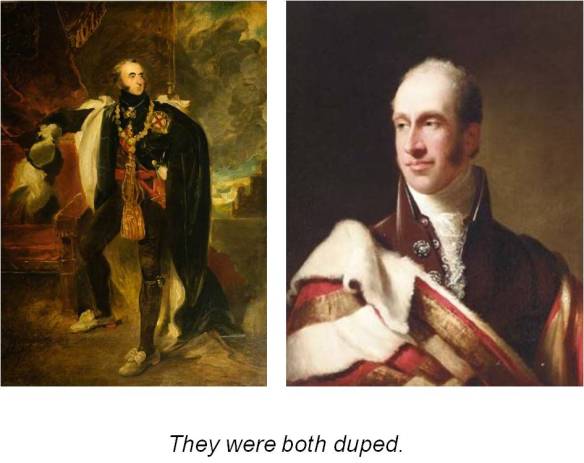
The proof came from a letter found among Young’s papers from A. H. She prefaced her writing with instructions to burn it immediately, never thinking the steward would ignore such a command from the oldest daughter of the Duke of Hamilton:

“You will be astonished to hear that among his papers is a letter from Lady Anne Hamilton written several years ago, before he came into Watkin’s service which appears to direct and advise him in frauds he was then carrying on.”

— from Charles W. W. W. to Lady W. W. , Sept. 27, 1814

by Lonsdale, Lady Anne was the oldest daughter of the 9th Duke of Hamilton — “very forward, very ugly and unpleasant..”

A copy of Lady Anne’s letter was enclosed in Charles’ next letter to his mother. It is remarkably creative in the variety of suggestions the duke’s daughter makes to allow Young to defraud both families which are related to her. The marquess is her cousin–the  duke, her brother-in-law. To both she highly recommended Young and managed to shift him from the service of one to the other before his thefts could be detected.

” ..You may do anything, as your character is so well established.”

— letter from Lady Anne Hamilton to Mr. Young, 1806

The matter quickly became public knowledge. Gossip would have it that all of Wynnstay Hall’s staff was dishonest and the lot be fired, or worse. Sir Watkin refused to have Young prosecuted but charged the son to take him away. The Lincolnshire property was signed over to the baronet but no further action was taken.

As for Anne, the Williams-Wynn family said nothing publicly, nor did they share evidence of Young’s fraud with the marquess or the duke. They remained discreet out of respect for her family.

It is presumed the proposed courier Mr. Chesswright got the job. His reference was finally obtained from Lord Lake, who employed the man in Ireland.

The correspondence of Lady Williams-Wynn are preserved and available for viewing in the Internet Archive.


A Bridge for the Regency

Cover from an older edition of Heyer's Regency Buck

This is the cover of my copy. Judith’s impetuous race to Brighton is priceless.

“Highgate afforded the travellers their first glimpse of London. As the chaise topped the rise and began the descent on the southern side, the view spread itself before Miss Taverner’s wondering eyes.”

— Regency Buck, by Georgette Heyer (1935)

Until Regency times, the great northern road approaching London climbed a very steep hill, rising some 450 feet above the Thames. The summit at Highgate village certainly afforded a splendid view.

Today’s view of London from Highgate, no longer the hamlet that Heyer’s heroine passed through.

Highgate had once been a hermitage, under the protection of the Bishop of London. The hermit, however, was not entirely occupied with remaining aloof from society. The great northern road passing just by his door, he was in a great position to collect tolls. For the bishop.

Highgate hill became something more than just an obstacle in the Georgian era. Pack animals had long since been replaced by wagons and carriages. Increasing speed and traffic, combined with the slope’s incline:

“..occasioned the loss of many lives, both of men and cattle.”

— Ackermann’s Repository (July, 1813)

The village of Highgate served as an emergency way station, receiving many broken bodies and carriages from accidents upon the hill. Exhausted horses and impatient drivers, with London just in sight, made conditions ripe for skidding off the steep shoulder of the road, overturning conveyances and flinging passengers downhill with great force.

Parliament considered remedying the situation on several occasions. One surgeon residing in Highgate reported his observations during government proceedings on the matter:

“..during the preceding three years, he had had under his care two persons with compound fractures of the legs, who suffered amputation; two simple fractures; a boy who had his skull fractured, and died a few hours after..”

–Monthly Magazine (July, 1810)


1812 J. Hill print depicting construction of the Highgate Archway
— Credit British Library via Science Photo Library

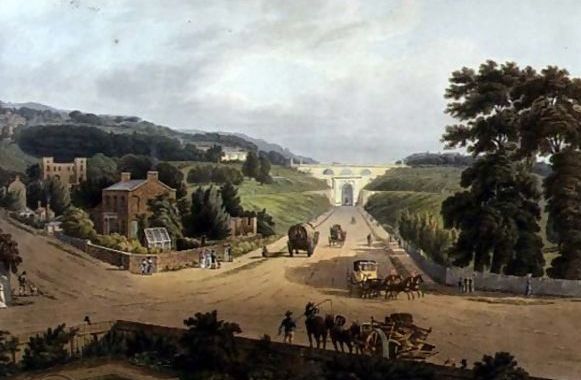
It was decided to build a tunnel through the hill. Unfortunately this solution met with disaster, for the whole caved in during construction. The only other idea was to cut the road through the hill. To prevent the excavated hillside from falling into the road, John Nash was engaged to design a brick archway. The resulting monument, of great size and majesty, became a well-known sight in England.

Too, the great northern road became much more efficient–and profitable. To pass beneath Highgate Archway, one paid four pence per horse, and one penny per person on foot (Ackermann’s Repository, July 1813).

Meanwhile, a bridge was placed over the whole, so that traffic on Hornsey Lane could stop and view London from the elegant balustrades:

“From the path-way of the bridge, there is an excellent view of the surrounding country, and of many buildings in the capital.”

–A New Picture of England and Wales, Samuel Leigh (1820)


The completed Archway. Augustus Charles Pugin, the artist, was a draftsman for Nash. He later illustrated guide books.


Bonomi – Architect to the Regency

” ‘I am excessively fond of a cottage; there is always so much comfort, so much elegance about them.’ ”

Sense and Sensibility – Jane Austen (1811)

So says Mr. Robert Ferrers, a secondary character in Austen’s novel. His oft-quoted ode, following a discourse on Gray’s toothpick cases, forms a particularly odious lecture given to Elinor, the heroine. Odious because he clearly imagines his patronizing speech will inspire her to feel fortunate in her much-reduced circumstances after his sister forces her and her family to move out of their home, Norland Park.

“..a cottage… calculated for the convenience of persons of moderate income.” Designs for Elegant Cottages and Small Villas, E. Gyffard (1806)

He positively presses Elinor on the advantages of building a cottage, going so far as to relate to her, in his self-important way, that he advised no less a personage than Lord Courtland on the matter.

” ‘Lord Courtland came to me the other day on purpose to ask my advice, and laid before me three different plans of Bonomi’s. I was to decide on the best of them.’ “


Rear view of cottage showing servants’ entrance to the kitchen and extension of a veranda

Joseph (born Giuseppe) Bonomi came to England in 1767 at age twenty-eight, to work as a draftsman at the invitation of the Adam brothers, innovators of Neo-classicism in Georgian design and architecture. Bonomi also worked with Thomas Leverton, the famed English architect who had the distinction of executing a triumphal arch commemorating American independence for a British nobleman.

From these connections, Bonomi took his native foundation in Roman antiquity to design country residences for the ton. He was known for adapting classicism to suit practical needs. As an example, classicism demands an even number of columns, but Bonomi would made their number odd, if that suited the proportion and function of a building. He took the classical portico and extended it, to protect arriving and departing carriages from inclement weather.

The Royal Institute of British Architects calls Bonomi the creator of the porte-cochère.

Roseneath House, designed by Bonomi for the Duke of Argyll. Note the fifth column, put there so folks wouldn’t confuse the carriage way with a grand entrance. — from Papers Read at the Royal Institute of British Architects (1869)

A Bonomi-designed country house was the sign of marked distinction during the Regency. Even his drawings were on display at the Royal Academy. Yet Robert Ferrers destroyed Lord Courtland’s set, boasting:

” ‘My dear Courtland,’ said I, immediately throwing them all into the fire, ‘do not adopt either of them, but by all means build a cottage.’ And that, I fancy, will be the end of it.”

One must surely choose a cottage over a mansion, after such a masterful demonstration of preference (and destruction!) We do not learn of Lord Courtland’s eventual course of action, but Robert Ferrers lives on as perhaps the most-quoted person on the desirability of cottage-living.

I daresay his brilliance has quite cast poor Elinor in the shade. Her reaction to his conceit, ever sublime, can scarcely be remembered:

“Elinor agreed to it all, for she did not think he deserved the compliment of rational opposition.”


Regency-era Infant Suffocation

A bonnet can’t hurt, can it?

Recently, there have been reports of a troubling rise of infant suffocation in bed, even as the rate of SIDS has been decreasing. Researching this post, I’ve just learned that infant sleep positioners are no longer recommended, having been discredited by the FDA. 

In the Regency, infant suffocation was a real problem:

“Sometimes from accident but oftener from culpable inattention, young children are not infrequently smothered in beds and cradles.”

Observations on Apparent Death from Drowning, Hanging, Suffocation: and an Account of the Means to be Employed for Recovery. To which are Added, the Treatment Proper in Cases of Poison; with Cautions and Suggestions Respecting Circumstances of Sudden Danger (whew!) by James Curry M.D. (1815)

Dr. Curry is careful to distinguish infant smothering from “bruising by overlaying,” a condition caused when a child is crushed by others, often the parents, they sleep with.

Suffocation occurs when there is no other air to consume in the vacuum created by bedclothing. Yet there may be time to save the child, Dr. Curry notes, if the body is still warm. As in the case of drowning, respiration by artificial means may be implemented. Also, the body should be exposed to a current of fresh air and sprinkled with water, as a stimulus.

Dr. Curry reserves special condemnation of parents and cats (!) who contribute to the dangers of infant suffocation, noting:

“..a very improper habit of cats lying in the bed or cradle of young children; as these animals, from their love of Warmth, almost always lay themselves across the Child’s neck, and often either cover the Mouth with their bodies, or press the bedclothes over it, so as to impede or stop the breathing.”


sleeping girl, pouncing cat
I think we’re fine here, but it’s still advised to keep the cat out of the cradle.


Regency-Era CPR

“The trouble with writing history comes from suspending knowledge in what we know now, to what was known then.”

— an author of historical fiction

The understanding between absolute and apparent death was just beginning in the Georgian period. In his remarkable volume, Observations on Apparent Death (1815), Dr. James Curry informs the reader that though the victim appears lifeless, there is still a chance she may be saved.

All persons should know how to properly resuscitate a victim of drowning, he declares, deploring the general state of ignorance in this regard:

“..the practice of holding up the bodies of drowned persons by the heels. or rolling them over a cask (!) … is highly dangerous; as the violence attending it may even burst some of the Vessels which are already overcharged with blood, and thus convert what was only Suspended Animation, into Absolute and Permanent Death.”

“Thus it appears a pond of Water may prove an instrument of Slaughter.” –Thomas Rowlandson

In the case of suffocation, stimulating the lungs through artificial means was already a known procedure. In 1732, a collier was recovered from a coal pit not breathing. He had been overcome by fumes but was eventually revived by inflating his lungs. Various instruments could be used for this, but, as Dr. Curry complains, these are only in the possession of ‘medical men’ who know how to use them.

Instead, he urges readers to use whatever may be at hand about the house to artificially inflate the lungs–horns, air-filled bladders, even bellows. He advises the body be kept warm, the temples of the head rubbed with hartshorn, stomach stimulated by negus (awful stuff) and such efforts must be made for an extended period of time, if necessary.

He relates the heroism of Mrs. Page of Hornsey in this regard. With the assistance of her servants and an instructional card distributed by the Royal Humane Society,  she resuscitated a girl that had drowned in the New River.

Tipton’s Mrs. Caddick also managed to do the same, reviving a boy who drowned in a nearby pond. In this case, it took nearly two and a half hours to coax life back into the child’s lifeless body.


A receiving house for the purpose of rendering aid to drowned or injured persons in Hyde Park – erected by the Royal Humane Society. Image via WellcomeImages.org

Today’s post is yet another example of the advantages afforded by rising literacy during the Regency. Mrs. Page’s card highlights such a benefit–the Royal Humane Society is one of several institutions founded for the betterment of society, disseminating information to the masses on ways to revive victims of accidents, particularly drownings.

Dr. Curry dedicates his volume to George III, widely credited for sponsoring such endeavors:

“..(his) benevolence of heart, uniformly displayed throughout a long reign, has not only secured the lasting veneration of the wise and good..but the rare and enviable appellation of–A Patriot Sovereign, the Father of His People.”


George III: What of the colonies, Mr. Pitt?
Pitt: America is now a nation, sir.
George III: Is it? Well. We must try and get used to it. I have known stranger things. I once saw a sheep with five legs…


Christmas Gifts for the Regency Nursery

From the Advertisement Section of Ackermann’s, December 1813–Christmas gift ideas for Young Persons:

The History of Cinderella, Or, the Little Glass Slipper – elegantly versified and beautifully illustrated with Figures which dress and undress.

Images of this book and the paper dolls are best viewed at Jane Austen World here.

According to the University of North Texas Rare Library collection commentary, novelty books like these were rather expensive for the time. The Cinderella offering was 6 shillings and 6 pence.  One imagines the book was a must-have item for a nursery library of the ton.

Little Fanny was another Christmas offering for children

S and J Fuller, the publishers of Cinderella and other novelty books, printed the stories in verse. As the story progressed, the child changed the doll-character’s attire to match the scene. The doll itself was only the head and neck–a tab below the neck slid into a corresponding slot on the outfit.

Cinderella joined a wide variety of books published by Fuller including Little Ellen, or Naughty (!) Girl Redeemed; Frank Feignwell’s Attempts to Amuse his Friends; Laurette, or the Little Savoyard; and Metastases, or Transformation of Cards “a pleasing or laughable amusement.”

Merry Christmas!

Not as fun as paper dolls, but definitely vintage!


A Regency Harvest

Checking back two hundred years, it appears the English crop production was very good.  I even learned some new agricultural terms.

“Return from the Market,” by George Morland (1763 – 1804). His paintings documented much of Regency-era rural life.

The New Monthly edition of September, 1818 reports it had been a dry, warm August and so an early harvest of many crops was permitted. Wheat, barley and oats production was high, particularly in the North. The by-product of these grains–straw–was therefore abundant as well, benefiting other industries like thatching.

Turnips, apples and hops were also in abundance. One observation of the potato harvest noted the singular appearance of the tuber in that year–“rough on the coat from being randed.” Near as I can figure, this means they grew so numerous in the ground as to be practically woven together. Once dug up, the potatoes appeared rough, or randed by such close growing conditions.

There were many Regency-era recipes devised from potatoes. If you had enough, Cook might be persuaded to make that attractive side dish of mashed potatoes formed into a collar surrounded by balls. After baking,  a sauce would be added:

“..half a pint of white wine, sugared to taste, add the yolks of three eggs beat, and a little nutmeg; set it on the fire and when thickish, pour it on the dish.”

The Frugal Housekeeper’s Companion, Elizabeth Alcock (1812)


Baked Mashed Potato Balls Recipe & VIDEO | Healthy Recipes

Mashed potato balls covered with bread crumbs and baked  healthyrecipesblogs.com

The harvest of beans and peas did not fare as well, however. The stems of this produce, called the halm, and used for thatching and bedding, was also lessened as a result.

Summer fallow, that is, those fields that were deliberately rested in 1818, were seen to be “more forward in their culture.” A fallow field is one allowed to rest for the year–a feature of crop rotation farming since medieval times. The ‘culture’ that takes place during the rest period is the process of breaking down left-over vegetation, especially in ideal weather conditions, which renews the soil’s nutrients. The more forward the process is, the more ready the field is for growing a new crop the next year.

And next year will be here before you know it.

20 Funny and Cute Vintage Thanksgiving Postcards ~ vintage ...


The Ghost of Major Blomberg

In 1823, a Bond Street printer published a collection of ghost stories collected by Mr. Jarvis, Esquire. Chronicling visitations from those who have passed on is considered a dubious business. But Jarvis protests the dead have a reason to speak to us:

“..to keep alive in the memory of mankind, the persuasion there are more things in heaven and in earth than are dreamt of in the school of athiestical philosophy..”

— Accredited Ghost Stories, J. Andrews (publisher) 1823

One ghost delivered a message so poignant that even a queen was impressed, and Prinny gained a playmate.

Major Blomberg was posted to Dominica during the War in the Colonies. The expected time of his arrival from England had long since passed and the island’s British governor and  staff were growing impatient over the delay. One evening, the governor was interrupted in his study by a servant, claiming the major had finally arrived.

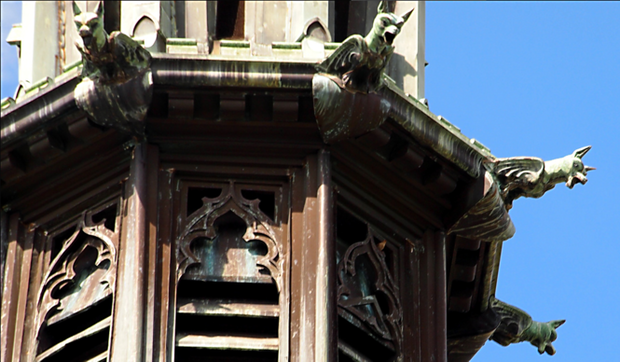
The spire at haunted Huntingdon College. The institution was named for Selina, Countess of Huntingdon, and cousin to Dominica’s governor.

Blomberg seated himself across from the governor’s desk without ceremony, rumpled, impatiently waving off the lingering servant. When they were alone, the major commanded his astonished host to seek out two orphans upon his return to England.

They are my children, the major said, the result of a secret marriage. He gave express details of their location in Dorsetshire, and where their fortune may be found. Rising, he begged the governor to take guardianship of them. No entreaty could persuade him to remain, no demand could compel him to explain himself further.

He merely withdrew, saying, ‘Adieu! You will see me no more.’

The good major shouldn’t have been seen at all.  His ship was never to arrive.

When news reached Dominica that Blomberg’s ship had sunk, killing all aboard, it was clear that something very odd had taken place in the governor’s island residence. In spite of this, the man took his task seriously, and sought out the children upon returning to England.  He found them in the village the ghost specified. He found their inheritance, and their papers, in a red Morocco case.

Just as the ghost specified.

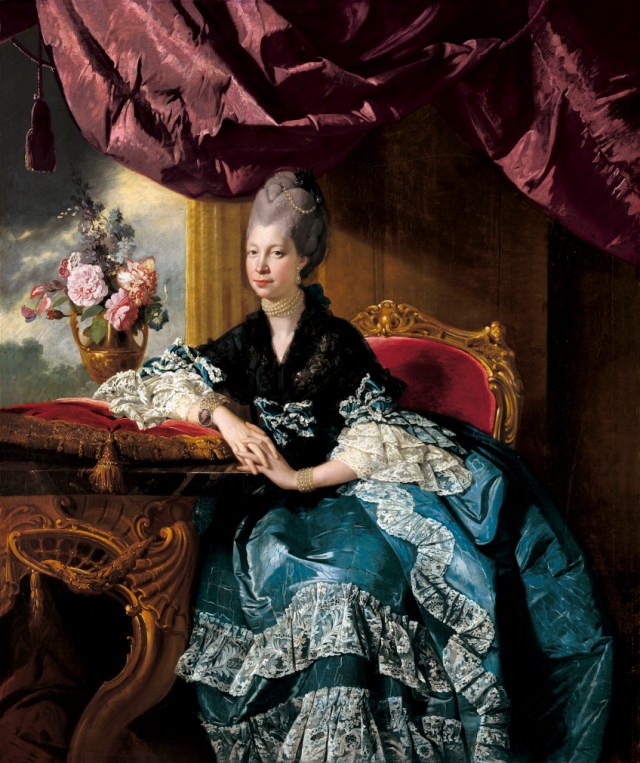
“This tale was related to the late Queen Charlotte, and so deeply interested her she immediately adopted the son as the object of her peculiar care and favor. He was brought to Windsor, and educated with his present Majesty, of whom he has through life been the favourite, the companion, and the friend. “


The spectre of Queen Charlotte may have photo-bombed a wedding selfie taken at Wiltshire’s Bear Hotel.


Happy Halloween!

Regency Furnishings: the Bergère

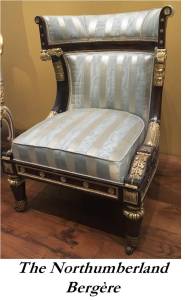
The bergère- a low, comfortable chair. The term means shepherdess in French.  In England, they called these easy chairs barjairs–or burjairs. They were first popular in the early part of the eighteenth century.

One can almost see a buck of the ton sprawled upon this exquisite piece of furniture. He would naturally stretch his nankeen-covered legs out, displaying his physique to advantage in negligent contrast.

The Northumberland bergère is on display at the V&A Museum in London, along with other remnants of the now-vanished Northumberland House. The following is a bill of sale from the manufacturer:

‘2 bergeres, from the antique, of your Graces aburra wood, highly polished, & richly carved & gilt with ornamented trusses, foliage leaves, scroll sides, &c the tablet back, & seats stuffed with the best horsehair in canvas, standing on brass socket castors.
£225 16s
To covering the seats, backs, & tablets of the bergeres with grey silk, lined with calico, & finished with silk gimps, & cord in suit £5 18s’ 

The Northumberlands also commissioned special covers in leather for the chairs, to protect such expensive pieces when the house was closed up. Not just any old Holland covers would do for Their Graces when they were not in residence.

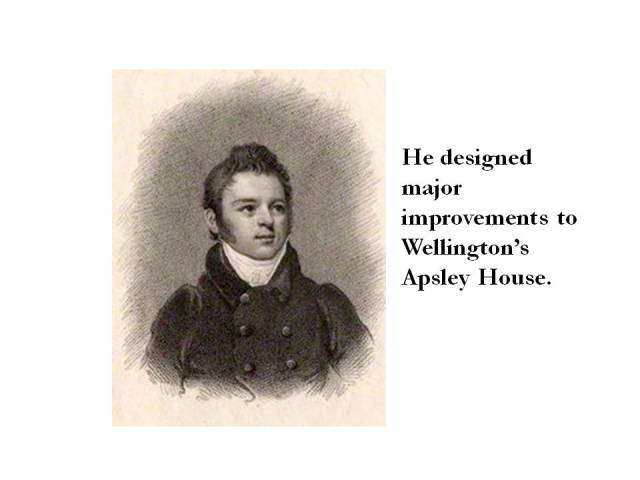
The chair was designed by Benjamin Dean Wyatt, eldest son of architect James Wyatt.  His clients, besides Their Graces of Northumberland, included the Prince Regent, the Duchess of Rutland and the Duke of Wellington.

His work on Lancaster House is the subject of this blog’s post from several years ago.


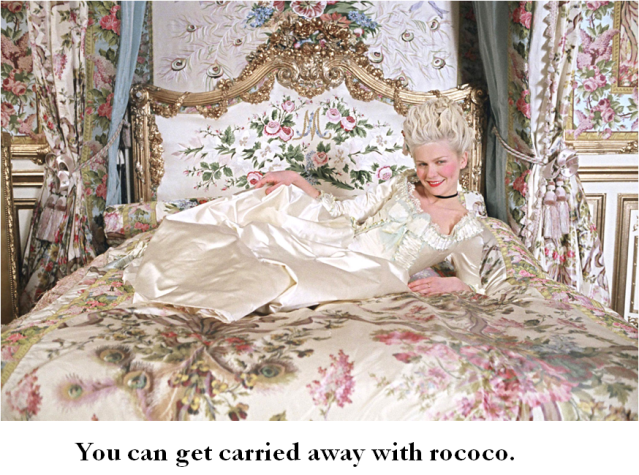
From the 1820s to the 1830s, Wyatt was responsible for a mini-revival of the Rococo, which had fallen out of favor decades before. As you can see, the bergère, while styled in the classical Grecian design, sports gilded scrolling .

Recalling the good times of the ancien régime.

The Duke and Duchess of Northumberland were married in 1817 in Northumberland House, which they renovated extensively during the late Regency. They had no children, so their energies were devoted to many and varied aspects of British public life, which, like their chair, live on today.

Regency Furnishings: Gothic Revival

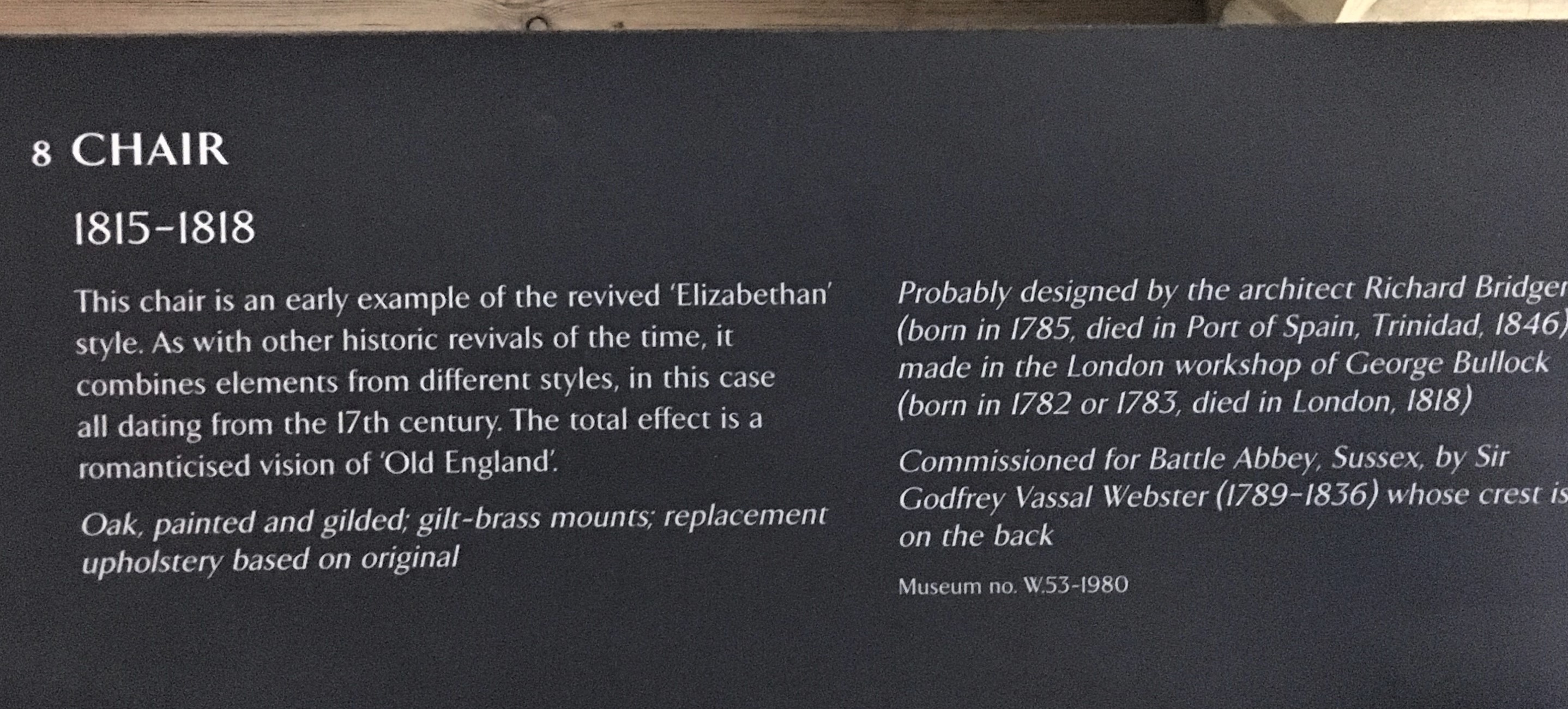
When I photographed this Regency-era chair at the Victoria and Albert Museum, it was apparent that its style was Gothic Revival.

“The total effect is a romanticized vision of ‘Olde England.’ ” — V&A Museum See the full tag accompanying this exhibit, along with the link, at the end of this post.

The tempestuous past of its owner, however, was not so apparent.

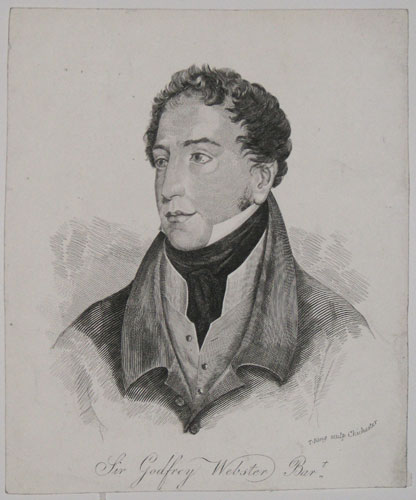
The chair was one of set Sir Godfrey Vassal Webster ordered for his country estate, the famous Battle Abbey. The manor began as an ecclesiastical complex, established as a memorial to the Conqueror’s victory over the Saxons.  The Abbey was later dissolved and the abbot’s house became the nucleus of the Webster family country seat.

The Websters were proud to own a piece of history. Battle Abbey was a place that hearkened to the distant past–when a descendant of Vikings put himself on England’s throne.


Sir Godfrey was 5th Baronet Webster. His mother was the notorious Lady Holland, who abandoned the 4th baronet for another man, and took up the active life of a Whig hostess. His father committed suicide, and young Godfrey was brought up by older relatives. Achieving his majority, he inherited an estate already encumbered by debt, and in tumble-down conditions.

His expensive campaign to restore the estate was a long endeavor, punctuated by notable distractions elsewhere.

Sir Godfrey Webster, via Grosvenor Prints

One of those distractions was romance. Sir Godfrey was Caroline Lamb’s lover.  They carried on openly in spite of her marriage to another; their affair deplored in relatives’ correspondence. Eventually they broke off, Caro falling into a mad infatuation with Byron. Later, she sketched Sir Godfrey’s character as the devil-may-care Buchanan in Glenarvon. It seems she cared deeply for him.

The clever story of a Regency miss whose novel features a caricature leading to everlasting love.

Others did not.

I never remember to have heard of anybody more generally disliked, or more completely excluded from the pale of good company.

— John Williams Ward, April, 1810

Another distraction was politics. Sir Godfrey blew lavish amounts of money to buy his way into Parliament. His ambition in this regard remains obscure, for no one could be certain where his loyalties lay. He wanted to stand for election in Sussex for the Tories, but had been known to curry the support of ‘mobs’ with decidedly Whiggish demands.
Money, when he could get it, brought more distractions. He thought to make a splash in the racehorse business–with limited success. He might as well have stayed on land for all the blunt he spent on a yacht named Scorpion.
When these distractions ceased, Sir Godfrey was left to concentrate on Battle Abbey, which became his solace.

The Novices Common Room – Battle Abbey via WyrdLight.com

The furnishings Sir Godfrey ordered for his manor house reflect his taste for the Romantic, a movement that flourished during the Regency. The Gothic Revival style, sometimes called Elizabethan, of the Webster chair signals a desire to make Battle Abbey look the part.

George Bullock (1782 – 1818) was one of several Regency-era furniture makers who were responsible for developing the Gothic Revival style:

“Battle-axes, battering rams, Roman fasces, halberds and shields should only be introduced into military apartments. (Bullock) was the only person who ventured into a new path: though some of his designs were certainly too messy and ponderous, nevertheless grandeur cannot be obtained without it.”

— The Rudiments of Drawing Cabinet and Upholstery Furniture…, Richard Brown (1835)

The emphasis in such a design is not just a departure from the classical Greek and Roman influences, but a desire to return to one’s roots, to recall the past as it was thought to be, in Britain. Indeed, Ackermann’s boasts that this style of furniture is particularly favored there because it is the only place where the style can be fully understood and appreciated.

Note the tracery decoration in this Gothic dressing table, reflected in the matching footstool. From Ackermann’s Ser.3,v.10(1827)

Interestingly, Bullock supplied the furniture for Longwood House, Napoleon’s last home in exile. The foot-bath he designed for L’Empereur was a notable departure from his Gothic style, bearing the leaves of victory in the Greek manner.  The commissioners in charge of this task rejected the bowl, of course.

As for Webster’s check made out to  Bullock, that too was rejected!

Ceremonial chair for Battle Abbey: http://collections.vam.ac.uk/item/O58202/ceremonial-chair-bridgens-richard/