Regency Confessor: A Suitor Responds

It was not long after our widow poured her desire into the Listener’s ear that she received a response.

“To the young widow who seems desirous of marrying again..this challenge of yours operates like an electric shock, and revives my hope of still being married.”

— “To the Young Widow Who Seems Desirous of Marrying Again,” The Listener, La Belle Assemblee, May, 1818

Signed Frederic Freeman (italics mine), the respondent, rather cleverly, admits that he has had ill luck at love. The woman he intended to marry was, alas, naught but a coquette who cast him and his extended courtship of her hand aside with nothing more than “an unfeeling nod.”

"Round dress of the new Parisian tissue silk, of a beautiful blush colour, trimmed round the border with Persian of the same hue...Bonnet of white Gras de Naples...triple ruff of fine lace, black kid slippers, tan-coloured kid gloves, and parasol of pearl gray."

“Round dress of the new Parisian tissue silk, of a beautiful blush colour, trimmed round the border with Persian of the same hue…Bonnet of white Gras de Naples…triple ruff of fine lace, black kid slippers, tan-coloured kid gloves, and parasol of pearl gray.”

He makes some noise of appreciation over the widow’s declarations of “plain dealing.” Her warning about conduct and character does not dismay him and agrees that such practical considerations can be dealt with later.

With that said, he busies himself with a more important task at hand–the kindling of romance.

“If I should be the man of your choice you never would have red eyes with crying for the coldness and unkindness of your husband (as too many of our modern ladies have); neither would you look “like a witch” through sorrow, or decrease your “native plumpness” through vexation.”

What shall I wear to please you? he asks, since the widow is ready to cast the color of black aside. Any color in the rainbow, he swears, if only to show her how accommodating a spouse he would make. As for those drawing room gentlemen she complains of–he is not of their ilk, that class of males called rakes. Indeed, he staunchly declares, such a suitor would make Euphrasia the worst of a second husband.

He speaks with peculiar authority on the matter, I daresay.

In any case, it is amusing to speculate on the result of such determined courtship on the part of a gentleman who exquisitely relates his past experience at love as a whipping by “Lucretia’s” lash. But that is all in the past, for he is filled with confidence that he is the man she will choose, and calls upon the Greek god of marriage as witness:

“If you, Madam, will take me for better and for worse, I also will be preparing my wedding garments. Then Hymen will announce to all his neighboring deities that Euphrasia and Frederic shall be an example of connubial felicity.”


Regency Confessor: Widow Seeking Husband

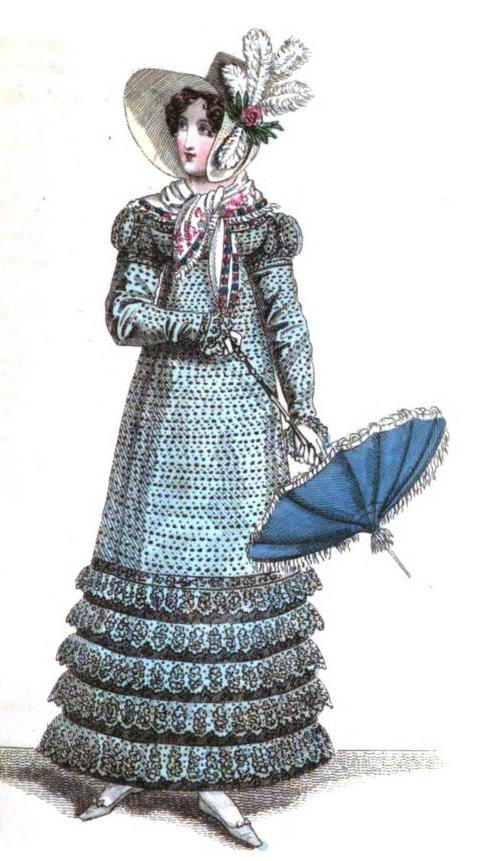
From the Magazine's September 1818 issue: "Parisian walking dress is a round dress of printed muslin, of a cerulean blue spotted with black, with bordered flounces of the same material to correspond, between each flounce a layer placed of black brocaded satin ribbon--bonnet of black brocaded satin ribband..parasol of barbel blue..slippers of pale blue kid and washing leather gloves."

From the Magazine’s September 1818 issue: “Parisian walking dress is a round dress of printed muslin, of a cerulean blue spotted with black, with bordered flounces of the same material to correspond, between each flounce a layer placed of black brocaded satin ribbon–bonnet of black brocaded satin ribband..parasol of barbel blue..slippers of pale blue kid and washing leather gloves.”

I am going to pass a week at Richmond, while my house in Manchester-square is getting ready; but do not imagine I am going alone.

— The Listener, “Letter from a Young Widow,” La Belle Assemblee, May, 1818

So writes a young widow who publicly states her desire for a companion–not another widow, or even a female.

But a man.

After two years of grieving the death of her husband, she had been left thin and red-eyed as a witch. She’s quite recovered her looks, she hastens to add, even so much as to be proud that her “native” plumpness has returned (!)

Now she will open her London town house and, as she plainly says in her letter to the Listener, she seeks a husband.

“I do not want a philosopher; but a man of mild and agreeable manners, and an easy temper: I would wish him always to be well-dressed; and, above all things, to have his heart in the right place.”

Upon this last quality she dwells a good deal, so that one wonders how unhappy her previous marriage had been. Indeed, there is mention of faithfulness, that women would never stray from their marital vows if their husbands did not cause them to do so. As if afraid she may have revealed too much, she states firmly her clear conscience regarding  the matter of her previous marital relationship.

Indeed, the purpose of her letter, she reminds the reader, is one of exigency. The drawing room should be the proper place to seek a second husband, but alas, that place:

“..is frequently deserted for the pleasures of Bacchus; and over the bottle, politics, fortune, and the way to rise in the world, are the favorite topics of men’s discourse, as they have long been the deities of their worship.”

Having failed through normal channels, she offers her hand to the Listener’s well-numbered audience, but in the words of a challenge. If any man should pick up the glove she has thrown down, he must be in earnest, for she will not enter marriage a second time without an abundance of caution:

“I shall take care to acquaint myself with every particular of their conduct and character.”

Signed, Euphrasia, for that well-known herbal remedy to clear the eyes.


Regency Confessor – London Buck turned Country Gentleman

From La Belle Assemblee, June, 1816 edition–another offering from The Listener:

“Letter from a Gentleman, Formerly a Modern Buck:”

I was for some time an inhabitant of London, and fluttered around all the goddesses of fashion and beauty; but now I am become a complete country gentleman, and no one can distinguish by my present appearance that I have been a dashing buck of the town.

The writer signs himself merely “Rusticus” (!) and extols the virtues he has discovered since retiring from town life. He describes these new virtues as follows:

Opera dress, as exhibited in the magazine, consisting of a slip of pink satin, ornamented down the front and border in black velvet bias, under a robe of black satin richly flowered in black velvet down the sides, full sleeves of black satin ornamented with pink, over a chemisette sleeve of white sarsnet. Hat of fancy spotted straw, lined with pink satin, with a superb wreath of full-blown roses. Shoes of white satin , with white kid gloves.

Opera dress, as exhibited in the magazine, consisting of a slip of pink satin, ornamented down the front and border in black velvet bias, under a robe of black satin richly flowered in black velvet down the sides, full sleeves of black satin ornamented with pink, over a chemisette sleeve of white sarsnet. Hat of fancy spotted straw, lined with pink satin, with a superb wreath of full-blown roses. Shoes of white satin , with white kid gloves.

In town, he would dine out, but hardly ate a thing. Instead, he would swear at the waiters, poke holes in the damask breakfast cloths or throw wine he found disagreeable out of the window. In the country:

I can attack a venison pasty with that keenness of hunger given by the sports of the chace, and even when I see my servant cut the bread with hands not over-clean, I fall to, without taking time to reprove him.

His clothes used to require hours planning with his tailors to prepare for the upcoming season, making certain his coats were tight at the bottom of his waist and his pantaloons preserved the exact shape of his knees.

Now I am very easily pleased; my wife’s dressmaker makes all my waistcoats and pantaloons, and this young woman, who is very clever, comes every six months and stays with us a fortnight, during which time she makes our clothes for the next six.

As much as London offered many amusements, they were all fatiguing. Plays full of cold chambermaids, grimacing footmen and the inflated language of lovers left him searching for something better, until he finally found it in the country:

Now I find the most beautiful spectacle in the rising sun, the beauteous hills and vallies, the verdant carpet and the glassy current.

On conveyances:

I had a telegraph in town as light as a fly, the best calculated in the world to throw anyone out…Now I have a good solid Yarmouth cart, which is never overturned, let the roads be ever so bad.

He used to have as many as ten “favourite” ladies, which equally swore fidelity to him even as he falsely promised them the same. Constant declarations such as these were tedious as much as they were hypocritical. But now that he is married:

My wife is the only woman I really love; I have no occasion where I must continually repeat my vows to her, she sees what my daily conduct is toward her, she knows the inmost thoughts of my heart; I divine hers, and our life is a series of mutual confidence, happiness and concord.

A veritable paragon of a man, I daresay.


Regency Confessor – Chance over Reason

From the archives of La Belle Assemblee, we find a section  entitled “The Listener,” a sort of  “Dear Abby” column for Regency readers. The next few posts will be taken from this informed source, appropriately named Timothy Hearwell, Esq.,  on salient points of good character during the reign of the Prince Regent.

From “Chance over Reason,” March, 1816 edition:

“There are, as Solomon says, those who strive and strive and yet are more behind.”

In this column, the writer pours a tale of caution into “the Listener’s” ear. He had got up a business, purely by chance, and made a considerable fortune.

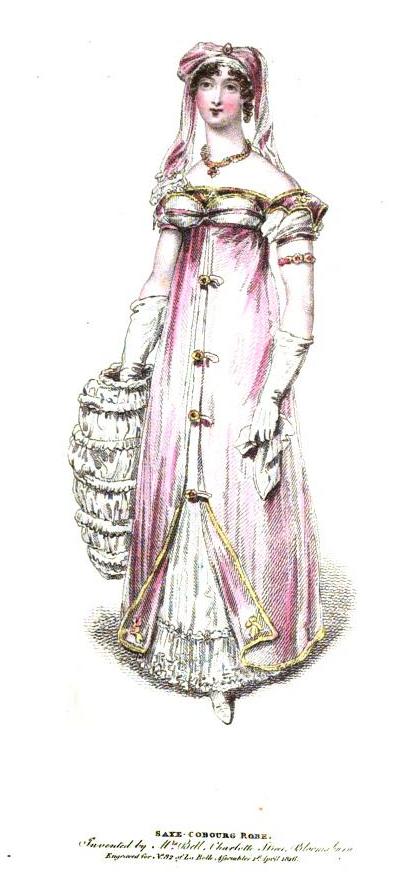
The Saxe-Coburg robe for evening dress as featured in the magazine

The Saxe-Coburg pink robe for evening dress, featured in the magazine, worn over a white satin slip flounced with crape, finished by blond. Bridal veil, fastened with a brooch of pearl and pink topazes, with the hair simply dressed in light curls and parted on the forehead. A muff formed of white satin and gossamer silk trimming. Necklace and armlets of pearls and pink topazes. White satin slippers and white kid gloves.

.

Ashamed of owing everything to good luck, and nothing to my own genius, wishing, as much as in me lay, to justify the favors of Heaven, I began to work (with purpose)….”

To his chagrin, his earnest labors were met with either criticism or downright annoyance, as his efforts seemed only to be getting in the way of the business, until even his friends avoided him. The business turning to failure, the penitent wrote a play about his troubles, a comedy, and later romantic novels that were written hurriedly, (and badly):

I took no pains to conceal the machinery by which I set my puppets in motion. I took care to banish from my works every serious and moral reflection, and only thought of crowding events one upon the other.

Having made another fortune in this accidental endeavor, the writer resolved to marry. His protestations of love with one young lady were met with little comment, she answering his suit by merely raising her “beautiful” eyes upward, as if overcome with like sentiment. This went on for some time, until one evening, as he was leaving her house, he spied a dark figure dropping to the street from the balcony of her window. He raised the alarm, thinking thieves were at work, but soon discovered his beloved in the act of elopement. Therefore, he cautions,

we must not always trust to simplicity of demeanor, or fine eyes cast modestly toward heaven.

Cursing his belabored attempt at matrimony, the writer resolved to flirt injudiciously with every pretty woman he met, having no regard for the feelings of expectation he might arouse in the feminine breast while himself remaining insensible to any like feeling the recipient of his “dishonorable” addresses might arouse in him. He happened upon a widow with five daughters, who made their living by executing painting on velvet (!). They, too, were victims of his false blandishments, except for one. This daughter remained “sprightly” in spite of his flirting, her fine mind ultimately catching his regard and his love, so that:

I had united my fate with the best of women, and ever since I have a thousand times blest that destiny which has always been a safer guide to me, than my own prudence.”

A destiny that was further rewarded by immense wealth bestowed on the widow and daughters by an uncle’s will, securing the happy couple’s financial future and rewarding, quite by accident, the writer’s trust in chance.


A Regency Country-House Christmas


“..there were contested interpretations of Christmas in the 1820s played out in the periodical press, a battle between an unashamed outpouring of joy and familial love set against satirical accounts of Christmas celebrations blighted by sustained contact with irritating friends, relations and acquaintances.” — Abstract of “England and German Christmas Festlichkeit, c.1800–1914″ by Neil Armstrong, Oxford Journals, Vol. 26, Issue 4

One such “satirical account” of the Regency Christmas was “A Country Christmas—Agreeability,” which came out in the February 1823 edition of New Monthly Magazine. I’m persuaded the author, known only as “M,” was the celebrated Mary Russell Mitford, whose sketches of English country life (Our Village) during the Regency were quite popular. Elizabeth Barrett Browning, her particular friend in later years, used to say dear Mary was even more amusing in person, her wit sending everyone into peals of laughter.

And now, the “evil destiny” of spending a Regency Christmas in the country.

Mary Russell Mitford, who won the lottery as a child, the fortune later gambled away by her Papa

Mary Russell Mitford, who won the lottery as a child, the fortune later gambled away by her Papa

Breakfast:

“At this time of the day, the men are all muzzy with the last night’s claret, and the women’s faces, and consequently their tempers, are discomposed by their late hours. A pun, a quotation, or a smart sensible remark, falls as flat as the great poet on the plains of Waterloo* …”

Conversation:

The author describes a hilarious scene of bored adults huddling around the fire or lying full length on sofas, trying to ignore the children romping in the middle of the floor. Female conversation is dull indeed, designed to “vex the drowsy ear,” with prosing on about the “wonderful charities of the lady of the house,” or the “most detestable set of interminable good qualities” of the vicar’s wife. Worse, some country gentleman is bound to:

“plunge you incontinently into a sea of grand jury politics, neighborly disputes about game, the intricate operations of a turnpike, intrigues for draining a duck-pond, and maneuvers for inclosing a common.”

Lunch:

“People who have nothing to do, always eat luncheons.”

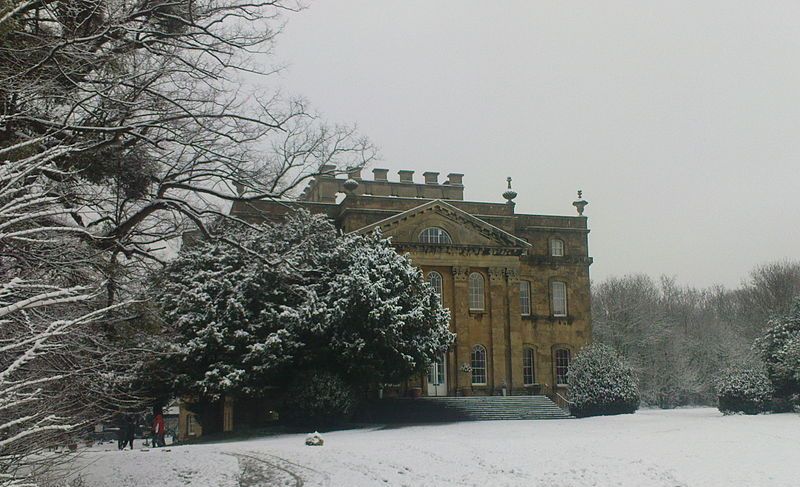
King's Weston House, photographed by Stephen Burns

King’s Weston House, photographed by Stephen Burns

The country visit:

For those who live in London, the author congratulates them on having avoided this “misery,”– this “consummation of a bore.” After having driven several miles in splendid turnout, splashed with cold mud and fainting from the carriage’s steamy interior, you arrive at the hostess’ frigid drawing room which contains a smoking fire only laid moments before. When the hostess makes her entrance,

“she is as cold as her room, and as formal as the regiment of chairs marshalled, with the drum major of a sofa at their head, along its walls. The conversation, a repetition of all you have already heard in the morning..”

Dinner:

“Unless someone of the company has been kind enough to go out skating on horseback, and has broken his own or his horse’s bones, for the amusement of the party, nothing remains but the claret for getting through a long, long evening.”

What follows from this is a little homily on the importance of being agreeable at Christmas. When one expects to be cooped up by isolation and weather, among the same set of persons, being agreeable is a gift to all around you, so that “hours, days, years under its influence, ‘roll unperceived away.'”

A little claret won’t hurt, either.

Christmas


* quotes an anonymous critic of Sir Walter Scott’s lyrical work on the great battle

Regency Critics: A Christmas Tale

Samuel Taylor Coleridge (1772 – 1834) wrote Zapolya in 1817. He was imitating Shakespeare’s Winter’s Tale, he claimed, hoping:

“I will be well content if my readers will take it up, read it and judge it, as a Christmas tale.”

Coleridge by Allston

Coleridge by Allston

There is little in the work itself that is decidedly Christmas apart from a mother fleeing with her infant. Instead, there are thrones usurped, sunken caves and werewolves(!) Despite these dramatic motifs, gaining Shakespeare’s lofty status proved elusive.

Writing a good drama was (and still is) hard–even for Coleridge, that “giant among dwarves.”

Jeffrey’s Edinburgh Review, Volume 80, was unstinting in its review:

1) Don’t be boring.

“In its present shape, we conceive (Zapolya) has about it that indescribable something, which, if not the dead weight of mediocrity will sink it, will ensure a speedy neglect from the bulk of readers.”

2) Convoluted plots are right out!

“To understand its plot and keep in view its progress, the reader must take some pains, and this is what no reader will ever do.”

3) Show. Don’t Tell.

“Much of the most striking parts of his story is related, and not acted…Enforce these with the exact sentiment which is to body them forth…pushing on the story, that purpose of dramatic action..”

4) Kill the darlings. Kill them.

Zapolya, then, as a drama, will never succeed. Nor, as a tale, is there anything in it to captivate. It must exist as a poem; and even in that case, we think it is decidedly too long.”

A Christmas gift to writers, if you will.


The Lake District of England, where Coleridge resided among other "giants" of English literature, all of whom were uniformly disparaged by the Edinburgh Review as the "Lake Poets."

The Lake District of England, where Coleridge resided among other “giants” of English literature, all of whom were uniformly disparaged by the Edinburgh Review as the “Lake Poets.”

Regency Critics: Thanksgiving, Part II

In January 1817, the Prince Regent survived an attack on his carriage as he was being driven to the opening of Parliament.

War had ended the year before, but transitioning to a peacetime economy had vexed the Government and there was much suffering. The Prince Regent was blamed in part for the situation. Nevertheless, a special Thanksgiving prayer was ordered to be said in chapels throughout the Church of England:

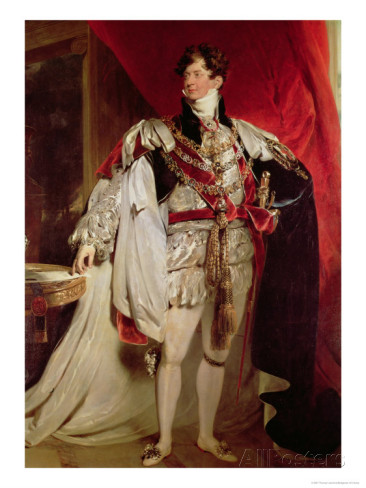
The Prince Regent, by Lawrence. Someone once said he looks like Ted Koppel.

The Prince Regent, by Lawrence. The observation has been made that His Royal Highness resembles Ted Koppel.

Merciful God, who, in compassion to a sinful Nation, hast defeated the designs of desperate Men, and hast protected from the base and barbarous assaults of a lawless multitude, the Regent of this United Kingdom, accept our praise and thanksgiving. Continue, we implore Thee, Thy protection of his Royal Person. Shield him from the arrow that flieth by day, and from the pestilence that walketh in darkness; from the secret designs of treason, and from the madness of the People.

A sinful Nation. The madness of the People.

Who are the People, it was demanded, and why should they, slandered for being mad and treasonous, give thanks that Prinny survived?

These sentiments were masterfully uttered by William Hazlitt (1778 – 1830) a man of many talents, including art and literary criticism. He had been a contributor to Jeffrey’s Edinburgh Review and his published commentaries on English literature made him a favorite of Leigh Hunt.

Blackwood’s was quite in charity with him as well:

“When Mr. Hazlitt’s taste and judgment are left to themselves, we think him among the very best, if not the very best, living critic on our national literature.”

Then came his remarkable Political Essays, with Sketches of Public Characters in 1819, criticizing, among others, the poet Southey and his lust for muzzling the press, but the Prince Regent as well, for being such an unworthy object of the people’s thanks:

“What have hereditary Monarchs..ever done for the people?”

“For one regicide committed by the People, there have been thousands committed by Kings themselves.”

Oh! Ungrateful wretch.

In less than a month, Blackwood’s threw Hazlitt under the bus, labelling him an “unprincipled blunderer.” One month more and the Leopard himself (under the pseudonym ‘old friend with a new face’) produced a scathing so-called cross-examination of “pimpled” Hazlitt. Unperturbed, Hazlitt responded to this article with his own letter refuting much of the allegations made against him, notably,

“And I am NOT pimpled, but remarkably pale and sallow.”

A self-portrait of young Hazlitt, sans pimples

A self-portrait of young Hazlitt, sans pimples

Something to be thankful for.


Regency Critics: Thanksgiving Part I

The Prince Regent declared January 18, 1816 an official day of Thanksgiving for all Regency England–to commemorate a Nation’s gratitude that war had ended.

Wordsworth wrote the following poem to mark the occasion:

Britannia

Britannia

O Britain! dearer far than life is dear,
If one there be
Of all thy progeny
Who can forget thy prowess, never more
Be that ungrateful Son allowed to hear
Thy green leaves rustle or thy torrents roar.

Thanksgiving Ode by Wordsworth

Scarcely remembered, this Ode represents the vexing condition gratitude often finds itself in–quickly forgotten before the day is out.

Like Thanksgiving.

In 1796, Robert Burns, the great pioneer of Romantic poetry, breathed his last, having opened a vast new literary landscape to successors such as Byron, Shelley–and William Wordsworth. Burns’ brother, Gilbert, thought it prudent to write a biography of Robbie before his character as a man should be forgotten. He sent a pamphlet ’round Edinburgh explaining his project and requesting anecdotes that might be used in the biography.

One was directed to the scholar James Gray who, in turn, shared it with Wordsworth.

By this time Wordsworth had achieved no little stature as a composer of the sonnet after Burns’ natural style. Of course, any comments he should care to make would be well-attended to. Indeed, he had already written a poem to comfort Burns’ sons, albeit with a mendacious warning against drinking too much:

Tintern Abbey, by Turner

Tintern Abbey, by Turner

Strong-bodied if ye be to bear
Intemperance with less harm, beware!
But if your Father’s wit ye share,
Then, then indeed.
Ye Sons of Burns! for watchful care
There will be need.

Address to the Sons of Burns, after visiting their Father’s Grave (August 14th, 1803)

When offered the opportunity to enlarge upon the merits of Scotland’s favorite son, the bard of Tintern Abbey entered into the exercise with enthusiasm:

“From the respect which I have long felt for the character of the person who has thus honored me, and from the gratitude which, as a lover of poetry, I owe to the genius of his departed relative, should most gladly comply with this wish.”

— Wordsworth to Gray in A Letter to a Friend of Robert Burns (1816)

A biography of Burns was already in publication, by one Dr. Currie. In it, certain details of the poet’s personal life had been rendered most candidly. To his family’s dismay, Burns’ reputation was beginning to resemble that of his creation, Tom O’Shanter.

Echoing his previous concern, Wordsworth addressed these details minutely–perhaps too much so–in his enthusiasm to clean up Burns’ image:

“His brother can set me right is I am mistaken when I express a belief that, at the time he wrote his story of ‘Death and Dr. Hornbrook,’ he had very rarely been intoxicated, or perhaps even much exhilarated by liquor. Yet how happily does he lead his reader into that track of sensations!”

He was a drunkard, to be sure, but not all the time!

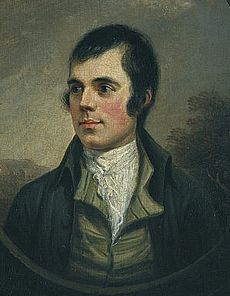
Nasmyth's flattering portrait of Burns

Nasmyth’s flattering portrait of Burns

Wordsworth’s gratitude was turned on its head when his Letter found its way into the hands of Blackwood’s and into the glare of the Public’s eye:

“(Wordsworth) has unquestionably written some fine verse in his day; but, with the exception of some poetical genius, he is, in all respects, immeasurably inferior, as an intellectual being, to the distinguished person he so foolishly libels.”

–Observations on Mr. Wordsworth’s Letter, by ‘a gentleman of distinguished literary talents’ (John Wilson, probably) Vol. I (1817)

Happily, Wordsworth’s role as literary critic was forgotten, smothered under the mantle of Britain’s Poet Laureate which was awarded to him in 1843.

Otherwise, he might have been remembered as the perfect example of a Regency ingrate.


Regency Essay on Ghosts

From a delightful Regency-era discussion in the Edinburgh Observer, or, Town and Country Magazine, Jan. 3, 1818:

“ON GHOSTS”

In churchyards:

“(they) have no particular business, but seem to appear, pro bono publico, or to scare idle apprentices from playing pranks over their tombs.”

Their appearance:

“dragging chains is not the fashion of English ghosts; chains and black vestments being chiefly the accoutrements of foreign spectres, seen in arbitrary governments.”

The female:

“if a tree stood in her way, she will always go through it. This I do not doubt: because women will go through anything, even if it be fire and water, much less a sturdy oak, to compass their end.”

they call him "Skeletor" -- an unexplained figure captured by closed-circuit camera at Hampton Court Palace

they call him “Skeletor” — an unexplained figure captured by closed-circuit camera at Hampton Court Palace

The effect of Christmas Eve:

“It is an established law, however, that none can appear on Christmas Eve…(and) there being some persons, particularly those born on Christmas Eve, who cannot see spirits.”

Conversing:

“The most approved mode of addressing a ghost is by commanding it in the name of the three Persons of the Trinity to tell you who it is, and what is its business. This may be necessary to repeat three times; after which it will, in a low and hollow voice, declare its satisfaction at being spoken to, and desire the party addressing it not to be afraid, for it will do him no harm.”

Mode of redress:

“In cases of murder, a ghost, instead of going to the next justice of the peace, or to the nearest relation of the deceased, appears to some poor labourer who knows none of the parties, draws the curtains of some decrepid nurse or alms-woman, or hovers about the place where the body is deposited.. the ghost commonly appl(ies) to a third person, ignorant of the whole affair, and a stranger to all concerned.”

Method of approach:

“The coming of a spirit is announced some time before its appearance, by a variety of loud and dreadful noises; sometimes rattling in an old hall, like a coach-an-six, and rumbling up and down the stair-case like the trundling of bowls or cannon balls..when any eminent person is about to enter their regions they make a great noise, like women..at a fire in the night-time.”

Getting rid of them:

“The process is to issue a summons to his worship, the parson of the parish , and another to the butler of the castle, who is required (by duces tecum) to bring him some of the best ale and provisions which he can find in his master’s larder. ..he is met and discomfited with ease by the parson in a Latin formulary:–a language that strikes the most audacious ghost with terror. What would be the effect of Greek, or wild Irish, or the American Choctaw, is not yet known.”

Place of banishment:

“..a but of beer, if an alderman–a pipe of Madeira, if a gentleman–he may be rolled up in parchment, if a lawyer, or confined to the garret, if an author.

HAPPY HALLOWEEN!

an authoritative book on the matter for late twentieth century juveniles

another authoritative source on the subject aimed at an audience of late twentieth century juveniles


Regency Critics: ‘No Such Things as Ghosts’

James Hogg (1770-1835) was the son of a tenant farmer and largely self-taught, the Bible being his primer. He worked as a sheep drover for another farmer, Laidlaw, who gave him more books to read and his son Will as companion. He began to write plays and pastoral poems, taking walking tours in the summers.

So things might have remained thus but for the approach of that ‘Wizard of the North:’ Sir Walter Scott.

This was 1802 and well before Scott singlehandedly rescued Scotland’s literary past from an undeserved reputation for being “provincial and antiquated.” As the composer Ralph Vaughan Williams was to later do for English folk music (I’m listening to his Symphony No. 3 even now), Scott immortalized the history of Scotland’s literature, collecting rural ballads and other oral traditions of the countryside for publication.

He was doing so ostensibly to feed the growing appetite for Romanticism, but he was quite keen to seek out the rustic and historical, preferably from the lips of old women and, you guessed it, shepherds. What he got instead was a poem Auld Maitland, so finely written that it could not have had its birth among the hills and forests of the Borders.
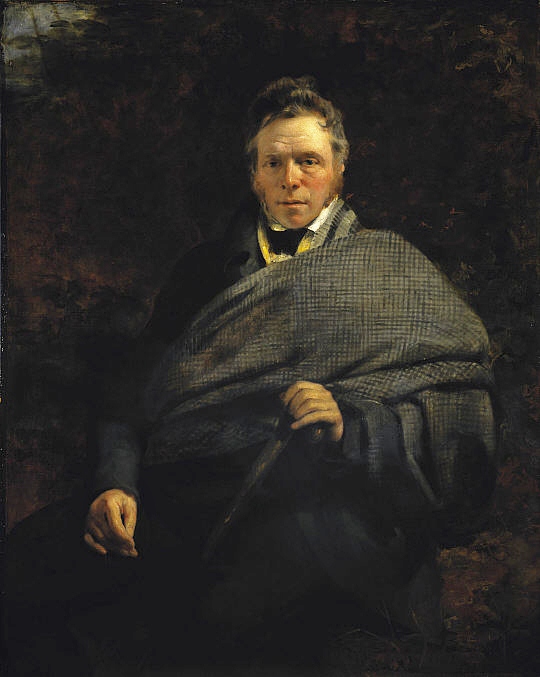
Jamie in his plaid.

Jamie in his plaid.

The author was “Jamie the Poeter,” who was promptly fetched from the sheep herds “down Ettrick break.” When Hogg was brought into Scott’s presence, he was a braw young man, tall and guid-looking. No’ unlike the fair hero of Gabaldon’s Outlander when he took off his bonnet, ‘from which fell a mighty cataract of fine red hair that flooded his back and shoulders.’*

Still, he was a peasant with coarse manners. Worse, he was not in the least cowed by being among those better educated than he. Above all, he insisted the ballad of Auld Maitland was genuine, having been sung by his mother. Indeed, he was verra proud of his parentage:

“This Hogg came of interesting stock, for there had been witches on the paternal side, and his maternal grandfather, Will o’ Phawhope, was the last man on the Border who had spoken with the fairies.” — Sir Walter Scott, John Buchan (1932)

Having met with Scott’s approval, the shepherd was engaged to collect more ballads and continue his fledgling career as a published poet. Between lovers and financial troubles, this man of the earth with unrefined tastes eventually found himself taken up by Blackwood’s Magazine to co-author the infamous Chaldee Manuscript, the very work which threw Whig society in an uproar.

He might not have fully understood the scandal and subsequent withdrawal of something deemed libelous. In his mind, the satire that was Manuscript was a fine piece. Moreover, he was basking in the glow of working with powerful critics such as John Lockhart and John Wilson. Indeed, he became quite caught up in the whirlwind of satire and duplicity that was attendant in working with those fellows. It was exhilarating at first, even if he was rather spooked by Lockhart’s personality, so like that of a mischievous brownie:

‘I dreaded his eye terribly,’ (Hogg) says, ‘and it was not without reason, for he was very fond of playing tricks on me..’

Christopher North, A Memoir of John Wilson, by Mary Gordon (1862)

But if his forthright mind could not immediately perceive what was happening, his friends became rather alarmed, particularly as they recognized Hogg’s  Shepherd persona with broad Scots accent and buffoonery being used rather liberally to amuse others at his expense. It was becoming clear he was no match for the Scorpion and the Leopard, their cleverness confounding him. So he left the critics to return to writing of the countryside’s mysterious, dark beauty, with its abandoned towers and glimpses of fairies, and the supernatural stories he’d heard at his mother’s knee.

His collection of those stories was bound in a volume he entitled Shepherd’s Calendar — so well-received he was finally able to retire much of his debts and happily ignore the caricature his former colleagues had created of him, a character which went on years afterwards delighting readers of Maga. Let them make sport of him, for he was to turn the tables, publicly chiding them for their false pride and superiority.

One of the tales Hogg included in his Calendar concerned the strange spectre of a lovely girl. She wore a green bonnet, its crown could be seen bobbing just over the horizon of a lonely path but would disappear as her pursuer approached, a wealthy, landed gentleman who would have fit in well among posh Edinburgh society. He was thwarted, bewitched by that which he didn’t understand, trying to catch a phantom old women warned him to stay away from, a warning he ignored, leading to a frustration and fear ending in madness:

“A great number of people now-a-days are beginning broadly to insinuate that there are no such things as ghosts or spiritual beings visible to mortal sight. Even Sir Walter Scott is turned renegade, and, with his stories made up half-and-half, like Nathaniel Gow’s toddy, is trying to throw cold water on the most certain, though most impalpable, phenomena of human nature.” — The Mysterious Bride

It was a different kind of literary criticism, and readers found delight in how the Shepherd’s characters, without regard to their education or their sophistication, would fall prey to the supernatural that still lurked in the country he loved.

* (as reported in Carswell’s Sir Walter, a Four Part Study in Biography)

Ettrick Forest Castle