Regency Essay on Ghosts

From a delightful Regency-era discussion in the Edinburgh Observer, or, Town and Country Magazine, Jan. 3, 1818:

“ON GHOSTS”

In churchyards:

“(they) have no particular business, but seem to appear, pro bono publico, or to scare idle apprentices from playing pranks over their tombs.”

Their appearance:

“dragging chains is not the fashion of English ghosts; chains and black vestments being chiefly the accoutrements of foreign spectres, seen in arbitrary governments.”

The female:

“if a tree stood in her way, she will always go through it. This I do not doubt: because women will go through anything, even if it be fire and water, much less a sturdy oak, to compass their end.”

they call him "Skeletor" -- an unexplained figure captured by closed-circuit camera at Hampton Court Palace

they call him “Skeletor” — an unexplained figure captured by closed-circuit camera at Hampton Court Palace

The effect of Christmas Eve:

“It is an established law, however, that none can appear on Christmas Eve…(and) there being some persons, particularly those born on Christmas Eve, who cannot see spirits.”

Conversing:

“The most approved mode of addressing a ghost is by commanding it in the name of the three Persons of the Trinity to tell you who it is, and what is its business. This may be necessary to repeat three times; after which it will, in a low and hollow voice, declare its satisfaction at being spoken to, and desire the party addressing it not to be afraid, for it will do him no harm.”

Mode of redress:

“In cases of murder, a ghost, instead of going to the next justice of the peace, or to the nearest relation of the deceased, appears to some poor labourer who knows none of the parties, draws the curtains of some decrepid nurse or alms-woman, or hovers about the place where the body is deposited.. the ghost commonly appl(ies) to a third person, ignorant of the whole affair, and a stranger to all concerned.”

Method of approach:

“The coming of a spirit is announced some time before its appearance, by a variety of loud and dreadful noises; sometimes rattling in an old hall, like a coach-an-six, and rumbling up and down the stair-case like the trundling of bowls or cannon balls..when any eminent person is about to enter their regions they make a great noise, like women..at a fire in the night-time.”

Getting rid of them:

“The process is to issue a summons to his worship, the parson of the parish , and another to the butler of the castle, who is required (by duces tecum) to bring him some of the best ale and provisions which he can find in his master’s larder. ..he is met and discomfited with ease by the parson in a Latin formulary:–a language that strikes the most audacious ghost with terror. What would be the effect of Greek, or wild Irish, or the American Choctaw, is not yet known.”

Place of banishment:

“..a but of beer, if an alderman–a pipe of Madeira, if a gentleman–he may be rolled up in parchment, if a lawyer, or confined to the garret, if an author.

HAPPY HALLOWEEN!

an authoritative book on the matter for late twentieth century juveniles

another authoritative source on the subject aimed at an audience of late twentieth century juveniles


Regency Critics: ‘No Such Things as Ghosts’

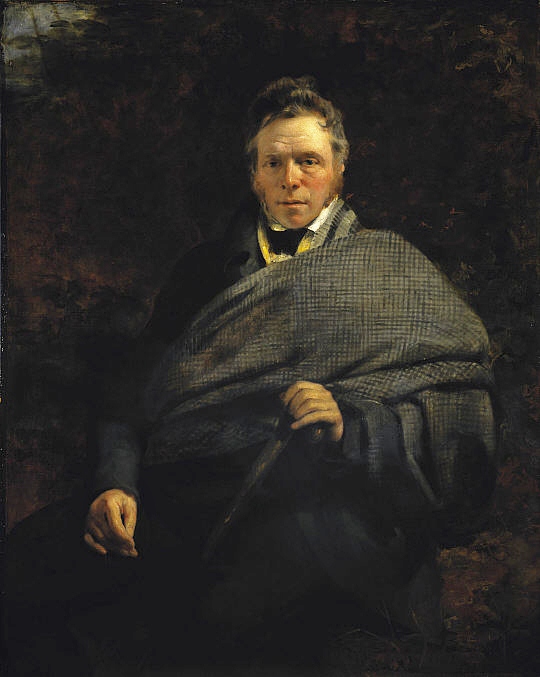
James Hogg (1770-1835) was the son of a tenant farmer and largely self-taught, the Bible being his primer. He worked as a sheep drover for another farmer, Laidlaw, who gave him more books to read and his son Will as companion. He began to write plays and pastoral poems, taking walking tours in the summers.

So things might have remained thus but for the approach of that ‘Wizard of the North:’ Sir Walter Scott.

This was 1802 and well before Scott singlehandedly rescued Scotland’s literary past from an undeserved reputation for being “provincial and antiquated.” As the composer Ralph Vaughan Williams was to later do for English folk music (I’m listening to his Symphony No. 3 even now), Scott immortalized the history of Scotland’s literature, collecting rural ballads and other oral traditions of the countryside for publication.

He was doing so ostensibly to feed the growing appetite for Romanticism, but he was quite keen to seek out the rustic and historical, preferably from the lips of old women and, you guessed it, shepherds. What he got instead was a poem Auld Maitland, so finely written that it could not have had its birth among the hills and forests of the Borders.

Jamie in his plaid.

Jamie in his plaid.

The author was “Jamie the Poeter,” who was promptly fetched from the sheep herds “down Ettrick break.” When Hogg was brought into Scott’s presence, he was a braw young man, tall and guid-looking. No’ unlike the fair hero of Gabaldon’s Outlander when he took off his bonnet, ‘from which fell a mighty cataract of fine red hair that flooded his back and shoulders.’*

Still, he was a peasant with coarse manners. Worse, he was not in the least cowed by being among those better educated than he. Above all, he insisted the ballad of Auld Maitland was genuine, having been sung by his mother. Indeed, he was verra proud of his parentage:

“This Hogg came of interesting stock, for there had been witches on the paternal side, and his maternal grandfather, Will o’ Phawhope, was the last man on the Border who had spoken with the fairies.” — Sir Walter Scott, John Buchan (1932)

Having met with Scott’s approval, the shepherd was engaged to collect more ballads and continue his fledgling career as a published poet. Between lovers and financial troubles, this man of the earth with unrefined tastes eventually found himself taken up by Blackwood’s Magazine to co-author the infamous Chaldee Manuscript, the very work which threw Whig society in an uproar.

He might not have fully understood the scandal and subsequent withdrawal of something deemed libelous. In his mind, the satire that was Manuscript was a fine piece. Moreover, he was basking in the glow of working with powerful critics such as John Lockhart and John Wilson. Indeed, he became quite caught up in the whirlwind of satire and duplicity that was attendant in working with those fellows. It was exhilarating at first, even if he was rather spooked by Lockhart’s personality, so like that of a mischievous brownie:

‘I dreaded his eye terribly,’ (Hogg) says, ‘and it was not without reason, for he was very fond of playing tricks on me..’

Christopher North, A Memoir of John Wilson, by Mary Gordon (1862)

But if his forthright mind could not immediately perceive what was happening, his friends became rather alarmed, particularly as they recognized Hogg’s  Shepherd persona with broad Scots accent and buffoonery being used rather liberally to amuse others at his expense. It was becoming clear he was no match for the Scorpion and the Leopard, their cleverness confounding him. So he left the critics to return to writing of the countryside’s mysterious, dark beauty, with its abandoned towers and glimpses of fairies, and the supernatural stories he’d heard at his mother’s knee.

His collection of those stories was bound in a volume he entitled Shepherd’s Calendar — so well-received he was finally able to retire much of his debts and happily ignore the caricature his former colleagues had created of him, a character which went on years afterwards delighting readers of Maga. Let them make sport of him, for he was to turn the tables, publicly chiding them for their false pride and superiority.

One of the tales Hogg included in his Calendar concerned the strange spectre of a lovely girl. She wore a green bonnet, its crown could be seen bobbing just over the horizon of a lonely path but would disappear as her pursuer approached, a wealthy, landed gentleman who would have fit in well among posh Edinburgh society. He was thwarted, bewitched by that which he didn’t understand, trying to catch a phantom old women warned him to stay away from, a warning he ignored, leading to a frustration and fear ending in madness:

“A great number of people now-a-days are beginning broadly to insinuate that there are no such things as ghosts or spiritual beings visible to mortal sight. Even Sir Walter Scott is turned renegade, and, with his stories made up half-and-half, like Nathaniel Gow’s toddy, is trying to throw cold water on the most certain, though most impalpable, phenomena of human nature.” — The Mysterious Bride

It was a different kind of literary criticism, and readers found delight in how the Shepherd’s characters, without regard to their education or their sophistication, would fall prey to the supernatural that still lurked in the country he loved.

* (as reported in Carswell’s Sir Walter, a Four Part Study in Biography)

Ettrick Forest Castle

Regency Critics: the Scorpion


It is perhaps appropriate, in the aftermath of the Referendum on Scottish Independence, that we turn to another Scot, a patriot to his birthplace, and famous Regency-era critic.

John Gibson Lockhart (1794 – 1854) was born to a clergyman and a clergyman’s daughter at the manse (rectory) of Cambusnethan House in the Scottish Lowlands. (Today, the place is marked by a rather haunting ruin in the Gothic revival style.) Lockhart was precocious at languages early on, and became somewhat of a specialist in translating the classics.

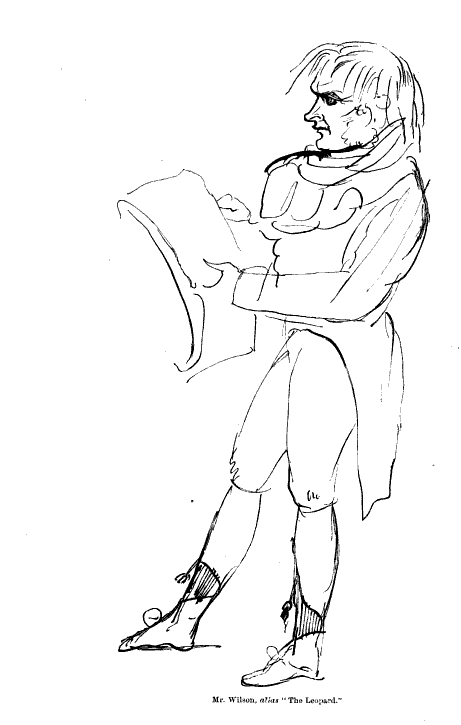
A self-portrait of the Scorpion--he was also an able caricaturist

A self-portrait of “Z”–he was also an able caricaturist

The publisher Blackwood took him up ostensibly to translate various German works for his magazine. He revealed his real purpose in a manger that reminds me of Dickens’ Fezziwig, as he wasted little time in introducing Lockhart to that other clever fellow he’d hired–John Wilson.

They were to be a team, but there were great differences between the two. Wilson was a ruddy blond, friendly and open-faced, if a little retiring. Lockhart, on the other hand, was not only dark in complexion, he was “cold, haughty and supercilious in manner,” such that even his own friends weren’t sure of his regard for them.

Even in their collaborations, the differences were stark:

“When (Wilson) impaled a victim, he did it..not vindictively, but as if he loved him. Lockhart, on the other hand, though susceptible of deep emotions, and gifted with a most playful wit, had no scruple in wounding to the very quick, and no thrill of compassion ever held back his hand when he had made up his mind to strike.”

— Christopher North, A Memoir, Mary Gordon (1864)

Lockhart became the Scorpion to Wilson’s Leopard. He also called himself, on occasion, “Z.”

The first attack he launched fell upon what he derisively christened the “Cockney School of Poetry.” Critics thought this was a mean-spirited jab at the artistic endeavors of the lower classes–particularly the poetry and other works by Keats, Hazlitt and Hunt. It certainly seemed that the Scorpion reserved his greatest sting for works that appealed to milkmaids and footmen longing to be poets themselves.

Of John Keats, he said:

“We venture to make one small prophecy, that his bookseller will not a second time venture 50 quid upon any thing he can write.  It is a better and a wiser thing to be a starved apothecary than a starved poet; so back to the shop Mr John, back to “plasters, pills, and ointment boxes,”& c.  But, for Heaven’s sake, young Sangrado, be a little more sparing of extenuatives and soporifics in your practice than you have been in your poetry..”

The attack devastated Keats. Some said it killed him.

Lockhart despised William Hazlitt’s social and literary commentaries, as well as his philosophizing on politics. Hazlitt was ‘pimpled’ and scarcely capable of any credible observation on the works of such ‘divine beings’ as Shakespeare and Spenser. Moreover, he was a member of ‘the vilest vermin that ever dared creep upon the hem of the majestic garment of the English muse.’

Zounds!

Hazlitt was not about to take this criticism lying down, (not like poor Keats, who was very, very ill). He vowed to sue Blackwood’s for libel and began his counter-assault by threatening the magazine’s agent in England, John Murray. The latter resided in London and was particularly sensitive about alienating the Scottish periodical’s London audience, naturally quite in charity with those “Cockney” poets.

Unabashed, Lockhart responded that attacking the poet was a necessary part to criticizing the poet’s work. (For more on this subject, see David Hill Radcliffe’s excellent overview of the Scorpion’s Cockney articles.)

John Gibson Lockhart as himself

“Mr. Gibson Lockhart, alias Baron Lauerwinkel, alias William Wastle, alias Dr. Ulrick Sternstare, alias Dr. Peter Morris, etc. as sketched by himself.”

Lockhart could not abide literary work that was put forth in bad faith, that was lazily executed or written only to satisfy what was fashionable. He felt that the literary scene in Scotland was far more sophisticated and diverse than that of London, concerned that the typical hand-in-glove, “wink-wink” collaboration common in England would corrupt Scottish artists and shackle them in English (translate Whig) style to politically connected, well-established magazines like Francis Jeffrey’s Edinburgh Review. 

Perhaps that was why his most famous victim became Leigh Hunt, whose labors he described were like those of:

“a vulgar man (who) is perpetually labouring to be genteel — in like manner, the poetry of this man is always on the stretch to be grand.” Blackwood’s, October 1817

Nevertheless, the Scorpion was forced to bow to his employer’s business concerns and retracted most of what he’d written in those early days. He did so reluctantly, quoting Tacitus, “rara temporum felicitas ubi sentire quae valis et quae sentias dicere licet” (rare felicity of the times when it is permitted to think as you like and say what you think).

Still, the scorn he heaped on the poet was simply diverted to the poet’s labors. Leigh Hunt, that darling of the Review, had written The Story of Rimini. Lockhart was convinced Hunt was forever dangling after favorable reviews from his Whig friends and he made certain to set the record straight on Hunt’s poetry, if not his character:

“The revisions became the most strained when they had to deal with the most personally flagrant aspect of the first article about the Cockney school: its insinuations about Hunt’s domestic life and sexual morality.

Z had written, ‘The very concubine of so impure a wretch as Leigh Hunt would be to be pitied, but alas! for the wife of such a husband!’

This was revised to read, ‘Surely they who are connected with Mr. Hunt by the tender relations of society, have good reason to complain that his muse should have been so prostituted. In Rimini, a deadly wound is aimed at the dearest confidence of domestic bliss.’ ”

— Romanticism and Blackwood’s Magazine: ‘An Unprecedented Phenomenon,’ edited by Robert Morrison and Daniel Roberts (2013)

Interestingly, Lockhart’s early description of Hunt’s personality was prescient. A later writer, and a good deal more famous, used Leigh Hunt as a model for that famous “sponger of friends,” Harold Skimpole of Bleak House.

It is him, I vow–to the life!

But as for London and its “Cockney” influence, he remained an implacable foe, viewing it as a scourge upon the Scottish literary scene. It was in this role that he caught the eye of Scotland’s literary giant, Sir Walter Scott, and, more importantly, the poet’s daughter–a lovely lass called Sophia. They married and lived together in a little cottage on her father’s estate. With her, he could give his heart its liberty and:

“speak of the chief ornament and delight at all these simple meetings—she to whose love I owed my own place in them.”

The Life and Letters of John Gibson Lockhart, Andrew Lang (1897)
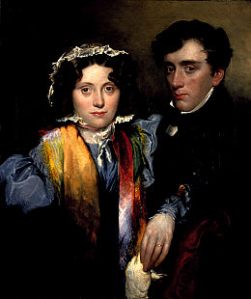
Lauder's portrait of Sophia and John--painted after she died. Note the prominence of her wedding ring, her countenance light while her surviving husband's remains in shadow.

Lauder’s portrait of Sophia and John–painted after she died. Note the prominence of her wedding ring, her beloved countenance placed in the light while that of her surviving husband, the Scorpion, remains in shadow.



Regency Love: The Man Who Ate His Boots

“The ship, probably the Terror, was very neat and orderly, but the Inuit descended into the darkness of the hull with their seal-oil lamps, where they found a tall dead man in an inner cabin.” — The Guardian, 2009

Sir John Franklin

Sir John Franklin

After years of tantalizing clues found in the ice and stories told by indigenous Arctic people of men freezing to death, it appears that one of two ships from Sir John Franklin’s expedition to chart the Northwest Passage has finally been found.

Sir John Franklin (1786-1847) “the man who ate his boots” became a subject of interest to this blog for having married the Regency poet Eleanor Anne Porden. She was his first wife, urging him not to linger while she was dying of tuberculosis, but instead to follow his dreams on the sea.

She was spared the agony of his disappearance. That would be reserved for Sir Franklin’s second wife.

Jane Griffin (1791-1875) was a good friend of Eleanor’s and a part of Regency London’s scholarly set. She had no inclination of who her future husband might be, but one Dr. Peter Mark Roget had made quite an impression on her. He was, she once said, “the only man to make me swoon.”

In 1828 she married her friend’s widowed husband and soon after became Lady Franklin upon his knighthood. His travels took her to places as far away as Australia, arousing her keen interest in its colonies, particularly for the condition of female convicts who’d been transported there.

Lady Jane Franklin

Lady Jane Franklin

When Sir Franklin embarked on his ill-fated expedition to navigate icy Arctic waters, she supported him unreservedly. When he failed to return, she made certain no one would forget him. Because of her tireless effort to discover his fate, the charting of the Northwest Passage occurred a good deal sooner than it otherwise might have. She sponsored seven expeditions in all.

And now my burden it gives me pain
For my long-lost Franklin I would cross the main
Ten thousand pounds I would freely give
To know on earth, that my Franklin do live

Lady Franklin’s Lament

It was by land the answer was eventually determined. Scotsman John Rae, an Arctic explorer familiar with the Inuit and their territories, found definite evidence of Franklin’s demise. His report mentioned cannibalism, shocking Victorian society.

Lady Franklin refused to believe her husband had been a part of an act so heinous and so she turned her efforts toward the messenger bearing such bad news. She made certain no one would remember him.

The End in Sight by Turner

The End in Sight by Turner


Regency Critics: the Leopard

John WilsonBlackwood’s Magazine, or “Maga,” first appeared in 1817, “breaking upon the startled gaze of Edinburgh Whigdom.” It soon gained a notoriety for being, more than anything, an affront to the Edinburgh Review, subject of this blog’s previous post.

This rivalry served to give Blackwood’s popularity a boost throughout Regency Britain, along with the curious way its writers adopted numerous pseudonyms; a practice that probably began with one John Wilson.

He was born a gentleman, with a comfortable fortune and had only dabbled in writing because of crippling self-doubt about his literary abilities, bringing himself to publish only a few of his poems. Then one day he discovered that his inheritance, made from the manufacture of paisley, had been speculated away, thanks to the efforts of an unscrupulous uncle.

With a wife and children to support, Wilson was forced to move into his mother’s house on Queen’s Street in Edinburgh and seek employment. Blackwood’s was hiring writers–the previous ones having been sacked by Mr. Blackwood for producing a dull first volume. Reluctantly, Wilson accepted the job, girding himself against his old insecurities by assuming a pseudonym, an alter ego that would serve as a cloak once he sallied forth with his fellow literary critics to assail (some called it assassinate) the characters and careers of those beloved by the Review and its editor Francis Jeffrey.

Wilson became known as the notorious Christopher North, that “beautiful Leopard from the valley of the palm trees.” The power of his criticism, some said, was like a force unleashed by “animal spirits:”

Of Coleridge and his Biographia Literaria: “a most execrable performance” by someone who possessed both “egotism and malignity.”

On Leigh Hunt: “a profligate creature..without reverence either for God or man.”

It must have felt positively delicious, this new-found freedom that came from masquerading as another. Indeed, the other critics at Blackwood’s adopted Wilson’s penchant for fake names, if for no other reason than to “perplex the public.” Some of these appellations were mystical, some were just ridiculous–Timothy Tikler, Baron Lauerwinkle, William Wastle and Dr. Ulrick Sternstare.

The pretension was carried even further when writers adopted the real names of ordinary Edinburgh citizens, preferably those far removed from the literary scene, and made them father articles of great distinction. One dentist became very well-known as a respected contributor to Blackwood’s, to his friends’ amazement. Even the doctor himself began to believe those clever jokes and observations were his, for they very often contained his own expressions and identified many of his acquaintances:

“The doctor’s fame when far beyond Edinburgh. Happening to pay a visit to Liverpool, he was immediately welcomed by the literary society of the town as the glorious “Odontist” of Blackwood’s Magazine, and received a complimentary dinner.”

— Christopher North: a Memoir of John Wilson, by his daughter, Mary Gordon  the Odontist

Pretense became deception, in the manner of a very wicked joke on poor Leigh Hunt. Blackwood’s was fond of targeting this darling of the Review and often accused the poet of badgering the Whig periodical to include favorable reviews of his work in its pages. This might have gone unnoticed by Hunt had he not received letter from one John Dalyell apologizing for the terrible things he’d written about the poet in Blackwood’s. Hunt scratched his head, perplexed, wondering who the devil Dalyall was. He sought the advice of the Review’s editor, who instantly recognized the name of the apologist.

Dalyell was appalled and furious. Of course he hadn’t written any such thing about Leigh or his poetry. He hated Blackwood’s. He had to sue them for libel once.

“Oh, the villainy of these fellows!” he declared. He’d been made a figure of fun. Everyone in Edinburgh knew John Dalyell–he was the most  prominent Whig in Edinburgh. Now they knew him as a contributor to a wretched Tory magazine.

As amusing as Blackwood’s was, John Wilson eventually wearied of writing as someone other than himself. Escape came in the form of a professorship of Moral Philosophy at Edinburgh University.

He was happy to leave the hurly-burly world of literary society to a place, however dull, where his insecurities could be soothed–the ivory tower.


Regency Critics: the Slasher

Edinburgh has been argued as the early nineteenth century’s “capital city of modern literature.” It is there that we find the original Regency-era critic.

The Edinburgh Review was one of the first, if not the inaugural, quarterly journal to feature in-depth literary reviews. It was created by a circle of Whigs, some of whom have been the subject of this blog in the past: Sydney Smith and Henry Brougham. Joined with them were Francis Horner and Francis Jeffrey, the latter becoming the Review’s editor throughout the Regency.

Old Calton Burying Ground in Edinburgh--split in half during the Regency era

Old Calton Burying Ground in Edinburgh–split in half during the Regency era

Francis Jeffrey (1773 – 1850), later Lord Jeffrey, took the helm of the Review with the intent of producing more than just what elementary students would term book reports. His periodical aimed to publish critical reviews that would be sought out for their own merits. These reviews would illustrate a deeper inquiry into literary works of the day, examining their qualities as they relate to Society as a whole. To deliver these mighty opinions one must have a salaried writer, who was hired for his politics as much as for his penmanship.

It was the birth of the professional literary critic.

Jeffrey submitted quite a few of these reviews himself, and in a very short time, he was to discover the hazards of offending the Regency-era writer. He pronounced Thomas Moore’s naughty epistles “a public nuisance” and was challenged to a duel (he and the Irish bard became friends afterwards). He chided beloved Marmion for disrespecting the great Whig politician Fox, and lost Sir Walter Scott’s patronage.

Not to be deterred, Jeffrey continued to develop a “slashing” style of critique that mowed down whatever he perceived to be overly wordy, superfluous and extravagant (we call it purple prose today–then it was known as Rousseau). Few writers in the Romantic vein (the favored poetic style of the Regency) failed to escape his scythe. Especially despised were those he derided as the Lake Poets, and for them a truly masterful trimming was reserved:

Wordsworth–“Even in the worst of [his] productions, there are, no doubt, occasional little traits of delicate feeling and original fancy; but these are quite lost and obscured in the mass of childishness and insipidity with which they are incorporated.”

Lord Francis Jeffrey, by Geddes He would have been a fan of Judge Judy

Lord Francis Jeffrey, by Geddes
He would have been a fan of Judge Judy

Southey – “All the productions of this author, it appears to us, bear very distinctly the impression of an amiable mind, a cultivated fancy, and a perverted taste.”

Keats  – “(Apart from Endymion) there is no work, accordingly, from which a malicious critic could cull more matter for ridicule, or select more obscure, unnatural, or absurd passages.”

Critical review was brutish, nasty work and in any case, Jeffrey had always preferred the practice of law. His popularity as a critic brought him a larger caseload which he welcomed and used to increase his standing at Bar, slashing opposing counsel. In the end, he was awarded elevation to the Bench.

Now that’s justice, (and criticism), with an attitude.


Regency Obituaries

By 1814, the Romantic “cult of feeling” was finding its way into all sorts of media, including the obituary section of Regency-era periodical. Evocation of far-away places, heroic sacrifice, violence and a desire to return to the natural state of things were being expressed:


Sarah Anderson, a free black woman, a native of Guinea, of the Congo country, died the 20th of September last, at Providence Grove, St. John’s, Jamaica, at the extraordinary age of 146 years! She arrived on that island in 1687, during the Government of the Duke of Albemarle, whom she remembered well, and whose person she described quite accurately.


Major Maxwell McKenzie, Lieutenant-Colonel of the 71st Regiment..this gallant officer received his mortal wound in an engagement with the enemy near Bayonne, while nobly cheering and leading on his men to charge the enemy, and thus terminated an honorable life in a glorious death..


At Gibraltar, in consequence of a severe and violent attack of the dreadful disease raging at that place, John Smith, Esq., son of the late J. Smith, merchant from Inverness


In Presburg, Hungary, Eve Zuacher, at the advanced age of 123 years. Her hair was abundant and remained black; her teeth were very white and she retained all her senses to the last. Her sight was so piercing, that she could, at a distance of 1000 paces, distinguish the different kinds of cattle in the meadows. When questioned once as to her mode of living, she answered, ‘I eat and drink, not because the victuals are placed before me, but because I am hungry and dry; I go to rest with the cock and rise with him.’ A few days before her death she taught catechism to an infant of four years and walked eight miles (!)


— taken from The Scots Magazine and Edinburgh Literary Miscellany, Volume 76, dated 1814


This engraving comes from one of many so-called “Memoirs” published in the immediate aftermath of Her Highness’ death. Note the prostrate gentleman at the foot of the memorial, complete with discarded shield and heroic bust. I wonder if he is meant to be Prince Leopold, her husband, or the Author, humble esquire.


Regency Family Disaster: Disinheritance

By the time of the Regency, the family of Chichester had been deprived of the majority of its vast fortune by one generation of spendthrifts. But it convulsed over the dignity it valued most, its English title–the barony of Fisherwick. Although the house that bore this illustrious name and symbol of an Irish family’s entry into the highest society had long since been demolished, the baronial title Fisherwick remained the jewel in the crown, which could not be bought, sold or torn down.

The Countess of Charleville wrote to Lady Morgan in 1819 describing various bits of news to be had ’round London, gossip being the only enlivening thing when what one really wants is to get away from England entirely. She conveyed a variety of things to her ladyship, such as Lord and Lady Westmeath’s separation “for temper” and the outrage over Byron’s impious Don Juan. But the most intriguing of all was the following:

Lord Belfast, when he later become 3rd Marquess Donegal

Lord Belfast, when he later become 3rd Marquess Donegal

“…the overthrow of Lord Belfast’s marriage and fortunes, by Lord Shaftesbury having discovered that the Marquis and Marchioness of Donegal were married under age by licence, and not by banns, which renders it illegal, and bastardizes their children irreparably, is the greatest news of the upper circles at present.”

Lord Shaftesbury was the sixth earl of that name (seventh, according to his contemporaries). He had lately come into the  title upon the death of his older brother and was one of the wealthiest men in England, with a daughter whose dowry could redeem many a debt. While still just the Honorable Cropley-Ashley Cooper, his lordship had been a clerk in His Majesty’s ordinance office. It is not too fanciful to imagine he had developed a healthy dose of skepticism during the course of administering a government function ripe with the potential for corruption.

When Lord Belfast, the heir of the Marquis of Donegall came courting, Shaftesbury had already been primed to sniff out any irregularity and not just because there were rumors about his mama.

It was generally known that Belfast’s mother, the Marchioness of Donegal, had been born a “natural” child. Even the circumstances of her marriage, a parson’s mousetrap baited by a scheming father, were overlooked in view of the high-flown family into which she had been brought in. Only after the birth of seven boys did talk surface that she might have been a minor at the time of her marriage. And according to the Marriage Act of 1753, with the aim of reducing clandestine marriages, a “natural” child had to have the consent of the Lord Chancellor to wed. Neither the couple who adopted her in Wales nor her putative father had standing to give consent for her marriage.

Some say Shaftesbury found out this anomaly via an anonymous letter. However this occurred, the marriage between his daughter and Lord Belfast was called off, a social event that made a family affair into a national one, as Lady Charleville goes on to relate:

Lady Glengall - "that little she-attorney"

Lady Glengall – “that little she-attorney”

“The young lady had said she married only for money; therefore, for her, no pity is shown; but poor Lord Belfast, to lose rank, fortune, and wife at once, at twenty years of age, is a strong and painful catastrophe to bear properly.”

All at once the family fortunes seemed at a standstill. Everywhere Lord Belfast became known as simply Mr. Chichester, for now his cousins, the sons of the Marquis’ deceased brother, Lord Spencer Stanley, were next in line to inherit the marquisate and its venerable barony of Fisherwick.

“I hear Mr. Chichester (rightful heir now) behaves well; but he cannot prevent the entail affecting his heirs, nor the title descending to him from his cousin.”

It wasn’t long afterwards that Belfast cast his eye on the daughter of the Earl of Glengall. According to Regency diarist Henry Edward Fox, Lady Glengall was a “little she-attorney,” determined to get her daughter off her hands even if she had to craft a new title for the Marquis of Donegal’s disinherited scion. Perhaps this was the reason that the indolent Lord Donegal was moved to Act.

What followed was a fascinating, if somewhat lengthy and confusing journey into Regency-era litigation. Far from disputing the lack of the Lord Chancellor’s order, Lady Donegal insisted she was not a minor when her father bamboozled Lord Donegal. Indeed, she scrambled together several aged witnesses and fought jurisdictional barriers to get evidence before the court as to her true birthdate.

The conclusion was a Parliamentary order to regularize the Donegal union that had been made illegitimate by the old Marriage Act.

Moral of the story: some families are too high up on the social ladder to fail–er, fall.

Harriet, Marchioness of Donegal

Harriet, Marchioness of Donegal

Postscript: What financial and legal ruin the Chichesters may have survived, their physical evidence has been erased. During the Victorian period, the mausoleum containing the bodies of the family, built near the vanished Fisherwick Hall, had become infested with rabbits and was destroyed.


Regency Family Disaster: Fisherwick’s Demise

George, Lord Belfast, had a brother six years younger–Lord Spencer Stanley Chichester (1775-1819). Spencer Stanley was the last child born to the old Marquis and his beloved first wife, Anne. He was only four when his mother died.

Lord Spencer Stanley Chichester

Lord Spencer Stanley Chichester

When George came of age in 1791, he had already declined an education at his father’s alma mater, Oxford, and left home for the gaming tables and the turf:

“I had the whole story of Lord Belfast and a sad one it is….the foolish young man had been bamboozled out of 40,000 pounds in the space of nine months by some villainous people..” — 1791 letter from Lady Newdigate

Sixteen year old Spencer Stanley remained at Fisherwick, companion to a perplexed father puttering about his shells and books in between trips to London for Parliament and the Season. One can easily speculate how his lordship, despairing over his absent elder son’s dissipation, should turn for comfort to the younger.

Imagine how he must have rejoiced, after seeing George rebuffed by a chit in the schoolroom, when Spencer Stanley married the Lady Harriet Stewart, the daughter of the earl of Galway. No one thought to question why the older son was absent from the nuptials, which was a good thing for it might have cast a cloud over the festivities.

Lady Harriet Chichester

Lady Harriet Chichester

You see, on that very day, George was being married to the daughter of a moneylender.

It was shortly afterwards that Spencer Stanley was informed by his father the Marquis that Fisherwick and all the furnishings therein would one day be his. And because the old man did not trust his older son to see his will carried out, he made the younger the executor and appointed a trustee to advise him:

“against the many embarrassments which the great extent and multiplicity of my concerns and his own inexperience and the unhappy conduct of his brother may otherwise involve him in..” —

In 1799, the brothers came into their inheritance, their father having died at age fifty-nine. Creditors descended in ever larger droves on the hapless George, who had executed a number of post-obit bonds to cover his debts incurred after his estrangement from the family. His younger brother held all the cards, including a cash settlement from the Lagan Canal in the family’s Irish property. The building of this waterway had yet to be paid for, its equity stripped to pay out the settlement. George, as the new marquess and owner, was liable for this worthless asset, already deeply encumbered by the interest payments on the construction bonds.

The new marquis and his family moved from house to cottage across England, sometimes barely escaping with their clothes. Meanwhile, Spencer Stanley lived on at splendid Fisherwick, among the Gainsborough portraits of his family and perhaps idly playing on Queen Elizabeth’s virginal.

Then, in January 1816, La Belle Assemblee reported that Lord Spencer Stanley Chichester had presided over the sale of his father’s collection, including the Queen’s virginal, almost twelve years before. This was followed by the Survey of Staffordshire which revealed Fisherwick had been sold to one Richard Howard, Esquire six years before, in 1810. The Survey, being concerned with the land’s economic value in its mines, farms, and woods, cast a cynical eye over the fall of Fisherwick:

“..a profusion of embellishment, and extravagance of expenditure, this earthly paradise, as it was termed by vulgar minds..demolished by other architectural projectors for the value of the materials, which have been carried off to decorate the paradise of some other fanciful mortal.” — A Topographical History of Staffordshire, William Pitt (1817)

A footnote to Fisherwick’s fate concerned its magnificent stone portico. Sadly, the wrenching away of this decorative feature had destroyed the house itself:

“..such was the firmness of the fabric, that the destruction of the building has been the almost entire destruction of the material itself..” The New Monthly Magazine, Vol. 6 (1816)

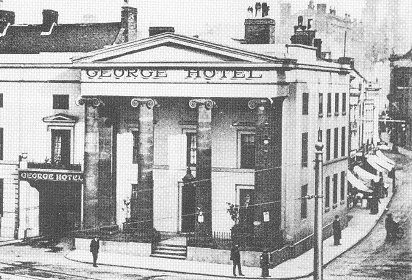
According to this source, the pillars were to fetch 1000 pounds bid for by a new church to be built in Birmingham, but went to the Viscount Anston for a fraction of that amount. Eventually the portico wound up in the industrial town of Walsall, decorating the old George hotel, until this too was demolished in 1934.

those pillars do appear to be Ionic in design

those pillars do appear to be Ionic in design

Spencer Stanley died in Paris in 1819, leaving two sons and three daughters.

How he had journeyed to this end, leaving in his wake the destruction of his papa’s beloved Fisherwick, is a matter of conjecture. Had George prevailed upon his younger brother to pledge what he had to stave off the never-ending horde of creditors, swallowing up what the old Marquis had fought in vain to save? Or had Spencer Stanley, without the steadying hand of his father, fallen prey to the gambling vice that afflicted his older brother, losing Fisherwick through his own efforts?

The answer may lie in a future dispute among members of the Chichester family–one concerning the very name of Fisherwick itself.


Regency Family Disaster: Debtors’ Prison

The heir to Fisherwick Hall was George Augustus Chichester (1769 – 1844). The oldest son of the Marquis of Donegall, Viscount Chichester was generally known as Lord Belfast, even in debtors’ prison, to his father’s chagrin.

"It's hard to be strict with a man who loses money so placidly," said a Yankee guard of his prisoner, one Rhett Butler

“It’s hard to be strict with a man who loses money so placidly,” said a Yankee guard of his prisoner, one Rhett Butler

For awhile, the marquis had covered his heir’s debts, which sprang primarily from gaming. He had ambition that his son, like himself, might marry well. Unfortunately, rumors of Lord Belfast’s profligacy reached the ballrooms of London, finally saturating them to such a degree that no willing candidate for his hand could be found.

Then success seemed probable when Lord Belfast took a fancy to the fifteen-year-old daughter of the Duchess of Leinster, “still in her frock.” But not even the schoolroom was proof against the news of mounting debts and the match was called off:

“..our dear Cecilia might have been made by it unhappy for life, as it is dear creature she has only to be thankful she has escaped so happily being married to a dissipated bad man..”

letter of Mrs. Anne Finch to Lucy Fitz-Gerald reprinted in — Living Like a Lord, the Second Marquis of Donegall, 1769-1844, W. A. McGuire 1984

By this time the harassed father had bailed his son out to the tune of 80,000 pounds and exhausted, bade him to go his own way, which was to prison. At times in Marshalsea and at others in Fleet, it appears Belfast preferred the latter. The beauty of life in this particular debtors’ prison allowed his lordship, according to one disgruntled creditor, the opportunity:

“of going to all public places and all races and fox hunting which were within forty or fifty miles of London for several years that his lordship was prisoner.” — Living Like a Lord, McGuire

Not all prisoners enjoyed such flexible “day rules” as Lord Belfast. It’s just that he made it so lucrative for guards and others alike to give him free rein and continue his poor performance at gambling. He seems not to have exercised any more judgment than before; indeed, prison seemed to encourage his bad habits, shielding him from the harassment of those to whom he owed many thousands of pounds.

Lord Belfast's illegitimate wife

Lord Belfast’s illegitimate wife

Eventually even this velvet restraint, however lenient, had become tiresome.

And when in need, Chichester tended to turn to those who did not have his best interests at heart.

One such fellow was Edward May, worse than a cardsharp and a good deal smarter. He looked past the worthless vouchers that could be wrung from Belfast’s cardplay toward a glittering horizon filled with political promise, in faraway Ireland. Belfast’s father, the marquis, was a great landowner in County Donegall and had in his patronage a good deal of government appointments and the like. Presumably these benevolences would be inherited, along with the marquis’ titles, and could be exercised on behalf of those who held them (or their dependents).

But the old man was still alive and who knew how long he might live?

A tie of a permanent sort was required, one that would last longer than some scribbled agreement. In exchange for his freedom, May offered his lordship the hand of his illegitimate daughter, Anna, in marriage. She, like her other siblings, was the issue from a union May entered into with the still-married wife of a Liverpool merchant.  Lord Belfast agreed.

The marquis was beside himself.  His son’s behavior had quite cut up the family peace but there was nothing that could be done to void such an lowering union.

It was then that the old man took stock in all that he held dear. The swine his son consorted with would soon hunger for more. So the marquis divided his estate between what he could not save–the marquisate and all the entailed properties–and gathered close to him what he could.

His beloved Fisherwick, its contents, even the Gainsborough portraits were inventoried meticulously and drawn up in a new will. None of which he loved the most would ever be wasted, sold or even touched by a son so unworthy. Lord Belfast was as good as dead to him.

And what remains lost, can never be found again.