Taking the Plunge

Prior to, and on into the Regency, the idea of bathing was connected to its medicinal value.  It was particularly valued for the salutary effect it had on one’s health, and not for the sensibilities of one’s neighbors.  By the eighteenth century, cold bathing had become quite the vogue.

The Regency Cold Bath

“Mr. Porter, who is an apothecary, was talking of the cold bath and the service it had done him by making him of a more strong firm constitution than before.  He says it is extremely good against the headache, strengthens and enlivens the body, is good against the vapours and impotence, and that the pain is little.  I have almost determined to go in them myself.”

–Dudley Ryder, London attorney, 1715

And much cheaper than Viagra!

A large country house like my character’s estate would not have been complete without an open air cold bath.  I modelled the cold bath at Northam Park after the one at Wynnstay in Denbighshire, pictured above.  A extended discussion of this building’s historical value is here.

Capability Brown included one in his landscape design for the Earl of Northam, commissioning the architect James Wyatt (1746 – 1813).  Wyatt was already a rival to Robert Adam by this time and had not yet entered his Gothic period.  He designed a classical pavilion for Northam Park’s gardens, distinguishing it with a portico echoing that of the great house itself, and supported by ornate Corinthian columns.  It overlooked a rectangular pit lined with stone.  The cold bath was large enough for swimming, nevertheless the temperature discouraged extended sojourns in its icy waters.  Afterwards, one could retire to the pavilion and change.  To enhance one’s feeling of accomplishment, refreshments would be served.  Just the thing for warming up.

The Countess of Northam, the main character in Notorious Match, would entertain guests to her estate with at least one trip to the bath house.  It was something of an outing.  Both sexes would bathe together, appropriately attired of course.
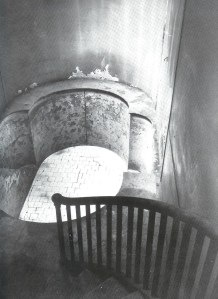
Wimpole Hall, Cambridgeshire plunge bath – prior to restoration

More examples of cold baths built and used during the Georgian and Regency periods are to be found here along with some very pretty photos of examples made out of grottos and gothic pavilions.

The various baths pictured in Jane Austen’s World are instructional, saving the naughty bits.

Temple of Diana

The principal house featured in my manuscript Notorious Match, Northam Park, boasts a large parkland reaching upwards of one thousand acres.  Much of it was laid out by the eminent landscape architect Capability Brown (1716 – 1783).

A prophet is not without honour, save in his own country. Lancelot Brown is commended throughout the world as the master of the English landscape garden, but at home, he is frequently dismissed as a vandal who destroyed large numbers of illustrious formal gardens. 

–“Great British Garden-Makers:  Lancelot “Capability” Brown,” Country Life, Feb. 20, 2010

Brown’s new style of gardening design eschewed carefully trimmed hedges and formal flower gardens (think Hampton Court) for a more natural environment with grass-covered undulations leading down to carefully installed lakes and trees.  The effect was beautiful, providing a panoramic view from the great Palladian houses being built as country residences for the wealthy.

One of the charactertistics of this new landscaping style was the garden temple, an outdoor feature normally given a classical design although many favored a more Gothic bent with the rise of Romanticism.  These would be placed not far from the main house, but within the natural setting of these “gardenless” gardens.  From them, you could look across the estate through a long-viewer while keeping your eye on the children as they bowl on the manicured lawn nearby.
Many times these beautifully designed structures were simple rotundas, like the one pictured above from Beachborough House in Kent in a painting attributed to Edward Haytley, circa 1745.
Several, like the one at Northam Park, were much more grand and served a variety of functions–greenhouses, etc.
I particularly adore the lovely one used for the shooting party lunch in Robert Altman’s mystery Gosford Park (2001) at 1:40.  Clive Owen, anyone?  Yes, please.
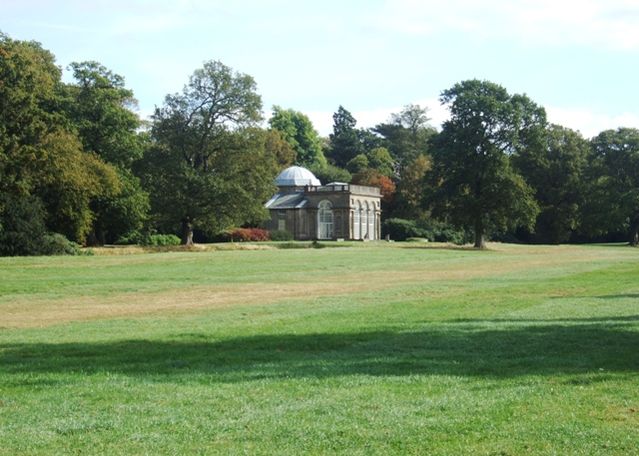
Northam Park’s landscape feature is called Diana’s Temple.  It is very similar to the one of the same name at Weston Park, pictured below.  For a wonderful view of the restored interior, with its remarkable plasterwork, see this exquisite photo from Country Life.  It looks just like a piece from someone’s blue Wedgewood collection.  This temple was designed by James Paine (1717-1789) who also designed the stables at Chatsworth House.

photo copyrighted and licensed by Simon Huguet

Regency stable

“This particular dress, Mr. Carson, is of the first stare,” Mugger insisted with clenched teeth.  “It has a rather daring stand-up collar along the back of the bodice and is the very latest design from France.  It requires her ladyship’s fitting immediately.”

“Stand-up collars are rubbish in my book, Mrs. Mugger,” Carson retorted.  “I’ve got the management of an estate.  Without Northam Park, you and your fripperies can go to perdition.”

Diana winced.  Her estate manager had sacrificed much for Northam Park in her absence.  She had yet to visit it since Vivien had married  but the thought of going there to stay alone in its brooding presence was insupportable.

Mister Carson,” Mugger replied, “you’ve been hounding my lady over that stable for nigh on six months.  Surely it can wait another day.”

“It could.  But you may be surprised to know that even my lord Montgomery agrees with my judgment.  It ought to be pulled down.”

Diana jerked her head up.   “What did you say?”

“Lord Montgomery agrees, my lady,” Carson explained eagerly.  “I spoke with his lordship about the matter the other morning, before you went for your ride.”

“You did?”

Carson visibly quailed.  “I beg your pardon, my lady, but it seemed only natural that I apply to him for an opinion on the matter, given his experience with horses and uh, estates.”

“May I remind you his experience with estates encompasses the loss of his own just this past year?”

“Yes, my lady.  It was merely a trifle—only—only in passing, I assure you.  My lord was kind enough to enquire—always solicitous my lord is,” Carson replied, his voice trailing off in misery.

Diana’s country estate, Northam Park, has a large stable that was the centerpiece of her family’s horse racing enterprise.  The red brick Jacobean-style complex has since fallen into disuse.

Now the steeple that crowns its breeding barn has tumbled to the ground, frightening the gardeners and posing a continued hazard to Diana’s retainers who live and work on the estate.  Diana is reluctant to pull down this last reminder of her earldom’s former glory, but she must do something before anyone is hurt.

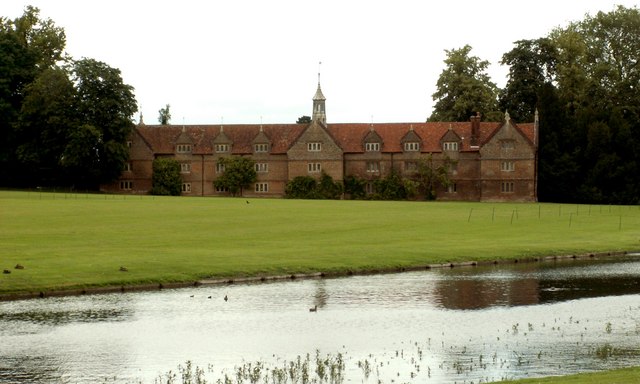
Audley End stable gives a fairly good picture of what Diana’s stable looks like.  It’s as fine as many lesser country houses.

Audley End Stables - © Copyright Robert Edwards and licensed for reuse under this Creative Commons Licence

Unlike Audley End’s stable, Northam’s is scheduled for demolition.  The horses for which it was built have died out, the last descendant having been stolen.  Thor was eventually recovered, but only after he had been gelded, an act as final as it was inexplicable.
The thieves would not have succeeded but for the terrible shock and distraction the estate had fallen under that night.  The night when its earl, Diana’s father, was found dead along a lane he must have driven over a hundred times before without incident.

The Ha-Ha Revisited

Diana’s country estate of Northam Park has a ha-ha.  Somewhat like the dower house at Lavenham Court, in Georgette Heyer’s marvelous Talisman Ring:

I mentioned this landscape feature in an earlier post because it figures largely in the book preceding Diana’s story entitled Notorious Vow.You cannot jump one in a side-saddle.  Trust me on this.  If you have, please comment and share your experience.In Diana’s story, this barrier that separates the immediate grounds of the mansion from the outlying agricultural fields is not immediately apparent from the house.  The architect of the estate’s landscape features tried to incorporate the beauty that is Leicestershire into a working farm so that its master, the earl of Northam, could enjoy the glory of his property without being reminded that it was the rents collected from labor and cultivation that made it all possible.

The Earl is Dead

In Notorious Match, heroine Diana Wace is strangely conflicted over the tragedy that made her Countess of Northam. 

On the one hand, she rebels against the tremendous wealth and property that are now hers.  She has no lack for suitors, many of them penniless fortune hunters, all of them eager to become the next Earl of Northam.

Diana also suffers from a terrible guilt that arose from the death of her father, the late Earl Reynold.  While he was alive, she was kept hidden away on his northern estate, forgotten and unloved.  With his death came her release from the prison that was Northam Park.

Since then, Diana avoids the estate, fancying it rebukes her still for that secret joy she felt when she was freed from its isolation.  One of the places there that she will never look upon is the abandoned lane where her father died in a borrowed carriage.  No one ventures there anymore, even if they must take an alternate route that goes around the estate.

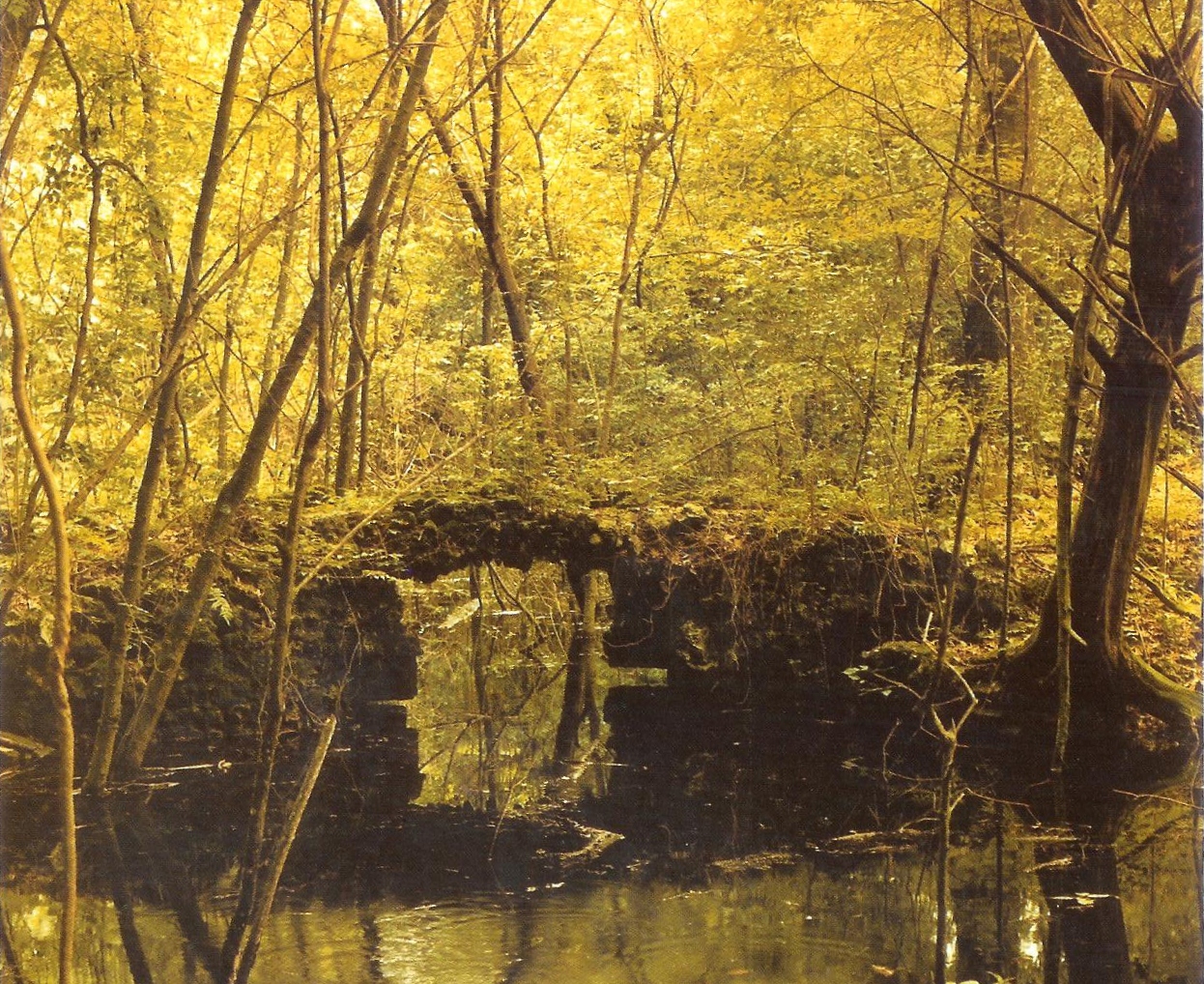
The lane is one of the most beautiful features of Northam Park.  It was designed and installed for a previous earl by that the great landscape architect, Capability Brown.  Note the picturesque bridge over a water feature the path follows.  If you drive your tillbury too fast along its shaded way, however, such beauty can be deadly.

Cast out of Olympus

In Notorious Match, Diana struggles against the memory of her lonely childhood.  Barbara Hutton Photo Gallery Page, Photo Album Page

She could so very easily have been the Barbara Hutton of the Regency.  You may recall the tragic life of the Woolworth heiress whose father was the wealthy co-founder of E. F. Hutton, a banking firm.  Remember those funny 80s commercials? “When E. F. Hutton talks, people listen.”

Not so funny–Barbara’s mother committed suicide and her father abandoned her.  She died after a string of broken marriages, a broken fortune and, some say, a broken heart.

Poor  little rich girl.

My heroine Diana spent most of her unhappy childhood at Northam Park, the seat of her family’s earldom in Leceistershire, England.  When she became countess in her own right, she travelled frequently to her estate but stayed only for a short periods of time.  Each visit she made served as a reminder she was unloved as a child.  In its own way, Northam Park insisted she never forgot.

The mansion at Northam Park was built in 1724 by the English master builder Francis Smith of Warwick for the 28th Earl (yes, you read that correctly–the earldom is at least as old as that of Arundel, held by the Howard family).  Northam Park’s architect designed the house very similarly to his creation of Sutton Scarsdale, built for the earl of that name.  Rivalling Chatsworth House in size and splendor, Northam Park was given a massive east front with nine bays of windows separated by Corinthian pillars.  Crowning the center was a large pediment, almost overwhelming in size and complexity when viewed up close and unmistakeable when spotted from afar.

But the earl of Northam did not want his coat of arms to decorate this central feature as was customary.  Desiring a neo-classical design, the Earl commanded that the pediment of the mansion’s front face depict a curious scene from Greek mythology–the casting out of Hephaestus by his own mother Hera.

The fall from Mount Olympus maimed the god of the forge forever.  What mother could do that to her child?

pediment from Sutton Scarsdale Hall

Whenever Diana is at Northam Park, her eyes are forever drawn to this terrible scene, wrought in sharp relief as clearly as any of the Elgin Marbles that were torn from the Parthenon.  The sight makes her shudder.  It reminds her that inside she is lame and unloveable.

Then a man comes to Northam Park.  The only one who can help her heal.  The only one who can love her for who she is.

Northam Park Revisited

Compton Verney – grounds laid out by landscape architect Capability Brown

“Northam Park is Diana’s now.  What she intends to do with it is, perhaps, a subject for a later book.”  Excerpt from my post Northam Park:  Sutton Scarsdale meets Chatsworth Park.

Having wrapped up the series on royal weddings, it’s time now to return to my work in progress–Diana’s story.  The above-referenced post is an introduction to her country estate and the seat of the earldom which she holds as countess in her own right.

Diana’s story is titled Notorious Match. 

For the next several weeks I shall explore the exterior features of Northam Park’s great house, an English country mansion on the grandest scale.  It is a Palladian home inspired by the great Inigo Jones with additions whose designs were wrought by Christopher Wren and Robert Adam.  The grounds of Northam Park were established and according to plans laid out by Capability Brown with numerous external features like the ha-ha, the enormous stable block and a Grecian temple.

Wingerworth Hall, photographed six years before its demolition in 1927 - photo via Wikipedia Commons

Wingerworth Hall, a Baroque creation, photographed six years before its demolition in 1927 – photo via Wikipedia Commons

Nor shall we neglect the great house’s interior.  Inside are rich decorative plaster work and carved staircases.  They favor reason over precedence–the greatest expression of the style we call neo-Classicism.

But we shall also see competing Regency styles in other country estates that are in the vicinity of Northam Park.  Godley Abbey, for instance, is a Gothic fantasy that Lord Byron had once visited and greatly esteemed.  Stansbury Vale is also nearby–a gawky Baroque creation that gives no hint of the beautifully elegant hall it contains.

Baroque, as you know, is unrestrained.  The celebration of ostentation.

I like it.