The Regency Poet of Wine and Love

Thomas Moore (1779 – 1852) was an Irish poet popular not only in Regency England but in America as well.

They called him Anacreon Moore, and not just for his translation of that poet’s Odes.
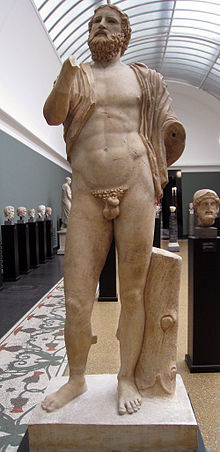
The Greek poet Anacreon 582-485 BC)

Anacreon was an ancient Greek poet whose bacchanalia earned him the reputation of a lecherous drunkard:

Ah tell me why you turn and fly,My little Thracian filly shy?

I can tell you why.  Just look at the man.

Apart from wine and love, a poet must needs be passionate, and Tom Moore was definitely that. It helped to be Irish–he being the son of a Dublin grocer.  Upon his arrival in London, Lord Lansdowne was among the first to recognize his considerable talent.  The marquess introduced him to the first circles of the ton and soon he was writing to his mama about how he was

“dining with bishops, supping with princes, going to concerts with Lady Harrington, escorting Lady Charlotte Moira to balls and attending Blue-Stocking parties.” — The Chautauquan:  Organ of the Chautauqua Literary and Scientific Circle, Volume 18

His diary at the time was filled with evidence of his immense popularity and the significance of Lansdowne House to his rising star:

“Dined at Lord Lansdowne’s..Introduced to Lady Cochrane, who told me she would at any time have walked ten miles barefooted to see me.”

All of this was bound to go to a young man’s head.

A triumphant tour of the United States ended rather badly.  Moore was an outspoken critic of the Democratic-Republican (dear me!) party and of Thomas Jefferson in particular.

By the time he returned to England, his passionate nature had not yet been tempered.  This made him particularly vulnerable to his critics and led him to fighting a duel with one of them, Francis Jeffrey, an editor (!)  Byron relished the events surrounding his potent rival and most particularly the rumor Moore had supplied his opponent with an empty pistol, gleefully observing:

 “…on examination, the balls of the pistols, like the courage of the combatants, were found to have evaporated.”

The duel was broken up and the combatants imprisoned.  Moore was eventually released but his love for extravagance and marriage to a penniless actress soon landed him in dun territory.  It was Lord Lansdowne who fished him out of River Tick but Moore found himself compelled to leave England.  In his travels abroad, he was to encounter Byron again.  That old Romantic begged his former rival to publish his memoirs.  However, Byron’s family persuaded Moore to destroy them which he did, to much criticism.

Thomas Moore - national bard of Ireland

Like many thwarted in other ambitions, Moore did two things.  He returned to his homeland to sing a duet with the Queen Mother before HM Queen Victoria.  And settle down to write novels.

Tragically, he witnessed the death of all his children.  Yet song and poetry remained to comfort him.

He is to Ireland what Robert Burns is to Scotland.  A true protegee of Lansdowne House.

The Most Popular Man of the Regency

Richard Sharp (1759 – 1835), born in Newfoundland, was a hatter and later prominent merchant in London.  He was also a Dissenter, becoming the champion of adult education.  His powers of persuasion were responsible for establishing the forerunner of the University of London, the London Institution, open to scientific scholars who were denied entrance to Cambridge and Oxford because of their unorthodox religious beliefs.

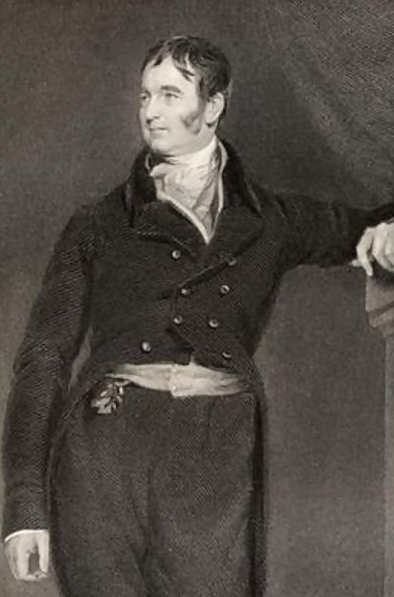
Richard "Conversation" Sharp - he quite looks like Geoffrey Rush, does he not?  Delightful man.

Richard "Conversation" Sharp - he quite looks like Geoffrey Rush, does he not? Delightful man.

Lansdowne House, along with its rival Holland House, drew Sharp into its orbit not only for these accomplishments, but because of his conversation.

Yes–conversation.  A highly sought-after quality in Regency England

You must remember from Anne Elliott’s declaration from Jane Austen’s Persuasion.  And William Elliott’s equally fine rejoinder:

“My idea of good company…is the company of clever, well-informed people, who have a great deal of conversation; that is what I call good company.’

‘You are mistaken,’ said he gently, ‘that is not good company, that is the best.”

London was filled with good conversationalists.  Town wits, they were called, frequently evaluating one another and publishing their findings in essays and other periodicals for the delectation of the ton.

Byron (1788 – 1824) was a notable practitioner of the art–his poetry the vehicle for satirizing other conversationalists.  Wordsworth was frequently a target for his notions of solitude and the love of the sublime.  But when it came to describing Sharp, Satire completely failed her master, giving way to her cousin, the Simple Truth.

“A man of elegant mind.”

Indeed, this is where we find not just the good, but the best.

But how?  The key lies in the recollection from a fellow Lansdowne House intimate, Thomas Babington Macauley, 1st Baron Macauley (1800 – 1859)

“One thing I have observed in Sharp which is quite peculiar to him among Town wits and diners-out – he never talks scandal. If he can say nothing good of a man he holds his tongue. I do not of course mean that in confidential communications about politics he does not speak freely of public men, but about the follies of individuals I do not believe that – as much as I have talked with him.”

Richard Sharp remained single all his life.  Yet he was moved to adopt a little girl, orphaned in a volcanic eruption in the West Indies.

He never wanted to be remembered after he died.

Sadly, his wish was granted, with one or two notable exceptions, like the following admonishment from a reader of Gentlemen’s Magazine and Historical Chronicle 1869) that reads like a Who’s Who list of the Regency:

“…your serial is calculated to mislead your numerous readers by giving them the idea that (Charles Kirkpatrick Sharpe) was the celebrated person who obtained the sobriquet of ‘Conversation Sharp’ ….. From his extraordinary conversational powers, and his attainments generally, he became the intimate friend of all the leading men of his time, especially of the Whig party, of whom space will not permit me to name more than a few–as Lord Holland, Marquis of Lansdowne, Duke of Somerset, Earl of Darnley, Lord Eskine (who consulted him constantly), Grattan, Curran, Plunkett, Campbell, the poet Moore, Sir James Scarlett, afterwards Lord Abinger, Wordsworth, Rev. Sydney Smith, &etc….A reference to the memoirs (amongst others) of Francis Horner, James Macintosh, Sir Samuel Romilly, Samuel Rogers, the poet, and Moor’s Life of Byron, will at once settle the identity of Mr. Richard Sharp.”

Laughing Gas at Lansdowne House

The third Marquess of Lansdowne was no stranger to the rich and famous that came to the great London house.  His father had hosted Benjamin Franklin (1706 – 1790) when the latter came to negotiate the terms for American independence.  One who was credited with the discovery of oxygen, Joseph Priestley (1733 – 1804) ran tame at Lansdowne House as well, living off the largess of the first marquess when he was still Lord Shelburne.

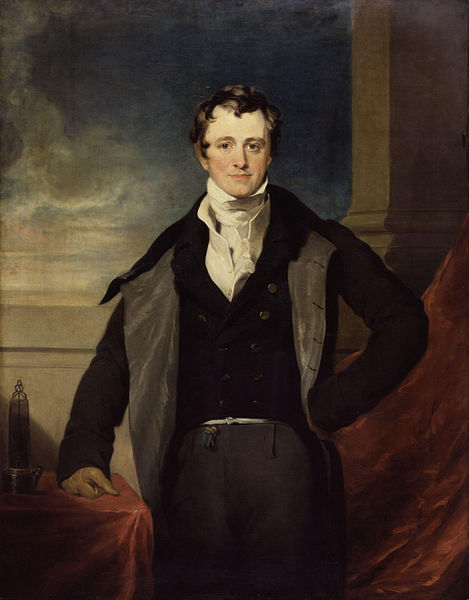
Sir Humphry Davy

But the parade of important persons during the Regency period, when our Lord Lansdowne was master there, is impressive indeed. There was a reason for this.  Unlike other patrons of artists and persons of science, the third marquess welcomed these to his home as equals:

“No trace of such distinctions ever checked the talk at Bowood or Lansdowne House.  If help was needed, it was freely given.” —  The Gentlemen’s Magazine and Historical Review, MDCCC LXIII, by Sylvanus Urban

The greatest scientist of the Regency was no stranger to Lansdowne House. Sir Humphry Davy (1778 – 1829) was a pioneer in chemistry, having discovered important earth elements and inventing the Davy lamp used by miners to detect dangerous gases.

But enough of the science.  I declare, the stuff makes me bilious.

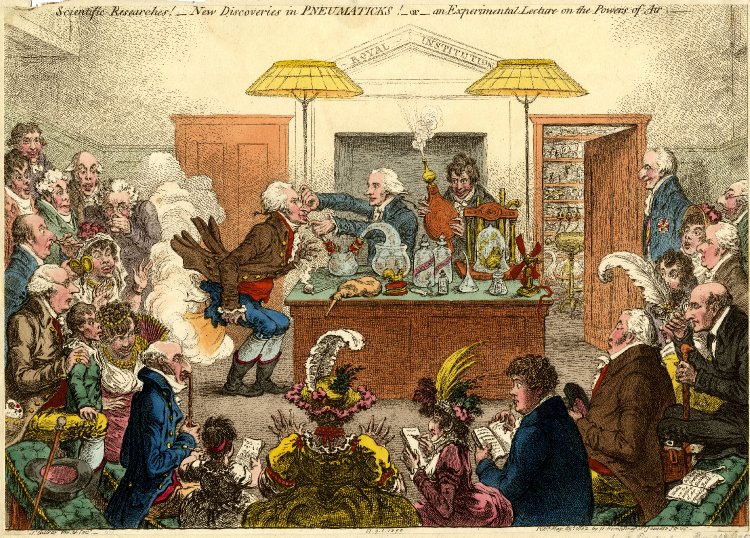
Truth to tell, Sir Davy put on exhibitions of his experiments that were not only explosive but made all the females swoon.  He was a very good public speaker, endowed with considerable charisma and the elusive ability to impart science in an understandable manner.  Note the cartoon and its display of Davy’s large female following.

I cannot deny he is rather attractive.  Is it the neckcloth or is it just me?

File:Royal Institution - Humphry Davy.jpg

Spectators were particularly drawn to his experiments depicting the effects of nitrous oxide.  He once said that laughing gas bestows all the benefits of alcohol and none of its flaws.

I’ll have what she’s having.

“Most Delicate in his Acts of Generosity” – the Third Marquess of Lansdowne

Lansdowne House was not only famous for its architecture and furnishings–it was known for its people, as well.  This post is dedicated to the one person who not only brought the house into its prominence in the Regency period, but very possibly saved it from destruction.

Lord Henry Petty-Fitzmaurice, Marquess of Lansdowne

Lord Henry Petty-Fitzmaurice, third Marquess of Lansdowne (1780-1863) was born in Lansdowne House to the second wife of his father, the first marquess, Lord William Petty, also known as Earl of Shelburne.  It was his older half-brother, Lord John Henry, who succeeded their father.  However, he died a few years later and Lord Henry became not only Earl of Kerry but Marquess of Lansdowne as well.

 An heir and a spare.

And what a spare he came to be.

The hero in Vivien’s story, Notorious Vow, also succeeded his older half-brother.  His patrimony was an earldom in shambles.  The marquisate was similarly situated when it came into Lord Henry’s hands.

Indeed, Lansdowne House had been left by Lord Henry’s predecessors in such a dilapidated state it might have gone on the auction block.  The situation was quite desperate, leading to a scandalous litigation over the debts the estate was faced with, brought by various creditors who held substantial mortgages on Lansdowne House and the family’s country estate of Bowood.  These persons sought to recover monies from the sale of many of the estate’s assets, among them the large art collection that was once once housed in the magnificent Adams rooms of Lansdowne House.  Even the trees themselves had all been cut down and sold as firewood.

Under Lord Henry’s watch, the trees were eventually replanted and Lansdowne House, along with its art collection, restored to former glory.  It was to be one of many of his lordship’s remarkable achievements.  He was a humble man, having turned down a dukedom and the office of Prime Minister.  Nevertheless, his presense was a powerful one in Britisih political life–championing the causes of eduation, Catholic emancipation and the abolition of the slave trade.

He was a man worthy of presiding over the Regency Centre of London:

“Under him the reputation which Bowood and Lansdowne house had secured in the lifetime of Lord Shelburne as meeting-places not only for politicians, but for men of letters and of science, was fully maintained. In the patronage of art and literature Lansdowne exercised considerable discretion, and re-established the magnificent library and collections of pictures and marbles which had been made by his father, and dissipated during a short period of possession by his half-brother. Most delicate in his acts of generosity, he freed the poet Moore from his financial troubles; he assisted Sydney Smith to long-waited-for preferment and he secured a knighthood for Lyell.”

—–from an article written by William Carr and published in 1895 (as reprinted in Dr. Marjorie Bloy’s English History website here.)

The Ghosts of Lansdowne Passage

The layers of history in an old place like London continually fascinate me.  The city is like an ancient mansion that’s been made over by successive generations to suit changing tastes in fashion and function.  New wallpaper is placed over the old, new paint is slathered over faded oak.  When these layers are peeled back, we see something completely different, in the same place.  And it never fails to amaze.

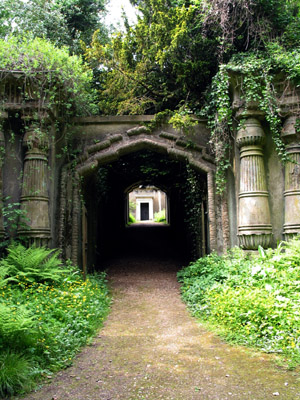
Highgate cemetery - London (licensed under the Creative Commons Attribution ShareAlike 3.0 License)

Fitzmaurice Place is a small street leaves the southeast corner of Berkeley Square and runs into Curzon Street, just where the old core of Lansdowne House sits.  Across from its truncated facade is a pedestrian walkway lined with shops that leaves the house and ends up at Hay Hill on the other side.   It is called Lansdowne Row.

In the days of the Regency, this was a narrow walkway sunken between forbidding walls.  Walls so tall that they permanently darkened this shortcut linking the two ends of Mayfair.  You couldn’t see what was on the other side of either wall, nor were you meant to.

There are very few good photographs of the passage.  I used this image of the Egyptian Avenue monument from London’s Highgate cemetery.  It looks imposing–and a little spooky.

At Lansdowne Passage, in the middle of the most fashionable part of Regency London, two great estates–two great families–came together in a physical way.  As mentioned in an earlier post of the series, Lansdowne House was built in such a way as to give Devonshire House an unobstructed view toward Berkeley Square.  The two houses had enormous gardens.  They abutted one another yet gave way to that ancient right of passersby–an easement, if you will, called the right of way.  This came to be known as Lansdowne Passage, appearing much like a crevasse when Diana, sometimes called Viscountess Northam, climbed the ladder of the Lansdowne House garden to remonstrate with the Viscount Hartington, heir to His Grace, the Duke of Devonshire, who stood on his garden ladder opposite.

Many legends abound of the walkway, mostly because its long length was hidden from observation and provided a perfect route for robbers and ladies of the night.  Indeed, Hay Hill at one end of the passage was long a favorite of highwaymen.  Even the Prince Regent was robbed there at gunpoint, along with his brother, the Duke of York, of the three shillings they had between them.

A highwayman once urged his steed down into the deep passageway to escape apprehension, goading his horse to leap across the descending stairs, landing heavily on the paved stones below.  They were now in a narrow passageway, mind you, and the rider must needs take the reins in one hand and grip the cantle behind him with the other so as to reduce the width of his profile, spurring into the darkness lit only by a full moon riding the sky above.  Then there was the ascending stair opposite.  Even the most intrepid horse must pause, his ears pricked forward, throwing his head down to eye the obstacle ahead.  But alack!  Pursuers are even now approaching–their cries funnelled between haughty walls to spur even a spooked animal to leap upwards, scrambling and skidding for purchase on stone steps to Hay Hill above and the wilds of undeveloped London beyond.

Iron bars were erected to prevent this sort of thing from happening again.

Today, Lansdowne Row is listed as one of London’s haunted places.  Spectres of highwaymen, footpads and the Loquacious Lady still wander the passage, lit by the storefronts of Hugo Morelli and Starbucks.

In the Garden of On-Dits and Blue Ruin – Lansdowne House

the Marquess of Hartington

Russell drove his tilbury at a rapid pace towards Berkeley Square.  His niece, Diana, fidgeted beside him.

“Dash it, darling, what the devil is the matter?”

She tossed her fire-blond hair, so like his and leaned out of the sporting carriage to catch the breeze like a hoyden.  “I hate London.”

“We’ve only just arrived,” he pointed out.  “I’m persuaded you will like this party we are going to.  Lansdowne House affairs are really quite the thing.  Besides, you probably know some of the girls from that school of yours who might be in attendance there.  Lady Louisa, for instance.  It is said she might get an offer from Lord Henry Petty, heir to Lansdowne.”

“Louisa is a bore,” Diana declared, pulling herself back in the tilbury with a sigh.  “There is a girl from school I should like to see–but she lives in Knightsbridge.”

The Marquess of Wimberley wisely restrained himself from responding.  It would be just like Diana to tease him, pretending she would rather befriend some merchant’s daughter from the City instead of an earl’s daughter.

The tilbury paused at a set of dark doors set in a high wall that ranged the entire length of Berkeley Square’s south side.  A porter emerged from an ivy-covered lodge set in the wall.  He bowed and opened the entrance so his lordship’s carriage could pass through.  Once inside, it was as if they had stepped into the countryside, although they were in the middle of London.  The sounds of traffic diminished to merely hoofbeats on a well-kept gravel drive. The fresh green lawn was so very nearly perfect it might have been brought up from the riverside moments before. Tall oaks towered over them, old enough to have been present when nearby Hay Hill was still a farm in Queen Anne’s day.

Solemn footmen with real powdered wigs appeared before the stately home’s portico to escort the pair inside.  Soon, Diana found herself in the company of the very girl her uncle desired her to accompany.

“What would you like to do?” Louisa asked.

Diana shrugged, gazing up at the exquisite ceiling of the Adam drawing room.  “Dashed if I know.  Shall we take a turn on the grounds?”

Shortly thereafter they were walking toward an ancient wall, the boundary of the Lansdowne garden.  There was a small ladder placed against it.

“What’s on the other side, I wonder?”

“Oh,” Louisa answered, in her diffident way, “‘Tis His Grace of Devonshire’s garden.”

Diana immediately went to the ladder and began to climb, taking care not to let her slippers get scuffed on the wooden rungs.  She ignored the remonstrations of her missish companion.

“I should like to see His Grace’s garden,” Diana declared.  “One can never tell what a duke’s cabbage looks like.”

Diana reached the top of the ladder.  Below her was a narrow, dark passage that opened below her like a crevasse.  Without warning, another person peered at her–from an opposing wall scarcely feet away, all ears and a wide grin.

“Hello,” he said.

“How did you get up there?” she demanded.

“I’ve got a ladder, same as yours.” He asked, “Who are you?”

“I am Diana.”

“Well, then,” he replied, triumphant.  “I’m Marquess of Hartington.  But you may call me Hart.”

“I shan’t call you anything,” Diana retorted.  “Because we have not been properly introduced.”

“Tell your uncle you’ve met the heir to the Duke of Devonshire and I’ll wager he’ll tell you we’re intimates.”

“How dare you!”

Berkeley Square south side – Lansdowne House Gardens

There’s not much more one can say about the Lansdowne House gardens.  The description of its environs came from Nash’s Pall Mall Magazine, Volume 31 by Ernest Jessop, published in 1903.  By then the massive area in front of the house had become rarified real estate in the middle of London and valued at a price that would just about cover a marquisate’s death duties–taxes that were the scourge of great houses in the early twentieth century.

The new death taxes were to become, as Giles Worsley titled his first chapter in England’s Lost Houses, a Gathering Storm.

Lansdowne House – Rape and Death in a Ballroom

“Do you mean to tell me you’ve another interesting display?”

Louisa cringed.  “Oh, I wish you would not tease me, Diana.  You cannot know how dreadful it is to have a husband who brings home everything that is dug up.  Why is it that the Romans had to conquer so many places and scatter their things about?  I vow they did this just to distract wives in decent society hundreds of years later.”

The offending art was located in the ballroom at Lansdowne House.

Louisa gestured to large fragment of Roman sculpture mounted on the wall, watching Diana’s reaction with trepidation.

“It’s called the Rape of Persephone.  And from a coffin, no less.  Lansdowne would have it mounted there, just in time for our first ball of the Season.  I declare he has done so for no other reason than to vex me.  And you know there will be any number of debutantes and their mamas in attendance.  They shall all think it terribly ill-bred, being forced to gaze upon the image of a young girl being carried off to suffer any number of indignities.”

“I shouldn’t worry about it, Louisa.”

“Really?  You amaze me.”

Diana turned to face her.  “It’s a metaphor for untimely death.  Not at all improper, I assure you.  The sarcophagus probably belonged to someone who died very young.  Snatched away by Death in the prime of her life.”

Louisa swallowed, just then remembering Northam’s tragedy.  “Diana, please forgive me.  I had no notion, otherwise I shouldn’t have–”

“Do not be distressed, Louisa.  My parents have been dead for so long that I can scarce remember them.”

Yet Louisa could not miss the strange glitter in Diana’s eyes.

She took Diana’s arm.  “Uh–come away, dear and see my latest watercolor.  I am persuaded you will enjoy il Signor Rossi’s technique.”

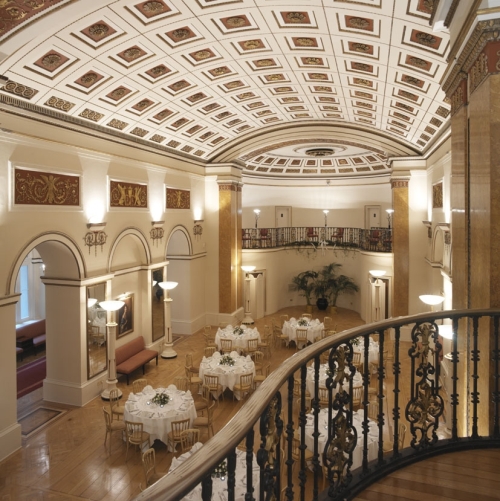
The ballroom at Lansdowne House is still extant, but without the decoration that made it famous.  The panel known as the Rape of Persephone was one of several Lansdowne marbles that were arranged in this room–originally intended to be a sculpture gallery.  In the 1930 photo, you can see them set in the wall.

And you thought only Elgin had them.

Originally the ballroom  was meant to be a music room by Lord Bute, the first owner of Lansdowne House.  The Earl of Shelburne, later Lord Lansdowne, had visited Italy after purchasing the house and was possibly inspired by the excursion to have a gallery for his sculpture.  He commissioned the Scottish painter Gavin Hamilton to convert the music room to a suitable space.  Hamilton lived most of his life in Rome and was considered a gifted neoclassical history painter, favoring Greek and Roman subjects.  He was also an art dealer and excavator of antiquities.  How convenient.

Eventually, however, the plans for the sculpture gallery were dropped and by the time of my story Notorious Match, the room assumed its present and final function.

The ballroom can still be seen today at the Lansdowne House Club (see below) which has a marvelous gallery of its own you can peruse here.

Lansdowne House Drawing Room

A drawing room was not just for drawing.  During the late Georgian period and beyond, when socializing was made easier with more efficient transportation, great houses utilized their spaces in new and creative ways to enhance the party experience.

Lansdowne House Rear Drawing Room – Philadelphia Museum of Art

And you thought your living room was just wasted space.

In Notorious Match, the Lansdowne Ball featured dancing and gaming.  After arriving, Diana found herself at a game of faro that was set up in the famous Adam drawing room.  Her luck at the game was indifferent at best.  The last time she played she lost her mother’s pearls.  To her disappointment, the banker refused to accept her voucher to play.  So she staked something else that Lord Harcourt would be unable to resist.  Irresponsible?  Perhaps.  Did she do it to provoke Griffin?  For once, no.

Unknown to anyone, she was desperate to extinguish a little girl’s anguish, enough to pledge something very dear.

Diana unclasped the heirloom about her neck and tossed them on the table toward Harcourt.  “For my mother’s pearls.”

Harcourt’s eyes fastened on the jewels.  “Those are the Northam emeralds, are they not?  You must be very certain of your luck to stake them.”  He lifted the necklace to the light.  “They’re worth ten times your mama’s baubles.”

“A sentimental whim,” she responded.  “Indulge me, my lord.”

Out of the corner of her eye, Diana saw Griffin fold his arms.  She suspected he was trying very hard to look unconcerned.  Serves him right for playing governess.  Griffin knew she did not like any hand on her bridle—whether her uncle’s or Vivien’s.  But least of all his.

“Be advised, my lady, that I shall not be lenient,” Harcourt warned.  “Not even your lord uncle will be able to redeem these from me.”

The emeralds were so fine they made the diamond setting holding them look insipid.  They were the dowry of some long ago heiress who brought them to Northam when she married its earl, one of many sets of jewels Diana had in her strongbox at herLondontown house.  Harcourt laid them beside bank notes, property titles and a variety of coins wagered by other players.  Seeing them in that light gave Diana pause.

They, like anything else belonging to Northam, were her responsibility.

“Deal the cards,” she commanded nevertheless, determined not to reveal her fear of losing them.

Robert Adam ceiling

The drawing room used for faro and baccarat games that evening was the famous Back Drawing Room, designed by Robert Adam in about 1763 along with the original plan commissioned by the 3rd Earl of Bute.  It is considered the most elaborately decorated of the entire suite of reception rooms in Lansdowne House before its mutilation in 1930.  Its primary feature is a great bay that was originally designed to contain Lord Bute’s elaborate mechanical organ.

The ceiling is Adam’s design but he used artists with special gifts to enrich the design, such as the great Italian painters Cipriani and Zucchi, the latter the husband of the famous bluestocking painter, Angelica Kauffman.  From the 1903 edition of Nash’s Pall Mall Magazine, volume 31, we have a description of the room filled with an incredible array of treasures, all long since dispersed:

“…some lovely old Sevres, in yet another a very beautiful pair of rose-coloured marble vases mounted in ormolu of the finest workmanship, while around all in serene beauty hang the works of Reynolds, Romney, Van der Helst and others of the greatest.”

It took nearly twelve years to install the room at the Philadelphia Museum of Art, once it was removed just prior to demolition at Lansdowne House.  Funding was short in the thirties and forties and it took time to amass enough funds to present the Adam room in its new location.  The museum’s director at the time, Fiske Kimball, remarked that the new exhibit, christened the Lansdowne Room:
 “crowns the series, coming as it does from the moment when England, fresh from her greatest conquests, seized for a moment also the artistic mastery of the world.”

Lansdowne House – dining with a nude

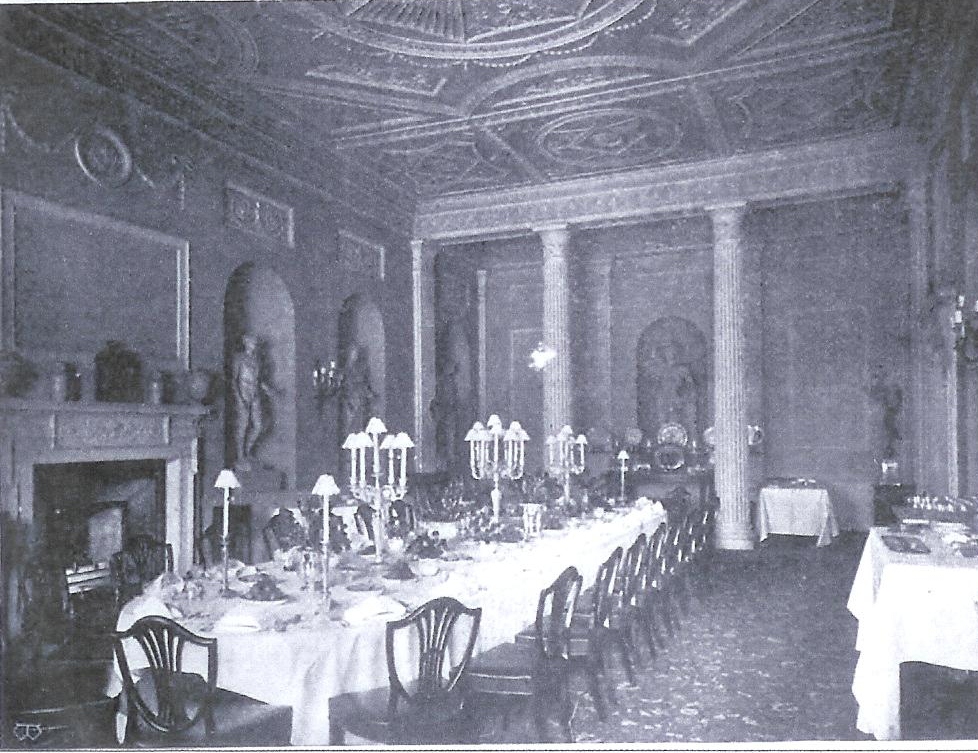
Lansdowne House Dining Room pre-demolition

“I wish you would not go in there.”

“Whyever not?” Diana asked.  “I’ve heard all about Lansdowne House’s new acquisition and would like to have a look.”

Louisa, Lady Lansdowne, was mortified.  Her husband’s new Canova sculpture was the talk of London.  “Ever since that dreadful Payne Knight was here for dinner everyone wants to look at it.”

“Good heavens,” Diana exclaimed.  “You had that man over for dinner?  The one who wrote A Discourse on the Worship of Priapus?”

“The very one.  But I am persuaded he is exaggerating.”  Louisa felt herself flush under Diana’s amused glance.  “She is not at all what they say she is.”

“Then there can be no objection to having a look.  Just to be sure.”

Reluctantly, Louisa followed the countess into the famous Adam dining room.  Grim grey statues in their wall-bound niches stared down in disapproval at the female nude who reclined, in all white marble, on her couch.

Louisa grew alarmed at Diana’s prolonged inspection.  “This is all so very distressing.  Do tell me she is not an, er, hermaphrodite?”

Diana folded her arms.  “That fellow Knight may have to reexamine his theory of pagan culture.  Your naiad is missing a most important piece if she’s to be what he says she is.”

Louisa nearly sagged against the sculpture’s buttocks in relief.  Then she caught a gleam of mischief in Diana’s glance.

“Stay–did you say a naiad?  Is that bad?”

Diana shrugged.  “Oh, most decidedly.”

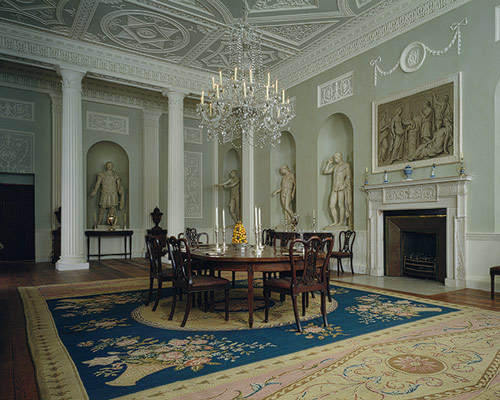
Metropolitan Museum of Art - Lansdowne Dining Room

The dining room at Lansdowne House was executed under the brilliant design of the great Scottish architect Robert Adam.  His neoclassical creation was located in a part of the house that was demolished to make way for a street and additional buildings today known as Fitzmaurice Place.  This mutilation deprived the house of its historic design.  A design that gave the great London mansion “movement.”

The dining room was a part of the south wing–to the left of the old photograph in last week’s post.

Word got round in 1930 that the sculptures and other contents of Lansdowne House were to be put up for sale.  This was to be followed by demolition of the two wings.  Fisk Kimball, director of the Philadelphia Museum of Art, was very interested in the house’s role as the venue for the negotiations of a Nation’s independence.  He tipped off the Metropolitan Museum of Art in New York of the pending destruction and the institution was emboldened to Act.

The dining room was dismantled and shipped over the Atlantic to its new home where it can be seen today, sans the Canova.  From the Met’s website, we have this marvelous description:

…the design of the ceiling…was carried out in plaster by Joseph Rose. The carving for the wooden doors and door frames, shutters and window frames, columns, baseboard, and chair rail, executed by John Gilbert, was finished in December 1768. The marble chimneypiece was supplied by John Devall & Co., chief masons for the royal palaces, the Tower of London, and the Royal Mews. The oak floor of the room is original. The niches originally held nine ancient marble statues acquired by Lord Shelburne in Italy from the artist Gavin Hamilton, which were dispersed at the Lansdowne sale of 1930. Now, the niches have been filled with plaster casts.  The original furniture, designed by Robert Adam and executed by John Linnell, no longer survives.

Thanks to this reconstruction, we can note several prominent features that would not be out of place in any Regency gathering.  Celadon green is the term for a particular jade coloring that is an enduring part of neoclassical design.  The fireplace is white marble, matching the large frame above it which often stood empty back in its London home.  The Lansdowne family had a vast collection of paintings, but no one individual work was large enough to fill the space Adam designed for it.

Sleeping Nymph - Antonio Canova

What of the reclining nude?  She is now in London’s Victoria and Albert Museum.  Lord Lansdowne commissioned her in 1820 from the great Italian sculptor, Antonio Canova.  An earlier post describes his work, but in the case of the reclining naiad, the sculptor had died before her completion and his assistants were relied upon to finish it.

Canova is thought to have been greatly influenced by a famous “marble” unearthed in Italy and presented to the Cardinal Borghese in the seventeenth century.   Known as the Borghese Hermaphroditus, the discovery electrified Western Europe.

Many copies were made of this reclining figure who lay on his (her?) stomach, not quite concealing the object of such amazement.

Lansdowne House – Regency Centre of London

The opening chapters in Notorious Match take place in a London mansion that still stands today.

In my manuscript, the fictional hostess, Lady Louisa Lansdowne, has the privilege of holding the inaugural event of the Season.  Louisa has little regard for the house’s political history even though it witnessed the final negotations that confirmed a Nation’s independence.  She is more concerned that her balls are well-attended and therefore is thrilled when Lord Griffin Montgomery arrives at her party.  Now she is assured her ball will be the premiere event for every eligible, unmarried female for many Seasons to come.

Lord Griffin Montgomery rarely attends ton parties, you see.

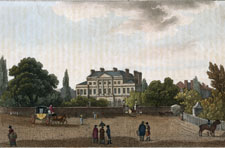
Lansdowne House – before alteration

This post is the beginning of several in a series that tours this magnificent home.

Lansdowne House was built upon real estate sold off by Lord Berkeley’s widow in the eighteenth century.  The third Earl of Bute purchased the south side of the square that took her husband’s name.  Lansdowne House was built according to Robert Adam’s 1761 design and was largely completed by 1768.  By then Lord Bute had thrown in the towel and the house was finished under the ownership of another British prime minister, Lord Shelburne, whose name graced the house for a time until his lordship was granted the marquisate of Lansdowne.

Lansdowne House was built according to Adam’s predeliction for ‘movement,’ a term which refers to the diversity of form throughout the building, inside and out.  One can see from the black and white photograph several elements:  the rusticated (dare we say, Tuscan?) ground floor topped by the classical coolness of the Palladian pediment and the portico with its Ionic pillars.  The pavilions on either side were placed forward, giving the mansion an assertive, yet graceful presentation:

“This august edifice…unites at once the gay, the elegant and the grand.”

—James Ralph, A Critical Review of the Publick Bulidings:  Statues and Ornaments in, and about London and Westminster

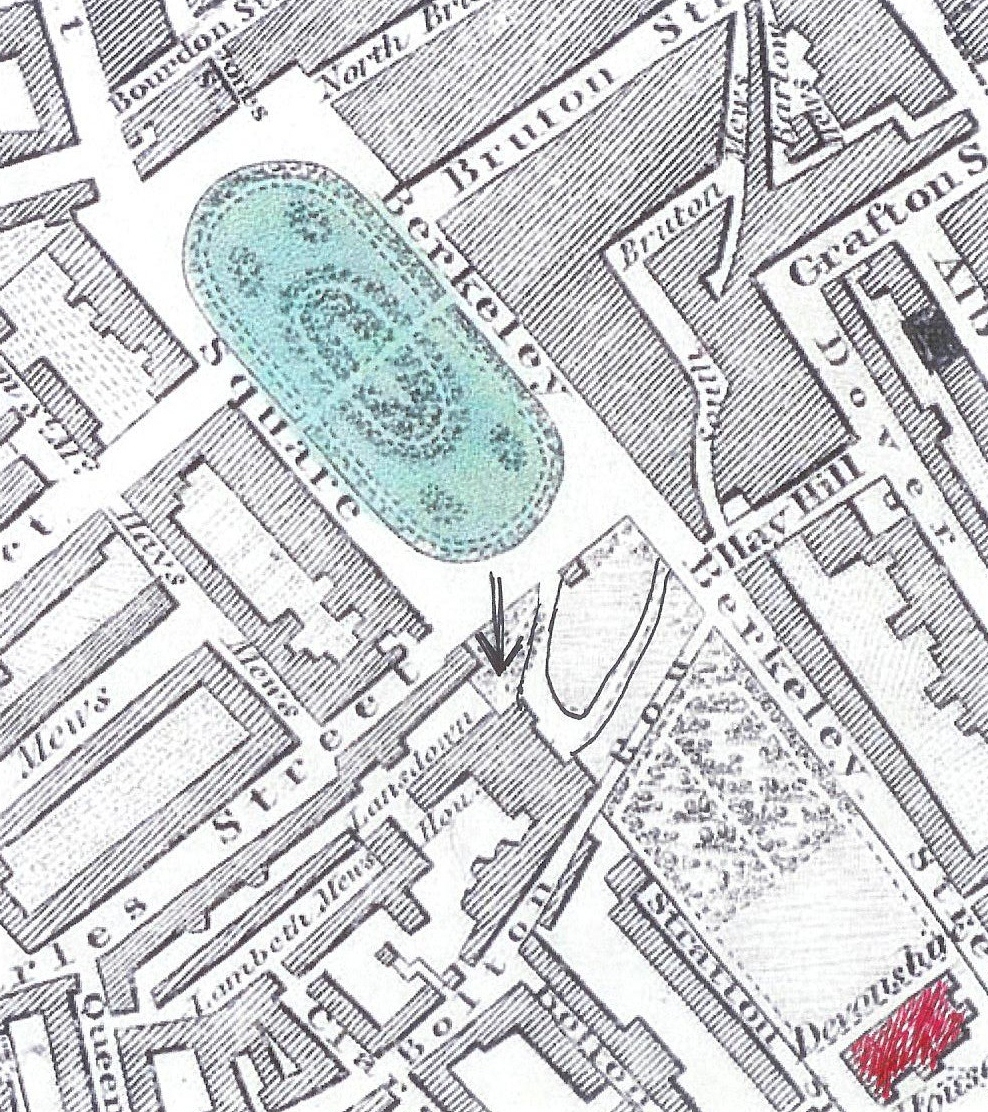
Berkeley Square – 1830

The odd thing about Lansdowne House is its placement.  It does not face Berkeley Square (note the arrow in the adjacent map and the circular front drive), having been situated in such a way as to present its side to the park.   This configuration was to allow the Dukes of Devonshire to have an unobstructed view of the square from their London mansion situated to the south-east (in red).  Lansdowne House was therefore allowed a massive front garden, an advantage few others in the great metropolis had.  Indeed, walkers in Berkeley Square were excused from assuming they were in the country when walking past Lansdowne House, peering through the iron gates at a drive that disappeared into carefully tended landscape.  The only evidence of a building beyond was its exquisite pediment rising above the trees.

This quality was also very nearly the downfall of Lansdowne House.

In the Great Depression, the London council with authority over Berkeley Square determined that a road linking Curzon Street to the square was sorely needed.  The line of houses known as Bolton Row, where Henry James’ sister and other intellectual luminaries had resided, was demolished.  But this was not enough.  The road was extended through Lansdowne’s front garden and Fitzmaurice Place was created in front of the mansion.  To accommodate the new street and buildings, Lansdowne House had to be moved back forty feet.  The only solution, short of destroying the house, was to remove all the front rooms and reconstruct the facade on the truncated building.

Lansdowne House – post truncation

Some of these front rooms were among the finest designs of Robert Adams in England.  The mutilation of Lansdowne House meant that they must go.  And so they went–to far-flung places.

Now that’s cutting off your nose to spite your face.