James Bond and the Regency Townhouse

I was rather ambivalent about the opening ceremony of the 2012 Olympics. HM Elizabeth II actually received her spy in person, and that’s not the half of it.

She’s the Head of Government, the Queen. He’s supposed to be a secret agent known only by a number.  Should they need to communicate, that’s what M is for.

James Bond and the Regency townhouse have something in common, it seems.  Neither are immune to changing tastes.

In Dr. No, we learned 007 had a name.  It was in the Le Cercle club when he uttered those immortal words, “Bond, James Bond.”

The club is housed in the famous casino known as Les Ambassadeurs–or, “Les-A.” It occupies No. 5 Hamilton Place, an area of Mayfair developed for the Regent in 1806 by the architect Thomas Leverton.

An interesting side note: Leverton had been hired in 1802 to build the home of the Fraternal Guild of Grocers.  The Grocers were once known as the Pepperers. Their interesting history may be found here.  To the Order’s dismay, Leverton’s edifice turned out to be unsatisfactory, that is, “badly built, due to defective foundations (!)”

Happily, No. 5 still remains–built in 1805 it was first occupied by Robert Hobart, 4th Earl of Buckinghamshire (1760 – 1816). A Tory, he was the Secretary of State of War and for the Colonies (1801 – 1804) and President of the Board of Control (1812 – 1816).  The latter occupation was a difficult endeavor, fraught with petitions from various persons railing against the abolition of the East India Trade Company.  In a letter from one known only as Fabius, the Regent’s plan to open up trade was despised.  It was thought that such a plan would bring about a glut of cheap Indian goods.  The Indians themselves had no need for British goods.  Why should they by good English wool, for example, when their

“..warm climate renders any clothing beyond what decency requires intolerable.”

He died at No. 5.

The earl met an early end at the age of 56, the consequence of being thrown from a horse. He suffered a “tedious” three months after the accident, going to Bath upon the advice of his doctors.  He did not improve and demanded to be taken back to No. 5 Hamilton Place where he died.

No. 5 then became the home of the 1st Marquess of Conyngham.  Henry Conyngham (1766 – 1832) was an Irish peer and a “familiar” friend of the Regent, serving as lord steward when the Prince became George IV.  Upon his king’s death, he broke his staff of office upon the coffin of the monarch, as was the custom.

Lord Conyngham had an interesting lineage.  A considerable part of his fortune came to him by way of his grandmother, who retained full control of her estate through two marriages.  Another ancestor, one Edward Burton, narrowly escaped imprisonment and execution during the persecution of the Protestants.  His death was apparently the result of “excessive joy” at the death of Bloody Queen Mary in 1550.

The marquess, like the earl, died in the house at No. 5.  His funeral procession was headed by “two mutes and a plume of black feathers.”

Years later, the house passed from the Conyngham family to the Rothschilds, who made it over in the fin de siecle Louis XV style.  This heavily ornamented renovation covered over the elegant Regency decoration both inside and out.

Like 007, No. 5 is something to be made over to suit modern taste, until it is scarcely recognizable.
The Treacherous Hills of Greenwich Park

Summer Olympics. Three-Day Eventing. Greenwich Park. What could go wrong?

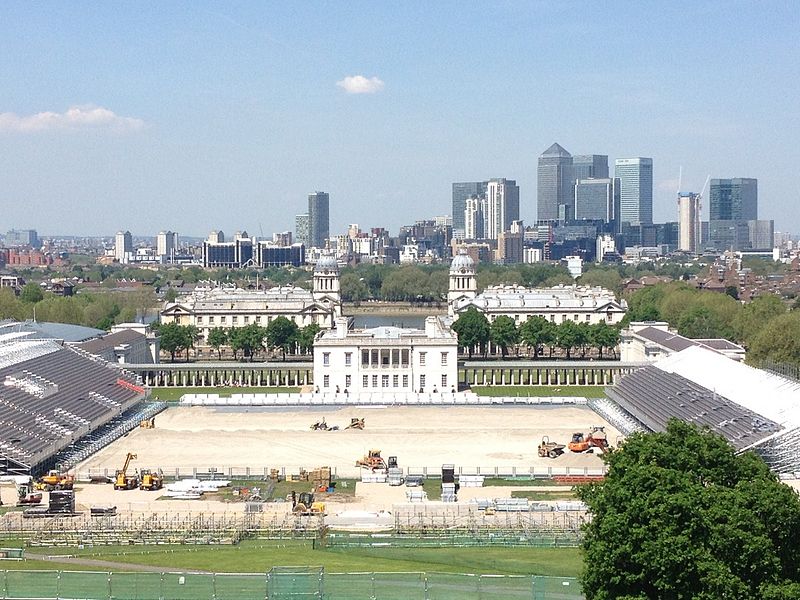
Queen’s House – Olympic Equestrian Stadium under construction
Licensed by Paul Arps

Queen’s House is one of several historic buildings on the grounds of the park. It was the first major commission for the great Inigo Jones, who brought Palladian design with him after his tour of Italy. Its famous Tulip Stairs, the first spiral staircase to be built in England, are reportedly haunted.

The Queen in question was Anne of Denmark, consort of James I. Legend has it the palace was compensation from the king for swearing at his lady in public, after she accidentally shot one of his dogs.

Some say Greenwich Park is an accident waiting to happen.

The lovely weather on Easter Monday and Tuesday drew crowds to Greenwich and many a fair and slender ancle tripped it gaily in the park, as well as down the hill; while others, whose understandings proved they do not stand upon trifles, were less venturous. A few old sinners of the male sex, far down in the hill of life as that at Greenwich, were waiting for those little accidents which, though sport to them, are no joke to the parties…  — The Literary Chronicle and Weekly Review, 1825

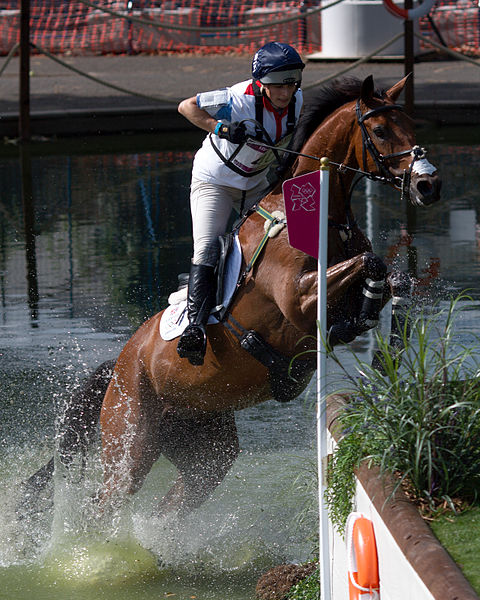
It is very easy to trip down the slopes at Greenwich Park. A number of horses and riders discovered this just last week during the cross-country phase of the Olympic Three-Day Event for equestrian sport. The undulating terrain of this oldest of all the Royal Parks poses a difficult obstacle in and of itself. Indeed, I believe there were less jumps on this course than what one would normally find on at a cross-country event–an apology for the terrain, you might say.

Compensation, indeed.

Olympian and Queen’s granddaughter Zara Phillips aboard High Kingdom
licensed Henry Bucklow/Lazy Photography

“The Stately Homes of England”

THE stately Homes of England,

How beautiful they stand! Amidst their tall ancestral trees,

O’er all the pleasant land. The deer across their greensward bound

Thro’ shade and sunny gleam, And the swan glides past them with the sound

Of some rejoicing stream.

The Homes of England, Felicia Hemans (1827)

Felicia Dorothea Browne Hemans (1793 – 1835) was an English poet.  Born in Liverpool she came to refer to Wales as her adopted birthplace:

The land of my childhood, my home and my dead.

She was only fourteen when she published her first works, dedicated to the Prince of Wales, and soon attracted the notice of Percy Bysshe Shelley.  Her husband left her, so she supported herself and her five sons with her pen.

When she died of the dropsy, she had a considerable following in both the UK and the US.

I love the stately homes of England.  So did she.  Neither of us have ever lived in one.

“Husbands are Dreadful and Powerful Animals”

“Now, that’s Lady Pembroke. Handsome woman, what? Daughter of the Duke of Marlborough. Stuff of generals. Blood of Blenheim. Husband an utter rascal. Eloped in a packet-boat.” – George III in The Madness of King George 

Elizabeth Spencer (1737 – 1831) was a handsome woman, much admired by the King.  She became Lady of the Bedchamber to Queen Charlotte in the latter half of the eighteenth century.  Suffering through the numerous infidelities of her husband, Henry Herbert, 10th earl of Pembroke, she finally separated from him in 1788, thanks to the King’s generosity in giving her a residence.

Some awkwardness was to be expected.  In his madness, George III is alleged to have given her “sporadic and unwanted attentions until his recovery in 1805.”

She lived forever, it seems, even outlasting her son, the third Earl of Pembroke.

Her London residence was Pembroke House, immortalized in Constable’s The Opening of Waterloo Bridge (1832).  It was built on the rubble of Whitehall Palace, where various persons swore they saw the ghost of Henry VIII on the night of his only son’s death.  Now Pembroke House is rubble, the foundation for the Ministry of Defense.

The Opening of Waterloo Bridge, Constable (1832) – Pembroke House is to the left

Now Thank We all Our God

This is a departure, to be sure, from our normal discourse on English country houses and salons.

Now Thank We all Our God is a recognized tune for a variety of Christian hymns.  It was used at the royal ceremony celebrating the marriage of the Crown Prince of Denmark.

What is it about the ancient tunes like Nun Danket Alle Gott that pulls us back into the past, when wars and famine killed the children and wiped out entire villages?  How can we all thank our God under such circumstances?

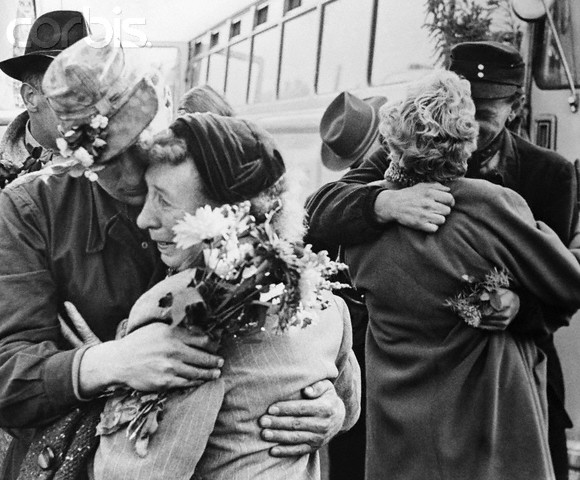
The return of the Ten Thousand invokes our hope for the future.  In this most moving chapter of German post-war history, we can thank our God that redeems and devises our Thanksgiving.

Even if it is only a partial redemption for a nation’s debt.

the return of German POWs

The Salon of Nature – Kenwood House

Sometimes one must get away from the salons of London’s great houses.  Elegant Lansdowne with her sculpture and paintings.  The convivial meals at Holland House.  Even the bohemian conversation at No. 10 St. James.  Let us repair to the country just outside the metropolis and follow in the footsteps of Constable and Coleridge.  To the northern end of Hampstead Heath and a creation in the highest order of Palladian design.  To Kenwood House, I say.

They called it Caen Wood in the old days.  Caen from an old Norman town, the place where the Conqueror’s body rests, if in a somewhat scattered state by tomb raiders.  Wood from that part of the old county of Middlesex, a “very wild and darlking region.”

Kenwood was close to London but remained as it was when it was buiilt, protected from urban expansion and development by the uneven terrain of Hampstead Heath. A nearby hill was called Highgate:

“The old green of Highgate yet boasts its old buildings, it old elm and lime-tree avenue, and has an air of quiet and of the past.  Around stretch fields, and hills, and glades that possess an eminent beauty, which on Sundays and holidays suddenly make the Londoner think himself a countryman, and almost poetical.” — The northern hieghts of London:  or Historical associations of Hampstead, Highgate, etc. Howitt, 1869

Purchased by Baron Mansfield in 1754, Kenwood House was remodelled by Robert Adam, and contains one of the finest libraries that master artist had ever designed.   It was a fitting residence for the baron, even more so when he was raised to an earldom in 1776.

Robert Adam library at Kenwood House

In that year, his nephew married the third of seven daughters sired by Lord Cathcart (try saying that nine times).  Louisa (1758 – 1843) would soon be in a position to do a service for the earl.

His lordship had it in his mind to bequeath Kenwood and his earldom to David, but at the time there was a strong aversion to passing an English peerage to a Scot.   Thus, the earldom of Mansfield seemed destined to end.

Happily, Lord Mansfield was Chief Justice of the King’s Bench and a rather clever lawyer.  The earl cast his eye over his nephew’s pretty wife.  No Scot was she.  So he devised a special remainder to his own title so that it could pass to her upon his death and save the earldom for the family.

Louisa became a countess in her own right.

But her real value lay in being hostess at Kenwood, happy to receive the weary tourist to Hampstead Heath.  She was also a Patroness of Almack’s, hostess to the weary debutante.

Altogether Her Ladyship was a rather accomodating person.

A Shrewd and Masculine Mind – No. 10 St. James Square (Part Two)

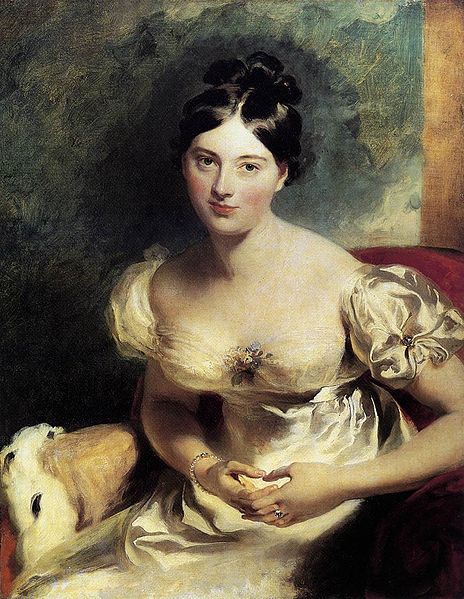
She was an Irish nobody, an outrage to the haute ton.  She had married a man who died during a drunken orgy when he fell out of a window at King’s Bench prison.  She had lived under the “protection” of another who received 10,000 pounds reimbursement for her upkeep.  She had snatched up a titled, rich husband.  Now she had come to make her mark upon society, not even troubling to hide her desire of becoming a posh London hostess.

Entrance Hall – No. 10 St. James Square

Her choice of house to accomplish this ambition was a scandal in and of itself.  No. 10 St. James Square had been the scene of grave deliberations by Prime Ministers.  Its walls had witnessed the re-drawing of Europe’s maps.  Now it was to house an empty-headed beauty and entertain a pack of frippery gentlemen.

When Lady Blessington stepped into its entrance hall, pausing to take in the “carved moulded architrave and rich pulvinated frieze and cornice,” did the house tremble in disgust?

No, indeed.  No. 10 was in alt.

It was Autumn of 1818 when Marguerite Gardiner, nee Power, took up residence in St. James Square.  Her husband, the Earl of Blessington, was seven years older than she, with children from a former marriage who conveniently remained behind in Ireland on their father’s estate, Mountjoy Forest.  Like Lady Holland, Marguerite was shunned by female callers.  But she had known adversity before and this snub in no way depressed one such as she.  Her husband knew all the great men of society and was pleased to introduce her to them.  Soon No. 10 was receiving those frippery gentlemen, the very ones other hostesses would give their eyeteeth to entertain.

It seemed that Holland House and yes, even that grande dame of Regency salons, Lansdowne House, would be destined to look to their laurels.  Fellow Irishman and noted diarist, the abolitionist Dr. Richard Robert Madden, made special note of the salon at No. 10:

Two Royal English dukes condescended not unfrequently to do homage at the new shrine of Irish beauty and intellect….Whig and Tory politicians and lawyers, forgetful of their party feuds and professional rivalries for the nonce, came there as gentle pilgrims.

Dr. Samuel Parr, noted Whig political writer and stern schoolmaster, also came under Lady Blessington’s spell, calling her “most gorgeous.”  He was the first to divine the intelligence behind the beauty, rightly predicting an unlikely development that would occur long after his death:

With her shrewd and masculine mind, she would be even more impressive in middle age than while in the lovely splendor of her youth. 

Lady Blessington would need that shrewd and masculine mind developed in the company of the Regency’s brilliant and distinguished.  It turned out that No. 10 served to be an incubator of developing intellect that would take the place of fading beauty.  After her husband died and No. 10 passed to another, Marguerite had to find a way to sustain herself, turning to writing.  Her works include Conversations with Lord Byron, Idler in Italy and Idler in France.  They were popular works that gave her the income she needed until she died in Paris in 1849, far from No. 10 St. James Square.

Let’s Do Our Business in Bed

St. James Square was already beginning to pall as a fashionable area by the time of the Regency.  Yet the simple, classically styled No. 10 survived to become, by virtue of its occupants alone, a salon rivalling any in Kensington and Berkely Square.

No. 10 St. James Square

No. 10 was purchased by Sir William Heathcoate, a merchant elevated to the peerage.  He married the only daughter of his neighbor in no. 11, the Earl of Macclesfield and one-time Regent of Great Britain.   His family owned the house until 1890.

During that period, the house was leased to a variety of renters, the first being William Pitt the Elder.  When he was Secretary of State, he conducted government business in the house and one time from his bed when he was ill.  The Prime Minister at the time was the Duke of Newcastle.  He had gone to No. 10 to transact some business with Pitt.  The two did not get along.  Maybe that was why His Grace complained of the cold in Pitt’s bedroom.  When no sympathy was forthcoming, he cursed and climbed into the other bed in the room to finish his business with the Secretary.

Mr. Pitt moved out of the cold house in 1762 and No. 10 saw a number of tenants until it began service as a gaming hell.  Then it became known as a snug little place, “a low house, humorously called a pigeon hole.”  With expenses kept to a minimum, no. 10 was rumored to bring in 30,000 pounds in 1817.

unusually fine oak staircase with stucco work “to be done very well by an Italian” for 20 pounds sterling

Then in 1820, the house was let by one Charles John Gardiner, Earl of Blessington.  He had a new countess, and the house was ordered fitted up to her high expectations.

Society thought her bohemian before they knew where Bohemia was.

The Princess Biographer – Holland House Part Three

In 1874 Macmillan & Col published a leather=bound set of memoirs on Holland House.  The author was the Princess Marie Leichtenstein.

Princess Marie Liechtenstein

“As it was, we must think its publication a mistake….It is impossible to say what is the central figure in it.  Holland House, Charles James Fox, the mutability of human fortune, Napoleon’s snuff-box, or the knights who dined round Holland House’s table.”–The North American Review, 1874Well, what can you expect from an American critic?Her Highness was brought up in Holland House when the 4th Baron Holland and his wife, Lady Mary Coventry, were in residence.  Lord Holland was the last of his line and the couple had no children.  They adopted a little girl and she was christened Marie “Mary” Henriette Adelaide Fox.  She was thought to be Lord Holland’s illegitimate daughter by another woman, but this circumstance seems to have posed no impediment.  After all, she married a prince.

“When ladies get hold of a little learning, they experience no sense of danger.” — Sketches (Holland House) by Abraham Hayward

Oh!  What an odious thing to say.

Despite these naysayers, Her Highness’ biography of Holland House was well-received.  By reason of her ties to the family, she had access to Holland House’s records which she used to bring it back to life long after its heyday during the Regency:

“The circle of Holland House was a cosmopolitan one, and Holland House was among houses what England is among nations–a common ground, where all opinions could freely breathe.”

On her grandmother, the indomitable Lady Elizabeth Holland:

“It is easy for some natures to say a disagreeable thing, but it is not always easy to carry a disagreeable thing off cleverly.  This Lady Holland could do.”

Her grandfather, Lord Holland:

“..while he enjoyed and preferred the society of choice spirits, while with him absence could not extinguish friendship, his benevolence and courtesy made him extend a kind reception to all who came to Holland House.”

And others, famous and in many cases, foreign:

“Talleyrand, the diplomatic wit and witty diplomatist, who cared not which party he supported, provided it was the stronger.”

“Madame de Stael, who in graceful French painted Italy, and in solid French digested German literature.”

“Whishaw (the Pope of Holland House), whose sense made his opinions valuable to have and difficult to obtain.”

We are lucky even princesses were moved to record the past.  Places like Holland House tended to be done away with in rapidly developing, expanding London.  And the old house had reason to tremble at the time of its biography.  Great Northumberland House was being pulled down and there was movement afoot to do the same in Kensington where this rival to Lansdowne House still remained.

A Shout for Joy – the Diamond Jubilee

Diamond – mark of a monarch’s 60th anniversary

Jubilee – derived from the Latin verb iūbilō, “shout for joy”

The last Jubilee celebrated by a monarch other than Her Majesty was that of her grandfather, George V.  This is fitting.  She has always followed in her grandpa’s footsteps.

Our Lilibet

She perched on a little chair between the King and me, and the King gave her biscuits to eat and to feed his little dog with, the King chortling with little jokes with her–she just struggling with a few words, ‘Grandpa’ and ‘Granny’ and to everyone’s amusement had just achieved addressing the very grand-looking Countess of Airlie as ‘Airlie.’  After a game of bricks on the floor with the young equerry Lord Claud Hamilton, she was fetched by her nurse, and made a perfectly sweet little curtsey to the King and Queen and then to the company as she departed.

—  an observer of the Princess Elizabeth of York as reprinted in King George V by Kenneth Rose (1983)

Winston Churchill noted at Balmoral, later that year:

There is no one here at all except the family, the household and Princess Elizabeth–aged 2.  The latter is a character.  She has an air of authority and reflectiveness astonishing in an infant.

Those were the thirties.  Grim years of Depression and a war looming over a country exhausted and heartbroken after the last.  George V had not been popular in the first years of his reign because he lacked the flash and warmth of his father, Edward VII.  During the Great War he kept to a behind-the-scenes role, conscious of other monarchies falling all around him.  He was also mindful of Britain’s rising republicanism and felt he must persuade his government to deny asylum to his own cousin, the Tsar of Russia.

He never aimed to be popular.  When the wind blew the other way, he kept to his convictions that would never sacrificed for “good press.” He even rebuffed his son, the man who could not rule without the woman he loved, for prosing on about giving great press.

“I do things because they are my duty, not as propaganda.”

He was a Sailor King like William IV, another monarch doomed to follow a predecessor (George IV) given to indulge in self-acclaimed brilliance.  He was frugal, modernizing his father’s Britannia for a second racing career even as the yachtsmen of England urged the king to have the 1892 boat replaced.  He refused and kept the vessel throughout his reign.

In personal matters, he was even less like his popular father.  Edward VII eschewed the bed of Alexandra, Europe’s loveliest princess, for that of another woman.  George V remained devoted throughout his life to the redoubtable Queen Mary (who will someday receive the richly-deserved devotion of several posts on this blog):

“I can never sufficiently express my deep gratitude to you, darling May, for the way you have helped and stood by me in these difficult times.  This is not sentimental rubish, but what I really feel.”

On the sixth of May in 1935, George V celebrated his Silver Jubilee, astonished at how many people were lining the streets.  But none of this went to his head, as he indicated upon leaving St. Paul’s after the service of Thanksgiving.

“The Queen and I are most grateful.  Just one thing wrong with it–too many parsons getting in the way.  I didn’t know there were so many damn parsons in England.  It was worse than a levee.”

Duty renews us all, year after year.  It binds us to the past so that we can live in the future.  I suppose that is why the Lebowitz portrait of Her Majesty is so apposite of the Reign, funereal in its depiction of an order that is everlasting.

Long live the Queen. Princess Elizabeth

When George V died, Britannia was towed into deep water south of the Isle of Wight and sunk.

The official website for Queen Elizabeth II’s Diamond Jubilee is herehttp://www.thediamondjubilee.org/