Ghostly Portent – the Radiant Boy

The notion of a supernatural child is disturbing to me.

I know someone who used to live far out in the country. Her house sat isolated down a rural road. Her nearest neighbor lived a mile away. From her window one night, she observed a strange figure standing beneath a rural electric co-op light pole in her yard. The height of a toddler, it remained perfectly still, illuminated by the fixture overhead, in a circle of light surrounded by darkness.

A lost child.

Just as my friend was about to go to the rescue, it turned its head and met my friend’s gaze.

It was an enormous owl.

She was scared out of her wits and so was I.

The Marquess of Londonderry was certain he wasn’t mistaken. He really did see a ghostly child. And the ones who loved him wished he hadn’t.

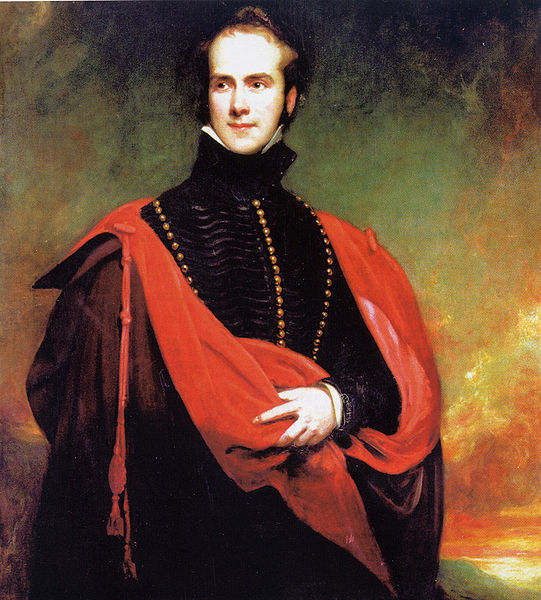
Robert Stewart, Viscount Castlereagh
You know what a neckcloth and cutaway coat does to me.

The Reverend Richard Harris Barham (1788 – 1845), intimate of Regency wit Sydney Smith, first mentioned the spectral phenomenon known as the “radiant boy” in his famous Ingoldsby Legends (1837). In this tale, a family’s young son becomes obsessed with the spirit of a boy, pale and crying, wandering the grounds of his home, a modest manor.

His mother tells her son it is nothing:

“The linden tree is straight and tall, its leaves are fresh and fair; but there’s no little boy at all–no pretty boy is there.”

But as she said this, her cheek was a little red and her voice hesitated. For she knew the legend of the radiant boy–that its appearance was a portent of bad luck and violent death.

Germanic folklore told of a curse of the kindermorderinn–children murdered by their mothers. The legend found its way to northern England where such apparitions were common, occurring particularly on the great estates of the wealthy. The spirits resembled young boys naked or nearly so, surrounded by white light–heirs deprived of their rightful inheritance, or so it was said.

Corby Castle in Cumbria, with its Regency facade by Peter Nicholson, used to be nothing more than a Border tower. Years ago, the rector of Greystoke and his wife stayed overnight in the old part of the house. The next morning, they departed so precipitously their hired chaise knocked the flower garden’s fence down.

The rector later wrote:

“Soon after we went to bed, we fell asleep; it might be between one and two in the morning when I awoke. I observed that the fire was totally extinguished; but, although that was the case, and we had no light, I saw a glimmer in the centre of the room, which suddenly increased to a bright flame.

I looked out, apprehending that something had caught fire, when, to my amazement, I beheld a beautiful boy, clothed in white, with bright locks resembling gold, standing by my bedside, in which position he remained some minutes, fixing his eyes upon me with a mild and benevolent expression.

He then glided gently towards the side of the chimney, where it is obvious there is no possible egress, and entirely disappeared. I found myself again in total darkness, and all remained quiet until the usual hour of rising.

I declare this to be a true account of what I saw at Corby Castle, upon my word as a clergyman.”

Corby Castle in Cumbria

A similar apparition, called the “Blue Boy,” resides in another border fortress, Chillingham Castle. Once the seat of the Grey family and the Earls of Tankerville, it was a popular country house party pad in the late nineteenth century. Even so, guests often reported blue flashes followed by a loud wail in the castle’s chamber known as the Pink Room.

Eventually the castle fell into ruin but recently a new owner has attempted a restoration. A remarkable account of this process, including the update of the Pink Room, can be found here.

But back to the Marquess of Londonderry–as Viscount Castlereagh, Robert Steward was a well-known Regency era figure and husband of an Almack’s Patroness. Long before his duel with rival and fellow ghost-observer George Canning, his lordship served His Majesty’s forces in Ireland. There he witnessed the apparition known as the Goblin Child of Belashanney. According to Thomas Moore, “Regency Poet of Wine and Love,” Castlereagh recounted his experience to Sir Walter Scott and ‘told it without hesitation as if he believed it implicitly:’

“It was one night when he was in the barracks and the face brightened gradually out of the fireplace and approached him. Lord Castlereagh stepped forward to it, and it receded again and faded into the same place  approached it.”

Strangely enough, of the two men who confessed their ghostly encounters to Scott, both ended their lives by suicide. One was the Earl of Stanhope.

The other was Lord Castlereagh.

The Most Haunted House in London

The Beast. The Thing. What was inhabiting No. 50 Berkeley Square?

Very bad ton, I daresay.

No. 50 Berkeley Square

The stories varied, but a dandy had a dashed good notion to test the on-dit that No. 50 harbored a ghost.  Full of blue ruin and holding a pistol, he spent the night in one of its rooms only to confront a “jet black shape” that leaped at him. Discharging his pistol, he was found dead with his eyes bulging, expired in the grip of apoplexy. Others say he managed to escape to endure another horrible fate–this Bond Street beau was the Lord Lyttleton who committed suicide by throwing himself down the stairs of Hagley Hall.

Later, two sailors were offered lodging in the house.  They too, offered fire against the apparition which appeared to them in the shape of a large man, and one died for his pains. This gave rise to the rumor the house was uninhabitable.

Neighbors in adjacent streets would peer out of their windows, astonished to see others peering back at them from the windows of the uninhabited house:

“He wore a periwig and had a drawn, morose ashen face. The two women thought he
had been to some New Year fancy dress party, because his clothes were centuries
out of date. The man moved away from the window, and Mrs Balfour and her maid
were later shocked to learn from a doctor that they had sighted one of the
ghosts of number 50 Berkeley Square. The doctor told them that number 50 was
currently unoccupied.”

Who was the man in the periwig?

George Canning

Joan Scott’s father was Major General John Scott, a man wealthy from card play. He instructed his daughters to never marry men with titles. His eldest disobeyed him and became Duchess of Portland. His youngest followed suit, and became Countess of Moray. Of all three, Joan (a viscountess in her own right!) was the only one to follow his wishes and married a politician.

Her husband was George Canning (1770-1827), the Prime Minister of the shortest tenure. He was the son of an actress and as one man famously said, never follow a man who is born of an actress. But this did not deter him. As a member of Pitt’s government, this hard-boiled Tory challenged Lord Castlereagh to a duel and got shot in the thigh for his pains.

He lived at No. 50 Berkeley Square.

He was the most divisive man in government. The Regent refused to meet him in person because he was  rumored to have had an affair with the consort Princess Caroline. He reduced his boss Lord Liverpool to tears and managed to force the poor man to apologize for it.

In the end he was reduced to begging prominent Whigs to join his Tory government, including Lord Lansdowne. But he died before he could realize his life’s ambition, in the very same room where the most radical of Whigs had expired, Charles James Fox.

They call him a lost leader. Perhaps he’s been found, in the rage of unfulfilled ambition.

The location is appropriate. It’s now a bookstore.

The Brown Lady of Raynham Hall

It’s the season for Halloween and I can’t resist providing the post I send to the Seduced by History blog:

Can anyone identify this well-documented photo from Country Life?  I say it is well-documented because, to my knowledge, it has yet to be thoroughly debunked.

“I will not spend another hour in this accursed house, for tonight I have seen that which I hope to God I never see again.” — HRH George, Prince of Wales

Baroque face – Raynham Hall

This was the first time we have credible documentation of a haunting at Raynham Hall in Norfolk.  No wonder–this was about the time when it became fashionable to go country-house visiting, a custom begun by the Regent himself. Now, for the first time, the old house was to host overnight visitors outside the family–and regularly.

Raynham Hall was an older Baroque mansion. It had been built in 1630, rather grand and up-to-date for its owner, Sir Roger Townshend, not well known for either quality. A little Palladian design was added in the Regent’s time with a pediment supported by Ionic columns on the seldom-seen east side.

Raynham Hall has remained in the Townshend family for over three hundred years.

His Royal Highness was awakened from a sound sleep by the figure of a woman standing at the foot of the bed in a brown brocade dress sadly out of fashion. This visitation was clearly not the result of a romantic assignation. Our aging Lothario was horrified when she turned her eyes toward him–empty in their sockets.

Imagine the chagrin Prinny’s hosts must have felt. They had always thought the Brown Lady was the figment of silly maids’ imagination and drunken family members. Something must be done since the apparition could no longer be ignored. Raynham Hall with its excellent shooting could be expected to remain on the country-house visiting itineray for many more seasons.

Lady Dorothy Walpole – the Brown Lady

Who the devil was she?

The answer didn’t come until twenty or so years later. A novelist, Captain Frederick, Marryat, was a a writer of sea novels and friend of Dickens. He came to stay at the house. His room was exhibited the well-known portrait of Dorothy Walpole, the “Brown Lady” of Raynham Hall.

At this time, the house still had the features of the Baroque house with inner and outer doors to each apartment. The captain had retired, accompanied by friends staying across the hallway from him. When he noted a light at the end of the corridor, he waited within the space between his apartment and hall until the aura had approached from the opposite end of the hallway:

“My father was in a shirt and trousers only, and his native modesty made him feel uncomfortable, so he slipped within the space of the outer doors (his friends shollowing his example) in order to concel himself until the lady should’ve passed by. …as she was close enough for him to distinguish the colors and style of her costume, he recognized her figure as the facsimile of the portrait of the “The Brown Lady.” He had his finger on the trigger of his revolver, and was about to demand it to stop and give the reason for its presecne there, when the figure halted of its own accord before the door behind which he stood, and holding the lighted lamp she carried to her features, grinned in a malicious and diabolical manner at him.”

Our sea novelist shot at her, the bullet passing through her into the opposite wall. Unperturbed, her ladyship gazed upon him, with socketless eyes, and then disappeared.

red looks good on him

This account was given by the captain’s daughter, the actress Florence Marryat. In those Victorian times, women were not supposed to exhibit such insolence. Because of his outrage over feminine insolence, Miss Marryat’s father was the first to look the spectre “in the eye” and give us her identity.

The connection was thence made to an old story. Charles Townsend, the Turnip Townsend, had married his true love, Dorothy Walpole. But she had already enjoyed the favors of a lover, Lord Walpole, and Townsend was incensed that what he had brought to Raynham’s marriage bed had been sullied by another. He locked up his beautiful wife in his Baroque manor, and she was to die there, separated from her children, and her one true love.

True love can bear true fury.

Too Good for that Infamous ‘Whore’ – Bridgewater House

‘I din’d, together with Lord Ossorie and the (Earl) of Chesterfield, at the Portugal (Embassy), now newly come, at Cleveland House, a noble palace, to good for that infamous…the staircase is sumptuous, and the gallerie and gardens..” — John Evelyn, Memoirs (1641 – 1705)

I’m sure he meant to say “whore.” Barbara Villiers was the most infamous mistress of Charles II, first Lady of the Bedchamber to his queen, Catherine of Braganza, of little dowry and no heir.  I highly recommend Charles II:  The Power and the Passion, a TV series starring Rufus Sewell.

remember this one?

Anyway…  my lady Castlemaine, Barbara Villiers, was made Duchess of Clevelend. She purchased Berkshire House, an isolated mansion separated from Westminster by a deer park. Surrounding properties were also acquired and two wings were added to the mansion, now called Cleveland House.

By 1700, the Earl of Bridgewater had purchased most of the property, a rambling collection of unrealted houses surrounding an area some called “Cleveland Square.” Frances Egerton (1736 – 1803), third and last Duke of Bridgweater largely rebuilt the mansion using James Lewis, neo-classical architect. His great painting collection was housed there, in the tradition set by Lansdowne House and other London mansions that showed off the political and intellectual influence of their aristocratic owners. Even the Orleans paintings, the spoils of the French Revolution, found their way into the former whore’s house.

The 3rd Duke died, unmarried. He bequeathed the mansion and its fabulous collection to Earl Gower, owner of Stafford House of the previous post.

From the lengthy description of Cleveland House given by British History Online:

George Granville Leveson-Gower, Earl Gower, who was the third Duke’s nephew, became Marquis of Stafford in 1803, shortly after his uncle’s death. He carried on the third Duke’s work of restoration at Cleveland House and had a new gallery built, designed by Charles Heathcote Tatham, to accommodate his own as well as his uncle’s pictures. The new gallery was opened tot he public in May 1806.

In 1840, the whole of the original part of Cleveland House was demolished. The roof was falling in and the supporting walls were found to be quite derelict. Interestingly enough, Lord Francis Leveson-Gower, the 2nd son of Earl Gower, Marquis of Stafford and lastly Duke of Sutherland, was charged by the trust which devolved the house to him in accordance with his father’s will for an amount of money equal to the waste he incurred by the demolition. The Bridgewater estates, including the mansion, still belonged to the duchy of Sutherland and Lord Francis had only a life estate in them. Therefore he was charged with their upkeep.

Demolition of the whorehouse is not quite what the Trust had in mind.

Bridgewater House bombed in the Blitz

London’s Versailles – Stafford House

“It is arguable that Stafford House was the only true private palace ever built in London, even if it did not surpass Versailles as Wyatt intended.”

The Great Gallery of Stafford House

The Great Gallery of Stafford House

Commissioned by the Duke of York, construction began on what was known then as York House. Princess Charlotte had died and HRH Frederick Augustus (1763 – 1827) was thinking he ought to have a palace now that he was heir to the throne. He once marched 10,000 men up a hill only to change his mind and order the lot back down. When York House scarcely had its foundation stone laid, the Duke sacked his architect, Robert Smirke, whose snide remark is noted in the the previous post.The Duke was as indecisive a builder as he was a military leader.

Benjamin Dean Wyatt (1775 – 1825) was appointed to finish the job. He had been urged upon his royal patron by the Duchess of Rutland, who was remodelling her own home, Belvoir Castle (hmm, I sense a subject for a future post). BD Wyatt designed the house to be two story, with Palladium attributes such as a rusticated ground floor and a lofty piano nobile beneath a shallow pediment raised high by Grecian columns.

It remained a shell, however, until it was leased to the Marquis of Stafford. He was also the late Duke’s largest creditor. However, Lord Stafford was unable to finish the house, having passed away as the “richest individual who ever died.”

Stafford House central hall

I pause here briefly to note the Marquis had become Duke of Sutherland in 1833, by virtue of his marriage to the Sutherland heiress. Elizabeth Gordon (pictured below) became Countess of Sutherland when a mere baby. Both were notorious figures in a couple of ways.  The couple was briefly imprisoned in France for attempting to aid Marie Antoinette’s escape. They were also responsible for some of the worst of the Highland clearances. The Marquis, appalled at the condition of his wife’s Highland tenants, decided they should be cleared and sent off to become fishermen. It did not go well, like so many well-meaning intentions great powers have for the good of the people.

The 2nd Duke of Sutherland was primarily responsible for the fabulous interior of Stafford House. The state rooms were larger than those at Buckingham Palace. The central hall alone was 80 feet across and the stair rising 120 feet high. White marble Corinthian columns lined the walls.

He added a third story to the house for all the nurseries, schoolrooms, nannies, nurses, tutors, governesses, et al for his eleven (11!) children.

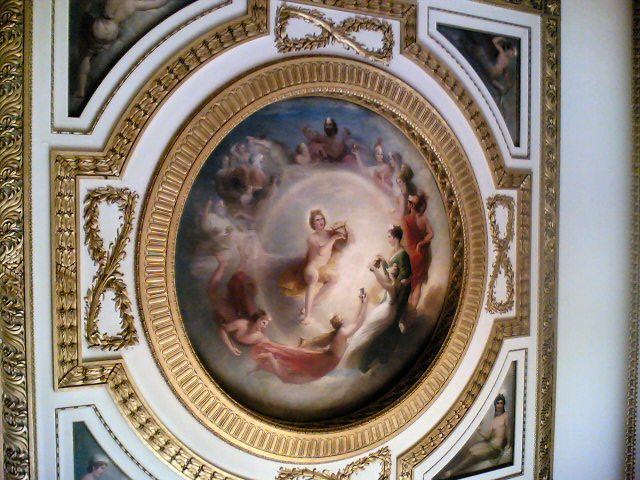
The decorative style has been described as Louis Quatorze — it could easily be termed rococo on steroids. The coffered and coved ceilings were heavily ornamented in the boiseriestyle and painted with lots gilding. Below is one of several ornate ceilings in the house. As if that were not enough, the great Stafford collection of paintings was gathered together in the house, including art brought to England from plundered French aristocrats.

Today, the palace is called Lancaster House. It serves as a government reception site.

Better than being in a dustbin like some other houses we know.

Calgon! Take me away!

Grosvenor House – Regency Treasure House

In 1805, Gloucester House, home of several lesser Royals, was purchased by the Grosvenor family. The house had a long frontage along Park Lane and extensive gardens beside Mount Street. The noted architect William Pordon was hired to remodel it. Upon initial inspection, he found it to be “dirty..and not so cheerful as the situation would lead one to expect.”

In 1808, Grosvenor House, as it was renamed, was thrown open for the ton’s inspection. Lord Lonsdale, Lord Grosvenor’s fellow Tory, pronounced it “expensively furnished, but in bad taste.”

Richard Grosvenor, 2nd Marquess of Westminster
red looks good on him

No matter–Grosvenor House was principally known for its collection of paintings. Stubbs, Gainsborough, Benjamin West were just a few of the artists represented in a collection that required extensive additions to the House. An entire wing some fifty feet long, double story, was added. An entire room was devoted to the religious paintings by Rubens, looted by the French from a Carmelite convent during the Spanish Peninsular War. These were purchased for 10,000 pounds. Presumably the nuns saw none of that money.

The development of the Grosvenor Estate, of which the house was only a small part, made the family one of the wealthiest in England during the Regency. Successive generations became wealthier, eventually becoming the Marquesses and later Dukes of Westminster.  The present duke is almost (if he isn’t) the wealthiest person in the U.K.

Grosvenor House is now demolished.

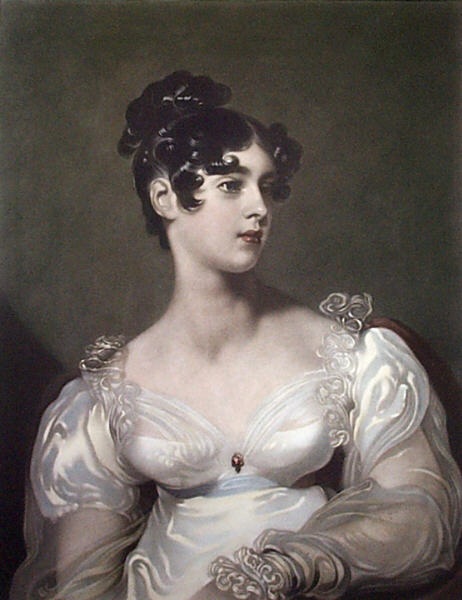
The Viscount Belgrave, Richard Grosvenor, and his wife, Lady Elizabeth Leveson-Gower, as she was known before her marriage, lived in Grosvenor House during the London Season with his parents, the first Marquess and Marchioness of Westminster.

I’ve pictured them here because they are both rather good-looking.

Lady Elizabeth published two very interesting travel diaries. During her trip to Russia in 1827 her knee suddenly swelled. An English doctor was found, along with eight leeches:

“…more voracious animals never were seen. I could hardly prevent them from biting my fingers in taking them out of their glass; and they fixed the moment they were applied; biting like pen-knives, we put on seven, and never saw anything like their size, and the quantity of blood they took away..”

Elizabeth Grosvenor, Marchioness of Westminster
no leeches in this 1816 portrait

Northumberland House: Three Centuries, Three Families

It was a plea that fell on deaf ears, in the interest of progress and the Board of Works:

“The Duke of Northumberland is naturally desirous that this great historical house, commenced by a Howard, continued by a Percy, and completed by a Seymour, which has been the residence of his ancestors for more than two centuries and a half, should continue to be the residence of his descendants; but the Metropolitan Board of Works are desirous that this house, which, with its garden, is one of the landmarks of London, and is probably the oldest residential house in the metropolis, should be destroyed.”

—-‘Northumberland House and its associations’, Old and New London: Volume 3 (1878)

Before the Victorian Embankment was constructed, the Strand was once a river road connecting London to Westminster. During the Elizabethan period and into the reign of James I, great mansions were erected along this route with gardens that stretched down to the river. At the corner of the Strand and Whitehall, at a small hamlet called Charing, Henry Howard, Earl of Northampton, built the largest one in Jacobean style. Its principal feature loomed over the Strand–a three story high frontispiece topped by a high parapet. It looked like it was designed to hold a Bavarian glockenspiel.

Northumberland House – Canaletto

A Fleming, Gerald Christmas, was allegedly one of the architects. He left his mark on the front portal of the house by embedding his initials in the stonework. Scarcely a decade after the house was built, this stone fell and killed a young man standing below on the Strand, watching Anne of Denmark’s funeral procession.

When the Earl of Northampton died, the house passed to another Howard, newly created Earl of Suffolk. The river mansion became known as Suffolk House, but not for long. A daughter married a Percy and took the residence with her as part of the marriage settlement. Henceforth it was called Northumberland House.

In the middle of the seventeenth century, the river mansion was given a fourth side along the river to complete the enclosure of its quadrangle. This was the new entrance and where the main living areas were moved, away from the noise and dust of the street side. Great stone stairs were constructed leading from the dining room down to the riverfront terrace and its verdant gardens.

Elizabeth Percy was the sole remaining heiress of the Percy line in 1670. She had the distinction of being a twice-widowed virgin, having been married as a child to Lord Ogle, who died soon after and then to Thomas Tynne, a philanderer who was “barbarously murdered” before he could sleep with his new wife. He was shot to death by another suitor for her hand as he sat in his carriage in Pall Mall:

“Here lies Tom Thynne of Longleat Hall/Who ne’er would have miscarried;

Had he married the woman he slept withal/Or slept with the woman he married.”

The heiress of the Percy family was not yet seventeen years of age when she then married Charles Seymour, the ‘proud’ Duke of Somerset: “a man in whom the pride of birth and rank amounted almost to a disease.” Their son Algernon made major alterations to the house as his wife, Frances, complained of in 1749:

“I am actually frightened with the sum my lord is laying about Northumberland-house;..”

She had not recovered from the death five years before of her only son, the Viscount Beauchamp “my ever lamented Beauchamp” and hated the thought of travelling to Bath instead of finding a resting place at Northumberland House. But no one could get near the place:

 “..It is still hid with scaffolds toward the street, but by the plan, and the little I could see of it when I was in London on the king’s birthday, it will be very handsome and indeed it should:  my lord destined ten thousand pounds for the alterations.”

The house was to pass to her daughter, who married a man with the pedestrian name of Smithson. The new Duke and Duchess of Northumberland lived in great style on the Strand, expanding the house by adding on two Palladian wings, one of which contained a picture gallery: “(a) sumptuous chamber,..might have been in better taste,” wrote Horace Walpole.  Oh, dear.

Topping it all was the Percy lion, a cast iron sculpture placed on top of the glockenspiel parapet, his tail outstretched like a handle.

The Northumberland fortune increased and so did the house. By the Regency, it had a magnificent glass drawing room and a grand marble staircase, a final burst of magnificence before the family moved away to the more fashionable neighborhood of Grosvenor Place. Then along came Trafalgar Square in front of it and the Embankment behind, isolating the great mansion, although still beloved by the Percies.

In 1873 the Board of Works demanded the Duke sell Northumberland House to make way for a street to the Victoria Embankment. There were other routes proposed, through lesser houses and considerably less ancient, but the Ministry had set its sights on putting the road straight through the house and its gardens. The house was handed over for 500 thousand pounds and the auction of what could be salvaged from demolition amounted to 6500 pounds.

“3,000,000 bricks, the grand marble staircase…the elaborate ornamentations of the hall, dining and reception rooms; the state decorations which adorned the hall and corridors, and a large quantity of lead, stated to be of the weight of over 400 tons.”

The story of Charing Cross and its immediate neighborhood, by J. Holden McMichael

The lion is now atop the Duke’s suburban London residence, Syon House.

Syon Park – licensed for reuse by Don Cload under the Creative Commons
see the lion at the top?

Great Regency Fortunes

Lansdowne, Holland, Devonshire and the others–great London residences that were also Whig powerhouses of Regency London. We leave them now, along with their satellites Kenwood and No. 10 St. James. Time to visit the London palaces built with Tory fortunes.

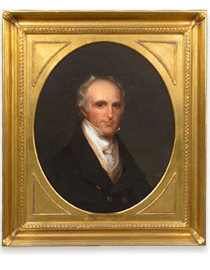
Richard Rush, by Thomas Sully
Yes, but can the American tie his neckcloth properly?

In 1817, the United States sent a most unlikely ambassador to Regency Britain. Richard Rush was the son of Benjamin Rush, prominent physician and signer of the Declaration of Independence.

Upon entering service with the federal government, Rush became one of President Madison’s closest advisors. He was a strong advocate for waging the War of 1812 with Britain. When John Quincy Adams returned from Europe, Rush was no doubt was surprised as everyone else when he was appointed to take Adams’ place as the new Envoy Extraordinary and Minister Plenipotentiary to Great Britain.

He remained in England for eight years and became very popular there, successfully negotiating a number of important treaties with Britain and laying down the foundation of a “special” relationship between the U.S. and the “mother ship” — the foundation of the world’s most strategic alliance.

His “Residence at the Court of London,” a journal of the time he spent as ambassador shows remarkable insight into the latter years of Regency England.

He made the following observation:

At dinner, I sat between the Chancellor of the Exchequer and Lord Lynedoch. Speak-
ing of the property-tax, the former mentioned that the four largest incomes in the kingdom,
as returned under it while in operation, were those of the Duke of Northumberland, Earl
Grosvenor, the Marquis of Stafford, and the Earl of Bridgewater ; these, he said, were the
richest Peers in England, and there were no Commoners whose incomes were returned as
large.

It was estimated each of these noblemen enjoyed an income of over 100,000 pounds sterling a year–an enormous sum at the time.

Their London homes were among the finest. Well-worth a visit.

Will you join me?

One House Saves Another–and Perhaps, a Nation

Vivien let her fingertips glide along the curved glass railing of the crystal grand staircase of Devonshire House.  “It’s been so many years since Hart’s death but all his things remain here just as they were when he was alive.”

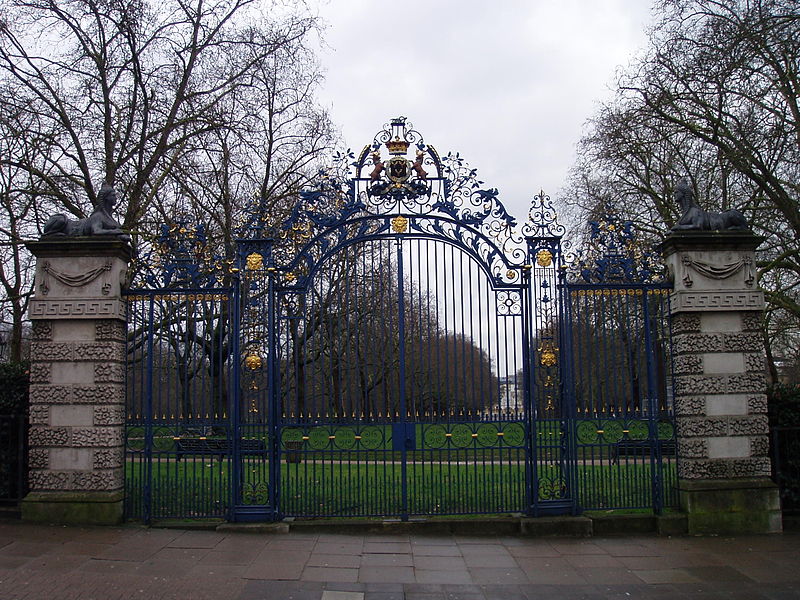
Devonshire House gates

She smiled sadly at her companion, the Dowager Countess of Northam, who pulled her ermine fur more closely about her shoulders as they passed into the grand saloon.

Diana was well aware Vivien was watching her. She shrugged as her eyes roved over the giltwood and gesso overmantel frames containing the priceless paintings Hart had collected for years. “Perhaps it was a blessing Blanche passed away before her husband could succeed to all this. Hart adored her–she was his favorite niece by far and he really wanted her to have all these things, though I can’t conceive why.”

“Who will be the next chatelaine of this house, I wonder?”

Diana threaded her arm through Vivien’s. They were two old ladies whose opinions mattered to no one anymore. “Spencer will never marry. He’s too much like Hart with that silly mistress of his. The one they call Skittles.”

Vivien’s dark eyes toward her. “Are you jealous of her? She’s very beautiful, I hear, and has the admiration of all the gentlemen when she rides in Hyde Park. Just as you used to do.”

“Hush,” Diana said.

Vivien patted her hand. “Don’t fly up into the boughs, my dear.”

Yes, Diana was jealous, despite her eighty some-odd years. Age had done nothing to dispel the fierceness of feeling. As always, she relied on her dearest friend to soothe the violence of her temper. She looked down on darling Vivien’s face, noting the eyebrows that were still as black as her hair once was. “Devonshire House will need a mistress made of sterner stuff than the daughter of a customs official.”

They had paused before a great window that looked out across Devonshire’s gardens. In the distance was a long wall separating the duke’s cabbage from the Marquess of Lansdowne’s fine lawn, fresh from being dug up along the riverbank. The ancient frame of an old ladder leaned against the wall.

“Stay,” Vivien exclaimed, pointing to the Palladian mansion opposite Devonshire House. “Did I not tell you there’s a baby girl just born to Lansdowne House? Louisa, God rest her soul, has a new great-granddaughter. They mean to call her Evelyn, I hear.”

Diana could not take her eyes from that ladder, her mind seized on the memory of that day long ago when she first met Hart, to Louisa’s dismay.

“Oh, darling,” Vivien exclaimed, seeing a tear slip down Diana’s face. “If you cry, then you know I will. And then we shall all be the basket.”

The last mistress of Devonshire House was that baby girl, who made sure the memory of the old house and its “Bachelor Duke” were never to be forgotten.

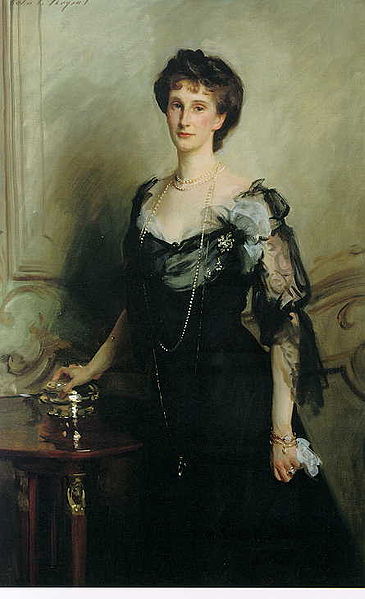
Lady Evelyn Emily Mary FitzMaurice, (1870 – 1960) was the oldest child of the 5th Marquess of Lansdowne and his wife, Maud. She married Victor Cavendish in 1892 and became the 9th Duchess of Devonshire. She was unprepossessing, serious-minded and nothing like her flamboyant predecessor, the German Louisa van Alten, England’s Double Duchess.

Lady Evelyn Cavendish, 9th Duchess of Devonshire – by John Singer Sargent

She was the chatalaine who presided over the death of Devonshire House.

“…by the close of World War I, the social and political London scene had changed greatly for aristocrats, and the Cavendish family sold Devonshire House. Before it was demolished in 1925, Evelyn, the ninth duchess, who had a deep appreciation for architecture and antiques, had all of the interiors photographed and the rooms painstakingly disassembled before the contents were shipped to Chatsworth.” The Ultimate Attic

The well-publicized Chatsworth sale in 2010 of those various Devonshire House fittings and furnishings could not have happened without the 9th Duchess’ labor almost a century before. Her little pieces of paper were found, under the soot from Chatsworth’s attic, attached to every picture frame, chimney-piece and wood carving, noting what room in the long-vanished London house the item was taken from. From contemporary accounts, notably Evelyn’s daughter, it appears as if Her Grace knew that a portal into the past was about to be closed forever:

“..much of the furniture and even the silk off the walls were spread about Chatsworth. Piled high in the kitchen maids’ bedrooms were silk curtains, cushions, tassels and braids. Chimney pieces lay on the backs by the forge in the stables, while in the granary loft above were stored the London state harness of the carriage horses, extravagantly carved and painted pelmets, gilded fillits….” — from Her Grace, the Dowager Duchess Deborah Mitford Cavendish’s book All in One Basket

I’ve often wondered if the Royal Collection owes a debt of gratitude to the 9th Duchess of Devonshire. It was Queen Mary who set about reinstating many “lost”items that had been loaned out by preceding generations of the Royal Family. No doubt she relied on the steady advice of her Mistress of the Robes. Doubtless she realized that those born of Lansdowne House were great collectors. Duchess Evelyn had experience in such matters.

It seems Her Grace came at the right time to serve another House–and perhaps a Nation.

All that’s left of Devonshire House’s Crystal Staircase

Devonshire House – “Its Beauties all Within Reside”

So much has been written about Devonshire House, most of it concerning the period of the Devonshire House Circle, presided over by the beautiful Georgiana, wife to the 5th Duke.

south front – Devonshire House

After such brilliance, it seemed anticlimatic when the house was inherited by the 6th Duke, William “Hart” Cavendish, a man witty and handsome. Alas, because of a disability, he was unable to carry on his mother’s significant political career and leader of the Whig circle.

One of my characters, Lady Diana, quite liked the young duke whose Devonshire House gardens abutted those belonging to her friend, Louisa, Marchioness of Lansdowne.

Long after those days when it was thought they might make a match of it, Diana heard that Hart was planning to leave London.

“Di, I mean it. I’m removing to Chatsworth. Never coming back to London, I daresay.”

Diana eyed the duke’s tall form in dismay. “But you’ve done so much work on this house. I can’t imagine you shutting it up for years and years.”

His Grace rubbed his ear and motioned for her to repeat herself. “You’ll have to shout, my dear. Can’t hear a damn thing, you know.”

“Oh, you heard me well enough,” she retorted. “You’ve joked often enough that you hear more than people imagine, and a good deal more than they intended.”

Hart laughed. “I can never fool you, Di.”

He looked up at carved blue and silver ceiling of his mother’s boudoir. “The thing is, I’m bored. I’ve remodelled and redecorated this place, all except this room.  Belonged to Mama, you know.”

“But to leave London? What could you possibly find to do in the country?”

Hart reached out and stroked the fine organza of her sleeve. He sometimes did that with beautiful women, taking the opportunity to touch them under the excuse of having to stand close by to capture the fading sound of their voices.  Sounds that had become almost inaudible.

“There’s much to amuse me at Chatsworth.”

“How silly of me to forget your little rookery you keep there for your lady-birds.” She covered his hand with hers and squeezed it. “I shall miss you, Hart.”

The sixth Duke was really far more important to Devonshire House than his mother ever was. He had carried out necessary repairs and renovations, refreshing the gilding and the like, before leaving London in the 1830s. But by the 1840s, he had returned and transformed the Piccadilly mansion.

He removed the Palladian entrance with its external stairs. A porte-cochere now led to the ground floor, which had formerly been the servants’ area. Visitors passed through it directly to a crystal staircase leading to the main floor above. A ballroom was created from two drawing rooms and many of the entertainment areas had their ceilings lifted at the expense of bedrooms above. Hart had clearly returned to London, according to Lady Eastlake in May 1850:

“..the stairs themselves splendid, shallow, broad slabs of the purest white marble, which sprang unsupported, with their weight of gorgeous crystal balustrade, from the wall; and such a blaze of intense yet soft light, diffused round everything and everybody by a number of gas jets on the walls. The apartments were perfect fairyland, marble, gilding, pictures and flowers….”

When Devonshire House was demolished, it was already in a somewhat dilapidated state. The large brick wall that shielded it from the street (built in the eighteenth century to deter burglars that plagued London’s great houses) was a magnet for graffiti. There were only a few statues remaining in the gardens. The house was sold in 1920, along with its three acres. All of it, including the crystal staircase were soon to be nore more, lamented in a poem by Siegfried Sassoon.

But all was not lost. Thanks to an intrepid duchess, the house lives on, in bits and pieces. They are by and large the legacy of the sixth Duke. These numerous Regency pieces are to be found in the most surprising places.

north front Devonshire House