Cowper: Fanny Price

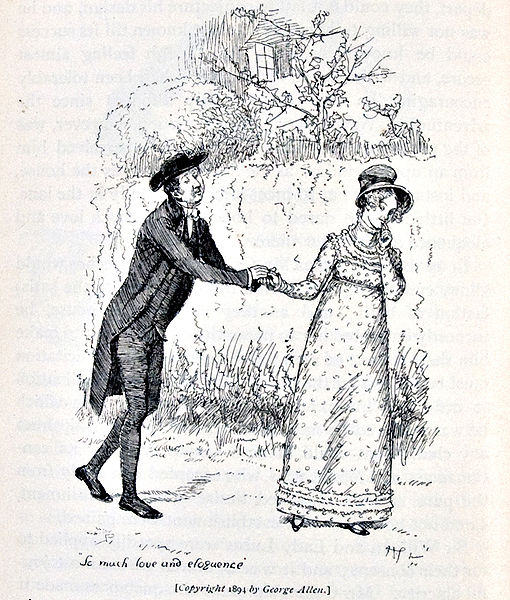
Fanny, who was sitting on the other side of Edmund, exactly opposite Miss Crawford, and who had been attentively listening, now looked at him and said in a low voice– O Brother, where Art thou

“Cut down an avenue? What a pity! Does that not make you think of Cowper? ‘Ye fallen avenues, once more I mourn your fate unmerited.’ ”

Mansfield Park, Jane Austen

Fanny Price, like Austen, was very fond of William Cowper, a poet of the eighteenth century. He was not a Romantic poet, but his brooding, melancholy, emotional writing had great influence over poets of the Regency, such as Wordsworth and Coleridge. Cowper suffered bouts of insanity and deep depression–he wrote various hymns preserved today in the Sacred Harp (think O Brother, Where Art Thou?) but it was his poetry, encouraged by various women in his life, that gave him a much-needed outlet for his despair.

In Nature he sought solace:

Who loves a garden loves a greenhouse too.
Unconscious of a less propitious clime,
There blooms exotic beauty, warm and snug,
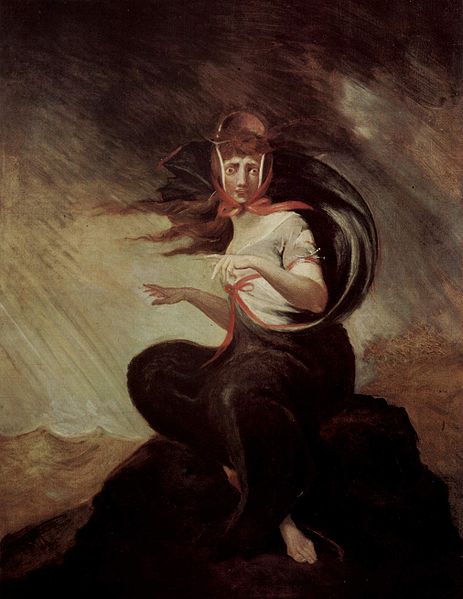
While the winds whistle and the snows descend.Crazy Kate from Cowper's "The Task" by Fussli - the depths of despair
The spiry myrtle with unwithering leaf
Shines there, and flourishes.

The Task, Book III, The Garden

But humanity, like nature, eventually dies:

I was a stricken deer, that left the herd
Long since: with many an arrow deep infix’d
My panting side was charged, when I withdrew,
To seek a tranquil death in distant shades.

What does it mean to have a Regency-era character who adores Cowper? He might be depressed and perhaps thinking of his own death. She might look upon the trees in the park,  and find comfort from the stress of every day living, as Fanny does in Mansfield Park:

“Here’s harmony! Here’s repose! Here’s what may leave all painting and all music behind, and what poetry only can attempt to describe. Here’s what may tranquilize every care, and lift the heart to rapture!”

Regency Poetry: Nuances of Sensibility

Speaking of Downton Abbey, Violet’s character is so very rich, is it not? Her remarks are cleverly acid and yet illuminating as well. Certainly we know what her ladyship thinks of Byron. We probably can guess what she thinks of Regency poetry in general, with its idealism and “sensibility:”

Edith: “..am I to be the maiden aunt? Isn’t this what they do? Arrange presents for their prettier relations?”

The Dowager Countess: “Don’t be defeatist, dear, it’s terribly middle-class.”

No pining about and no nonsense.

"Oh, Anne."

“Oh, Anne.”

I like to speculate what poets my favorite Regency-set characters favor. As dear Anne from Austen’s Persuasion famously says, “We are living through a great age for poetry, I think.” In the next few posts, this blog will consider some characters from Regency fiction and what poets they might find appealing.

Which of the following would Heyer’s Kitty Charing like?

“..Shelley’s ‘silver music,’ Coleridge’s ‘wings of healing,’ Wordsworth’s ‘wild unpeopled hills’ and above all..Keats.”

from  Byron in Love: A Short Daring Life by Edna O’Brien

Hang on–wasn’t it Anne who advised caution against too much poetry? Her companion, Captain Benwick, was:

“..intimately acquainted with all the tenderest songs of the one poet (Walter Scott), and all the impassioned descriptions of hopeless agony of the other [Lord Byron]; he repeated, with such tremulous feeling, the various lines which imaged a broken heart, or a mind destroyed by wretchedness, and looked so entirely as if he meant to be understood, that she ventured to hope he did not always read poetry.”

Persuasion by Jane Austen (as presented by Janet Aikens Yount in Eighteenth Century Life, Winter 2010)

It must be recalled, however, that Anne Elliot is a masterfully drawn character. She is so nuanced in her beloved, practical way that it is a beautiful serendipity to find in her a great capacity for the “sensibility” vital to Romantic poetry. That capacity was hidden, in a:

“..heart large and expansive, this seat of deep, kind, honest and benevolent feelings–a bosom capacious of universal love, but through which there flowed a deeper stream…” — The Retrospective Review, Vol. 7 Part 1 (1823)

Still waters run deep, as they say.

Downton Abbey’s Byron

It turns out the Earl of Grantham might be a poet.

Newstead Abbey, photo by Andy Jakeman, licensed under the Creative Commons Attribution-Share Alike 2.0 Generic license

Newstead Abbey as photographed by Andy Jakeman and  licensed under the Creative Commons Attribution-Share Alike 2.0 Generic license

When a family must be evicted, one that has held their tenancy at Downton for many generations, Lord Grantham gropes for a reason to let them stay:

“If we don’t respect the past,” he says, “we’ll find it harder to build our future.”

“Where did you read that?” asks the Dowager Countess.

“I made it up.”

“It’s too good,” she admonishes. “One thing we don’t want is a poet in the family. The only poet peer I am familiar with is Lord Byron and I presume we all know how that ended.”

A teasing remark a mother might make to her prosing son.

Still, the Dowager Countess must have been keenly aware that Byron’s finances, like the earl’s, were a mess. Moreover, the great Romantic owned an abbey, which had to be got rid of to pay his debts.

Clearly there exists some parallels between Baron Byron and the Earl of Grantham.

And they are just too appalling to contemplate.

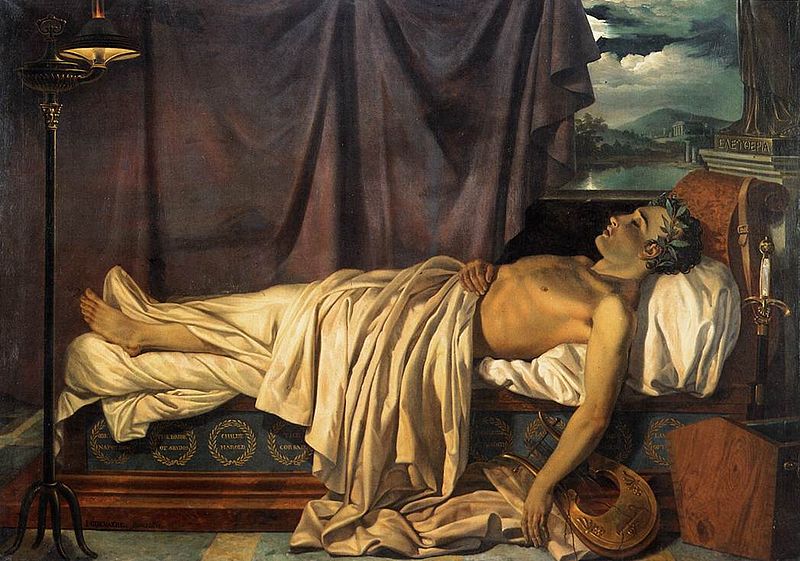
Lord Byron on his Deathbed

Lord Byron on his Deathbed

Regency Love: To Die For

Russell Square in London

Russell Square in London

Dr. Roget had not even begun his famous Thesaurus when he heard a terrible crash upstairs in his uncle’s house. Sprinting up the stairs, he found the man who had raised him like a son bespattered with blood. He gathered his uncle in his arms, appalled that such a nurturing figure had quite deliberately slashed his own throat.

Why had he committed suicide?

Sir Samuel Romilly’s (1757-1818) last words were a fragment, scribbled down before he succumbed:

“My dear, I wish…”

Romilly had been distraught over the death of his wife some days before. The news of her passing came to her husband at Cowes Castle, on the Isle of Wight. It was thought that removal to his town residence at 21 Russell Square might revive him. His daughter Sophia attended him there, but she had, alas, for a moment, left him alone.

He died, as they said, of an excess of sensibility. He died of an excess of love.

Regency society was in shock. Romilly had been a beloved barrister, a tireless opponent of the slave trade, a champion of the criminal defendant at bar. It struggled to condemn him, for such cases generally provoked disapproval. In previous years, as reported by The Times in the case of one Mr. Green: “..to be inconsolable over one’s wife, and to follow her to the grave–is madness.

There was much prevarication in those first reports. Donna Andrews’ Aristocratic Vice: The Attack on Duelling, Suicide, Adultery, and Gambling in Eighteenth-Century England is instructive. Surely Romilly had committed his act in “mental delirium” and “under instant paroxysm of the brain.” Indeed, he had been working tirelessly for the good of a Nation. He cannot be blamed for a physical manifestation that had little to do with lack of character. Other writings were not so charitable. Remember how stoic Princess Charlotte’s husband had been in the wake of Her Highness’ death?

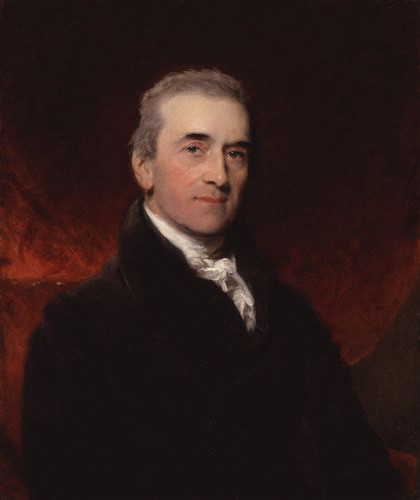
by Sir Thomas Lawrence. Perhaps some of his sensibility emerges about the mouth of this brilliant lawyer, I vow.

Sir Samuel Romilley by Sir Thomas Lawrence. A slight smile of sensibility about the mouth, perhaps.

These illustrations seemed wretchedly unsatisfactory. More writings, including poetry, continued to pour forth, as the Regency struggled to reconcile the Act with the Man. From much hand-wringing emerged the most soothing explanation, which became widely adopted. Here was a man who had defended the least among us, they said, with such devotion that he surely suffered from “an excess of feeling, or rather than by sentiment, which is the most binding one in our social system.”

Had he been less feeling, less sensitive to the tragic death of his wife, he would still be living.

In a watershed moment, Society allowed itself to salute what Byron once reviled (see Castlereagh.) In leaving this world, as Lady’s Magazine beautifully related, Romilly was both weak and wise, delicate and great, showing “human nature in a point of view, which commands at one and the same time our utmost love and veneration.”We cannot judge those who love and lose. We must only imagine their pain, and perhaps hope that we have had occasion to experience such exquisite joy.”

Finally,

“To lose Lady Romilly, after an attachment so formed, and after years flown away in the tranquility of domestic joy, disturbed only by the pursuits of a splendid ambition, synonymous with virtue, was one of those shocks which must be left, undefined, to the imagination of such as know what it is to feel.” The New Monthly Magazine, Vol. 10, 1818

Regency Servants: Nurse Nanny

Downton Abbey, like many great British family sagas, features a wicked nanny. Did you see the austere portrait of Queen Mary in the servants’ quarters downstairs?

That was Wicked Nanny’s cue.

Eddy and Bertie's younger brother, Prince John, pictured with Nanny Bill

Eddy and Bertie’s younger brother, Prince John, pictured with Nanny Bill

Mary of Teck’s trials with nannies were recorded by her oldest son, the abdicating Edward VIII. According to him, one had been dismissed for insolence, another for abuse. Both boys were allegedly pinched to make them cry so that a return trip to the nursery was necessary. Little Bertie might have been starved. All were reported by an assistant, the undernurse, Nanny Bill.

In Downton Abbey, Nanny West got sacked for calling Sybil’s daughter a “wicked little cross-breed.”  Her role was rather brief. I suspect she was a device to set up the viewer’s sympathy for her successor, who very well may do something really naughty.

Nannies during the Regency used to be called nurses. They had enormous influence over their young charges in the nursery. Happy was the family who could trust such a servant, and having found one they might retain her to stay on for future generations.

Nurses figured largely in the literature of the time. They might be intimate confidantes, mentors, or providers of safe refuge for their former charges, now grown up yet fleeing to them in times of adversity.

Indeed, one might have a mother but ’tis better to have a nurse:

Save the child–give it a truer mother, the domestic nurse, who possesses the equanimity of humble station, whose self-interest is more vigilant and attentive, and (such is the providence of nature) whose attachment often grows more maternal than that of the mother herself. — The Belfast Monthly Magazine, July, 1811

Worries over the nurse’s abilities seemed minor:

A child that is much danced about, and much talked to, by a very lively nurse, has many more ideas than one that is kept by a silent and indolent person. A nurse should be able to talk nonsense in abundance, but then she should know when to stop. — “On the Progressive Development of the Faculties of Children,” by Elizabeth Hamilton as printed in The Lady’s Magazine 1802

The Wet Nurse, by Marguerite Gerard

The Wet Nurse, by Marguerite Gerard

My favorite nurse from the Regency is featured in Heyer’s Sylvester, or the Wicked Uncle. Even when she is not in the scene, Nurse’s absence is rendered quite acute.

The following passage finds the pompous dandy, Sir Nugent Fotherby, attempting to placate his stepson’s demands. He has just sawed off one of the buttons from his elegant coat:

‘No need to cry, dear boy! Here’s your button!’

The sobs ceased abruptly; Edmund emerged from the blanket, tearstained but joyful. ‘Button, Button,’ he cried, stretching out his arms. Sir Nugent put the button into his hand.

There was a moment’s silence, while Edmund, staring at this trophy, realized to the full Sir Nugent’s perfidy. To blinding disappointment was added just rage. His eyes blazing through his tears he hurled the button from him, and casting himself face downward gave way to his emotions….

Fortunately, the noise of his lamentations reached Phoebe’s ears. She came quickly into the cabin, and upon being assured by Sir Nugent that so far from bullying his son-in-law, he had ruined one of his coats to provide him with the button he so insistently demanded…

(Phoebe) said contemptuously, ‘I should have thought you must have known better! He means his nurse, of course!’

Regency Love: A Battlefield

Eleanor Anne Porden (1795 – 1825) met her future husband on board his ship, the HMS Trent, and wrote a poem about his travels to the Arctic.

Captain John Franklin took her admiration to mean he could have her for the taking.

Eleanor was one of England’s Romantic poets. Her “Veils or, Triumph of  Constancy,” written when she was a teenager, had been published by John Murray II, Byron’s publisher, in a “vanity” arrangement brought about by her father.
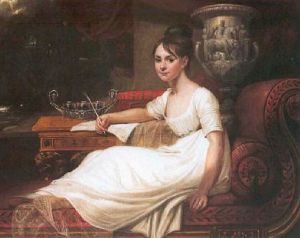
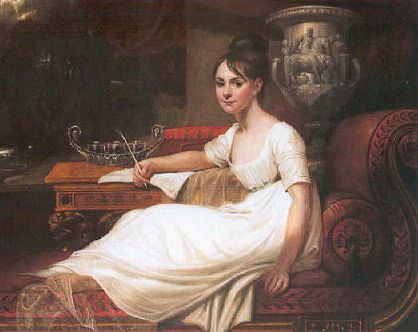
She was not the accredited beauty Lucy Barry was, but she displays a lively intelligence here, I believe.

It was said Miss Porden was not an accredited beauty like Lady Barry, but in this portrait she displays a lively intelligence that is most attractive, I vow.

Veils did not sell well at first. Perhaps the dissatisfaction came from Porden’s attempt to express her admiration for science in romantic terms. Rich in allegory, at some future date this blog will address Porden’s singular work, but for now, it must be known that her father had to forward eighty-four pounds and four shillings to the publisher to cover initial losses.

John Murray Publishing is still in operation today, presumably no longer offering vanity arrangements.

Upon Captain Franklin’s return, he found Miss Porden still unspoken for and repaired to her London house to pay his addresses. His suit was not accepted, a circumstance she explained by post:

“No one else in my acquaintance could have spoken to me on the subject as you have done without meeting with an instant and positive denial.”

He dashed off a letter in response, appalled that his proposal had upset her “exquisitely.” He would have her know he was not the cold and formal stranger she thought him to be. His proposal was clumsy only because it was likely to be met with rejection. After all, there were ten other aspirants for her hand, many of whom danced attendance upon her constantly at the modish salon she presided over, which discussed scientific and literary topics.

She accepted the Captain’s explanation and now admitted he had thrown her into “pretty confusion,” agreeing to marry him. However, throughout their long engagement, the couple exchanged such heated correspondence (and not a word about love) that it seemed their marriage might not take place.

For one thing, Eleanor loved science. She offered to share with the good captain her notes from a lecture on Electro-Magneticism. The good captain rather wished she would not, being disinclined to “venture on so intricate a subject.”

Perhaps her fiancé’s reluctance in this matter gave Eleanor the sense he might not approve of her literary endeavors:

‘It was the pleasure of Heaven to bestow those talents on me, and it was my father’s pride to cultivate them to the utmost of his power. I should therefore be guilty of a double dereliction of duty in abandoning their exercise.’

He replied that he did not wish his name to be connected with anything like the publication trade. It would be most lowering. (Never mind the fact he was about to publish his own book accounting his adventures in the Arctic–for which England had come to know him as the “Man Who Ate His Boots.”)

Well!

“You must not expect me to change my nature,” she wrote, “I am seven and twenty, an age after which women alter little.”

He conceded that point but demanded she give up her Salon, which met on Sundays. The Sabbath is a day which must be devoted to reading books on moral instruction.

Eleanor told him to go to the devil with his books. “The simpler our Religion, the better.” Besides, the works he thought worthwhile reading she believed “mere dilutions of the Sacred Text.” And as for his desire she spend Sundays in seclusion, the notion was absurd, stemming from “the same religious zeal which drove many of the early Christians into the deserts of Syria and Egypt.”

Still clumsy, her fiancé then proffered for Eleanor’s education some correspondence he enjoyed with his good friend Lady Lucy Barry. Her ladyship had generously provided religious books which had been of great comfort to him and his men on their Arctic journey.

Eleanor was not impressed.

“Should I find you to be really tainted with that species of fanaticism which characterizes Lady Lucy Barry’s letters, it would be the severest shock I could receive.”

She added that Her Ladyship must be a Methodist and had perhaps converted the good captain.

"It was my mother. SHE was the Methodist!" Elizabeth Taylor in "Life with Father"

“It was my mother. SHE was the Methodist!” Elizabeth Taylor in “Life with Father”

Horrified (for no one wanted to be accused a Methodist), he protested:

“..you mistake in supposing me a Methodist. I can by no means enter into the exclusive ideas and opinions which they entertain..nor do I go the length which my friend Lady Lucy Barry has done in the letters I sent for your perusal.”

Shortly thereafter, Captain Franklin became Lord Franklin. Nevertheless, his elevation to the peerage left Eleanor unmoved and unwilling to set a date for the marriage. This was in July of 1823, four years after the engaged couple had met, seven months after their betrothal.

Then Lord Franklin left off his correspondence and demonstrated his intent by deed. He sent Lady Barry packing.

The battle was at an end and the couple wed in August.

They had a daughter, but the birth plunged Eleanor into another battle–one she could not win. Now it was time for her to demonstrate her love.

Lord Franklin was to embark on another long voyage of exploration. Eleanor readily urged him to pursue his vocation. She told him not to linger and wait for the tuberculosis she suffered from to run its course.

She loved him enough to let him go, even though she knew she would never see him again.

Regency Love: Happiness with Him

Pragma is one of four types of love in classical (Greek) philosophy. It is distinctive for its apparent lack of emotion. Love without love. It’s like zen. If you think you understand it, you really don’t. In the time period of the Regency, we have the example of Charlotte Lucas of Pride and Prejudice. The following is her explanation to dear Lizzy on the subject:

 I hope you will be satisfied with what I have done. I am not romantic, you know; I never was. I ask only a comfortable home; and considering Mr. Collins’s character, connection, and situation in life, I am convinced that my chance of happiness with him is as fair as most people can boast on entering the marriage state. Charlotte Lucas

“Happiness with him,” she says. Does this sound like love, or even an expectation of it? Indeed, there seemed to be little of it when Lizzy later discovers her friend has ordered her household so that her sitting room is on the opposite end of the house from her husband’s. Where is the love? To modern eyes, it seems nonexistent. To the ancient Greeks, it is there–and so, too, for those in the Regency.

“I believe most young women so circumstanced would have taken Mr. W. & trusted to love after marriage.” — Caroline Austen on her aunt’s rejection of her suitor, Harris Bigg-Wither

Trusting to love after marriage was more common in those days than entering that estate with it. As proposed in Ruth Perry’s essay, Sleeping with Mr. Collins, the notion of love during the Regency was poised between two eras, the sensibility of the prior century and the growing desirability of romantic love in the next. She couches this theory within the context of marriage, that in the seventeenth and eighteenth centuries romantic love was not required for marriage and indeed, sexual desire was not in any way a component thereof. A sensible marriage had a better chance for producing love than the notion of proceeding with the vows while clouded by emotional desire.

This had begun to fade in the nineteenth century. Thus, we have in Austen’s famous novel the two friends, one representing the old way and dear Lizzy the new. We don’t know if Charlotte eventually fell in love with Mr. Collins. It seems if Austen wanted to condemn her to eternal disgust she might have indicated that future for this character, but she did not, leaving us to speculate.

Austen’s niece went on to relate that her aunt’s rejected suitor later found great happiness with a woman who was “quite fond” of him. Caroline practically sighs with regret even as she admires her aunt for choosing love over the security of marriage.

Frankly, I agree with Ms. Perry that Jane Austen just couldn’t see herself being called Mrs. Bigg-Wither.

Nun danket alle Gott

“Now Thank We All Our God” has made its appearance once before in this blog.Eilenburg, Germany

Eilenburg was known as a center for German Reformation, prosperous and even boasting a walled exterior by the late sixteenth century. It was greatly favored by its Duke, George of Saxony.

Martin Luther called it a blessed lard pit.

Then came the Thirty Years’ War. By that time, Martin Rinkart (1586 – 1649) had become one of four pastors serving the town. Hundreds of refugees fleeing the fighting had taken shelter in Eilenburg and soon disease spread, culminating in the Great Pestilence. Afterwards came famine and it was not uncommon to see wretches in the street fighting over dead animals to eat.

One of the pastors fled the town and refused to return. The other two died, leaving Rinkart to officiate at their funerals in addition to many, many more, almost 4,500 in all. Not even his wife was spared.

Nevertheless, Rinkart still found time to compose prayer. The following offer of thanksgiving is his most famous, written to comfort his children:

Happy ThanksgivingNow thank we all our God

With hearts and hands and voices;

Who wondrous things hath done,

In whom this world rejoices.

Who, from our mother’s arms,

Hath led us on our way,

With countless gifts of love,

And still is ours today.

Regency Love: My Little Comet

It  has recently come to light that Sir John Lethbridge of Sandhill Park fathered an illegitimate daughter with Mary Jane Vial, who married her neighbor, the gothic novelist and anarchist (!), William Godwin. He was the widower of Mary Wollenstonecraft. Most of Godwin’s friends despised his new wife.

Charles Lamb called her a bitch.

Mary Jane’s daughter was then known as Jane. She was a hurly-burly, forward sort of girl who somehow managed to form a close relationship with her new stepsister, the reserved Mary Godwin.  No sort of adventure was beyond Jane. They say she promoted her stepsister’s elopement with the poet Percy Bysshe Shelley, if only to get away from home. Those six weeks they trekked across Europe are summed up in Jane’s observation of her prim stepsister:

From Rousseau's Confessions

From Rousseau’s Confessions

..we came to a clear running shallow stream, and Shelley entreated the Driver to stop while he from under a bank could bathe himself – and he wanted Mary to do the same as the Bank sheltered one from every eye – but Mary would not – first, she said it would be most indecent, and then also she had no towel and could not dry herself – He said he would gather leaves from the trees and she could dry herself with those but she refused and said how could he think of such a thing?

— from “Claire Clairmont and Mary Shelley: identification and rivalry within the ‘tribe of the Otaheite philosopher’s’ ” by Deidre Coleman

They were all reading entirely too much Rousseau, who liked to explore alternative domestic arrangements, particularly in his Confessions: La Nouvelle Heloise.  The female characters of Confessions seemed very like the two stepsisters. Julie was prim like Mary and naturally Jane saw herself as vivacious Clara. She began to call herself Claire, longing to act out Rousseau’s drama with her stepsister and husband, as a “household for three.”

But there was conflict, and instead it was a love triangle.

Shelley rather saw himself and his wife as a tranquil constellation upset by the importunities of his fair sister-in-law, disruptive as a comet:

“Comet beautiful and fierce/Who drew the heart of this frail Universe/ Towards thine own; till/ wrecked in that convulsion/Alternating attraction and repulsion/ Thine went astray and that was rent in twain.” — Epipsychidion

Their eventual destination, the Villa Diodati in Switzerland, was decided upon by Claire. She’d had an affair with Lord Byron and was now pregnant by him. Byron,protested to his disapproving half-sister:

“What could I do? — a foolish girl — in spite of all I could say or do — would come after me — or rather went before me — for I found her here … I could not exactly play the Stoic with a woman — who had scrambled eight hundred miles to unphilosophize me.”

Again, a triangular relationship reemerges at Claire’s instigation. Shelley absolutely worshipped Byron. Yet it was not he Claire brought to the Great One’s notice–it was her half-sister she would draw into his orbit, writing:

“[Y]ou will I dare say fall in love with her; she is very handsome & very amiable & you will no doubt be blest in your attachment.”

The trio eventually returned to England ignominiously and without funds. Much had been made of their relationship. Shelley’s friend, Thomas Jefferson Hogg, chortled that Shelley had two wives. Coleman offers another theory: that the love triangle was not seen by Claire with the male “on top.” Her position in the triangle was, predictably, at the apex point.

Scarlett - a comet, too

Scarlett – a comet, too

But what men may indulge, women may not dream of. Byron called her a “little fiend” and her unconventional ways served to isolate her from others. Her predilection for the love triangle may have faded by the time became a governess in Russia, for she spurned two men at once, joking:

“I must really take great care of my poor heart lest I should not only fall in love with one but perhaps with both at once.”

Regency Love: Infatuation

“Dear Sir–I have just returned (without reading it) a letter of Ly. F(alkland) & a parcel containing I know not what–…she is certainly mad or worse–I think you must really take some step or she will commit herself in some greater absurdity–I heard from her once before but did not like to trouble you again and soon–but really this is too bad–Believe me”

— 1813 Letter from Lord Byron to William Corbett, kinsman of Christina, Lady Falkland

Lady Falkland’s husband had been one of Byron’s good friends. In 1808, Lord Falkland and one Mr. Powell had parted friends after a night of drunkenness. The next evening, Falkland hailed Powell with a good-natured sally: “What? Drunk again tonight, Poggy?”

Chalk Farm, London, the site of Lord Falkland's duel, as it appears today. Photograph licensed under the Creative Commons Attribution-Share Alike 3.0 Unported license.

Chalk Farm, London, the site of Lord Falkland’s duel, as it appears today. Photograph licensed under the Creative Commons Attribution-Share Alike 3.0 Unported license.

“Mr. Powell did not relish the mode in which he had been accosted and, after a retort, Lord Falkland snatched a cane from a gentleman’s hand, and used it about his head.” — The Lady’s Magazine: Or Entertaining Companion for the Fair Sex (1809)

The parties were unable to resolve their differences, with the result that Lord Falkland was fatally wounded in a duel with Powell. His widow, Christina, was left destitute.

Byron felt sorry for her and left a significant sum of cash for her to find in a teacup where she resided in Manchester Square’s “Durant’s Hotel.” He did so discreetly, to avoid drawing attention to her insolvent state. Thus he set in motion an infatuation fueled by her imagination, and his poetry.

It was not the money, mind you. It was the act itself–a furtive, secret offering, that no one was meant to see but her alone. That act was like a seed planted in her mind made fertile by the Thyrza stanzas in Byron’s wildly popular Childe Harold:

“Ours too the glance none saw beside / The smile none else might understand.”

Christina convinced herself of an intimacy with Byron that did not exist, yet seemed very real to her. The hero of the poetry was, like Byron, “world-weary and isolated” and she identified with him. Adding to that appeal was the notion he dared not publicly announce his love for her, nor would he dare ask she do the same.

Durrants Hotel, still in operation today.

Durrants Hotel, still in operation today.

She dashed off a letter to him:

“Tell me my Byronif those mournful, tender effusions of your Heart & mind, to that Thyrza, who you lamented as no morewere not intended for myself […] now my Byron if you really believe I could add to or constitute your happiness, I will most joyfully receive your handbut remember I must be loved exclusively.”

They say infatuation is a form of madness. Who knows if Christina had recovered from it by the time she died in Vauxhall in 1822.

But that was where they had moved Bedlam Hospital in 1815.