Regency Critics: Thanksgiving, Part II

In January 1817, the Prince Regent survived an attack on his carriage as he was being driven to the opening of Parliament.

War had ended the year before, but transitioning to a peacetime economy had vexed the Government and there was much suffering. The Prince Regent was blamed in part for the situation. Nevertheless, a special Thanksgiving prayer was ordered to be said in chapels throughout the Church of England:
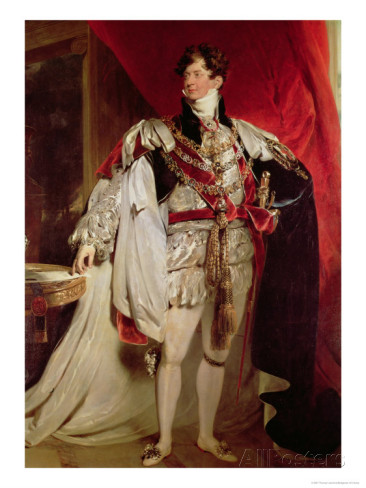
The Prince Regent, by Lawrence. Someone once said he looks like Ted Koppel.

The Prince Regent, by Lawrence. The observation has been made that His Royal Highness resembles Ted Koppel.

Merciful God, who, in compassion to a sinful Nation, hast defeated the designs of desperate Men, and hast protected from the base and barbarous assaults of a lawless multitude, the Regent of this United Kingdom, accept our praise and thanksgiving. Continue, we implore Thee, Thy protection of his Royal Person. Shield him from the arrow that flieth by day, and from the pestilence that walketh in darkness; from the secret designs of treason, and from the madness of the People.

A sinful Nation. The madness of the People.

Who are the People, it was demanded, and why should they, slandered for being mad and treasonous, give thanks that Prinny survived?

These sentiments were masterfully uttered by William Hazlitt (1778 – 1830) a man of many talents, including art and literary criticism. He had been a contributor to Jeffrey’s Edinburgh Review and his published commentaries on English literature made him a favorite of Leigh Hunt.

Blackwood’s was quite in charity with him as well:

“When Mr. Hazlitt’s taste and judgment are left to themselves, we think him among the very best, if not the very best, living critic on our national literature.”

Then came his remarkable Political Essays, with Sketches of Public Characters in 1819, criticizing, among others, the poet Southey and his lust for muzzling the press, but the Prince Regent as well, for being such an unworthy object of the people’s thanks:

“What have hereditary Monarchs..ever done for the people?”

“For one regicide committed by the People, there have been thousands committed by Kings themselves.”

Oh! Ungrateful wretch.

In less than a month, Blackwood’s threw Hazlitt under the bus, labelling him an “unprincipled blunderer.” One month more and the Leopard himself (under the pseudonym ‘old friend with a new face’) produced a scathing so-called cross-examination of “pimpled” Hazlitt. Unperturbed, Hazlitt responded to this article with his own letter refuting much of the allegations made against him, notably,

“And I am NOT pimpled, but remarkably pale and sallow.”

A self-portrait of young Hazlitt, sans pimples

A self-portrait of young Hazlitt, sans pimples

Something to be thankful for.


Regency Critics: Thanksgiving Part I

The Prince Regent declared January 18, 1816 an official day of Thanksgiving for all Regency England–to commemorate a Nation’s gratitude that war had ended.

Wordsworth wrote the following poem to mark the occasion:

Britannia

Britannia

O Britain! dearer far than life is dear,
If one there be
Of all thy progeny
Who can forget thy prowess, never more
Be that ungrateful Son allowed to hear
Thy green leaves rustle or thy torrents roar.

Thanksgiving Ode by Wordsworth

Scarcely remembered, this Ode represents the vexing condition gratitude often finds itself in–quickly forgotten before the day is out.

Like Thanksgiving.

In 1796, Robert Burns, the great pioneer of Romantic poetry, breathed his last, having opened a vast new literary landscape to successors such as Byron, Shelley–and William Wordsworth. Burns’ brother, Gilbert, thought it prudent to write a biography of Robbie before his character as a man should be forgotten. He sent a pamphlet ’round Edinburgh explaining his project and requesting anecdotes that might be used in the biography.

One was directed to the scholar James Gray who, in turn, shared it with Wordsworth.

By this time Wordsworth had achieved no little stature as a composer of the sonnet after Burns’ natural style. Of course, any comments he should care to make would be well-attended to. Indeed, he had already written a poem to comfort Burns’ sons, albeit with a mendacious warning against drinking too much:

Tintern Abbey, by Turner

Tintern Abbey, by Turner

Strong-bodied if ye be to bear
Intemperance with less harm, beware!
But if your Father’s wit ye share,
Then, then indeed.
Ye Sons of Burns! for watchful care
There will be need.

Address to the Sons of Burns, after visiting their Father’s Grave (August 14th, 1803)

When offered the opportunity to enlarge upon the merits of Scotland’s favorite son, the bard of Tintern Abbey entered into the exercise with enthusiasm:

“From the respect which I have long felt for the character of the person who has thus honored me, and from the gratitude which, as a lover of poetry, I owe to the genius of his departed relative, should most gladly comply with this wish.”

— Wordsworth to Gray in A Letter to a Friend of Robert Burns (1816)

A biography of Burns was already in publication, by one Dr. Currie. In it, certain details of the poet’s personal life had been rendered most candidly. To his family’s dismay, Burns’ reputation was beginning to resemble that of his creation, Tom O’Shanter.

Echoing his previous concern, Wordsworth addressed these details minutely–perhaps too much so–in his enthusiasm to clean up Burns’ image:

“His brother can set me right is I am mistaken when I express a belief that, at the time he wrote his story of ‘Death and Dr. Hornbrook,’ he had very rarely been intoxicated, or perhaps even much exhilarated by liquor. Yet how happily does he lead his reader into that track of sensations!”

He was a drunkard, to be sure, but not all the time!

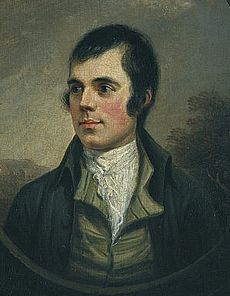
Nasmyth's flattering portrait of Burns

Nasmyth’s flattering portrait of Burns

Wordsworth’s gratitude was turned on its head when his Letter found its way into the hands of Blackwood’s and into the glare of the Public’s eye:

“(Wordsworth) has unquestionably written some fine verse in his day; but, with the exception of some poetical genius, he is, in all respects, immeasurably inferior, as an intellectual being, to the distinguished person he so foolishly libels.”

–Observations on Mr. Wordsworth’s Letter, by ‘a gentleman of distinguished literary talents’ (John Wilson, probably) Vol. I (1817)

Happily, Wordsworth’s role as literary critic was forgotten, smothered under the mantle of Britain’s Poet Laureate which was awarded to him in 1843.

Otherwise, he might have been remembered as the perfect example of a Regency ingrate.