Regency Wrecks: “The Dangerous Area”

In England, there was a good deal of schadenfreude accompanying the outrage following the sensational wreck of the Medusa. The French in command of a French frigate–the best possible combination for maritime incompetence, they said, Even the masterful painting of the drifting raft of desperate survivors received tumultuous applause in London because Monsieur Gericault’s effort was:

“of the utmost difficulty, and with a singular absence of the national vanity ascribed to his countrymen, one which it would be well for the naval character for France to have blotted from her maritime annals.” — the Globe (1820)  the Hortense

Had British seamen been at her helm, such a disaster might have been diverted. Unless one happens to be sailing in a place known as “The Dangerous Area.”

Off the southern coast of present-day Sri Lanka lie two great coral reefs and accompanying rocks called the Great and the Little Basses. Unlike the Arguin Bank that the Medusa foundered upon, these formations along Ceylon’s shores, as it was known in those days, were well-documented and mapped. Yet time and again, ships fell victim to their deadly projections.

Some believed it was the haze that lay over the water, so that:

“..even in the day time those excellent landmarks along the shore, which, if, discernible, afford an infallible guide, cannot occasionally be distinguished when close to the Basses.” —  The Nautical Magazine (1848)

But that didn’t account for the number of wrecks that occurred at nighttime, and to ships that were well out to sea. Or, so they thought.

On several occasions, from 1792 to 1804, English ships believed to be well away from the treacherous reefs would suddenly find themselves during the night observing breakers, the signal they were among the rocks. It was as if the alien shore had lured their vessels toward danger like the Sirens of old.

The Corona was a forty-gun frigate of the Hortense class, built for the French Navy. Like her sister ship the Caroline, she had been captured by the British Navy during the Napoleonic Wars. Corona’s decks were covered with the blood of her dead captain and 200 of her crew before she was set ablaze by her captors. Pulled to Malta, she was repaired and renamed the Daedalus, now in the Prince Regent’s service.

She was given to the command of Captain Murray Maxwell, grandson of the Second Baronet of Monreith. She nearly ruined his naval career.

Daedalus was escorting East India Company ships Atlas and Bridgewater to China. Ceylon, now known as Sri Lanka, is the gateway to the South China Sea. Captains knew to pass by its coast well to the south and avoid the reefs there altogether. Yet somehow, by morning, to everyone’s surprise and alarm, it was discovered the ships were among the Basses:  Shipwreck - North Sea

“..the Atlas grazed outside the Little Basses, and soon after that the Daedalus struck on a reef within the Basses, and the Bridgewater, close on the starboard side of the frigate, grazed over the same reef, but she bore away and passed between the Little and the Great Basses as did the rest of the fleet…” —The Nautical Magazine (1848)

Daedalus was doomed. To haul her off the reef would sink her faster than leaving her where she was. Almost to the minute that everyone was evacuated, she keeled over and sank.

Later, it was discovered that strong underwater currents exist all along the southern coast of Ceylon, capable of hauling even a British frigate to places it never intended to go. Because these conditions seems to be especially strong at night, the British government eventually installed two lighthouses to warn ships of their proximity to “The Dangerous Area.”
Regency Wrecks

Ship surgeon Jean Baptiste Henri Savigny reached Paris on September 11, 1816, having just survived an ordeal that was to become a sensation of the Regency. Within twenty-four hours of his arrival, a tiny paragraph was inserted in the newspapers that the ship he sailed on, the Medusa, had been lost off the coast of West Africa.

Shipwreck was common in those days, but Monsieur Savigny carried with him a singular account of his ordeal. He had been one of the survivors consigned to a cumbersome raft to be pulled by one of the ship’s lifeboats to safety. He submitted his diary to the French government, detailing:

“the hasty and chaotic abandonment of the Medusa and detailing the suffering of the 150 people on the raft. Although soberly and tightly written, the facts of cannibalism and butchery were in themselves sensational. Nor had he concealed the fact that the towrope of the raft has been deliberately cast off by the First Lieutenant of the Medusa, amid cries of “Let’s abandon them!”

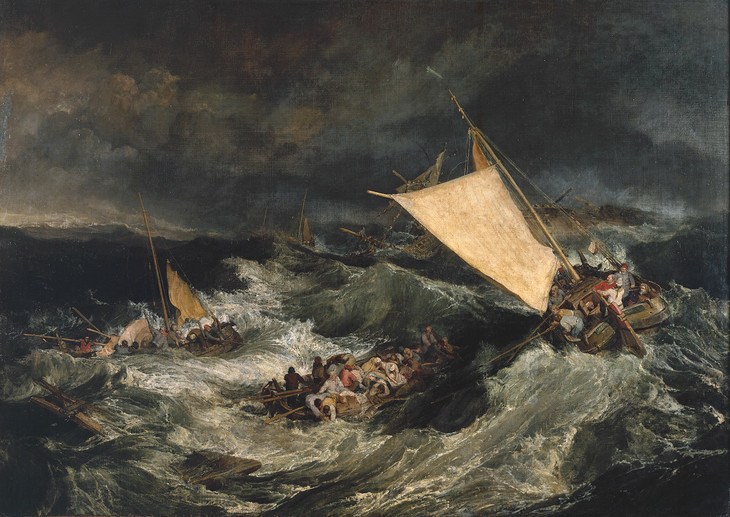
Turner's Shipwreck (1805)

Turner’s Shipwreck (1805)

Monsieur Savigny was simply looking to be compensated for his expenses incurred by his voyage home, and for the loss of his property in the shipwreck. The government accepted his account and did nothing. However, a copy of his account was carried away. The damning story of the Wreck was published soon after and it was not long before English translations of it were available to Regency England. It was a sensation, the story of French sailors and captain, charged with the responsibility and safety of their passengers, deliberately abandoning them to a fate of privations so horrible that an entire Nation was shamed before all Europe.

This is not the first time this blog has addressed the singular catastrophe that was known as the Wreck of the Medusa. It was a powerful subject of the Romantic age, a sublime image of depravity and abandonment in an age that prided itself for culture and civilization. I am compelled to return to this subject matter because these occurrences captured the attention of Regency society. There are other Regency wrecks that bear attending to, of other French ships under Britain’s flag, and the heroism of their crews that inspired even the admiration of Jane Austen.

The Real Regency Reader: Jane Austen

“It is difficult to think of a novelist who makes reading a more animating part of her characters’ lives than Jane Austen.”

–John Mullan, What Matters in Jane Austen?: Twenty Crucial Puzzles Solved (2013)

We know how Northanger Abbey’s heroine, like Cotillion’s Kitty, was much guided by knowledge gleaned from novels and therefore committed foibles as a result of such reliance. Or Fanny of Mansfield Park who had rather more learning from books than those rich Bertram girls who supposed her ‘stupid at learning.’ Already mentioned is Sir Elliot of Kellynch Hall in Persuasion whose reading was limited to the Baronetage and so, too, was his conversation. Recall in Pride and Prejudice Miss Bingley’s spectacular attempts at diverting Mr. Darcy from his book when a day earlier she had attacked our darling Lizzie for not playing cards because she loved books.

1940's Pride and Prejudice, starring Greer Garson and Laurence Olivier

1940’s Pride and Prejudice, starring Greer Garson and Laurence Olivier

I did not understand the significance of reading in Jane Austen’s world until it was illuminated by Professor Mullan:  being literate during the Regency means reading books. In Sense and Sensibility, Lucy Steele is illiterate not because she can’t read, but because she does not read.

“Lucy’s ignorance of books will be as much a torment to poor Edward, her future husband, as her cunning and self-interestedness.”

This blog has mentioned the value of book collecting during the Regency, A library of any size was a mark of distinction because it conferred upon those who had access to it an erudition valued in those days. Professor Mullan points out that Austen had no more than two years’ formal schooling but yet had access to her father’s library which was vast for a country clergyman.

One must suspect that her admiration for books and reading must reflect what Regency readers must have thought:

“I only mean what I have read about.  It always puts me in mind of the country that Emily and her father travelled through, in The Mysteries of Udolpho (Penguin Classics). But you never read novels, I dare say?”

“Why not?”

“Because they are not clever enough for you — gentlemen read better books.”

“The person, be it gentleman or lady, who has not pleasure in a good novel, must be intolerably stupid.” — Mansfield Park

The Real Regency Reader: A World Without Souls

In 1805, John William Cunningham had the great fortune of marrying Sophia Williams, youngest daughter of a wealthy Hertfordshire merchant. She gave him nine children and her papa bought him the living of Harrow-on-the-Hill. As vicar, he could leave many duties to his curate, and concentrate on his Calling–sermonizing.

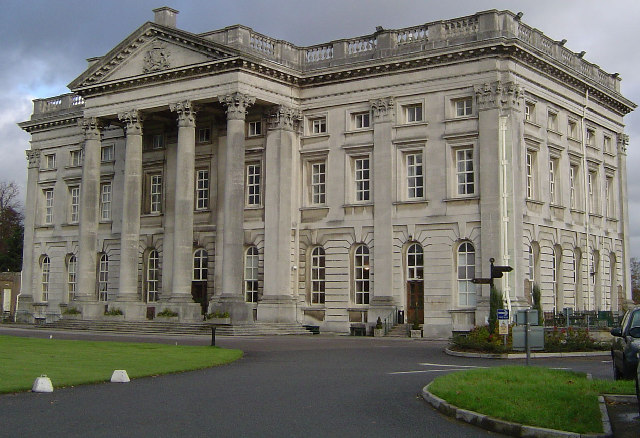
Sophia's father owned Moor Park. Photographed by Nigel Cox, Creative Commons Attribution Share-alike license 2.0

Sophia’s father owned Moor Park. Photographed by Nigel Cox, Creative Commons Attribution Share-alike license 2.0

Unfortunately, there was only so much sermonizing the people in the village could take.

To reach the faithful beyond Harrow-on-the-Hill, John was determined to publish a book of sermons. However, he must have realized his potential readers, like the villagers, might be put off by his message. He decided to put forth his evangelizing effort in the guise of a Novel. His publisher, the venerable Hatchards, evidently approved.

John wrote his novel after the fashion of a work he much admired, The Story of La Roche, which follows the travels of a Christian philosopher and his beautiful daughter, Madamoiselle La Roche. It was a French tale serialized in The Mirror (not the current tabloid, but a late eighteenth century magazine out of Edinburgh). Incidentally, the editor warned the readers of the Mirror in the preface to La Roche that the work had a religious theme.

Inspired, John dashed off A World Without Souls. In it, a young man, Gustavus, leaves his home and the girl he is much attached to and travels abroad (to a place very like Regency England) in the company of a wise mentor. They come to a place resembling Hyde Park where the ladies and gentlemen are in full promenade on Sunday:

“But have they no veneration for the Sabbath?”

“Yes..the females do their utmost..by enforcing servants and horses upon unnecessary employments, to defraud two beasts of their lawful rest, and shut out two souls from heaven.”

Harrow-on-the-Hill

Harrow-on-the-Hill

Souls was well-received by some, but excoriated by others. Not because it was religious in nature, but that it sought to fool the reader into thinking it was a novel. And one should never try to fool the Regency reader:

“We cannot say that such flimzy disguises altogether please our taste. They remind us of a coarse and clumsy deception well known to and put into practice by Essex shepherds. When an ewe has lost a lamb by premature death, these men strip the fleece off the carcase, and fasten it on the young of some other ewe, in order to induce the mourner to suckle the substitute.

With the silly animal the imposture succeeds. Not so does it fare with man. We detect, we smile, we contempt, we are disgusted.”

The Gentleman’s Magazine and Historical Chronicle (1813)

John was completely unapologetic. Even in the epilogue of his novel, he disparages the notion his young male character be reunited with his love:

“If I marry Gustavus and Emily, it will be objected to me, that it is incredible a tale of truth like mine should terminate like a novel (!)”