“The Hostess from Hell” – Holland House Part Two

Elizabeth Fox, Baroness Holland, was the daughter of a Jamaican planter.  Married off to Lord Webster, a man twenty years her senior, she gave birth to three children before falling in love with another man, bearing him a child out-of-wedlock.  Not two days divorced, she married her lover Lord Holland.
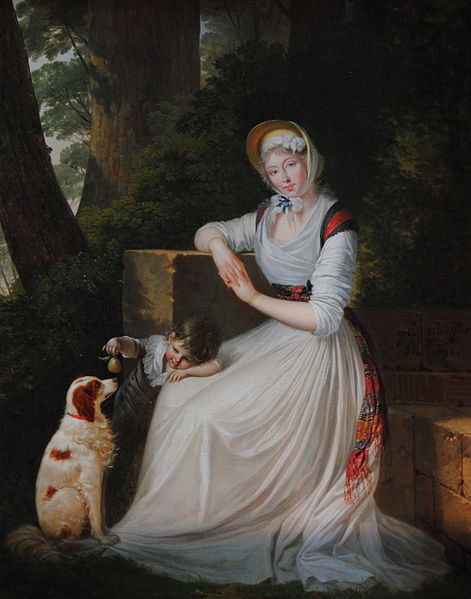
Lady Holland with her son – Louis Gauffier

The ton could not forget her scandalous past and so declined to receive her.  No matter, Lord and Lady Holland did their own receiving, hosting the most influential men of the day at Holland House.  The few women who came were fellow Whigs, the Duchess of Devonshire and that fashionable marchioness from Berkeley Square, Lady Lansdowne.

Baroness Holland was the complete opposite of her husband.  She was gruff where he was affable, imperious when he would give way.  Long, boring discourse was not tolerated at her table–her ladyship was known to dispatch her footman to admonish the offending guest.

Thomas Moore, which this blog christened Regency Poet of Wine and Love, once said, “poets inclined to a plethora of vanity would find a dose of Lady Holland now and then very good for their complaint.”

“I’m sorry you are going to publish a poem,” she said to Lord Portchester.  “Can’t you suppress it?”

And to the great English poet, Samuel Rogers, she advised, “Your poetry is bad enough, so pray be sparing about your prose.”

Lady Holland reminds me of the Gosford Park character Constance, Countess of Trentham.  There is something sinfully joyous about her acidic observations.  This one she offers to the American film and radio star Ivor Novello:

LadyTrentham: It must be hard to know when it’s time to throw in the towel… What a pity about that last one of yours… what was it called? “The Dodger”? Novello:   The Lodger. LadyTrentham:   The Lodger. It must be so disappointing when something just flops like that.

Lady Holland lived to the age of seventy-four.  When tentatively shown Byron’s memoirs, which were none too complimentary of his hostess at Holland House, she shrugged.

“Such things give me no uneasiness; I know perfectly my station in the world, and I know all that can be said of me.  As long as the few friends I am really sure of speak kindly of me, all that the rest of the world can say is a matter of complete indifference to me.”
Holland House – A Rival to Lansdowne House (part one)

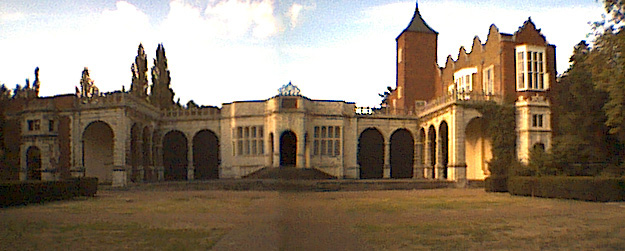
Its turrets and gables lacked the elegance of London’s newer, Palladian town homes.  Its “relics and curios” were dusty books and historic English papers.  Its location was staid Kensington, not fashionable Mayfair.  Its mistress was not even received at court.  But this Regency seat of influence was nontheless a formidable rival to glittering Lansdowne House:

Holland House

Yet great things were done at Holland House–reforms planned and accomplished, literary lions fed with appreciation and encouragement.  All the great names of that period may be found on the lists of the Holland House entertainments.

—  Charles Dickens, “Holland House,” All the Year Round, A Weekly Journal, Vol. 66, 1890

With the Regency barely on the horizon, the house was known as Cope Castle and practically a ruin when it came into the possession of Lord Henry Richard Fox, third Baron Holland.  He was a mere baby and presumably not ready to take on any renovations even though the house had an illustrious history.  Its best days, it seemed, were behind it.

Those days began when Queen Elizabeth I granted a part of Kensington Manor to one Walter Cope–that part that once belonged to the Abbot of Abingdon–and built a multi-turreted Jacobean mansion that others mockingly called Cope’s Castle.  The Renaissance had penetrated English architecture by the time of its construction in 1607 but classical features like columns, arcades, parapets and the like were applied in a more freeform style rather than with any strict order that characterized the later Palladian movement.  Cope Castle, unlike Lansdowne House, was more like a free spirit.

the haunted Gilt Room

Cope’s daughter inherited the house and it became greatly enlarged upon her union with the Rich family, also grown wealthy on confiscated church property when its patriarch had prosecuted Sir Thomas More on Henry VIII’s behalf.  Her husband was Henry Rich, Earl of Holland, from whom the house takes its present name.   He negotiated the marriage of Henrietta Maria to Charles I and built the house’s famous gilt-room in expectation of entertaining the new Queen there.  This did not come to pass, nor was the Earl to survive the coming storm.  His ghost was said to be seen in that very room, richly dressed as he had been on the scaffold, holding his head in his hands.

After the Restoration of Charles II, the house was sold to Henry Fox, whose sire had the distinction of fathering this first of three sons at the age of seventy-three.  Fox eloped with one of the famous Lennox sisters and it was his grandson, also named Henry, third Baron Holland, who made Holland House a rival in Regency gatherings, as we shall soon see.  Today, Holland House is a ruin, destroyed by a fire-bomb in World War II.

Holland House library – World War II

There’s a Tory in Lansdowne House

“Ah, Lord Grenville,” said Lady Portarles, as following a discreet knock, the clever, interesting head of the Secretary of State appeared in the doorway of the box, “you could not arrive more a propos. Here is Madame la Comtesse de Tournay positively dying to hear the latest news from France.”

The distinguished diplomat had come forward and was shaking hands with the ladies.

“Alas!” he said sadly, “it is of the very worst. The massacres continue; Paris literally reeks with blood; and the guillotine claims a hundred victims a day.”

The Scarlet Pimpernel, Baroness Orczy                                           File:1st Baron Grenville.jpg

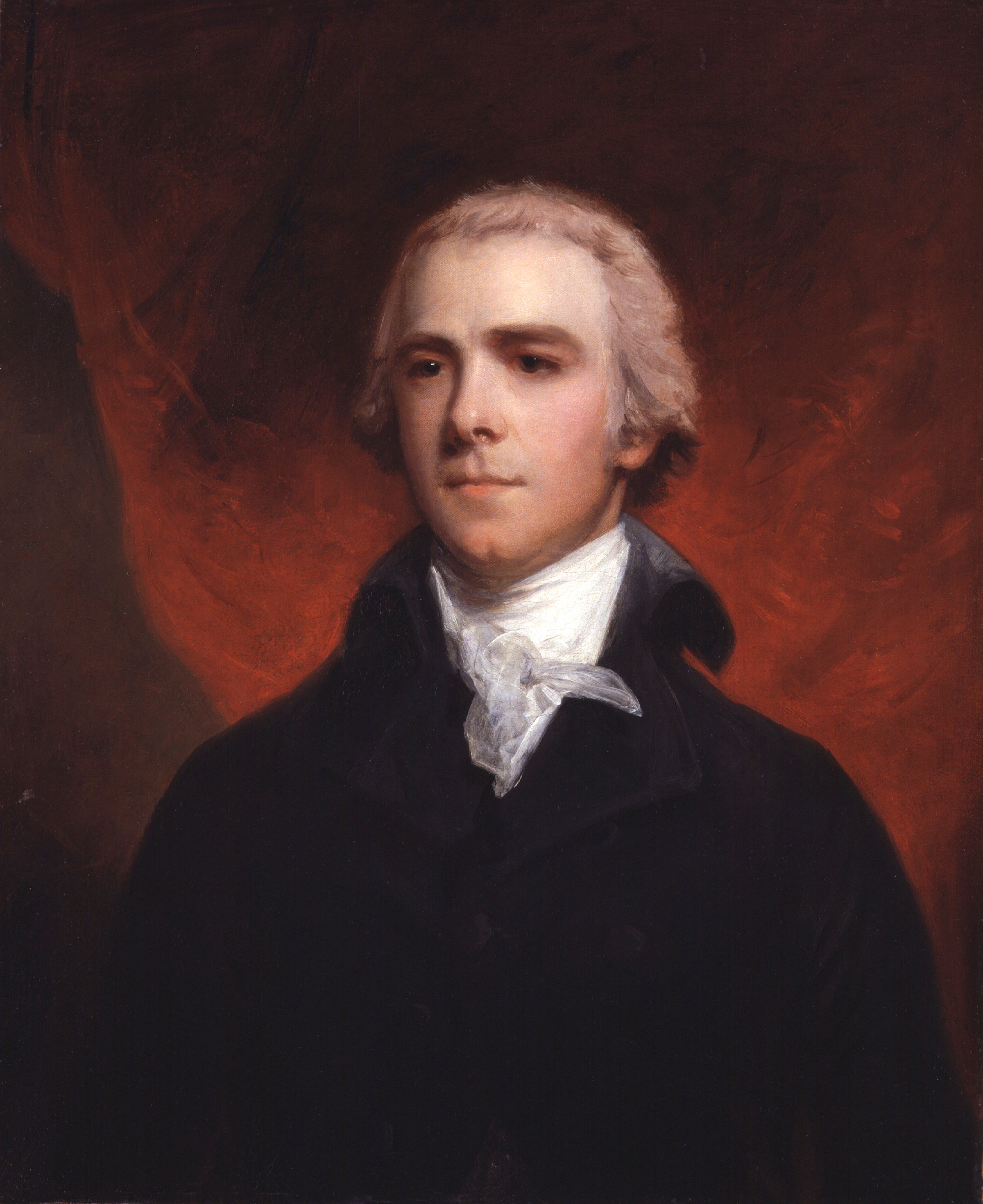
The year was 1792 and Lord William Wyndham Grenville (1759 – 1834), First Baron Grenville, was Foreign Secretary.  He was a member of the Tory cabinet formed by Prime Minister William Pitt the Younger and was tasked with managing the blood bath and upheaval that was occurring on the Continent.  To complicate matters, there was conflict among the ministers.  Lord Grenville was positive that greater success against the French in the War of the First Coalition could be had with military action on the continent, as opposed to skirmishes at sea and jousting with the colonies as proxies.

He was up against Pitt’s great friend, Henry Dundas, First Viscount Melville and the kingdom’s Secretary of War:  “a man so profoundly ignorant of war that he was not even conscious of his own ignorance.”  Dundas was a wealthy man, purely by virtue of his first wife.  He divorced her over adultery, and ensured she would never see her children again.  This was a sentence imposed for the rest of her life.  She lived another sixty-nine years.

Pitt could not be persuaded to abandon Dundas, even when the man became instrumental in stopping all efforts to abolish the slave trade.  It is almost certain that at this time Grenville began to rethink his Tory connections.  Then came the King’s refusal to consider the question of Catholic emancipation and the Pitt government resigned.

A quiet interlude followed while Grenville was out of office.  A time for reflection and for preparation of his greatest life’s work that still lay ahead.  He had heard of the ideas being discussed in a Palladian home in Berkeley Square.  He did not have to visit there for long before he found himself surrounded by a circle of Whig supporters.

Grenville’s chance came in 1806 when Pitt died, leaving a vacuum of power.  Enter his lordship with the backing of Lansdowne House and he was elevated to the position of Prime Minister.  It was an extraordinary moment as he became head of a coalition government known as the “Ministry of All Talents.”  And none too soon.  War with France had reached a fever pitch and national unity was vital.  Grenville’s charm united politicians from almost every persuasion.  He even managed to placate His Majesty to accept such persons to whom he had been previously hostile.

It was then one of the most important goals cherished in Lansdowne House was achieved–the abolition of the slave trade.

In 1823 Grenville retired.  He and his wife withdrew, childless, to a country home he had built, Dropmore House, near Windsor Castle.  He established one of the largest stands of conifer trees in Britain at his pineturn there.

Sadly, Dropmore was badly damaged by a fire that took four days to put out in 1990. Another in 1997 left the house uninhabitable.  The property has since been restored by a developer interested in turning the mansion into luxury apartments.  It is a pity the firm in charge of this endeavor has gone into liquidation.

http://www.youtube.com/watch?v=4y5fybV7vW4 at 52.51 is a lovely clip from the 1934 movie production of the Scarlet Pimpernel.  It is the ballroom scene in which his lordship plays a slight role.

http://www.youtube.com/watch?v=AvctyYcUIaE at 6:03 is also a clip from the Dr. Who series showing the exterior of Dropmore before it was destroyed by fire.

Is There a Doctor in Lansdowne House?

Sir James Mackintosh was a doctor in Lansdowne House.  But you may remember from an earlier post that his presence was required for something other than practicing medicine.  He was called to exercise his great conversational power.

Dr. Francis Willis – physician to George III
copyright Richard Croft http://www.geograph.org.uk/photo/903770

He might have needed a doctor.  He died from a chicken bone lodged in his throat.

Jane Austen’s World has a lovely article on physicians during the Regency.  I particularly enjoyed the discussion on a doctor’s place in society.

The Beau Monde’s collection of articles is another favorite source of mine.  Alicia Rasley contributed a very comprehensive outline on the subject here.

Actually, this post was inspired by a recent article in a major newspaper http://on.wsj.com/IKwNny.  Click on the link to test your knowledge of old medical terms.  See if you can match them with the modern ones.

If someone were to become ill at Lansdowne House, they might be suffering from the following:

Stopping (constipation)

Humid tetter (exzema)

Ship fever (typhus)

Morphew (scurvy blisters)

Podagra (gout)

Catarrh (inflammation of the sinuses)

Brain fever (could mean meningitis, encephalitis or malaria

Grippe (influenza)

I thought these terms were interesting.  I hope you did, too.

This clip from Monty Python’s Holy Grail on the matter is amusing:  http://bit.ly/JTg8f at 3:00.

“They’re doctors?”