
Regency Confessor – London Buck turned Country Gentleman

From La Belle Assemblee, June, 1816 edition–another offering from The Listener:

“Letter from a Gentleman, Formerly a Modern Buck:”

I was for some time an inhabitant of London, and fluttered around all the goddesses of fashion and beauty; but now I am become a complete country gentleman, and no one can distinguish by my present appearance that I have been a dashing buck of the town.

The writer signs himself merely “Rusticus” (!) and extols the virtues he has discovered since retiring from town life. He describes these new virtues as follows:

Opera dress, as exhibited in the magazine, consisting of a slip of pink satin, ornamented down the front and border in black velvet bias, under a robe of black satin richly flowered in black velvet down the sides, full sleeves of black satin ornamented with pink, over a chemisette sleeve of white sarsnet. Hat of fancy spotted straw, lined with pink satin, with a superb wreath of full-blown roses. Shoes of white satin , with white kid gloves.

Opera dress, as exhibited in the magazine, consisting of a slip of pink satin, ornamented down the front and border in black velvet bias, under a robe of black satin richly flowered in black velvet down the sides, full sleeves of black satin ornamented with pink, over a chemisette sleeve of white sarsnet. Hat of fancy spotted straw, lined with pink satin, with a superb wreath of full-blown roses. Shoes of white satin , with white kid gloves.

In town, he would dine out, but hardly ate a thing. Instead, he would swear at the waiters, poke holes in the damask breakfast cloths or throw wine he found disagreeable out of the window. In the country:

I can attack a venison pasty with that keenness of hunger given by the sports of the chace, and even when I see my servant cut the bread with hands not over-clean, I fall to, without taking time to reprove him.

His clothes used to require hours planning with his tailors to prepare for the upcoming season, making certain his coats were tight at the bottom of his waist and his pantaloons preserved the exact shape of his knees.

Now I am very easily pleased; my wife’s dressmaker makes all my waistcoats and pantaloons, and this young woman, who is very clever, comes every six months and stays with us a fortnight, during which time she makes our clothes for the next six.

As much as London offered many amusements, they were all fatiguing. Plays full of cold chambermaids, grimacing footmen and the inflated language of lovers left him searching for something better, until he finally found it in the country:

Now I find the most beautiful spectacle in the rising sun, the beauteous hills and vallies, the verdant carpet and the glassy current.

On conveyances:

I had a telegraph in town as light as a fly, the best calculated in the world to throw anyone out…Now I have a good solid Yarmouth cart, which is never overturned, let the roads be ever so bad.

He used to have as many as ten “favourite” ladies, which equally swore fidelity to him even as he falsely promised them the same. Constant declarations such as these were tedious as much as they were hypocritical. But now that he is married:

My wife is the only woman I really love; I have no occasion where I must continually repeat my vows to her, she sees what my daily conduct is toward her, she knows the inmost thoughts of my heart; I divine hers, and our life is a series of mutual confidence, happiness and concord.

A veritable paragon of a man, I daresay.
 

Regency Confessor – Chance over Reason

From the archives of La Belle Assemblee, we find a section  entitled “The Listener,” a sort of  “Dear Abby” column for Regency readers. The next few posts will be taken from this informed source, appropriately named Timothy Hearwell, Esq.,  on salient points of good character during the reign of the Prince Regent.

From “Chance over Reason,” March, 1816 edition:

“There are, as Solomon says, those who strive and strive and yet are more behind.”

In this column, the writer pours a tale of caution into “the Listener’s” ear. He had got up a business, purely by chance, and made a considerable fortune.

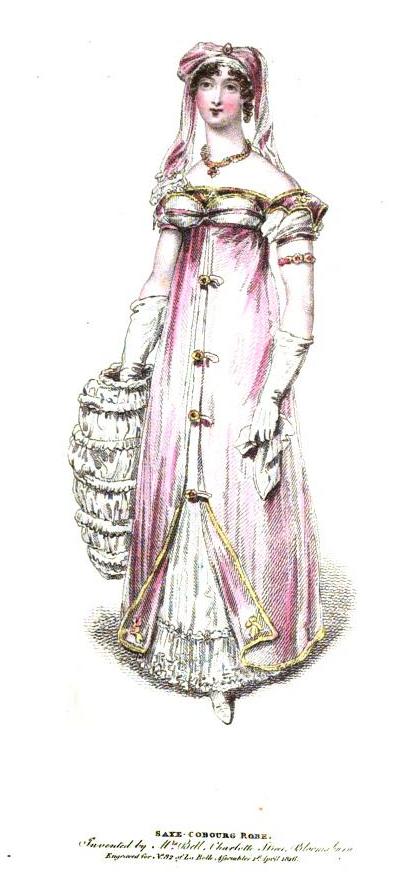
The Saxe-Coburg robe for evening dress as featured in the magazine

The Saxe-Coburg pink robe for evening dress, featured in the magazine, worn over a white satin slip flounced with crape, finished by blond. Bridal veil, fastened with a brooch of pearl and pink topazes, with the hair simply dressed in light curls and parted on the forehead. A muff formed of white satin and gossamer silk trimming. Necklace and armlets of pearls and pink topazes. White satin slippers and white kid gloves.

.

Ashamed of owing everything to good luck, and nothing to my own genius, wishing, as much as in me lay, to justify the favors of Heaven, I began to work (with purpose)….”

To his chagrin, his earnest labors were met with either criticism or downright annoyance, as his efforts seemed only to be getting in the way of the business, until even his friends avoided him. The business turning to failure, the penitent wrote a play about his troubles, a comedy, and later romantic novels that were written hurriedly, (and badly):

I took no pains to conceal the machinery by which I set my puppets in motion. I took care to banish from my works every serious and moral reflection, and only thought of crowding events one upon the other.

Having made another fortune in this accidental endeavor, the writer resolved to marry. His protestations of love with one young lady were met with little comment, she answering his suit by merely raising her “beautiful” eyes upward, as if overcome with like sentiment. This went on for some time, until one evening, as he was leaving her house, he spied a dark figure dropping to the street from the balcony of her window. He raised the alarm, thinking thieves were at work, but soon discovered his beloved in the act of elopement. Therefore, he cautions,

we must not always trust to simplicity of demeanor, or fine eyes cast modestly toward heaven.

Cursing his belabored attempt at matrimony, the writer resolved to flirt injudiciously with every pretty woman he met, having no regard for the feelings of expectation he might arouse in the feminine breast while himself remaining insensible to any like feeling the recipient of his “dishonorable” addresses might arouse in him. He happened upon a widow with five daughters, who made their living by executing painting on velvet (!). They, too, were victims of his false blandishments, except for one. This daughter remained “sprightly” in spite of his flirting, her fine mind ultimately catching his regard and his love, so that:

I had united my fate with the best of women, and ever since I have a thousand times blest that destiny which has always been a safer guide to me, than my own prudence.”

A destiny that was further rewarded by immense wealth bestowed on the widow and daughters by an uncle’s will, securing the happy couple’s financial future and rewarding, quite by accident, the writer’s trust in chance.


People’s Magazine of the Regency

Vivien felt a little gauche when she spied Diana thumbing through an issue of La Belle Assemblee’ in my debut Regency novel Notorious Vow.  This popular magazine from the Regency period contained a plate featuring the viscountess wearing a striking Turkish cape.  Diana had beautiful titian-colored hair, and so the deep red color of this cape merely accented her well-known feature.

You can find this reproduction in an excellent source on the following website that documents unusual (read—exclusive) Regency fashion:  http://yourwardrobeunlockd.com/freebies/357-unusual-regency-by-serena-dyer?start=2

I owe so much to Georgette Heyer’s unrivalled exposition on everything that encompassed Regency culture.  In particular, the following passage from her Cotillion does great justice to the wardrobe of someone like Diana who devotes considerable resources to assembling one of the ton’s most varied wardrobes:  Freddy Standen’s sister Meg, Lady Buckhaven.  Her dresser is quite determined that her ladyship’s young friend from the country take some of her mistress’ ill-chosen articles of clothing, which do not compliment her blond beauty:

“When Miss Charing shrank from accepting an opulent evening cloak of cherry-red velvet, ruched and braided, and lined with satin, she contrived to draw her a little aside, and to whisper in her ear:  ‘Take it, miss!  My lady—-Lady Legerwood, I mean!—will be so very much obliged to you!  Miss Margaret—Lady Buckhaven, I should say! — should never wear cherry!”

If Cotillion does not positively make you scream in delight, you have my leave to remonstrate with me in the comments below.  But I warn you!  I am devoted to Ms. Heyer and her work.