
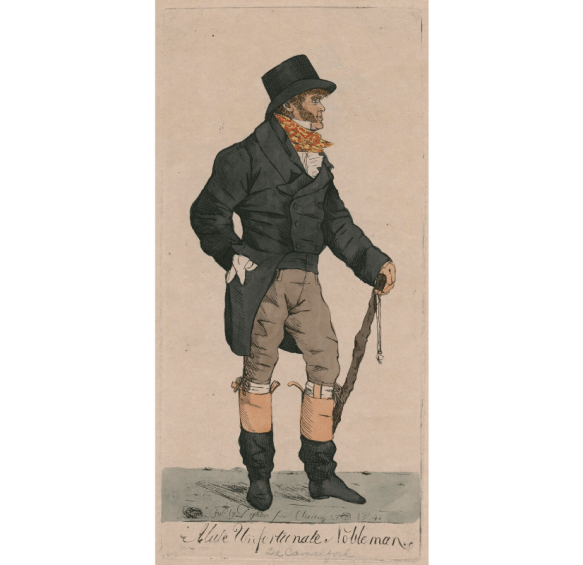
1804 memorial etching by Dighton, via the National Portrait Gallery. ‘Lord Camelford was not such a man as you would have supposed. He was tall and bony–rather pale–with his head hanging generally a little on one side–so.’ — Lady Hester Stanhope
“If his lordship could have conquered that irritability of temper, which involved him in such a variety of disputes that ultimately ended in his death, he would have attained the highest naval honors.” — Life, Adventures and Eccentricities of the late Lord Camelford (1804)Perhaps it was that irritability of temper which helped him survive his first voyage, one the history books record as ‘almost unparalleled.’ He and a skeleton crew navigated the crippled frigate HMS Guardian — little more than a raft — almost 2000 kilometers back to port. And yet: While imminent shipwreck conditions suited Thomas, smooth sailing did not. His naval career ended after he assaulted his former commander, shot and killed a fellow officer and attempted a solo invasion of France.**

Camelford’s sister, Anne, painted here as Hebe by Élisabeth Vigée Le Brun in 1792 — She was one of the few persons her brother loved. He left his fortune to her and her husband, Prime Minister Lord Grenville.
“..ambition was the spur of his life..to achieve success independent of inherited rank and wealth.” — The Half-Mad Lord, Nikolai Tolstoy (1978)Returning to England, Thomas became a fearsome presence, particularly in London. He never shrank from physical violence. His temper and courage were legendary. Many thought him insane. A jury awarded £500 in damages (a huge sum in those days) against him for assault in the Theatre Royal during a play appropriately titled, The Devil to Pay. The watch-house constables knew him well and sometimes let him take their place in adjudicating offenders, who he always pardoned after a stern talking-to. Woe betide the nightwatchman he found asleep at his post. His notoriety alone invited unprovoked challenges from the foolhardy. As Lord Camelford, Thomas could live in the most sumptuous of surroundings. He owned beautiful Boconnoc in Cornwall, an estate of over 7,500 acres, ‘made for its late owner and for a great mind.’ His Mayfair townhouse was a refined neo-Classical villa on Park Lane, Camelford House.

Shepherd’s 1850 watercolor of Camelford House, for a short time the residence of Charlotte, Princess of Wales, later demolished in 1915. Photo via British Museum
” ‘Lord Camelford!’ returned the former, in a tone of voice scarcely audible; horror-struck at the recollection of his own impertinence, and almost doubting whether he was still in existence..actually stole away without daring to taste his Madeira.” — The Eccentric Mirror by G. H Wilson (1807)

via National Portrait Gallery – Gillray illustrates the rude phenomenon of the Bond Street Loungers in 1796. They were rather more respectable by the time of the famous 1820 illustration from Captain Gronow’s Reminisces.

Bill Richmond, prize fighter and cabinet maker. He is credited with dragging his employer Lord Camelford to safety.
“In such deeds as these, and at an expense of several thousands a year (he mortgaged one of his estates in this effort) did this unaffected philanthropist pass the hours which he stole from the dissipation of high life; and his protégées were not aware of the name or quality of their benefactor, until his untimely fate put a period to his munificent donations.” — The Clubs of London, by Charles Marsh (1832)Thomas loved all kinds of sports and was a nonpareil himself. An accomplished amateur boxer, he sponsored many professionals of the sport and could be counted on for a generous purse even after their careers. He patronized the Jolly Brewer, an establishment owned by the famous Jem Belcher, gifting his valuable dog to the retired pugilist.
“He always received the respect due to his position, and if a coal-heaver or meatporter of his acquaintance attempted any insolence he was swiftly paid in his own coin.” — TolstoyAnd yet: He could shed his rough exterior and become the fashionable beau, being among the first to wear a Jean de Bry coat and the Belcher neck cloth. He was a rather ‘well-looking man.” This was evident during his brief courtship of his cousin, Lady Hester Stanhope, herself an enigmatic figure of beauty and independence. Her memories of Lord Camelford are full of admiration and very illuminating–‘people were very much mistaken about him.’ His wide-ranging adventures inspired her to embark on her own travels. Generally unchaperoned, the two attended ton parties, drove down turnpikes in Thomas’ curricle and spent time at his estate in Cornwall. She told her doctor many years later that Lord Camelford’s appearances at balls and routs put people in a fright, but when engaged in conversation, he was ‘charming, irresistible, so well-bred, such a ton about him.’ Her greatest tribute to Thomas was the fact he couldn’t abide hypocrisy, particularly amongst those who occupied the highest levels of society. He hated whoever who took advantage of others and used his status as a peer to rectify injustice:
“He was a true Pitt, and, like me, his blood fired at a fraud or a bad action.” — Memoirs of the Lady Hester Stanhope by Charles Lewis Meryon, I (1846)

Lady Hester Stanhope on Horseback – Her lonely and abusive childhood was similar to Camelford’s–isolated on a country estate with her brother by a father who meant to force his heir to renounce his inheritance, once he came of age, thus breaking the entail that protected the family fortune from Lord Stanhope’s spendthrift habits. Hester helped her brother escape.
“He was a man of superior abilities but of singular character…in him Courage was a struggle of sentiment against Constitution.” — The Farington Diary, Vol II, Joseph Farington (1923)*The Guardian’s passengers were mostly convicts being transported to Australia. They and the accompanying crew and guards abandoned ship only to die almost to a man in the life boats. **Lord Camelford was often flogged and placed in irons under mutinous conditions on board ship closely resembling those of the Bounty. Unlike Christian Fletcher, his lordship made it back to England and assaulted old Captain Vancouver until the latter’s brother, fresh from fighting native Americans and felling trees in Kentucky, returned the favor and nearly killed his lordship. As for the murder of a fellow officer, his lordship’s actions were found to be necessary to quash what was ruled a mutiny.






 Angelyn's Blog