
Regency dogs

Jane Austen’s World and Regency Ramble both give comprehensive discussions on dogs of the early nineteenth century.

In this post, however, I would like to draw attention to the changing nature of how persons viewed their dogs during the Regency.

Of course one valued his canine friend for his practical traits which aided such pursuits like hunting.  But the dog was also becoming prized for those qualities that were lauded in the romantic literature of the period–noble characteristics that were always evident in Man’s best friend, but never appreciated fully until now:  bravery, loyalty, humility, etc.
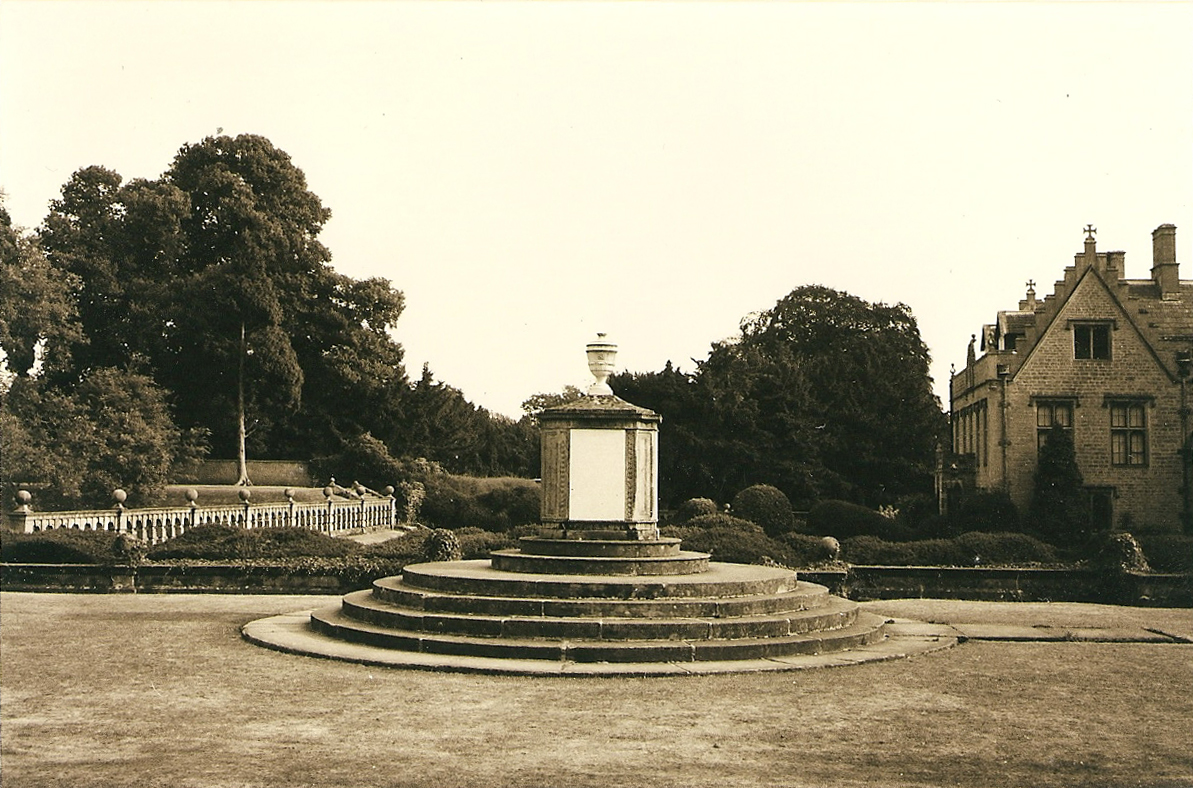
Boatwain’s Monument – licensed by Johnson Camerface

Byron wrote a poem eulogizing his own Newfoundland, which had contracted rabies and died in 1808.  The poet nursed his dog throughout the illness, never minding that he himself might contract the disease.  Boatswain was buried on his lordship’s estate at Newstead Abbey.  His monument is larger than that of his owner.

The last line of the Epitaph for a Dog are particularly affecting:

“To mark a friend’s remains these stones arise; I never knew but one – and here he lies.”

Regency owners also saw their dogs as an extension of their own personality and their tastes in the exotic.  It became particularly fashionable among the ton to own a dog with a background that inspires one to think of faraway places in the Orient.

The author Georgette Heyer demonstrated just this very aspect in her delightful Frederica.

In this novel, the jaded hero makes an elaborate representation to an irate cowman, two park-rangers and one hatchet-faced lady that the heroine’s family pet, which had caused some riot and rumpus, is actually a rare speciman from Asia.  He succeeded in fooling me as well.  There is no such thing as a Baluchistan hound.  What manner of breed Lufra was is up to conjecture, but the Marquis of Alverstoke demonstrates an insightful perspective into Man’s best friend in the early nineteenth century.
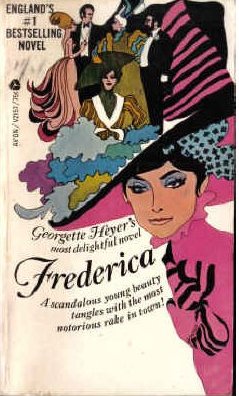
1967 Edition -- blame the gay nineties look on Avon!

1967 Edition — blame the gay nineties look on Avon!

You see, all except for the hatchet-faced lady were only too ready to believe that a nobleman had taken a fancy to owning an exotic dog.  In the Regency, anything attached to one’s person that spoke of the Orient gave a fellow distinction.

I also was unaware that persons under royal license were allowed to graze cattle in London’s Green Park.  That famous Regency denizan Beau Brummel had the distinction of being related to two aunts who held such a license to graze their milch cows in the park.

I love dogs and I love Regency romance.  This passage combines the best of both:

“Really, Cousin, you are too shatterbrained.  He is a hound, not a collie; and what I told you was not Barcelona, but Baluchistan!  Baluchistan, Frederica!”

“Oh, dear!  So you did.  How–how stupid of me!” she replied unsteadily.

Neither of the park-keepers seemed to find his lordship’s explanation unacceptable.  The elder said wisely that that would account for it; and the younger reminded the company that he had known all along that the dog wasn’t Spanish.  But the cowman was plainly dissatisfied; and the hatchet-faced lady said sharply:  “I don’t believe there is such a place!”

“Oh, yes!” replied his lordship, walking towards the window and giving one of the two globes which stood there a twist.  “Come and see for youself!”

Everyone obeyed this invitation; and Frederica said reproachfully:  “If you had only told me it was in Asia, Cousin!”

“Oh, Asia!” said the elder park-keeper, glad to be enlightened.  “A kind of Indian dog, I daresay.”

“Well, not precisely,” said Frederica.  “At least, I don’t think so.  It’s this bit, you see.  It’s a very wild place, and the dog had to be smuggled out, because the natives are hostile.  And that’s why I said he was very rare.  Indeed, he is the only Baluchistan dog in this country, isn’t he, Cousin?”

“I devoutly hope he may be,” returned his lordship dryly.

“Well, all I have to say it that it makes it so much the worse!” declared the hatchet-faced lady.  “The idea of bringing wild foreign animals into the park!  Smuggled, too!  I don’t scruple to tell you, my lord, that I very much disapprove of such practices and I have a very good mind to report it to the Customs!…I am speaking of the English Customs, my lord!” she said, glaring at him.

“Oh, that wouldn’t be of the least use!  I didn’t smuggle the dog into the country; I mrerely caused him to be smuggled out of Baluchistan.”

Ignominious Burial

In Notorious Match, the hero uncovers the truth behind the carriage wreck that killed the Earl of Northam and his wife.  See this post for further detail.

Diana shook her head at the pity in Griffin’s expression.

“My uncle always blamed himself for my parents’ death,” she explained.  “He still did, even after the evidence all pointed to murder-suicide.  Of course, it was all very hushed up.  But the state of the earldom’s finances could not lie.  My father was under a mountain of debt and about to lose everything.  So he took my mother with him and left me.”

Griffin stepped forward and cradled her face in his hands, his shoulders strangely hunched up as if she were something fragile.

Poor little rich girl.

 She pulled away, feeling the revulsion against herself coming up from her stomach to gag her.  “Don’t do that, please.  It’s quite unnecessary.”

“Good God, Diana, why shouldn’t I?  You’ve—”

“Don’t pity me, for God’s sake,” she interrupted, her voice quavering so much she wanted to choke herself.  “Please.  I’ve done absolutely nothing to deserve your pity.”

Griffin remained silent, inviting her to continue.

“I wasn’t glad that they died,” she said.  “Not even I could be so heartless.  But I was ever so glad they left me behind.”

Robert Stewart, Marquess Londonderry

Suicide deaths were condemned right through the Regency.  Diana’s uncle, the Marquess Wimberley, did everything possible to shield the truth of his older’s brother’s death from the ton. 

Why?

To avoid the horror of the ignominous burial.

Case in point:  Marquess of Londonderry, 1822.

Robert Stewart served as Chief Secretary for Ireland and was known as Viscount Castleraugh for most of his life before succeeding to his father’s title as marquess. He was a force to be reckoned with in British politics.  The Napoleonic Wars required extraordinary skill in diplomacy and his lordship provided ample support as a member of the Ministry of all the Talents (yes, that was a real ministry).  See an earlier post on the matter.  He was Lord Secretary of Ireland, securing union with that land to prevent it from becoming a French satellite as Scotland had been three hundred years before.  He became Secretary of State of War and the Colonies and later Foreign Secretary, an illustrious diplomatic career that culminated in the Congress of Vienna.

His wife was Amelia (Emily) Hobart, daughter of the second Earl of Buckinghamshire.  Regency lovers know her as a Patroness of Almack’s.  The couple had no children but remained devoted to one another.  She was there to support her husband when he fell in a deep depression from his widespread unpopularity.  Even the poet Shelley excoriated him:

I met Murder on the way/He had a face like Castlereagh

The marquess had the unfortunate destiny of being reviled for effecting decisive policies for the kingdom.  It is a fate which no politician, even to this day, can escape.

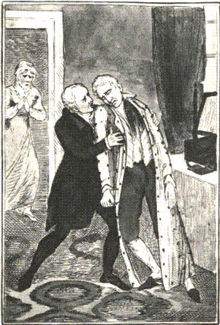
In any case, his sovereign, George IV, was so alarmed at his condition His Majesty took it upon himself to notify Stewart’s doctor.   It was too late.  Robert Stewart used a penknife, left forgotten in a desk drawer, to slit his throat.

It was a terrible scandal.  Were the marquess declared a suicide, he would have commited a felo de se, or crime against the self.  It was an old common law offense that bedevilled prosecution until a more horrible penance could be devised–one that was extracted from the survivors.  The body of a suicide was denied burial in consecrated ground.  Worse, it would be consigned to an ignominious burial in a highway crossroads where all manner of cartage and transport may occur over the body.  A demeaning location of anonymity where the remains would suffer the indignity of offal and every kind of refuse, to be trampled and mingled with the earth that held the body of a person once kissed, caressed and held.

Worse, the decedent’s body would be staked through the heart.  Presumably to prevent removal by the family.

Even Byron was relishing the prospect of this suicide’s burial:

Posterity will ne’er surveyA nobler grave than this:Here lie the bones of Castlereagh:Stop, traveller, and piss.[16]

And you thought you knew Shelley, Byron and Stoker.

Lady Castleraugh was desperate–enough to have her husband declared insane.  Without intent, as the requirement of common law demands, a suicide had not occurred.  And his lordship could be given a proper burial.

Today you can see his lordship’s grave near his mentor, William Pitt, at Westminster Abbey–the graveyard of England’s greatest.