The Rake and a Regency House Remnant

On the outskirts of London, at the edge of Epping Forest, lies the site of old Wanstead Manor, which belonged to Elizabeth I’s favorite Robert Dudley and, in turn, his stepson, the Earl of Essex. A century later, Sir Richard Child, Earl Tilney built what was called the ‘noblest’ Palladian mansion there. Its magnificence entertained the Prince Regent, provided a fitting temporary residence for the refugee Bourbons and served as a backdrop for epic celebrations of Wellington’s victory over Napoleon.

Wanstead House was the crown jewel of a Regency heiress’ fortune.

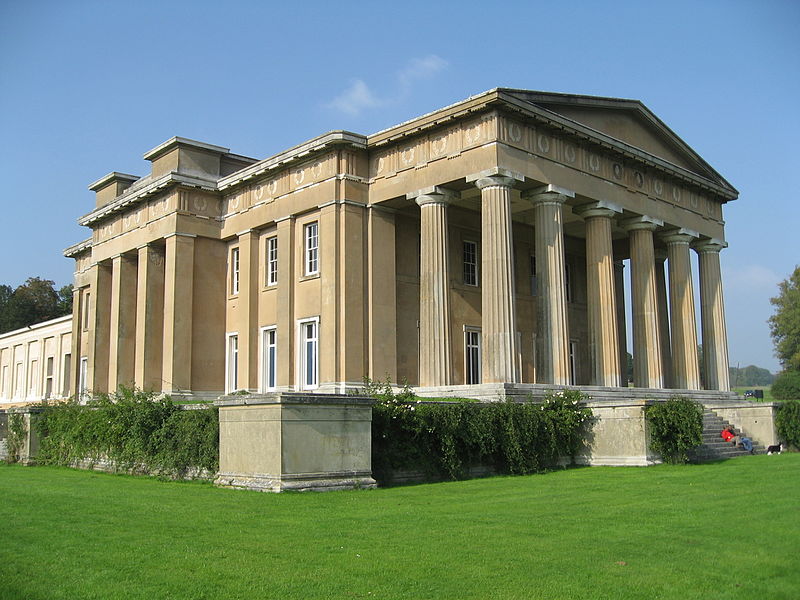
The east front of Wentworth Woodhouse resembles Wanstead, minus the Baroque ornaments. Ironically, at one time the parkland of this house was made the largest open pit mine in post-war Britain. Photo by Dave Pickersgill — via geograph.org.uk

Catherine Tylney Long was the ‘Wiltshire heiress’ in possession of Wanstead House. Against the advice of her relations and his, she married the notable rake William Wellesley-Pole, a nephew of Wellington.

The progress of their courtship and disastrous marriage has been well-documented–a perfectly cautionary tale against reforming the spendthrift libertine. As for the marital abode, Wanstead House, its demolition and dispersal makes an informative study of Regency-era creative financing. Wellington tried to save the estate for the unfortunate offspring of the ill-fated match–a mighty effort that kept the Court in Chancery as busy as the one portrayed in Dickens’ Bleak House.

What remains of Wanstead House is the beautiful park containing the ornamental waters once connected by picturesque bridges, the Temple and the Grotto, and surviving portions of tree-lined avenues.

Author John Harris, “No Voice From the Hall” recollected that only pits from the Wanstead House cellars remained. This is the ruined grotto on the grounds.

The best remnants of Wanstead, however, were sold in a famous 32-day sale the rake held of his wife’s belongings. These heirlooms are still selling today in the most exclusive auctions in the world, giving a glimpse of the fine objects that once adorned the great Regency-era houses.

via the Royal Collection Trust, the Nautilus Cup was purchased at the Wanstead Sale by George IV



Jane Austen and a Regency house remnant

The reference Jane Austen makes to Kempshott Park is from her January, 1799 letter– familiar to many of her fans:

“Charles is not come yet, but he must come this morning or he shall never know what I will do to him. The ball at Kempshott is this evening and I have got him an invitation . . . . I am not to wear my white satin cap to-night, after all; I am to wear a mamalouc cap instead,..”

The turban Mrs. Croft wore in 1995’s BBC version of Persuasion is probably similar to the marmalouc cap — a nod of admiration to British efforts against Napoleon in Egypt.

Kempshott was an out-the-way manor in Hampshire’s Basingstoke Hundred, and not far from Miss Austen’s residence in Steventon.  The logistics of nearby toll roads and rather good hunting combined to make this corner of England greatly desired during the Regency and Kempshott came to the notice of the Prince of Wales, who conceived a fancy for the estate as his hunting box.

HRH leased the commodious house from a man named Crooke, who was then residing at Stratton Park, the mutilated house mentioned in this blog’s previous post.  The course of the house’s history during this time is well-documented at Kempshott Park: a Prince’s Retreat. At various times the Prince entertained both Mrs. Fitzherbert and Princess Caroline of Wales at Kempshott.

By the time Miss Austen was summoned there, Prinny had left for the Grange–the one whose fabulous art collection was bombed by the Luftwaffe (see previous post).  Then Kempshott was leased to Lady Dorchester. It was her ball Miss Austen immortalized in her letter, living on after countless others have been forgotten.

Alas, Kempshott House did not live on. We are lucky one Constance Hill, author of Jane Austen: Her Homes and Her Friends (1904), was able to visit the mansion in its waning years. It had come into the hands of the Rycroft baronets, after undergoing some alteration since the Regency, sporting a fine Italianate exterior that had been added in the 1830s. Miss Hill was able to discover the ball-room of Jane Austen’s day and noted that it had been divided in later years to form a drawing room.

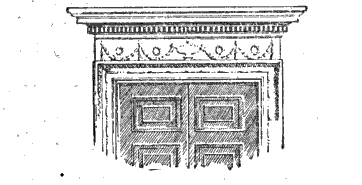
Presumably Miss Hill had her sketchbook with her, for she includes a fine pencil drawing of the ballroom’s intricate door frame in her volume.

World War I led to a long period where the house was vacant, its fixtures gradually dismantled and sold. One dealer attempted to capitalize on the house’s impressive connections, for a chimney piece like the one pictured below was plundered from Kempshott. This was sent on to America where it was joined with odds and ends from unknown origin, to form the centerpiece of a room puffed off as if taken from the house wholly intact–what some would later call a spoof.

This chimney piece, attributed to Henry Holland, is crafted out of Breche marble. Holland was in his French period when hired by Prinny to redo Kempshott, and would have favored this type of marble prominently featured at Versailles. Photo via 1st Dibs

Kempshott House was about to be demolished when visited by author John Harris in the 1960s.

“We found a brooding house, dark and gloomy, its stucco crumbling, deserted, abandoned to agricultural use…potatoes inside, and bales of hay, and an end wall had been broken open at ground floor level to shelter a tractor.”

— No Voice from the Hall by John Harris (1998)

One wonders what Jane Austen would have thought of potatoes piled where she once danced.

More Remnants of a Regency House

Probably the strangest remnant of a Regency house is Stratton Park in Hampshire. The estate was once a monastery, dissolved and reduced to rubble by that advisor to the Tudors, Wriothesley (easy to pronounce, hard to spell). A Palladian house was built upon the site and later sold by the Duke of Bedford to Sir Francis Baring in 1801.

Sir Francis was a powerful banker to the Whigs and a great friend of Lord Shelburne, whose Lansdowne House has been featured several times in this blog. He remodeled Stratton Park into a neo-classical Regency house, relying on the expert services of Dance the Younger, who had a hand in the design of aforementioned Regency centre of London.

Elizabeth Coade, whose stoneworks made her into a wealthy Regency-era business woman, was applied to for a supply of marble to make up the neo-Greek entrance hall and staircase installed behind a magnificent Doric portico. These elements were fashioned by Coade’s craftsman and later famous sculptor, John de Vaere.

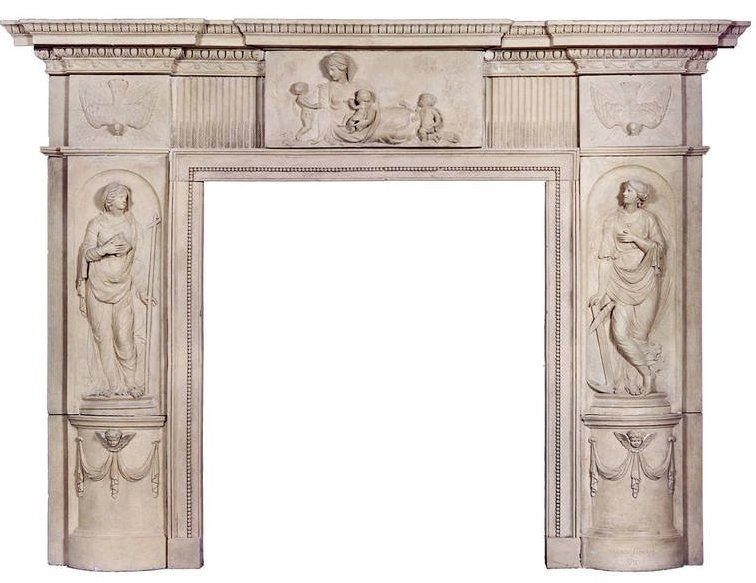
Coade white marble chimney piece

Henry Repton was engaged to create a magnificent park from some of the finest oak-tree plantings in the country which the Hampshire woods were famous for, making the region a favorite site for country houses.

Indeed, just up the road from Stratton Park is Northington Grange, pictured below. Surviving today, it unfortunately lost its trove of Old Master paintings, destroyed when sent away from the estate for safekeeping during the war. Apparently the warehouse storing these priceless treasures was obliterated by a Luftwaffe bomb.

Feeling a little Doric today.
Northington Grange, via Mpntod at English Wikipedia

The Grange was in a state of deterioration, its owner unable to cope with the extraordinary burden of repair and upkeep, when author and country-house snooper John Harris saw it. He planned to see nearby Stratton Park afterwards, for it was scheduled to be demolished. Presumably it, too, would be like the Grange, and many other country-houses that had survived the war in a state of collapse.

Upon inspection, Stratton Park appeared to be in surprisingly good repair despite war misuse. Its fabulous French interiors were still intact, along with the exquisite marble fittings. It seemed the house’s only fault was that it didn’t suit modern taste and therefore was destined for the wrecking ball.

“Even today one wonders, ‘how could they?’ ”

— No Voice from the Hall, by John Harris (1998)

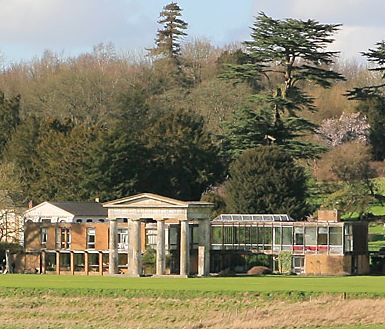
Stratton Park — the Doric portico in front of the modern house is all that remains. Photo via Wikimedia Commons, Peter Facey

Only the Doric portico was saved.


Remnants of a Regency House

This blog has visited lost houses of England before, mostly the result of scouting for locations that may one day be resurrected as fictional houses in this author’s historical romances. For example: Coleshill House, Cassiobury Park and Sutton Scarsdale.

 A plaster remnant the salvage firm left behind at ruined Sutton Scarsdale – photo via Wikicommons, Phil Sangwell

The stories of Regency-era house demolition are, on the whole, a sad affair. These large mansions with separate worlds of upstairs and downstairs, gardens and parks, coverts and woodlands, employing distinct crafts outside and domestic servants inside, fascinate viewers of Downton Abbey and Gosford Park. They fail to survive modern life, however, much as anything else that is labor-intensive to sustain.

When post-war Britain underwent huge economic and social upheaval, what was formerly sacred was broken up, dispersed, or burned on the lawn.

“In 1955, one house was demolished every two and a half days.”

— No Voice from the Hall, by John Harris (1998)

I’m particularly glad Mr. Harris went to great effort to record his own experiences of these vanishing houses. Uffington and Burwell Houses in Lincolnshire, the former already a ruin, the latter to be demolished, gave up vivid remnants of the Regency period.

Uffington was destroyed by fire in 1901. The conservatory remained standing, storing what had been hastily saved from the conflagration but never reclaimed, forgotten for over fifty years.

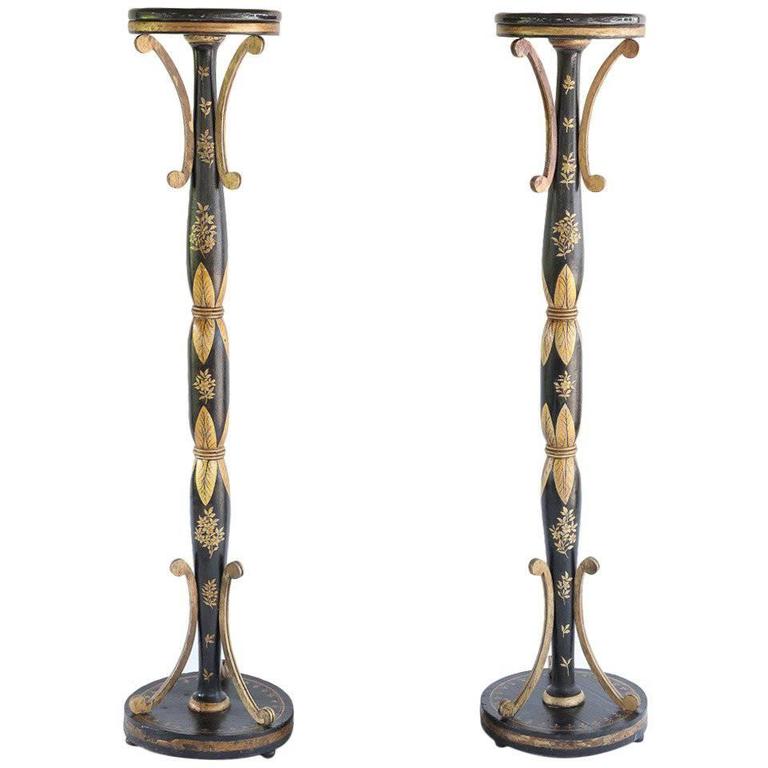
“..a half-burnt Regency side table, broken gilt picture frames, bits of marble, plaster fragments, a shattered gilt Georgian torchère.”

 1815 Regency torchères for sale  in Houston, Texas of places – photo via 1stDibs

At abandoned Burwell, the author found the house being used as a barn. Sheep exited the manor beneath the Doric entrance as freely as you please. Grain flowed like a vast desert beneath ornate plasterwork ceilings. A massive overmantle frame still containing its two-hundred year-old landscape painting reigned over sightless sacks of potatoes. These were stacked up so high they reached the bottom of family portraits still hanging on the drawing room walls, festooned in spiderwebs.

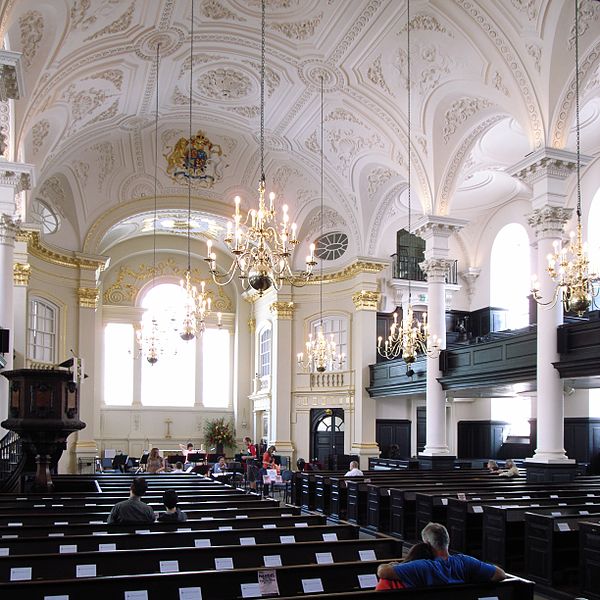
The ceiling of St. Martin in-the-Fields, designed by Gibbs, influenced the plasterwork ceilings of many Regency-era homes, including Burwell’s. photo via Wikimedia Commons, Steve Cadman photographer

Later, the author returned to Burwell, only to find the “philistine” Lindsey County Council had given consent for its demolition. He arrived in time to see workers hacking away at the rococo plasterwork, a pile of broken marble on the lawn, and a fire burning up the mahogany-carved stair.

“I was black with rage. As a single act of destruction, the burning of a masterpiece from the National Gallery would have been no worse.”


The Smock-Race of a Regency Easter

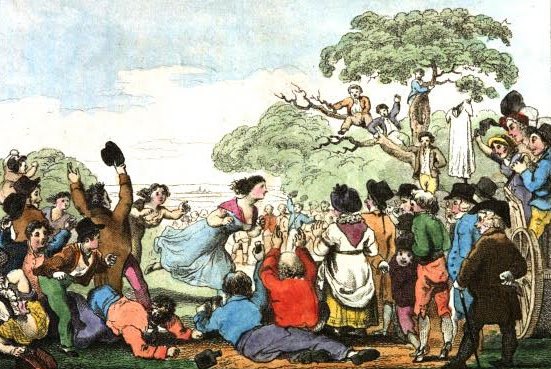
“Some years ago I saw a female race’;

the prize, a shift–a Holland shift, I ween:

Ten Damsels, nearly all in naked grace,

Rush’d for the precious Prize along the Green.

— The Works of Peter Pindar, 1812

It’s almost Easter and Popular Pastimes (1816) advises one can readily find a smock-race in “country places” this time of the year.

Word Wenches has an excellent description of the custom here. This post is a little like adding some color to the custom.

The smock race was merely one of several spectacles at spring festivals and fairs. James Birchall (England Under the Revolution and the House of Hanover 1688 to 1820, 1876) relates that smock races were held in Pall Mall through the eighteenth century, along with other amusements like “prize fights, bull-baiting and the Cock-pit, and (goodness me!) an execution at Tyburn.”

I suspect that spring, for a country lass, was not only an excellent time to acquire a new frock, it was imperative. The weather was warming, making one’s winter smock sadly out of fashion as well as unsuitable for the changing season’s temperature. The condition of last year’s summer smock, by virtue of the fact it saw a great deal more outside activity than winter’s raiment, was beyond help, being hopelessly stained and mended many times over.

Not every female had the luxury of heedless excursions in the rain. The want of sense. A surfeit of sensibility.

Easter was a holiday (along with Whitsun and Ascension Day) which provided time off from one’s labor to see about the getting of a new smock. The smock race coincided with such holidays–by design, no doubt.

The smock race featured a well-made prize. The smock (or chemise) was generally executed from fine Holland cloth, which may have been more practical than fine India muslin, but for me has the melancholy connection with the shutting up of houses and retrenching. So it was brightened up with ribbons and special poppy-colored bows attached to the frock, called coquelicot.

Darling Anne Elliot was not unacquainted with Holland cloth and retrenchment.

Hoisted on a standard for display,  the smock lured young females to indulge in unladylike pursuits, like running full-tilt in full view of interested onlookers. There seemed to be no lack of participants, so the garment must have been a seductive prize, indeed.

The custom acquired a notorious reputation when some races required competitive attire to be limited to an, er, smock.

The circumstances of feminine rustics being made to entertain was alternately celebrated and deplored. Favorable reviews came from those spectators that were generally squires, apprentices and sporting dandies in search of amusement. They brushed aside any disapproval, insisting the whole affair was a “very pretty and merry sight.”

Good for the lungs, what–what?

The remarkable painter George Morland, to whom we owe a great debt in the rendering of rural Georgian England, might have given us a good deal more to see of the period, but for his frequent habit of taking

“..a ride into the country to a smock-race or a grinning-match (!), a jolly dinner and a drinking-bout after it; a mad scamper home with a flounce into the mud.” — The New Wonderful Museum and Extraordinary Magazine (1805)


The specter of a mock-race called to mind licentiousness. It was ill-bred to indulge in it, both as a participant and observer. The lower classes were free to entertain themselves in such a manner, for that was the condition to which they were born to. For the upper classes, the smock race provided an excellent vehicle by which to pass judgment on others.

Consider, for a moment, a miss just arriving at church red-faced and wind-blown. Her appearance alone brings censure. Sitting down in the pew, she cannot but help overhear whispers behind her. The derision is almost palpable, the hushed tones impossible to ignore, speculating out loud that perhaps she looked that way because she’d just run a smock-race.

Happy Easter!

The Regency Maid-Servant – Part two

Continuing the Regency maid-servant’s “sketch of character,” we find she must suffer irritations all day, and without complaint.

In 2001’s Gosford Park, Lady Sylvia McCordle is the mistress of a great country house. The head house maid is Elsie. One evening, while entertaining a host of guests, her ladyship finds the temerity to interrupt dinnertime in the servants’ hall to inquire about a vegetarian meal for a tiresome American guest.

Cook pointedly turns her back on her. The housekeeper then assists, receiving a wealth of thanks and relief.

Elsie is an Edwardian-era maid-servant. But for purposes of illustration, she is timeless.

Elsie is an Edwardian-era maid-servant. But for purposes of illustration, she is timeless.

For the maid, there is no such luxury of ignoring a request nor expecting thanks for fulfilling it. She must obey the summons, whenever they come, even to the point of interrupting her meal. How she handles these annoyances without complaint, suppressing the very human reaction of irritation, makes her a far more interesting character than Cook, and even the housekeeper. Her position in the “down-stairs” hierarchy affords her no cushion.

She can’t always be successful, however, and:

“..she gets into little heats when a stranger is over saucy, or when she is told not to go down stairs so heavily, or when some unthinking person goes up her stairs with dirty shoes..”

— La Belle Assemblée; or, Bell’s court and fashionable … N.S. 15-16 (1817).

gosford-park-dancing

“..if there is a ball given that night, they throw open all the doors, and make use of the music up the stairs to dance by.

There are distractions. One of these might be a fellow servant singing a new song. If in town, she might espy a neighboring house’s maid through an open window, and enjoy an impromptu chat. Even better, a troop of soldiers might be going by.

And after the day’s work is done, and dinner is finished, interrupted or not, there is a bit of a candid discussion of the day’s events with the others in service, without regard to hierarchy. Surprisingly, she might play a game called hot cockles, which obliges her to kneel, blindfolded, her head on the lap of another, her hand palm-up on her back, all to guess the identity of whoever walks by and smacks it.

How others treat the Regency maid-servant is even more instructive. Tradesmen stop in at all times of the day, delivering their goods to the house. “Come, pretty maids,” says the milkman, followed by the butcher, the baker and the–well, you know the drill:

“…all with their several smirks and little loiterings.”

And if she is dispatched to pick up a bit of butter, the grocer makes a big deal out of it:

“For her, the cheese-monger weighs his butter with half a glance, cherishes it round about with his patties, and dabs the little piece on it to make up, with a graceful jerk.”

Along with the sailor and the schoolboy, we are told, the maid-servant is “a creature of sheer enjoyment,” and relishes the holiday more than “the rest of the world.” If in London, she’ll have been to Vauxhall, and the Tower with its beasties, and viewed all the tragedies at the playhouse, for they are far more to her liking than comedies.

If country-bred, the fair is her favorite, for it is there she can truly forget her place in the world, and be treated much as they are up-stairs.

“Here she is invited in by courteous, well-dressed people as if she were the mistress..(they) call her Ma’am..and says..Be good enough, Sir, to hand the card to the lady.”


A Regency Valentine Tragedy

Wedged among the death notices of the Princesse de Montmorency and Mathew G. “Monk” Lewis, is the following announcement of a newly-wed husband’s demise:

“He had left his residence, early in the morning, to bathe in one of the machines, and got out of his depth. Every effort was made by his servant and some gentlemen present, but without effect.”

La Belle Assemblee, Vol. 18, September 1818

No word on the fate of his widow.

bathing-machine

Death by bathing machine.


The Regency Maid-Servant – Part One

A sketch of the female domestic servant during the Regency period is summed up thus:

“..her own character and condition overcome all sophistications…her shape, fortified by the mop and scrubbing-brush, will make its way; and exercise keeps her healthy and cheerful. Through the same cause her temper is good..”

La Belle Assemblée; or, Bell’s court and fashionable … N.S. 15-16 (1817)

Of course, if the maidservant be “dirty always,” like the nature of her labor, there is little to be interested in. But if the maid is otherwise “snug and neat at all times,” and if she always has a pin to give you, that is something remarkable, and therefore worth examining.

In the “ordinary room,” which is usually the kitchen, the maidservant has a drawer assigned to her. It might be in the great trestle table, or among the zillions of drawers in the large wall-cupboard. Inside it she keeps her thimble, thread-case and a piece of looking glass to check her appearance.

The restored kitchen at Ickworth House in Suffolk and all those drawers

                       The restored kitchen at Ickworth House in Suffolk

In the garret, where she sleeps:

“a good looking-glass on the table; and in the window a Bible, a comb and a piece of soap…and, under lock-and-key, the mighty mystery–the box.

The writer of this character sketch must have once been the child of a family who employed such a maid. Perhaps he or she had been the young master of a great house in the country, or the pampered daughter of a grand Mayfair townhouse.

Only a child could be curious enough to know of the box and be completely obsessed with what it contained.

When it was opened, no doubt after much cajolery, the contents did not disappoint. Inside were the clothes the maid had stood up in upon her arrival at the house, during her interview of employment, to be stored away while she was in uniform. There were also song-books, tragedies costing a half-penny per sheet, little enamel boxes and other fripperies from the local fair, along with correspondence from home, penned in letters without regard to capitalization.

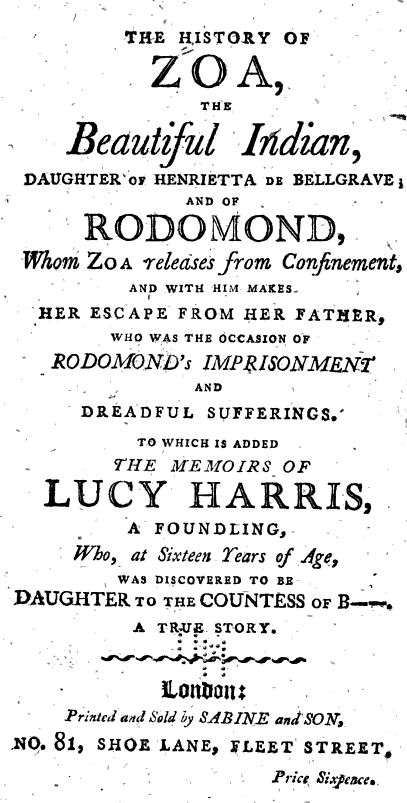
This popular tragedy was published in 1800.

This popular tragedy was published in 1800.

There, too, were coins, fascinating beyond their purchase power. They were evidence of the maid’s excursions beyond the gatehouse or the Mayfair square:

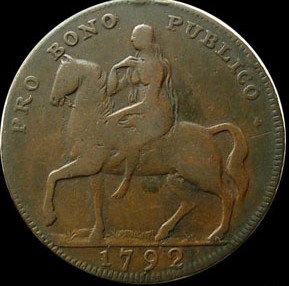
“…pieces of country money, with the Countess of Coventry on one of them riding naked on the horse; a silver penny wrapped up in cotton by itself, and a crooked sixpence.”

the Coventry half-penny

                    the Coventry half-penny

They lay beside the maid’s wages paid in half-crowns, nestled in a purse, the only thing that stood against her and an uncertain future were she to be turned off–without a character.


A Merry Regency Christmas

The poet Robert Southey, in the guise of a Spaniard travelling to England, remarked upon the great number of large sugared plum cakes to be had at Christmas in London. However, he concluded sourly that not much else was celebrated during the holiday.

“This is the only way in which these festivals are celebrated, and if the children had not an interest in keeping them up, even this would be disused.”

— Letters from England by don Manual Alvarez Espriella, Volume 3, By Robert Southey 1803

Twelfth cake-- historicfood.com

Twelfth cake– historicfood.com

The great festival of Christmas had been on the wane in Protestant England for some time, in danger of falling by the wayside like many other religious festivals of the old faith. Still, plenty of merriment went on during the holiday.

Take the battlefield, where a plan to march soldiers to another location to prevent excessive drinking was scarcely successful, for it was only a:

“.. change of scene and not of situation, for they got so drunk Christmas night that the grenadiers set fire to one of their tents…”
–Royal Military Panorama, Or, Officers’ Companion, Volume 3, 1813
 And who could forget the merriment in the Loveden household when a lady’s maid could recall, under oath, the circumstances of her mistress’ improper behavior:
A: “I had reason to know Mr. Barker paid particular attention to Mrs. Loveden, and she always made a Point of Dressing more upon those Occasions when he visited at the House.”
Q: “By Attentions, do you mean improper Attentions, that you thought their Attentions to each other were of an Improper nature?
A:”Yes.”
–Journals of the House of Lords, Volume 48
via the Royal Collection Trust

          via the Royal Collection Trust

Southey could not know that Christmas would soon regain new prominence in the Victorian era when it would take on a many-mantled cloak of new traditions. In the meantime, he and other Regency romantics had to remain content with what Christmas offered then: a moment of reflection, by which the entirety of the year could still be measured:

“From you the play’rs enjoy it and feel it here,
the Merry Christmas and the Happy Year,
There is a good old saying–pray attend it:
As you begin the year, surely you’ll end it.”
–from the Prologue of Cymon, A Dramatic Romance by David Garrick
The London Theatre: A Collection of the Most Celebrated Dramatic (Vol III) by Thomas Dibdin (1815)

A Mild Regency Winter

It is reported that the winter of 1807 in the British Isles was one of the mildest on record, up to that time.

“..the heat of the weather was exactly the same the 24th of June last as the 24th of December; on both those days the thermometer being nearly 60.”

— The Annual Register, or a View of History, Politics, and Literature for the Year 1807


Honeysuckle woodbine

                                    Honeysuckle woodbine

Throughout the land, gardeners were noting how their winter plots were full of flowers in full bloom–carnations, roses, woodbines and violets. A rose in full bloom was found growing in Sir Gabriel Powell’s shrubbery near Swansea. Even in common areas that received desultory treatment at that time of the year one could find:

“…double yellow and double purple primrose, the double purple stock, the purple campanula, the rue-leaved coronilla, ..all in high beauty.”


purple-campanula

                                                 purple campanula

Even the unexpected harvesting of wild plants for the table was remarkable, from two mushrooms in Stoney Knolls, to strawberries and a dish of green peas served to a gentleman in Wellesbourne on Christmas Day (!)

Nature’s animals were also found hard at labor. In Derbyshire, a hedge-sparrow’s nest had four eggs inside it, and in Warwickshire, two eggs were contained in a green linnet’s nest.

green linnet, also known as a greenfinch

     green linnet, also known as a greenfinch

As remarkable as these instances might be, still more confounding is the painstaking notations taken of them, in an age before the most minute recordings of climate change.