Animal Rights and Lansdowne House

“Mama, I’m as concerned about Diana as you are.  If she truly needs me, I will always be there to help her.”

“Of course.”  She poked her elegant finger among the brooches and earrings in the ornate box.  “You’ve managed everything quite well up to now, have you not?  But beware, my darling.  We have only just arrived in London.  Inevitably, Diana is bound to choose another improper friend.  One that may not be as amenable to your carte blanche as Miss Swynford.”

“Did you say Diana’s gone out riding?  I should go call for my horse.”

The dowager cocked her head.  “Your niece is all the way to Hyde Park by now, most likely.   Quite keen, she was, to try out her new mare.”

“That wretched animal she picked up from the horse knackers?  The dealers at Tattersall’s were glad to be rid of her after she injured one of their grooms.”

“The very one.  She tried to kick one of ours in the head just this morning.”

Diana’s Garnet was never a favorite of her Uncle Russell’s.  She was an ill-tempered mare and he always said Diana rode her just to spite him.   But in his heart he was proud of his niece for saving the animal from the knackers, and for trying to make something of the tall, angular chestnut.  He knew Diana needed Garnet, just as Garnet needed Diana.   The Marquess of Wimberley was only too aware that the victim of abuse, be it man or beast, can sometimes be set upon the road to healing when given a purpose–a destiny.  And his lordship fervently hoped this first step for Diana would lead her toward recovery.  Little did he know it would lead him there as well.

The notion of rescuing animals–saving them from ill-treatment–was a topic of considerable discussion in the Regency period.   Philosophy was motivated in those days by new ideas about the rights of man.  A century before, Locke, and later Kant, had already raised the notion that animal abuse was a bad thing–not for the animals, but for man.  In the mid-eighteenth century Rousseau argued the matter one step further.  The beasts of nature, by virtue of them being sentient, have their own right to the mercies of natural law, even if they cannot reason on their own.

The entire idea of introducing laws to protect animals remained, however, purely philosophical.

It was also something of a comedy.  Wollstonecraft’s In Defense of the Rights of Woman at the close of the eighteenth century was met with another tract published under the satirical title, Vindication of the Rights of Brutes.   In other words, if we give rights to women, we shall dashed well have to give them to the beasts!

Enter Lansdowne House and one of the Marquess’ most illustrious guests–Jeremy Bentham (1748 – 1832).  He was a philosopher well-known for his radical notions about freedom and equal rights, getting the C out of the E (ie, separating church and state), and abolishing slavery.  When it came to animal rights, he brushed aside natural law as “nonsense upon stilts” and made an argument that was unanswerable:

“…The question is not, Can they reason?, nor Can they talk? but, Can they suffer?”

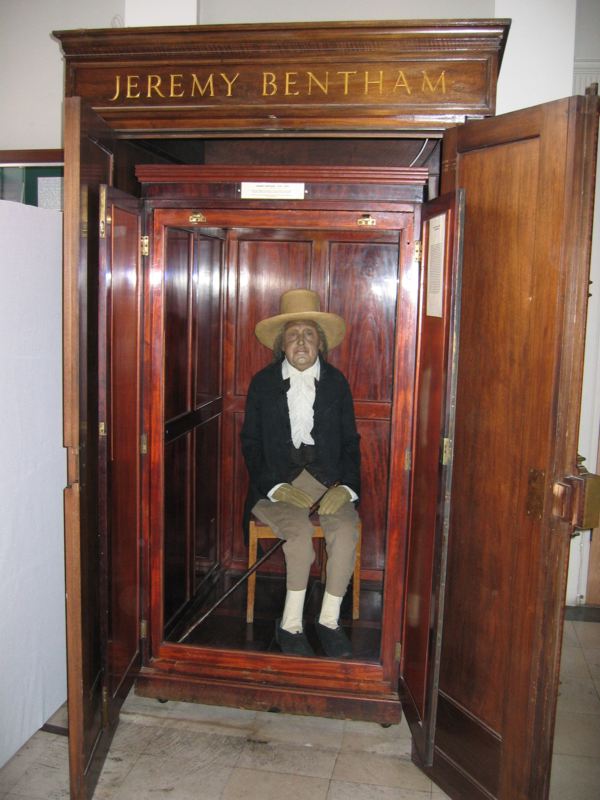
It must be said he did not oppose the use of animals for medical research.  He gave his own body to a medical college for public dissection and ordered that his corpse be put on display in an auto-icon.
When not engaged in philosophical dialogue, Bentham was known for courting women with “clumsy jocularity” (Michael St. John Packe’s The Life of John Stuart Mill).  The women in particular were members of the Marquess of Lansdowne’s family.  It appears from some of Bentham’s correspondence the ladies had refused to receive him when he called at Lansdowne House.  His style of rebuke, a mixture of pleasantries and irony so typical of the Regency, is amusing:

“I am glad to find you have begun to feel something like remorse; it is a virtuous sentiment–do not struggle to suppress it.”

An American in Lansdowne House

If Tom Moore was Anacreon, Washington Irving (1783 – 1859) was the “upstart American who dared to write English well.”

It is difficult to coax a Brutus from a receding hairline, but he has a lovely mouth.

Irving had initially sailed to England to bail out his family’s business in the aftermath of the War of 1812.  The conflict had been ruinous for American merchants and despite their son’s best efforts, the Irving clan’s cross-Atlantic enterprise was forced to declare bankruptcy.

Over his family’s protests, Irving remained in England to pursue a writing career.  His Sketch Book became a great success and soon Irving was fast friends with the Scottish bard, Sir Walter Scott, as well as the Irish one.  Sketch Book was really a series of installments first published in American and then in London.  The short stories it contained, like Rip Van Winkle and Legend of Sleepy Hollow, gained Irving admission into the highest circles of the ton and into the best houses of London, particularly Lansdowne.

Like many authors of new-found success, Irving was almost immediately a victim of literary piracy.  His publication in America was hastily copied and distributed in England without any compensation to him, there being no international copyright law at the time.  Eventually he acquired a more reputable (!) publisher and from then on his works were released concurrently on both sides of the Atlantic, to protect his copyright.

His presence in Lansdowne House was frequently noted.  There, Irving was:

“modest, shy and retiring…not the man to shine in large companies of perfect strangers.  Moore laughingly said of him that he was ‘not strong as a lion, but delightful as a domestic animal.’ “

Irving was also victim to that other scourge of authors–writer’s block.  He went to the Continent in search of new material, spending some time in Germany where he was well-received by the royal family.  There he made a frustrated attempt to woo a fellow American, Emily Foster, then living with her mother in Dresden.  Disappointed when she rejected him, he left for Spain to seek inspiration for new writings on the history of Christopher Columbus and that frontier of medieval conquest–Grenada.  He made popular the new genre of historical fiction, called romantic history at the time.

Eventually, after an absence of seventeen years, Irving returned to America to continue his writings.  This was briefly interrupted with a stint as U. S. Minister to Spain, a difficult position since he had to deal with warring factions vying for control over the twelve-year-old Queen Isabella II.

He died at Sunnyside, his beloved cottage in Tarrytown, NY.

Sunnyside Cottage--a long way from Lansdowne House, but just as charming.

It is no surprise that Lansdowne House should desire to have the First American Man of Letters, the first to earn his living by the pen in that new nation, to be one of its brightest luminaries.

The Regency Poet of Wine and Love

Thomas Moore (1779 – 1852) was an Irish poet popular not only in Regency England but in America as well.

They called him Anacreon Moore, and not just for his translation of that poet’s Odes.

The Greek poet Anacreon 582-485 BC)

Anacreon was an ancient Greek poet whose bacchanalia earned him the reputation of a lecherous drunkard:

Ah tell me why you turn and fly,My little Thracian filly shy?

I can tell you why.  Just look at the man.

Apart from wine and love, a poet must needs be passionate, and Tom Moore was definitely that. It helped to be Irish–he being the son of a Dublin grocer.  Upon his arrival in London, Lord Lansdowne was among the first to recognize his considerable talent.  The marquess introduced him to the first circles of the ton and soon he was writing to his mama about how he was

“dining with bishops, supping with princes, going to concerts with Lady Harrington, escorting Lady Charlotte Moira to balls and attending Blue-Stocking parties.” — The Chautauquan:  Organ of the Chautauqua Literary and Scientific Circle, Volume 18

His diary at the time was filled with evidence of his immense popularity and the significance of Lansdowne House to his rising star:

“Dined at Lord Lansdowne’s..Introduced to Lady Cochrane, who told me she would at any time have walked ten miles barefooted to see me.”

All of this was bound to go to a young man’s head.

A triumphant tour of the United States ended rather badly.  Moore was an outspoken critic of the Democratic-Republican (dear me!) party and of Thomas Jefferson in particular.

By the time he returned to England, his passionate nature had not yet been tempered.  This made him particularly vulnerable to his critics and led him to fighting a duel with one of them, Francis Jeffrey, an editor (!)  Byron relished the events surrounding his potent rival and most particularly the rumor Moore had supplied his opponent with an empty pistol, gleefully observing:

 “…on examination, the balls of the pistols, like the courage of the combatants, were found to have evaporated.”

The duel was broken up and the combatants imprisoned.  Moore was eventually released but his love for extravagance and marriage to a penniless actress soon landed him in dun territory.  It was Lord Lansdowne who fished him out of River Tick but Moore found himself compelled to leave England.  In his travels abroad, he was to encounter Byron again.  That old Romantic begged his former rival to publish his memoirs.  However, Byron’s family persuaded Moore to destroy them which he did, to much criticism.

Thomas Moore - national bard of Ireland

Like many thwarted in other ambitions, Moore did two things.  He returned to his homeland to sing a duet with the Queen Mother before HM Queen Victoria.  And settle down to write novels.

Tragically, he witnessed the death of all his children.  Yet song and poetry remained to comfort him.

He is to Ireland what Robert Burns is to Scotland.  A true protegee of Lansdowne House.

The Most Popular Man of the Regency

Richard Sharp (1759 – 1835), born in Newfoundland, was a hatter and later prominent merchant in London.  He was also a Dissenter, becoming the champion of adult education.  His powers of persuasion were responsible for establishing the forerunner of the University of London, the London Institution, open to scientific scholars who were denied entrance to Cambridge and Oxford because of their unorthodox religious beliefs.

Richard "Conversation" Sharp - he quite looks like Geoffrey Rush, does he not?  Delightful man.

Richard "Conversation" Sharp - he quite looks like Geoffrey Rush, does he not? Delightful man.

Lansdowne House, along with its rival Holland House, drew Sharp into its orbit not only for these accomplishments, but because of his conversation.

Yes–conversation.  A highly sought-after quality in Regency England

You must remember from Anne Elliott’s declaration from Jane Austen’s Persuasion.  And William Elliott’s equally fine rejoinder:

“My idea of good company…is the company of clever, well-informed people, who have a great deal of conversation; that is what I call good company.’

‘You are mistaken,’ said he gently, ‘that is not good company, that is the best.”

London was filled with good conversationalists.  Town wits, they were called, frequently evaluating one another and publishing their findings in essays and other periodicals for the delectation of the ton.

Byron (1788 – 1824) was a notable practitioner of the art–his poetry the vehicle for satirizing other conversationalists.  Wordsworth was frequently a target for his notions of solitude and the love of the sublime.  But when it came to describing Sharp, Satire completely failed her master, giving way to her cousin, the Simple Truth.

“A man of elegant mind.”

Indeed, this is where we find not just the good, but the best.

But how?  The key lies in the recollection from a fellow Lansdowne House intimate, Thomas Babington Macauley, 1st Baron Macauley (1800 – 1859)

“One thing I have observed in Sharp which is quite peculiar to him among Town wits and diners-out – he never talks scandal. If he can say nothing good of a man he holds his tongue. I do not of course mean that in confidential communications about politics he does not speak freely of public men, but about the follies of individuals I do not believe that – as much as I have talked with him.”

Richard Sharp remained single all his life.  Yet he was moved to adopt a little girl, orphaned in a volcanic eruption in the West Indies.

He never wanted to be remembered after he died.

Sadly, his wish was granted, with one or two notable exceptions, like the following admonishment from a reader of Gentlemen’s Magazine and Historical Chronicle 1869) that reads like a Who’s Who list of the Regency:

“…your serial is calculated to mislead your numerous readers by giving them the idea that (Charles Kirkpatrick Sharpe) was the celebrated person who obtained the sobriquet of ‘Conversation Sharp’ ….. From his extraordinary conversational powers, and his attainments generally, he became the intimate friend of all the leading men of his time, especially of the Whig party, of whom space will not permit me to name more than a few–as Lord Holland, Marquis of Lansdowne, Duke of Somerset, Earl of Darnley, Lord Eskine (who consulted him constantly), Grattan, Curran, Plunkett, Campbell, the poet Moore, Sir James Scarlett, afterwards Lord Abinger, Wordsworth, Rev. Sydney Smith, &etc….A reference to the memoirs (amongst others) of Francis Horner, James Macintosh, Sir Samuel Romilly, Samuel Rogers, the poet, and Moor’s Life of Byron, will at once settle the identity of Mr. Richard Sharp.”

Laughing Gas at Lansdowne House

The third Marquess of Lansdowne was no stranger to the rich and famous that came to the great London house.  His father had hosted Benjamin Franklin (1706 – 1790) when the latter came to negotiate the terms for American independence.  One who was credited with the discovery of oxygen, Joseph Priestley (1733 – 1804) ran tame at Lansdowne House as well, living off the largess of the first marquess when he was still Lord Shelburne.

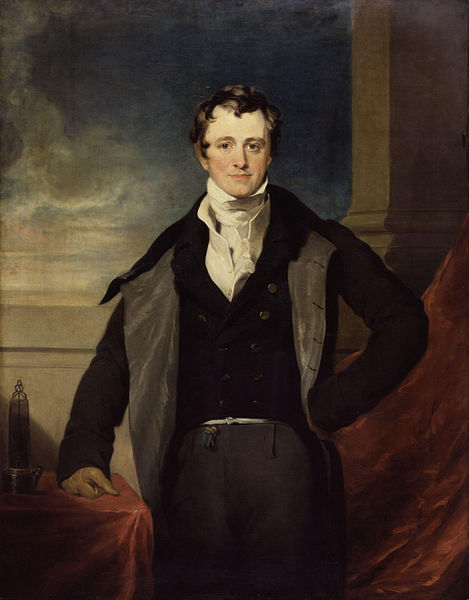
Sir Humphry Davy

But the parade of important persons during the Regency period, when our Lord Lansdowne was master there, is impressive indeed. There was a reason for this.  Unlike other patrons of artists and persons of science, the third marquess welcomed these to his home as equals:

“No trace of such distinctions ever checked the talk at Bowood or Lansdowne House.  If help was needed, it was freely given.” —  The Gentlemen’s Magazine and Historical Review, MDCCC LXIII, by Sylvanus Urban

The greatest scientist of the Regency was no stranger to Lansdowne House. Sir Humphry Davy (1778 – 1829) was a pioneer in chemistry, having discovered important earth elements and inventing the Davy lamp used by miners to detect dangerous gases.

But enough of the science.  I declare, the stuff makes me bilious.

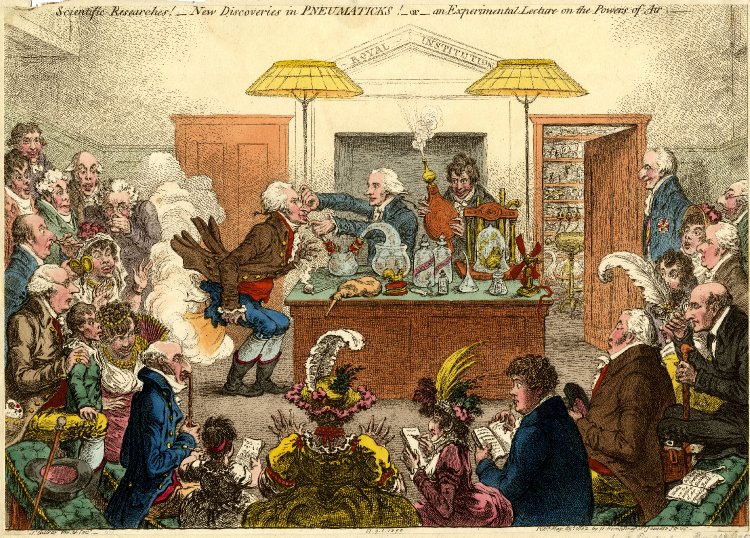
Truth to tell, Sir Davy put on exhibitions of his experiments that were not only explosive but made all the females swoon.  He was a very good public speaker, endowed with considerable charisma and the elusive ability to impart science in an understandable manner.  Note the cartoon and its display of Davy’s large female following.

I cannot deny he is rather attractive.  Is it the neckcloth or is it just me?

File:Royal Institution - Humphry Davy.jpg

Spectators were particularly drawn to his experiments depicting the effects of nitrous oxide.  He once said that laughing gas bestows all the benefits of alcohol and none of its flaws.

I’ll have what she’s having.