
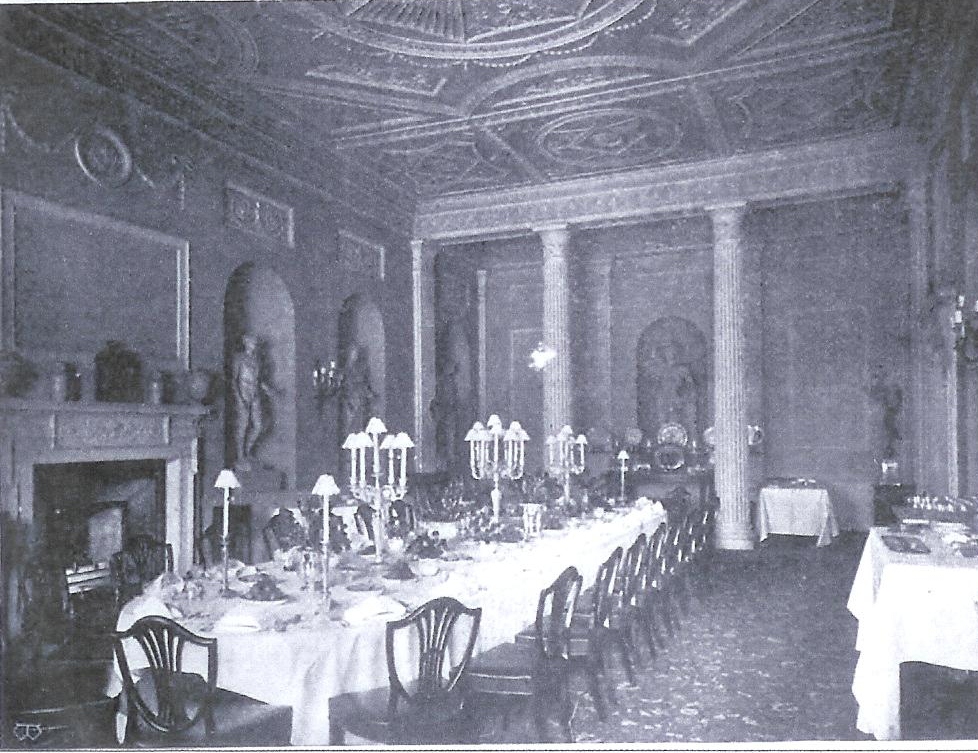
Lansdowne House Dining Room pre-demolition
“I wish you would not go in there.”
“Whyever not?” Diana asked. “I’ve heard all about Lansdowne House’s new acquisition and would like to have a look.”
Louisa, Lady Lansdowne, was mortified. Her husband’s new Canova sculpture was the talk of London. “Ever since that dreadful Payne Knight was here for dinner everyone wants to look at it.”
“Good heavens,” Diana exclaimed. “You had that man over for dinner? The one who wrote A Discourse on the Worship of Priapus?”
“The very one. But I am persuaded he is exaggerating.” Louisa felt herself flush under Diana’s amused glance. “She is not at all what they say she is.”
“Then there can be no objection to having a look. Just to be sure.”
Reluctantly, Louisa followed the countess into the famous Adam dining room. Grim grey statues in their wall-bound niches stared down in disapproval at the female nude who reclined, in all white marble, on her couch.
Louisa grew alarmed at Diana’s prolonged inspection. “This is all so very distressing. Do tell me she is not an, er, hermaphrodite?”
Diana folded her arms. “That fellow Knight may have to reexamine his theory of pagan culture. Your naiad is missing a most important piece if she’s to be what he says she is.”
Louisa nearly sagged against the sculpture’s buttocks in relief. Then she caught a gleam of mischief in Diana’s glance.
“Stay–did you say a naiad? Is that bad?”
Diana shrugged. “Oh, most decidedly.”
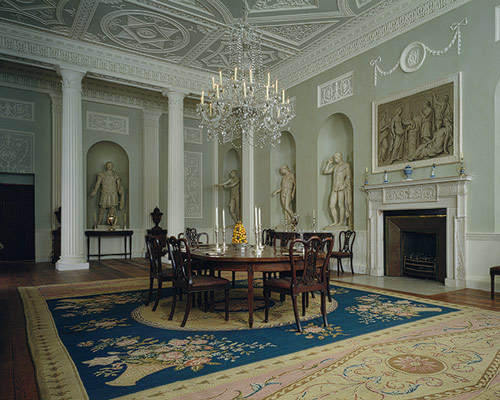
Metropolitan Museum of Art - Lansdowne Dining Room
The dining room at Lansdowne House was executed under the brilliant design of the great Scottish architect Robert Adam. His neoclassical creation was located in a part of the house that was demolished to make way for a street and additional buildings today known as Fitzmaurice Place. This mutilation deprived the house of its historic design. A design that gave the great London mansion “movement.”
The dining room was a part of the south wing–to the left of the old photograph in last week’s post.
Word got round in 1930 that the sculptures and other contents of Lansdowne House were to be put up for sale. This was to be followed by demolition of the two wings. Fisk Kimball, director of the Philadelphia Museum of Art, was very interested in the house’s role as the venue for the negotiations of a Nation’s independence. He tipped off the Metropolitan Museum of Art in New York of the pending destruction and the institution was emboldened to Act.
The dining room was dismantled and shipped over the Atlantic to its new home where it can be seen today, sans the Canova. From the Met’s website, we have this marvelous description:
…the design of the ceiling…was carried out in plaster by Joseph Rose. The carving for the wooden doors and door frames, shutters and window frames, columns, baseboard, and chair rail, executed by John Gilbert, was finished in December 1768. The marble chimneypiece was supplied by John Devall & Co., chief masons for the royal palaces, the Tower of London, and the Royal Mews. The oak floor of the room is original. The niches originally held nine ancient marble statues acquired by Lord Shelburne in Italy from the artist Gavin Hamilton, which were dispersed at the Lansdowne sale of 1930. Now, the niches have been filled with plaster casts. The original furniture, designed by Robert Adam and executed by John Linnell, no longer survives.
Thanks to this reconstruction, we can note several prominent features that would not be out of place in any Regency gathering. Celadon green is the term for a particular jade coloring that is an enduring part of neoclassical design. The fireplace is white marble, matching the large frame above it which often stood empty back in its London home. The Lansdowne family had a vast collection of paintings, but no one individual work was large enough to fill the space Adam designed for it.

Sleeping Nymph - Antonio Canova
What of the reclining nude? She is now in London’s Victoria and Albert Museum. Lord Lansdowne commissioned her in 1820 from the great Italian sculptor, Antonio Canova. An earlier post describes his work, but in the case of the reclining naiad, the sculptor had died before her completion and his assistants were relied upon to finish it.
Canova is thought to have been greatly influenced by a famous “marble” unearthed in Italy and presented to the Cardinal Borghese in the seventeenth century. Known as the Borghese Hermaphroditus, the discovery electrified Western Europe.
Many copies were made of this reclining figure who lay on his (her?) stomach, not quite concealing the object of such amazement.
 Angelyn's Blog
Very interesting post. I enjoyed it. It’s always nice to get a ‘peek’ into history.
LikeLike
Who can resist doing so? Thanks for stopping by, Callie.
LikeLike
Hi Angelyn,
entertaining blog, however as a writer/ HDR researcher of Lord Lansdowne, I can categorically tell you that he had a Roman adaptation of a Hellenistic intersex sculpture, a recumbent Hermaphroditus created in the form of a nursing mother. Ovid’s mythology notes that he was the young son of Aphrodite and Hermes, but he was transformed into an intersex individual by the gods on behalf of the thwarted nymph of the Salmacis spring, Salmacis, when he would not respond to her sexual advances (see Ovid, Metamorphosis, IV. 285; 368-375, LCL 42, trans. G.P. Goold, 1977).
In the ancient classical world he was worshipped as a deity representing motherhood and marriage. When Lord Lansdowne acquired this sculpture he had it refashioned as a water nymph. Its three infants expunged from its body by an undocumented sculptor, and its intact juvenile male attributes masked by pairing it with a similar youthful water nymph, Egeria (see Clarac). although many of his cosmopolitan viewers would not have found it offensive, his circumspect political opponents would have found it unseemly and so to be more circumspect and not give them fuel to attack him he had it refashioned. however, having said that, it is evident from his response that the idea of the ‘monster’ was uppermost in his mind when he made these changes. like all his peers he was classically trained and would have been well aware of the ancient Greek and Roman world’s aversion and negative response to these beings (see Diodorus). the sculpture was displayed in Lansdowne/Shelburne house, but in 1882 When Michaelis visited the collection it had been redeployed to the stairway. Much later it was displayed in the Orangery of Bowood House, his country estate, by his forebears, and after that it was sold four times. if you would like to read more about the Marquess of Lansdowne, his collection of sculpture, and this intersex sculpture in particular, then get hold of the eminent book by Angelicoussis, Reconstructing the Lansdowne Collection of Classical Sculpture, 2017, I, II. see Vol. II, 145ff. I hope you enjoyed hearing about his real, as opposed to the Canova copy, that i am unaware of, where did you get this information from?
Lucile Myers, BA HONS, MMS, Dip Arts, Egyptology, MPhil (marked and in the process of revision so it will be passed)
LikeLike
Hi, Lucile–Thank you for taking the time to reply to my post. The background you provided on the mythology is much appreciated. At the outset, the excerpt discourse between Diana and her friend Louisa is completely fictional–both are characters in an upcoming Regency romance novel I plan to self publish (eventually). Lord Lansdowne’s sculpture collection was quite extensive and I’m sure you know a good deal more about it than I do (thanks, by the way, for mentioning the Angelicoussis source on the matter). My inspiration for this post relied principally on two sources regarding his lordship’s Canova commission — the Met’s description of the Lansdowne Dining Room on display at the museum (recently renovated — I hope to see it this summer) and a chance mention of Payne Knight’s “joke” about the marquess’ Canova in Lord Lansdowne, A biographical sketch as reprinted from “The Saturday Review,” by Abraham Hayward (1872).
LikeLike
You are welcome Angelyn, any other information you would like just let me know. You can contact me on FB Messenger if you wish. As for knight’s comment would you kindly give me the reference, and the comment so I can look it up, and the correct reference for the Canova as well. As a social historian the pursuit of knowledge, in this instance the ancient classical world, mediaeval world, and the eighteenth century Age of Enlightenment is what my thesis is concerned with so anything you would like to know just ask. My work with revisions has just been submitted for approval so I can graduate. Right now I am researching the Hellenistic Venus de Milo and hope to write on her in the future in ways that have not been done in the past. Just like my present work, it is important to push the boundaries of research and look at objects of antiquity with new eyes. I love reading your blog. Ancient history gives us a window into the past, but if we care to learn, it also gives us insights into how to deal with the present and future. Unfortunately the world does not seem to learn from the mistakes of the past, and I see them constantly repeated through millennia, but also I see how, no matter the time period human nature is the same, in many instances so similar to our own, people’s desires, actions, reactions, humour, why I love reading 18th century journals, travel journals, personal correspondence, and classical antiquity’s poetry, scientific and medical texts, philosophy, plays, written texts that really can be very informative, insightful, fun to read, often very humorous, even scandalous, and that is what is so fascinating about being an historian. Why research for me is so addictive. Keep on doing what you do, it not only gives pleasure to others but it teaches others that real history is far more fascinating than reading a fictional book can ever be, no matter how well written.and yes I read these types of books as well.
LikeLike
The timing of your kind reply could not have been more fortuitous, Lucile–I was at the Met just then and was able to see the lovely Lansdowne House dining room with its statuary. And there she was–the Reclining Naiad–glorious! The placard indicated she was commissioned not by Lord Lansdowne but by Lord Darnley (the 4th, I believe) and was completed by the sculptor’s assistants in 1824 (see https://www.metmuseum.org/art/collection/search/205177). Of course, you probably already knew that plus the fact there was at least another variant of the Naiad given to the Prince Regent — I wish I knew more about that. Meanwhile, the V&A indicates the Lansdowne commission is in their collection (https://www.vam.ac.uk/articles/antonio-canova-an-introduction). I assume this is the sculpture that Hayward alludes to in the second volume of his Biographical and Critical Essays (page 314) relating the story of Payne Knight (who was considered an authority at the time on most everything in antiquity). I’m very glad you came along to illuminate the subject! You wrote: Unfortunately the world does not seem to learn from the mistakes of the past, and I see them constantly repeated through millennia, but also I see how, no matter the time period human nature is the same, in many instances so similar to our own, people’s desires, actions, reactions, humour.. — I feel exactly as you do! And again, thank you for your generous compliments.
LikeLike
Fascinating! So the Canova is really a hermaphrodite? How fortunate that the Met was able to acquire and reconstruct the dining room. It’s fabulous.
LikeLike
Actually, the Canova was inspired by the Borghese Hermaphroditus, a famous statue unearthed in the seventeenth century and installed at Cardinal Borghese’s villa in Rome. The Hermaphroditus is thought to be a Roman copy of a much older Greek statue. In any event, Canova executed several reclining nymphs–all of which can be traced in inspiration to the Borghese. The Hermaphroditus resides in the Louvre.
Thanks for commenting, Vivian!
LikeLike
Another fabulous post. While visiting family in Virginia over the holidays, we toured Montpelier, James Madison’s home. They’re in the process of converting it back to the way it was when he lived there. They moved an entire room dating from the Dupont’s ownership in order to convert it back to Madison’s time. I’m always fascinated by the history of these historic homes.
LikeLike
Montpelier deserves to be restored to its original design. Thank goodness they removed that hideous stucco. This mansion is proof of Palladio’s strong influence on American, as well as European architecture. Thank you for commenting!
LikeLike
Your blog sent me to my Greek mythology book. Hermaphorditus was named for his parents: Hermes and Aphrodite. He was a beautiful boy transformed to an androgynous being. He is portrayed in art as a female with male genitals…..the symbol of the sacred union of men and women.
Being an older Regency woman, I can understand Louisa’s distress.
Great post!
LikeLike
Oh! Did you rely upon Edith Hamilton’s excellent work on the subject? She’s quite an old favorite of mine.
Poor Louisa. Diana’s teasing didn’t help either.
Thank you for stopping by…
LikeLike
I loved your prose. Thank you for an illuminating post and the lovely pictures.
LikeLike
You’re very kind. I feel the same way about your blog, as well.
LikeLike
There was quite a crowd surrounding the Hermaphroditus when we were there. Apparently it still captivates… Great article, as always.
LikeLike
Yes–I never got near it. At least, not enough to see what the fuss was about. Thank goodness for internet images. Thank you for the compliment!
LikeLike
Angelyn thank you, I am a HDR researcher, doing my thesis on Hermaphrodites and their 18th century collectors in Britain, your blog is really great, I love history as well, so it is great to see a fellow lover of ancient history, and this topic is fascinating.
LikeLike
You are very welcome, Lucile. I had to look up what an HDR researcher is. Now that I know–I’m jealous! But getting back to the topic at hand–Regency England would not be such a magnificent canvas for authors like Jane Austen if it wasn’t for the previous century’s pursuit of classical antiquity. Thanks for commenting-and for your generous compliment.
LikeLike