“Most Delicate in his Acts of Generosity” – the Third Marquess of Lansdowne

Lansdowne House was not only famous for its architecture and furnishings–it was known for its people, as well.  This post is dedicated to the one person who not only brought the house into its prominence in the Regency period, but very possibly saved it from destruction.
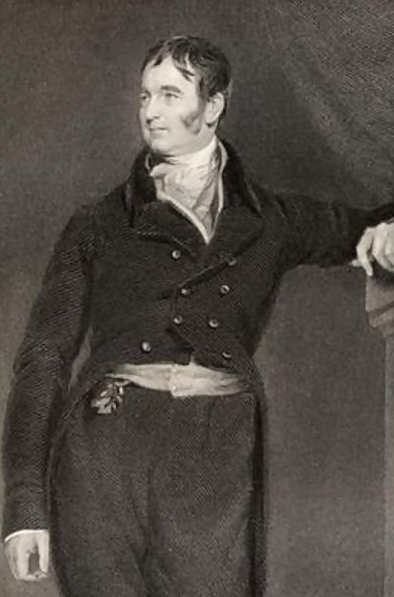
Lord Henry Petty-Fitzmaurice, Marquess of Lansdowne

Lord Henry Petty-Fitzmaurice, third Marquess of Lansdowne (1780-1863) was born in Lansdowne House to the second wife of his father, the first marquess, Lord William Petty, also known as Earl of Shelburne.  It was his older half-brother, Lord John Henry, who succeeded their father.  However, he died a few years later and Lord Henry became not only Earl of Kerry but Marquess of Lansdowne as well.

 An heir and a spare.

And what a spare he came to be.

The hero in Vivien’s story, Notorious Vow, also succeeded his older half-brother.  His patrimony was an earldom in shambles.  The marquisate was similarly situated when it came into Lord Henry’s hands.

Indeed, Lansdowne House had been left by Lord Henry’s predecessors in such a dilapidated state it might have gone on the auction block.  The situation was quite desperate, leading to a scandalous litigation over the debts the estate was faced with, brought by various creditors who held substantial mortgages on Lansdowne House and the family’s country estate of Bowood.  These persons sought to recover monies from the sale of many of the estate’s assets, among them the large art collection that was once once housed in the magnificent Adams rooms of Lansdowne House.  Even the trees themselves had all been cut down and sold as firewood.

Under Lord Henry’s watch, the trees were eventually replanted and Lansdowne House, along with its art collection, restored to former glory.  It was to be one of many of his lordship’s remarkable achievements.  He was a humble man, having turned down a dukedom and the office of Prime Minister.  Nevertheless, his presense was a powerful one in Britisih political life–championing the causes of eduation, Catholic emancipation and the abolition of the slave trade.

He was a man worthy of presiding over the Regency Centre of London:

“Under him the reputation which Bowood and Lansdowne house had secured in the lifetime of Lord Shelburne as meeting-places not only for politicians, but for men of letters and of science, was fully maintained. In the patronage of art and literature Lansdowne exercised considerable discretion, and re-established the magnificent library and collections of pictures and marbles which had been made by his father, and dissipated during a short period of possession by his half-brother. Most delicate in his acts of generosity, he freed the poet Moore from his financial troubles; he assisted Sydney Smith to long-waited-for preferment and he secured a knighthood for Lyell.”

—–from an article written by William Carr and published in 1895 (as reprinted in Dr. Marjorie Bloy’s English History website here.)

Lansdowne House Drawing Room

A drawing room was not just for drawing.  During the late Georgian period and beyond, when socializing was made easier with more efficient transportation, great houses utilized their spaces in new and creative ways to enhance the party experience.

Lansdowne House Rear Drawing Room – Philadelphia Museum of Art

And you thought your living room was just wasted space.

In Notorious Match, the Lansdowne Ball featured dancing and gaming.  After arriving, Diana found herself at a game of faro that was set up in the famous Adam drawing room.  Her luck at the game was indifferent at best.  The last time she played she lost her mother’s pearls.  To her disappointment, the banker refused to accept her voucher to play.  So she staked something else that Lord Harcourt would be unable to resist.  Irresponsible?  Perhaps.  Did she do it to provoke Griffin?  For once, no.

Unknown to anyone, she was desperate to extinguish a little girl’s anguish, enough to pledge something very dear.

Diana unclasped the heirloom about her neck and tossed them on the table toward Harcourt.  “For my mother’s pearls.”

Harcourt’s eyes fastened on the jewels.  “Those are the Northam emeralds, are they not?  You must be very certain of your luck to stake them.”  He lifted the necklace to the light.  “They’re worth ten times your mama’s baubles.”

“A sentimental whim,” she responded.  “Indulge me, my lord.”

Out of the corner of her eye, Diana saw Griffin fold his arms.  She suspected he was trying very hard to look unconcerned.  Serves him right for playing governess.  Griffin knew she did not like any hand on her bridle—whether her uncle’s or Vivien’s.  But least of all his.

“Be advised, my lady, that I shall not be lenient,” Harcourt warned.  “Not even your lord uncle will be able to redeem these from me.”

The emeralds were so fine they made the diamond setting holding them look insipid.  They were the dowry of some long ago heiress who brought them to Northam when she married its earl, one of many sets of jewels Diana had in her strongbox at herLondontown house.  Harcourt laid them beside bank notes, property titles and a variety of coins wagered by other players.  Seeing them in that light gave Diana pause.

They, like anything else belonging to Northam, were her responsibility.

“Deal the cards,” she commanded nevertheless, determined not to reveal her fear of losing them.

Robert Adam ceiling

The drawing room used for faro and baccarat games that evening was the famous Back Drawing Room, designed by Robert Adam in about 1763 along with the original plan commissioned by the 3rd Earl of Bute.  It is considered the most elaborately decorated of the entire suite of reception rooms in Lansdowne House before its mutilation in 1930.  Its primary feature is a great bay that was originally designed to contain Lord Bute’s elaborate mechanical organ.

The ceiling is Adam’s design but he used artists with special gifts to enrich the design, such as the great Italian painters Cipriani and Zucchi, the latter the husband of the famous bluestocking painter, Angelica Kauffman.  From the 1903 edition of Nash’s Pall Mall Magazine, volume 31, we have a description of the room filled with an incredible array of treasures, all long since dispersed:

“…some lovely old Sevres, in yet another a very beautiful pair of rose-coloured marble vases mounted in ormolu of the finest workmanship, while around all in serene beauty hang the works of Reynolds, Romney, Van der Helst and others of the greatest.”

It took nearly twelve years to install the room at the Philadelphia Museum of Art, once it was removed just prior to demolition at Lansdowne House.  Funding was short in the thirties and forties and it took time to amass enough funds to present the Adam room in its new location.  The museum’s director at the time, Fiske Kimball, remarked that the new exhibit, christened the Lansdowne Room:
 “crowns the series, coming as it does from the moment when England, fresh from her greatest conquests, seized for a moment also the artistic mastery of the world.”

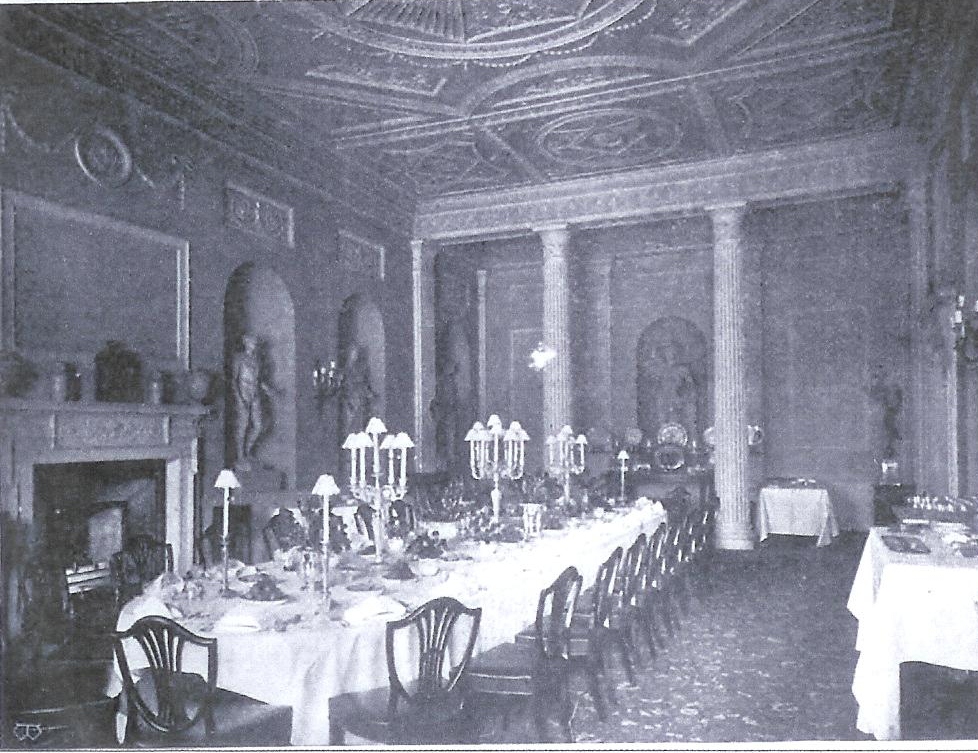
Lansdowne House – dining with a nude

Lansdowne House Dining Room pre-demolition

“I wish you would not go in there.”

“Whyever not?” Diana asked.  “I’ve heard all about Lansdowne House’s new acquisition and would like to have a look.”

Louisa, Lady Lansdowne, was mortified.  Her husband’s new Canova sculpture was the talk of London.  “Ever since that dreadful Payne Knight was here for dinner everyone wants to look at it.”

“Good heavens,” Diana exclaimed.  “You had that man over for dinner?  The one who wrote A Discourse on the Worship of Priapus?”

“The very one.  But I am persuaded he is exaggerating.”  Louisa felt herself flush under Diana’s amused glance.  “She is not at all what they say she is.”

“Then there can be no objection to having a look.  Just to be sure.”

Reluctantly, Louisa followed the countess into the famous Adam dining room.  Grim grey statues in their wall-bound niches stared down in disapproval at the female nude who reclined, in all white marble, on her couch.

Louisa grew alarmed at Diana’s prolonged inspection.  “This is all so very distressing.  Do tell me she is not an, er, hermaphrodite?”

Diana folded her arms.  “That fellow Knight may have to reexamine his theory of pagan culture.  Your naiad is missing a most important piece if she’s to be what he says she is.”

Louisa nearly sagged against the sculpture’s buttocks in relief.  Then she caught a gleam of mischief in Diana’s glance.

“Stay–did you say a naiad?  Is that bad?”

Diana shrugged.  “Oh, most decidedly.”

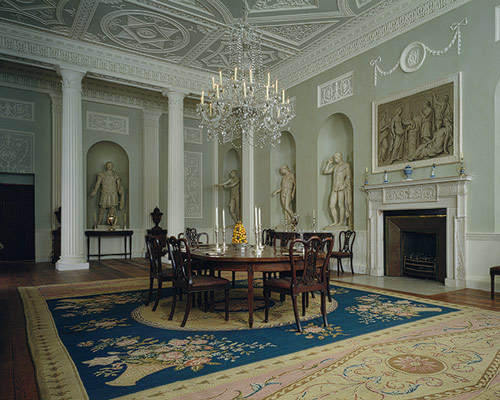
Metropolitan Museum of Art - Lansdowne Dining Room

The dining room at Lansdowne House was executed under the brilliant design of the great Scottish architect Robert Adam.  His neoclassical creation was located in a part of the house that was demolished to make way for a street and additional buildings today known as Fitzmaurice Place.  This mutilation deprived the house of its historic design.  A design that gave the great London mansion “movement.”

The dining room was a part of the south wing–to the left of the old photograph in last week’s post.

Word got round in 1930 that the sculptures and other contents of Lansdowne House were to be put up for sale.  This was to be followed by demolition of the two wings.  Fisk Kimball, director of the Philadelphia Museum of Art, was very interested in the house’s role as the venue for the negotiations of a Nation’s independence.  He tipped off the Metropolitan Museum of Art in New York of the pending destruction and the institution was emboldened to Act.

The dining room was dismantled and shipped over the Atlantic to its new home where it can be seen today, sans the Canova.  From the Met’s website, we have this marvelous description:

…the design of the ceiling…was carried out in plaster by Joseph Rose. The carving for the wooden doors and door frames, shutters and window frames, columns, baseboard, and chair rail, executed by John Gilbert, was finished in December 1768. The marble chimneypiece was supplied by John Devall & Co., chief masons for the royal palaces, the Tower of London, and the Royal Mews. The oak floor of the room is original. The niches originally held nine ancient marble statues acquired by Lord Shelburne in Italy from the artist Gavin Hamilton, which were dispersed at the Lansdowne sale of 1930. Now, the niches have been filled with plaster casts.  The original furniture, designed by Robert Adam and executed by John Linnell, no longer survives.

Thanks to this reconstruction, we can note several prominent features that would not be out of place in any Regency gathering.  Celadon green is the term for a particular jade coloring that is an enduring part of neoclassical design.  The fireplace is white marble, matching the large frame above it which often stood empty back in its London home.  The Lansdowne family had a vast collection of paintings, but no one individual work was large enough to fill the space Adam designed for it.

Sleeping Nymph - Antonio Canova

What of the reclining nude?  She is now in London’s Victoria and Albert Museum.  Lord Lansdowne commissioned her in 1820 from the great Italian sculptor, Antonio Canova.  An earlier post describes his work, but in the case of the reclining naiad, the sculptor had died before her completion and his assistants were relied upon to finish it.

Canova is thought to have been greatly influenced by a famous “marble” unearthed in Italy and presented to the Cardinal Borghese in the seventeenth century.   Known as the Borghese Hermaphroditus, the discovery electrified Western Europe.

Many copies were made of this reclining figure who lay on his (her?) stomach, not quite concealing the object of such amazement.

Lansdowne House – Regency Centre of London

The opening chapters in Notorious Match take place in a London mansion that still stands today.

In my manuscript, the fictional hostess, Lady Louisa Lansdowne, has the privilege of holding the inaugural event of the Season.  Louisa has little regard for the house’s political history even though it witnessed the final negotations that confirmed a Nation’s independence.  She is more concerned that her balls are well-attended and therefore is thrilled when Lord Griffin Montgomery arrives at her party.  Now she is assured her ball will be the premiere event for every eligible, unmarried female for many Seasons to come.

Lord Griffin Montgomery rarely attends ton parties, you see.

Lansdowne House – before alteration

This post is the beginning of several in a series that tours this magnificent home.

Lansdowne House was built upon real estate sold off by Lord Berkeley’s widow in the eighteenth century.  The third Earl of Bute purchased the south side of the square that took her husband’s name.  Lansdowne House was built according to Robert Adam’s 1761 design and was largely completed by 1768.  By then Lord Bute had thrown in the towel and the house was finished under the ownership of another British prime minister, Lord Shelburne, whose name graced the house for a time until his lordship was granted the marquisate of Lansdowne.

Lansdowne House was built according to Adam’s predeliction for ‘movement,’ a term which refers to the diversity of form throughout the building, inside and out.  One can see from the black and white photograph several elements:  the rusticated (dare we say, Tuscan?) ground floor topped by the classical coolness of the Palladian pediment and the portico with its Ionic pillars.  The pavilions on either side were placed forward, giving the mansion an assertive, yet graceful presentation:

“This august edifice…unites at once the gay, the elegant and the grand.”

—James Ralph, A Critical Review of the Publick Bulidings:  Statues and Ornaments in, and about London and Westminster

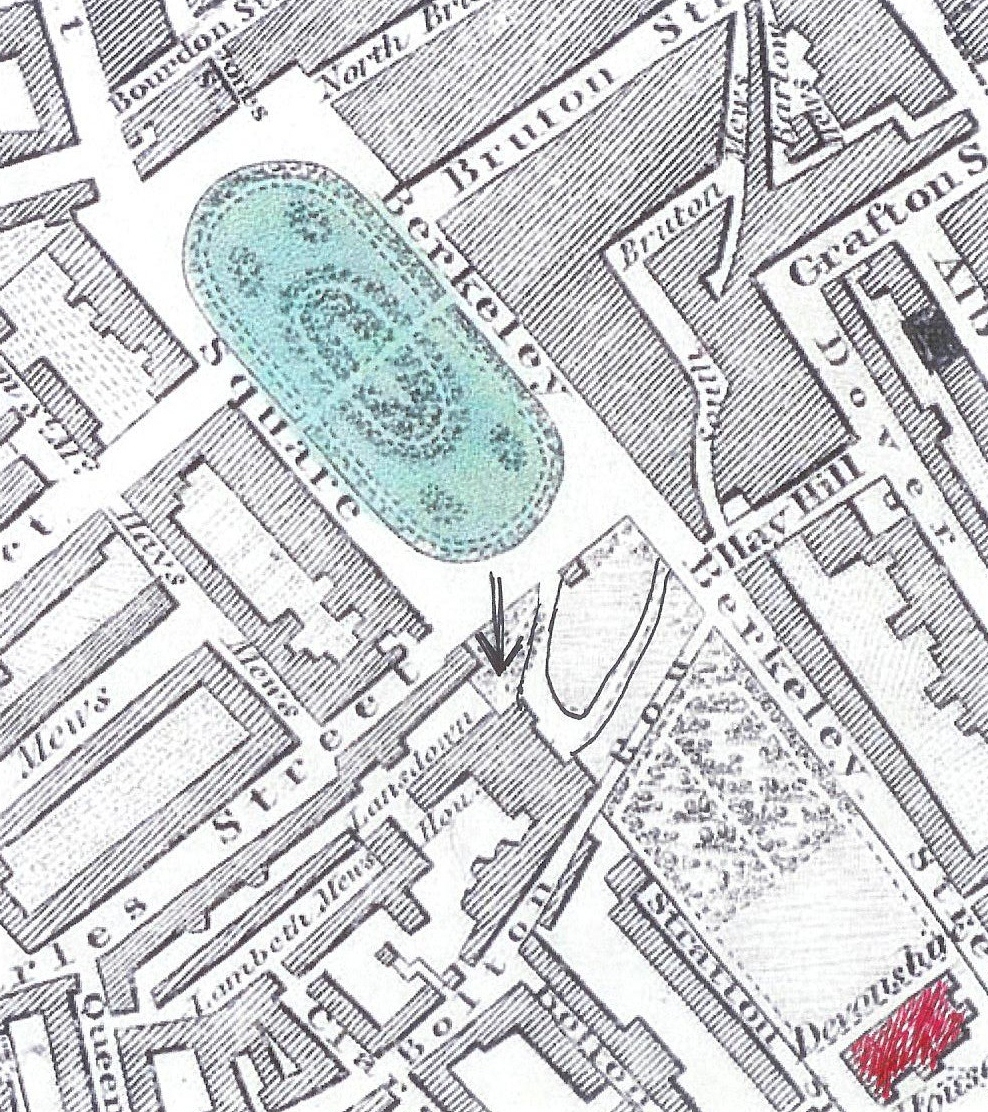
Berkeley Square – 1830

The odd thing about Lansdowne House is its placement.  It does not face Berkeley Square (note the arrow in the adjacent map and the circular front drive), having been situated in such a way as to present its side to the park.   This configuration was to allow the Dukes of Devonshire to have an unobstructed view of the square from their London mansion situated to the south-east (in red).  Lansdowne House was therefore allowed a massive front garden, an advantage few others in the great metropolis had.  Indeed, walkers in Berkeley Square were excused from assuming they were in the country when walking past Lansdowne House, peering through the iron gates at a drive that disappeared into carefully tended landscape.  The only evidence of a building beyond was its exquisite pediment rising above the trees.

This quality was also very nearly the downfall of Lansdowne House.

In the Great Depression, the London council with authority over Berkeley Square determined that a road linking Curzon Street to the square was sorely needed.  The line of houses known as Bolton Row, where Henry James’ sister and other intellectual luminaries had resided, was demolished.  But this was not enough.  The road was extended through Lansdowne’s front garden and Fitzmaurice Place was created in front of the mansion.  To accommodate the new street and buildings, Lansdowne House had to be moved back forty feet.  The only solution, short of destroying the house, was to remove all the front rooms and reconstruct the facade on the truncated building.

Lansdowne House – post truncation

Some of these front rooms were among the finest designs of Robert Adams in England.  The mutilation of Lansdowne House meant that they must go.  And so they went–to far-flung places.

Now that’s cutting off your nose to spite your face.