
Jane Austen’s World and Regency Ramble both give comprehensive discussions on dogs of the early nineteenth century.
In this post, however, I would like to draw attention to the changing nature of how persons viewed their dogs during the Regency.
Of course one valued his canine friend for his practical traits which aided such pursuits like hunting. But the dog was also becoming prized for those qualities that were lauded in the romantic literature of the period–noble characteristics that were always evident in Man’s best friend, but never appreciated fully until now: bravery, loyalty, humility, etc.
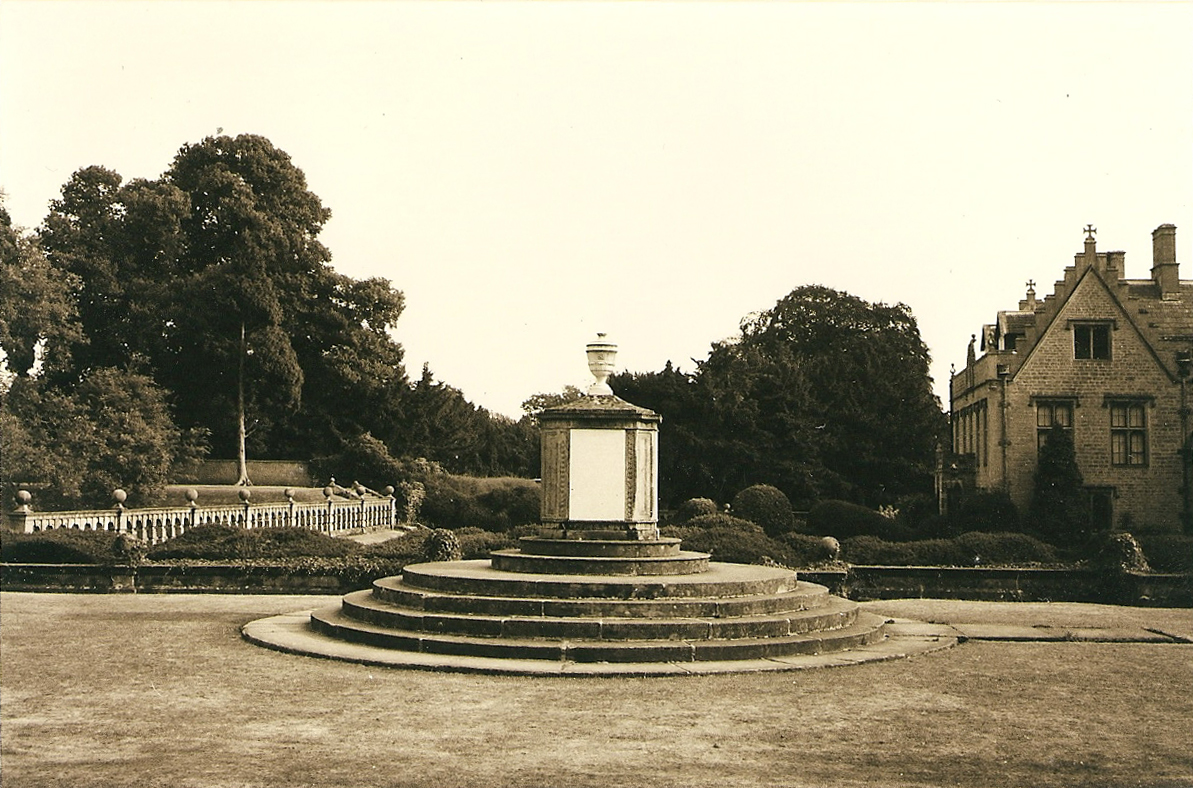
Boatwain’s Monument – licensed by Johnson Camerface
Byron wrote a poem eulogizing his own Newfoundland, which had contracted rabies and died in 1808. The poet nursed his dog throughout the illness, never minding that he himself might contract the disease. Boatswain was buried on his lordship’s estate at Newstead Abbey. His monument is larger than that of his owner.
The last line of the Epitaph for a Dog are particularly affecting:
“To mark a friend’s remains these stones arise; I never knew but one – and here he lies.”
Regency owners also saw their dogs as an extension of their own personality and their tastes in the exotic. It became particularly fashionable among the ton to own a dog with a background that inspires one to think of faraway places in the Orient.
The author Georgette Heyer demonstrated just this very aspect in her delightful Frederica.
In this novel, the jaded hero makes an elaborate representation to an irate cowman, two park-rangers and one hatchet-faced lady that the heroine’s family pet, which had caused some riot and rumpus, is actually a rare speciman from Asia. He succeeded in fooling me as well. There is no such thing as a Baluchistan hound. What manner of breed Lufra was is up to conjecture, but the Marquis of Alverstoke demonstrates an insightful perspective into Man’s best friend in the early nineteenth century.
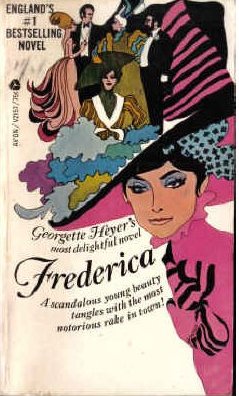
1967 Edition — blame the gay nineties look on Avon!
You see, all except for the hatchet-faced lady were only too ready to believe that a nobleman had taken a fancy to owning an exotic dog. In the Regency, anything attached to one’s person that spoke of the Orient gave a fellow distinction.
I also was unaware that persons under royal license were allowed to graze cattle in London’s Green Park. That famous Regency denizan Beau Brummel had the distinction of being related to two aunts who held such a license to graze their milch cows in the park.
I love dogs and I love Regency romance. This passage combines the best of both:
“Really, Cousin, you are too shatterbrained. He is a hound, not a collie; and what I told you was not Barcelona, but Baluchistan! Baluchistan, Frederica!”
“Oh, dear! So you did. How–how stupid of me!” she replied unsteadily.
Neither of the park-keepers seemed to find his lordship’s explanation unacceptable. The elder said wisely that that would account for it; and the younger reminded the company that he had known all along that the dog wasn’t Spanish. But the cowman was plainly dissatisfied; and the hatchet-faced lady said sharply: “I don’t believe there is such a place!”
“Oh, yes!” replied his lordship, walking towards the window and giving one of the two globes which stood there a twist. “Come and see for youself!”
Everyone obeyed this invitation; and Frederica said reproachfully: “If you had only told me it was in Asia, Cousin!”
“Oh, Asia!” said the elder park-keeper, glad to be enlightened. “A kind of Indian dog, I daresay.”
“Well, not precisely,” said Frederica. “At least, I don’t think so. It’s this bit, you see. It’s a very wild place, and the dog had to be smuggled out, because the natives are hostile. And that’s why I said he was very rare. Indeed, he is the only Baluchistan dog in this country, isn’t he, Cousin?”
“I devoutly hope he may be,” returned his lordship dryly.
“Well, all I have to say it that it makes it so much the worse!” declared the hatchet-faced lady. “The idea of bringing wild foreign animals into the park! Smuggled, too! I don’t scruple to tell you, my lord, that I very much disapprove of such practices and I have a very good mind to report it to the Customs!…I am speaking of the English Customs, my lord!” she said, glaring at him.
“Oh, that wouldn’t be of the least use! I didn’t smuggle the dog into the country; I mrerely caused him to be smuggled out of Baluchistan.”


 Angelyn's Blog