
Regency Terms: Introduction

Mr. Standen, already shaken by having his hand rubbed worshipfully against a lady’s cheek, goggled at her.  “You think I’ve got brains?” he said, awed.  “Not confusing me with Charlie?”

“Charlie!” uttered Miss Charing contemptuously.  “I darseay he has book-learning, but you have–you have address, Freddy!”

“Well, by Jove!” said Mr. Standen, dazzled by this new vision of himself.

Cotillion, by Georgette Heyer

The Queen of Regency Romance, IMHO, not only uses Regency lexicon to great effect, she encases these foreign sounding English terms in clever context that makes their meaning unmistakeable.

What does it mean to have address?

In a world where birth and wealth define one’s status, an added avenue of distinction was good character, a notion well-advanced in the works of Jane Austen.  Address was often (!) considered an indication of good character.  During social activities, manners, dress and ability to dance could be displayed to advantage, and were often taken as the first  indications of one’s character, achieved separately and independent of one’s antecedents. 

Hence Elizabeth Bennett’s outspoken inquiry into Mr. Darcy’s character, despite his prominent birth and fortune, is rather amusing:  “I’m trying to make it out!”

In Heyer’s Cotillion, Freddy, also known as the Honorable Freddy Standen, is the son and heir of wealthy Lord Legerwood.  But he was primarily favored for his address, which was displayed to great advantage in the competitive environs of Almack’s, that exclusive club where unmarried debutantes and gentlemen of the ton would gather for the Season.  Freddy could always be depended upon to ask the wallflower for a dance, or facilitate introductions that promoted connections essential to future alliances (marriage) among the ton.

He was really handy at a party.

Even before Kitty Charing drew his attention to this quality she admired in him, Freddy used his address on several occasions to get her out of a scrape.  You’ll have to read this delightful, traditional Regency to see how such a quality endeared a generation of readers to a character diametrically opposed to the rake.  Freddy made a romantic hero, nonetheless.

There are a number of wonderful sites that give a general overview, and glossary, of Regency terms.  I’ve listed them here:

http://www.thenonesuch.com/lexicon.html – excellent overall summary and glossary

http://www.michelesinclair.com/regency_era_info.shtml#lexicon – quite good for Regency dances

http://janeaustensworld.wordpress.com/social-customs-and-the-regency-world/ this marvelous(!) site could not be more comprehensive.

More to come on specific Regency terms.

In the meantime, enjoy this picture of a gallery in Apsley House above, not unlike the gallery where Vivien first saw the portrait of Calumet in Northam House.
What is a ha-ha?

The following is an excerpt from my new novel Improper Vow:

            “Oh, bother!” Diana said.  “I think she needs a run.”

            “A gallop will do,” Vivien suggested, not liking anything that approached racing, an unladylike pursuit.  It was all very well for the wealthy and fashionable Lady Diana to indulge in exploits, but not an out-of-the-way miss like Vivien Montgomery.

            Diana turned her horse off the path toward the boundary of the park, far in the distance.

            “Let us keep to the path, don’t you think?” Vivien added.

            “Not if you want to jump the ha-ha,”  Diana said. 

            “I don’t.”

            “I’m persuaded that Garnet is ready to try it. Especially if she is following Thor.”

            The ha-ha was a wall erected many years ago to separate Hyde Park from Kensington Gardens. To an approaching horse, the wall appeared less than two feet, a modest hop for a highbred mare like Garnet. But the other side was a steep drop-off, and capable of unseating the best of riders.

             “I have no intention of jumping anything. And neither should you,” Vivien warned. “Your sidesaddle is not stable enough.”

            “Then I shall go first,” she shouted, allowing Garnet to turn toward the serpentine lake and the wall beyond it.

            “Diana!”

            But the mare was rapidly retreating from sight. Vivien felt sick as she spurred Thor after her. If there was an accident, she would never forgive herself.

           Nor would Lord Northam.

            Thor covered the ground smoothly, his gait elongated and gaining on the much younger Garnet, who was by now fighting Lady Diana’s hold on her bit, her tail wringing like a flag and slowing their progress considerably. Vivien’s heart beat was so rapidly, she thought she might actually find out what it meant to have the vapors. 

            “Diana, do not be so foolish!” she called.

            To her relief, she saw the mare come to a halt. And then she saw why. Northam’s face was a mask of fury as his great bay galloped up.  Although she had not been at fault, Vivien still felt like a naughty schoolgirl. She must have looked guilty, for his lordship was scowling at her.  Thor didn’t help matters, acting as though he were at fault as well, flicking his ears back and forth worriedly.        

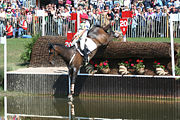
—-Jumping a horse over a ha-ha can be unsettling, at least for me.  Resembling a drop fence in cross-country terms, the jump is quite a ride if you are not prepared for the steep descent.  As Vivien, the heroine of my novel knows, one shouldn’t try it with a side saddle, because a fall while negotiating such an obstacle can result in severe injury to either rider or horse.  At a minimum, a successful jump over this fence puts a lot of stress on the horse’s front legs.  She’s also aware that 

cross country drop fence

the horse has to really trust his rider, because he cannot see the the landing until he is about to take off. 

 Queen Caroline had one installed to separate Kensington Gardens from Hyde Park in 1728.

Improper Vow

“”Miss Montgomery, I’ll wager, won’t be so easily pawned off like the last one.”

“The last one?”

“Yes.  The one you made your mistress.”

The proper Miss Vivien Montgomery, daughter of a scandalous marriage, has made friends with the earl of Northam’s heiress, in spite of his disapproval.  Mistaking Vivien for an adventuress, Lord Northam tries to sever the connection by proposing an improper one of his own.  Upon realizing his mistake, his lordship finds he is beguiled by Miss Montgomery, even when he discovers his stolen colt is now in her stable. Together, they must remove all deception between them if they are to satisfy an old vow and make a new one together.

An excerpt of my debut Regency novel—as yet unpublished.