Regency Wedding Dress

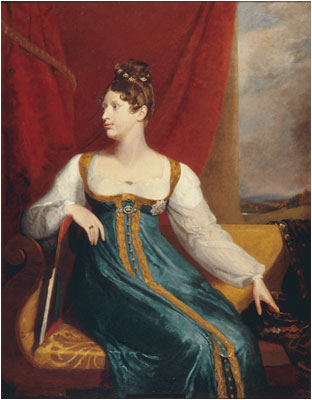
I shall leave you to judge the nuptial gown the new princess wore.  Some puckering around the bodice?  Possibly–a perfectly sculpted bodice is difficult to execute.

Forget I said that.  The gown was simply gorgeous!

And mostly due to a tiny motif created by a process nearly as old as the Regency: the Carrickmacross lace.  Even Princess Diana’s dress featured this lovely technique of handmade lace pictured here and executed for the new princess at Hampton Court Royal School of Needlework.

Princess Charlotte’s dress featured a tiny motif just as memorable–the bellflowers and shells decorating the edge of the heiress’ bodice and sleeves.  The following web sites do great justice to the intricacy and beauty of her dress for the reasons mentioned: bell flowers, silver lame’, and scalloped shells.

All of which are displayed in the Royal Collection housed in the Museum of London.  This museum used to be housed in Lancaster House, which was once York House that is part of the complex bordering St. James Park.  An interior is shown below:

The Grand staircase of Stafford House (Lancaster House): 19th century

The Regent’s House or God’s – Part Two

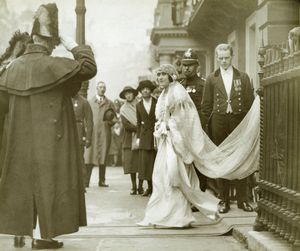
Lady Elizabeth Bowes-Lyon on her way to the Abbey

It wouldn’t seem right if Kate and William married, for instance, in Buckingham Palace instead of Westminster Abbey.  No processional, limited guest list, private ceremony off-limits to the press.  But prior to George VI’s wedding to the late Queen Mother, royal weddings were held in private chapels.

In 1816, the heiress to the throne, adored by her countrymen, was wed in her father’s house, which did not, like royal palaces, have a chapel.  It might have been a fatal error.

And the reason is one that is hauntingly familiar.
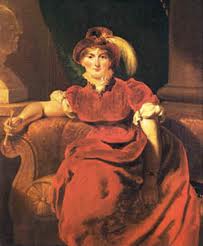
Caroline of Brunswick

Acrimony among royals is a magnet for public fascination, then as now. Princess Charlotte’s parents waged a very public battle over their troubled marriage and the Prince Regent emerged from it little better than an object of derision.  His subjects sided very much with his aggrieved wife, Caroline of Brunswick, and cast all their admiration and sympathy onto her daughter once her mother, the Princess of Wales, agreed to leave the country.

Charlotte’s father perhaps believed that holding the wedding at Carlton House would avoid the frenzy of a public processional to one of the royal palaces.  But to no avail.   Despite the arrangements he made, the people insisted on participating in the wedding of their princess.

The following is a contemporary description from the 1816 issue of the Asiatic Journal of the Princess’ attempt to get to her grandmother’s palace at Buckingham House to dress for the wedding:

“The Princess Charlotte of Wales, at 4 o’ clock, went in a carriage to the Queen’s Palace, and had the windows down to gratify the curiosity of the crowd in Pall-Mall, but they were found to be so extremely numerous, that the coachman could not with safety drive through them, he therefore returned, and went through the Park.”

At the time, the princess was living at Warwick House, a mean, tumble-down residence very near Carlton House on a dead-end lane.  She could either drive down the public thoroughfare known as Pall Mall, or access Queen Charlotte’s palace via the gated St. James Park.  Remember Kate and William in Edward VII’s carriage heading toward Buckingham Palace?  That was the route Charlotte took.  But in her time, St. James Park was off-limits to the public when the princess journeyed almost in secret up to Buckingham House.

Even her husband to be, Prince Leopold, had a scary moment just before when he was returning to the Duke of Clarence’s house, which was just across the way from the Duke of York’s house at the edge of the St. James Palace complex:

“His Serene Highness afterwards returned to Clarence House a little before half past three, when the crowd was so numerous, and the anxiety so great to see him, that the footman, in letting him out of the carriage, had nearly been pushed under it.  A number of women and children were forced into Clarence House against their will, by the extreme pressure (of the crowd).”

However, the prince took matters in hand and asserted his leadership over the crowd soon after:

“In a few minutes after, his Serene Highness walked across to York House (now know as Lancaster House) when the crowd behaved extremely orderly, and at the request of a few attendants, formed a clear passage for him to pass through; they, however, loudly huzzaed him, and he bowed to the populace.”

The Regent’s House or God’s – Part One

Westminster Abbey by Canaletto, 1749

Unlike Prince William, Princess Charlotte did not wed in a church or chapel.  In fact, she is the only heir-presumptive to the English throne that I can think of being married in a secular place.   If there are others, they are few in number.

The Regent was in charge of all the arrangements for his daughter’s wedding and thus ordered the ceremony to take place at his palace, Carlton House.  In part two, we shall see that the plot is nothing as humorous as Father of the Bride.   

But for now, it should be noted that Carlton House was extensively rebuilt and decorated at great expense by the Prince Regent. It was admired for its lavish decoration and derided as being inferior to many hotels in Paris.  In front of the palace there was a curious set of columns which perplexed passers-by and inspired the-then famous ditty:

“Dear little columns, all in a row, What do you do there?  Indeed we don’t know.”

Carlton House (those pillars do look odd)

I’m digressing a bit, but the following observation by a contemporary witness is rather amusing:

Then the Duke of York bas been sent, as it would seem, to the Round House, and the Prince of Wales to the Pillory.”

*gales of laughter*

At times the Regent found the Duke of York somewhat trying.  Especially when he believed his younger brother, fond uncle as he was, would get his niece Charlotte into a scrape, or encourage her natural inclination towards rebellious behavior (I wonder where she got that from?).  The Duke of York had his own palace called York House, which stands today as the Scottish office in Whitehall.  You can see its prominent feature–a drumlike circular hall beyond the entrance vestibule.

York House, now Dover House

Persistent Prince – Part Two

To be fair, the Princess Charlotte had been embroiled in a failed engagement with the Prince of Orange, a failed romance with a Prussian prince (or two, depending on who you ask) and quite possibly (ie, understandably) had her head turned by Lord Byron and his turquoise ring.

Lord Byron in Eastern costume

In any case, she had no interest in Prince Leopold.

It seems likes a minor footnote, yet the following excerpt leaves one in little doubt as to the prince’s intentions:

“He paid many compliments to Princess Charlotte, who was by no means partial to him, and only received him with civility. ..and when we drove in the Park, he would ride near the carriage, and endeavor to be noticed.”

–from the memoirs of Miss Cornelia Knight, companion to HRH Princess Charlotte.

Rebuffed, Leopold went back to the field of war. Napoleon had returned to the Continent and must be defeated.  By the time the conflict was over, Princess Charlotte had come to her senses.

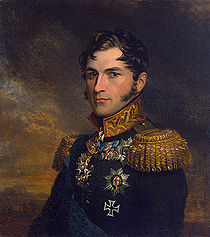
I mean, look at him!  What’s not to like?

In my Notorious series, Vivien and Diana joined in the speculation swirling around the unknown prince and his temerity to ask the Regent for Charlotte’s hand.

“I hear that Prince Leopold is very handsome.  Do you suppose Princess Charlotte picked him out when the Allied sovereigns visited last year?” Vivien asked.

Diana snorted.  “Not as random as that, my dear.  Russian intrigue, I’ll warrant.”

“And how would you know?”

Diana grinned.  “I’ve made inquiries.  ‘Twas the Grand Duchess of Oldenburg who introduced Prince Leopold to the princess.  Putting a spoke in Prinny’s wheel and his plans for the Dutch marriage, so to speak.”

“But the Russians were in favor of the match, I thought.”

“Ah, that’s the intriguing part.   You know how Prinny keeps Princess Charlotte all shut up at Warwick House?”

That circumstance never failed to arouse Vivien’s sympathy for the princess.  “They say no one is allowed to see her since she broke off with the Prince of Orange.”

“Except the Tsar’s sister.”  Diana tilted her head in amusement, the jaunty angle of her shako hat almost arch in manner.  “I had it at the Jersey ball.  Countess Lieven swore the Grand Duchess prevailed on the Regent to allow her to see the princess–on the assurance she would get Charlotte to reconsider the dutchman’s suit.”

“And her ulterior motive?”

“She was escorted by none other than your handsome calvary officer from Saxon von something or other.”

The Tsar’s sister may have had yet another motive.  Her own sister needed a husband.  And no one except the Prince of Orange would do.

Persistent Prince – Part One

Miss Catherine Middleton

I’m not convinced “Waity Katie” is an entirely accurate nickname.  With all the speculation and rumor over the last eight years, who was really the party that waited, or more importantly, the party that persisted?

During the Regency period, speculation and rumor also abounded.  Overwrought correspondence, backstairs intrigue and the unhappy marriage of Charlotte’s parents nearly scotched the unlikely courtship of England’s heiress by a penniless German prince–but for his persistence.

Leopold had no money but early on he had a way of attracting the rich and mighty, among them two emperors.  The first was Napoleon, who asked the young officer to join his army. In a fateful decision, Leopold instead accepted a commission in the Russian Imperial Army and went on to distinguish himself on the battlefield.  The Tsar brought him to England as a member of his retinue to celebrate the Allied victory over the Little Corporal.   It was then our hero was granted an audience with England’s princess.

Prince Leopold is introduced to Princess Charlotte

It seems Prince Leopold scarcely made an impression, favorable or otherwise, in Charlotte’s reception salon.

But he was persistent.

The Windsors aka Saxe-Coburg-Gothas

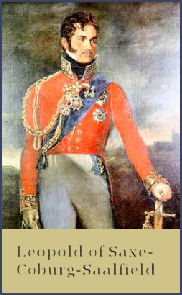
Prince Leopold

Regency’s beloved Princess Charlotte married Prince Leopold, formally Leopold Georg Christian FriedrichPrince of Saxe-Coburg-Saalfeld.  Saalfeld was switched out for Gotha.

You pronounce Georg GEE-org.

And here I was thinking Baroness Schrader was mangling the captain’s Christian name in The Sound of Music. The one with the smoky voice.  Sultry.  Cigarettes in long holders.  Glad to get that cleared up.

Prince William

Hmmm, Saxe-Coburg-Gotha:

Leopold was not fated to give his surname to a new English dynasty.  But later his nephew Albert did.

The Saxe-Coburg and Gotha dynasty of England became known as the Windsors.  It’s all of a piece.  And all in the family.

A year after the events in Notorious Vow, Diana announced her preference to stroll rather than ride with Vivien along Hyde Park’s Rotten Row.  She blamed Garnet’s pregnancy to justify this deviation.  Vivien was glad for the chance to walk with her friend for she had heard the Princess Charlotte had declared a preference for one of her suitors.

“I hear Her Royal Highness has fixed on some minor prince in the Emperor of Russia’s train,” Vivien remarked as they entered the Grosvenor gate of the park.

“I’ve heard that as well.  But Her Royal Highness may be fixed on the Emperor’s pet monkey for all Prinny cares.” Diana shook out the folds of her short pelisse.  It had just been made up by her modiste and featured the latest craze for Spanish buttons.  “The Regent is set on her marrying the Young Frog of Orange.”

“But why should he?” Vivien wondered aloud.  “Is he all that keen on a Dutch alliance now that Napoleon is defeated?”

Diana linked her arm through Vivien’s.  “The dutchman is willing to take Princess Charlotte out of the country.  Prinny has always been quite jealous of her popularity with the people.”

They walked in silence for awhile, broken only by various acquaintances that hailed them from time to time.

“Do you know his name?” Vivien presently asked.  “The German prince?”

“Prince Leopold of Saxon Schloss von something or other.”

“Oh, that cannot be his name.”  Vivien giggled.  “Be serious.”

“Does it matter?  Prinny is not going to let anyone have her that won’t take her away from England.  And Leopold hasn’t a feather to fly with.”

Regency Wedding

These days it seems appropriate to be discussing royal nuptials.  Therefore, who can resist making comparisons?  I, for one, cannot.  

On this day, May 2nd, 1816, one hundred and ninety-five years ago, HRH Princess Charlotte, the Prince Regent’s daughter, married Prince Leopold of Saxe-Coburg.  After revisiting some primary historical sources, I have discovered the rather surprising conclusion that Kate and Wills have much in common with the most popular royal couple from the Regency era.

Of course, we can be reasonably sure of at least two major differences.  I refer to them below using my favorite scenes from Monty Python for purposes of illustration only.

Indulge me.

1)  We know that the heir-presumptive will not have to undergo the rigors of childbirth at the hands of nineteenth century obstetrics.  But if he should want to, please see  I want to be a woman at :22.

2) Kate won’t have to become King of the Belgians.  You see, they’ve already got one!  See the French taunting King Arthur at 1:22.   Well, some Belgians do speak French.

Sorry, sorry!  I just get carried away.

In the coming weeks some curious connections and common paths between the Regency and modern royal wedding will be presented.  Courtship, houses, dresses, manners and other momentous concerns will be examined.  With the help of some characters from my Notorious series.

Will you join me?

Regency sports car

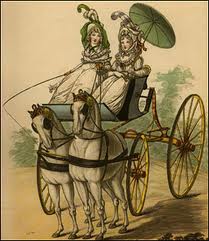
There were all kinds of carriages, suitable for a variety of purposes, during the Regency period.   In Persuasion, Anne Elliott pointed out to Captain Benwick that she believed they were living in a great age for poetry.  I feel the same way about the movies made within the last twenty years on Regency subjects.  Particularly their display of horses and carriages.  Willoughby drives Marianne in a phaeton (Sense and Sensibility, 1995), Sir Walter Elliott enters a town coach as he leaves Kellynch Hall (Persuasion, 1997), and Miss Elizabeth Bennett changes from her cousin’s gig to the public post-chaise, a large conveyance for regional travel (Pride and Prejudice, 1995).  Which she prefers to Lady DeBurgh’s barouche!

In Notorious Vow, Vivien is impressed by the earl of Northam’s customized tilbury, a light, fast, two-wheeled carriage normally designed for one horse, but which he had modified to be pulled by a pair of “sweet-goers” bred at Wimberley.

The image to the right is a phaeton driven by an intrepid female driver.  Read Heyer’s Regency Buck for an even more intrepid heroine who dares to drive her own racing curricle in a wagered race to Brighton that nearly lands her in the basket.  Her guardian, the Earl of Worth, has to employ his own record-setting team to catch her.

“You are not to be the judge of the propriety of my actions!  If it pleases me to drive a curricle to Brighton it is of no business of yours!”

“Do you think I will permit my ward to make herself the talk of the town?  Do you think it suits my pride to have my ward drive down to Brighton wind-blown, dissheveled, a butt for every kind of coarse wit, a object of disgust to every person of taste and refinement?”

Strong words indeed from a man to a woman whose wardship he never sought nor desired.   And small wonder it resulted in an unforgettable tension between two people hopelessly in love.

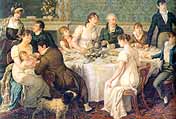
Regency Dining: two courses only?

In Notorious Vow, Vivien finds her mother’s middle-class family has varying reactions to her new friendship with Lady Diana.  Her cousin Susan is brimming with curiosity over what the viscountess wears.  Her uncle in particular, a solid man of business, blames it all on the horse she mysteriously received as a gift.

“Aha.  It all comes back to that horse.  I expect you will keep the animal?”

Vivien smiled.  “Of course, Uncle.”

He rose and held out his arm to escort her into the dining room for dinner.  Meals at Camden Place were complex affairs with multiple courses and every formality observed. If Uncle Camden did not care what how the upper class dined, Vivien knew her aunt certainly did.

“You must find our supper paltry after dining at Northam’s table,” Mrs. Camden said as she entered with her daughter, Miss Susan Camden, a lively girl with a bouncing sort of prettiness.  

“It was only a light repast, Aunt.  Not above two courses and served on a buffet.”

“Two courses only?”

Vivien’s Aunt Camden has the same view of how the upper classes keep their table as Mrs. Scorton in Heyer’s Cotillion.  From a masterful passage on the abundance of the English table:

Mrs. Scorton was a lavish housewife, and prided herself upon the table she kept.  When the soup was removed, the manservant, assisted by a page and two female servants, set a boiled leg of lamb with spinach before his master, a roast sirloin of beef before his mistress, and filled up all the remaining space on the board with dishes of baked fish, white collops, fricassee of chicken, two different vegetables, and several sauce-boats…

Eliza asked (Kitty) how many courses Lady Buckhaven in general sat down to.  When she learned that her ladyship contented herself with a very much lighter diet, she exclaimed at it; and Mrs. Scorton blessed herself to think that she should keep a better table than a baroness.

Where is Wimberley?

The earl’s proximity caused her to feel somewhat heated, and she moved away to look at an open-faced curio cabinet filled with

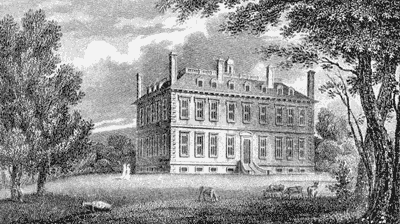
Coleshill House

objects. They included a series of miniature watercolors depicting two houses, one an English baroque with a pretty dome. She touched its frame, admiring the lovely home depicted, with its bold white casement windows and elegant chimneys. Its parkland was a wealth of varied landscaping, with huge oaks surrounding the whole.

“Wimberley,” Lord Northam said, following her. “It has been mine since before Northam came to me.”

Wimberley was the name of Russell’s marquisate in Notorious Vow.  He became marquess on the death of his maternal grandfather, long before the tragic death of his brother, which brought him the earldom of Northam.  

Originally bestowed on Lady Nellie’s family by Queen Anne, the principal jewel in the marquisate’s crown was its seat in Berkshire, which greatly resembled the now lost Coleshill House (pictured above).  Older than Northam Park by several decades, Wimberley was one of the first English country houses to feature a dome designed by Christopher Wren.  Like Coleshill, its main staircase was Italian in design, with impressive plasterwork throughout that emphasized Wimberley’s agricultural wealth.

Coleshill has a tragic history, however.  It had just been transferred to the National Trust when repairwork being carried out ignited the interior, leaving only a burned-out shell topped by its massive chimneys.  Its loss has been called “grievous beyond words.” (Country Life, 1952)  It contained a masterful display of decoration first introduced by Inigo Jones to the Stuart Court, and has never been replicated elsewhere.