The Real Regency Rake: Rich or Poor

They generally start out rich and then, generally, become poor.

By the time widow Lady Mornington met Lord Edmond Waite, a rake well-known for womanizing and drink, he had not quite run through his fortune.  At first, things didn’t seem very promising:

“You make me sick” she said. “Physically sick. Nauseated.”

Mary Balogh’s The Notorious Rake has finally been re-released (in conjunction with The Counterfeit Bride) as of April 30th.

Alas, the real Regency rake, John Mytton, did not “suffer” Lord Waite’s happy fate.

He succeeded to his father’s estate at Halston, entailed like the other he inherited, Habberly. What was not entailed included three other properties in Shropshire along with a fine shooting estate in northern Wales. The income generated from these ranged from ten to sixty thousand pounds a year.

It was never enough.

He had an agent, Longueville, out of Oswestry. The man despaired of his master’s spendthrift ways and begged Mytton’s friend, Nimrod, to urge him to practice some economy:

‘I have reason to believe you can say as much to Mytton as any man can; will you have the goodness to tell him you heard me say, that if he will be content to live on six thousand pounds per annum, for the next six years, he need not sell the fine old (Wales) estate..’

Nimrod relates how this news was received. Mytton was in his carriage at the time, lolling with that indolence peculiar to many a rake, and told his friend that Longueville may keep his counsel to himself.

To generate more revenue, he was eventually obliged to part with those properties that were unentailed, including the one in Shrewsbury. A relative begged him not to sell it, that it had been in the family for five centuries.

“The devil it has!” came the reply. “Then it is high time it should go out of it.”

Money had to be spent on dogs, horses and even the heronry at Halston. But by and large, a good part of it was just simply lost.
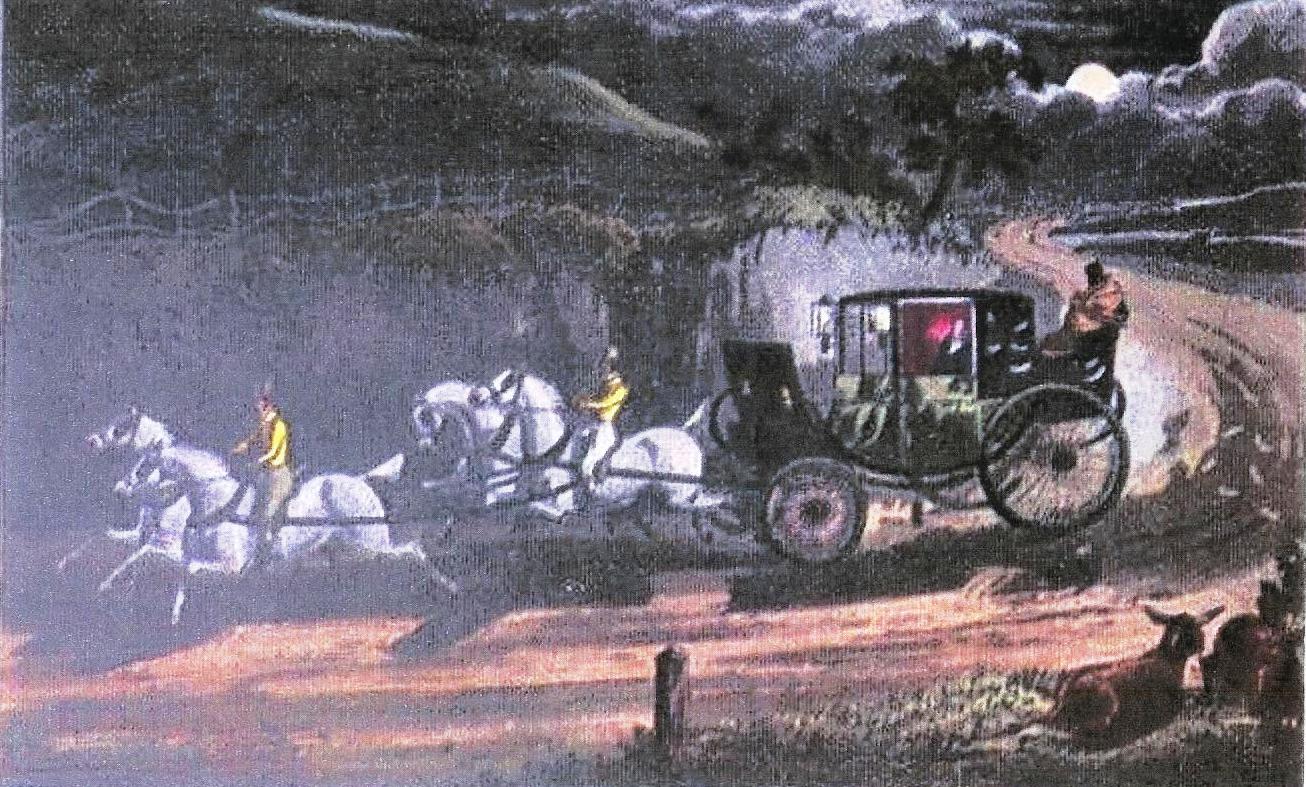
Light come, light go

Light come, light go

Mytton had a habit of carrying large sums of cash about him. It was not unknown for visitors to Halston to find rolled up bank bills that he had dropped in the fields. Even more remarkable was the manner in which he secured his cash on the road. On one occasion, after breaking the banks of two well-known gambling houses in London (a rake is also a damn fine gamester), he stuffed the rolls of bank bills into a travelling writing desk that sat on his carriage seat. He was off to the Doncaster races and liked to keep the windows down so that wind may blow through the conveyance. Mytton told Nimrod he was counting the bills on the seat when a gale came up, blowing the lot out of the carriage.

And so, by this means and others, he lost over a half million pounds sterling in less than fifteen years.

Light come, light go.

The Regency Rake: Endurance

Endurance is a particular quality generally associated with rakes. If this brings to mind a certain activity, you may also be aware that one doesn’t have to read above one Regency romance a year to understand the significance of this attribute. However, in polite circles, a rake’s endurance is assessed by his performance in the, er, field.

Hunting field, that is.

Fox covert in Scotland - The copyright on this image is owned by Richard Webb and is licensed for reuse under the Creative Commons Attribution-ShareAlike 2.0 license

Fox covert in Scotland – The copyright on this image is owned by Richard Webb and is licensed for reuse under the Creative Commons Attribution-ShareAlike 2.0 license

In those days, various groups hunted all throughout England–many more than at present, I daresay. Hunts were organized around the leadership of a well-known figure in the district, or locality–usually a member of the gentry or aristocracy. The range of a hunt might cover hundreds (or more) acres and the terrain could be decidedly rugged. A gentleman’s consequence could be made or broken, given his performance in the field.

“Your father tells me, Miss Marlowe, that you are a notable horsewoman.”

“Does he?” she responded. “Well, he told us you showed him the way with the Heythrop.”

He glanced down quickly at her, but decided, after an instant, that this remark sprang from inanity. “I imagine that I need not tell you that I did no such thing!”

“Oh, no! I am very sure you did not.”

To show anyone the way with a celebrated hunt like the Heythrop (side note: this is the current Prime Minister’s hunt) was high praise indeed. Miss Marlowe in Sylvester, or, The Wicked Uncle, piqued the Duke of Salford when she averred over his ability of riding to hounds.

Heyer at her most clever.

Even as intrepid a heroine as Miss Marlowe would agree there was no more bruising rider than John Mytton. It was said his abilities were known in every county–particularly his endurance. Hunting was the sport that taxed a rider for jumping various obstacles and “often in weather not fit for man nor beast.” In addition to hunting with his own pack, he would hunt with other packs throughout Shropshire.

“During the period of Sir Bellingham Graham hunting Shropshire, (Mytton) performed several gallant feats in the field. Whilst suffering severely from the effects of a fall, and with his right arm in a sling, he rode his favourite hunter, Baronet, over the park paling of the late Lord Berwick..to the astonishment of the whole field–Sir Bellingham himself exclaiming, “Well done, Neck or Nothing; you are not a bad one to breed from.” — Life of Mytton, Nimrod

And now we come full circle.

Lord Derby's Meet

The Real Regency Rake: Shooting

A gentleman knows how to shoot.

A rake is a damn fine shot.

According to one eyewitness account, John Mytton was known to take a cork (“not above an inch and a half in diameter”) used in pike fishing and afix a white piece of paper to it. This he placed on top of  a kennel he kept for tame foxes and their cubs. From fifty-five yards or more, he would shoot the cork for the amusement of his guests:

“..this he would do over and over to the amazement of all who witnessed it, and with his rifle to his shoulder, and not on a rest, as might be imagined by some. Talk of Americans, for their precision in shooting, after this! It cannot be surpassed, if equalled.” — Memoirs, Nimrod

Mytton stalking and shooting wild duck on a frozen lake

Mytton stalking and shooting wild duck on a frozen lake

To be compared to the Americans was something rather distinctive, indeed.

To such feats may be added the spectacular exhibit of Mytton shooting rats from atop the roof at Halston.

Halston, his country estate, afforded every kind of game to suit a hunter’s fancy. Twelve hundred brace of pheasants could be harvested there in a year. A brace equals a male and a female.

Multiply Halston’s yield in a year and that would be 2400 birds!

The Real Regency Rake: A Good Husband?

“It was not in the power of woman, no–nor in the power of himself–to have made John Mytton a good husband; indeed, he ought not to have entered into the marriage state at all.” — Memoirs of the Life of the Late John Mytton, by Nimrod

The real Regency rake poses a problem not only to himself but to the woman who thinks to conquer him.

Regency scholars were amazed at the reports brought back to them of Egyptian antiquities, particularly fascinated with the way women were depicted in mythology. Hathor, queen of heaven and perhaps a bastardization of the imported cult of Aphrodite/Diana, was discovered on many a priestess tombstone standing upon a lion. Gentlemen who studied the classics surmised that this motif was love was conquering the beast.

Love conquering the beast

Love conquering the beast

Whether such a miracle can be wrought (on a permanent basis) has yet to be proved.

John Mytton had been married before–to Harriet Emma–but she died in 1820 after two years of marriage.

Nimrod (Charles James Apperly) remembers counselling the mother of Mytton’s second wife. Her daughter Caroline was the issue of the late Earl Courtney of Powderham Castle in Devon. When her daughter was seventeen years of age, she approached Mytton’s close friend for advice and received this ambivalent response:

“In my opinion, Lady Charlotte, Mr. Mytton has no business with a wife at all; but should he marry your daughter, Caroline, there is a greater prospect of his making a good husband to her, than to any other woman in the world.”

Isn’t that always the case? You alone have the best chance, but beware–the man has no business with a wife at all.

Caroline bore Mytton five children after marrying him in 1821. She saw him throw their babies up in the air and pelt them with oranges. That was more than enough. She ran away from him in 1830.

"Darling, must you get your knickers wet?"

“Darling, must you get your knickers wet?”

Regency Easter

Eastertide during the Regency was a holiday facilitated by the adjournment of Parliament, new bonnets and rolling eggs downhill to symbolize the removal of the stone from the tomb.

Easter at Kenilworth Castle ruins

Easter at Kenilworth Castle ruins

Here are a few Regency Easter anecdotes:The Gentleman’s Magazine and Historikal Chronicle reports that in 1814 a man in a northern county was found in arrears–he had refused to pay his Easter tithe to the parish. The Committee appointed to protect the Civil Rights of Protestant Dissenters dismissed the case brought by the curate. This dismissal provoked widespread outrage, some even going so far as to say the committee has thrown down “an apple of discord between a clergyman and his parishioners.”

In 1818 there seemed to be, at least among some readers of the Gentleman’s Magazine, not a little confusion concerning the dating of Easter Sunday. “Almanacks,” that is, publications containing calendars and other important forecasting of dates, had Easter Sunday occurring on March 22nd. However, this date was apparently put into some dispute by the English Book of Common Prayer, which contained a Table that seemed to place the day as March 29th, if one followed the appearance of the full moon.The dating of Easter Sunday in England, as in other countries in Europe, mandated Easter fall on the Sunday after the first full moon following the March equinox of March 21st. This results in a difference between astronomical and ecclesiastical (that is, Paschal) full moons.A reader was so vexed by this difference that he was moved to comment to the editor of Gentleman’s Magazine:

“This discrepancy is awkward and strange–and ought not to be permitted. I have more than once conversed with able Astronomers on the subject, but the anomaly is not for the Almanack-makers, but for the Legislators to correct, and I wish they could be persuaded to undertake it.”

In 1824, the great Regency poet George Gordon, Lord Byron, died on April 19th. The English were shocked and appalled by the manner of his death. The Greeks cancelled Easter.

The Real Regency Rake: Mad with Drink

“Rochester was drunk for five years continually. Mytton beat him by seven.”

—-Memoirs of the life of the late John Mytton, Nimrod

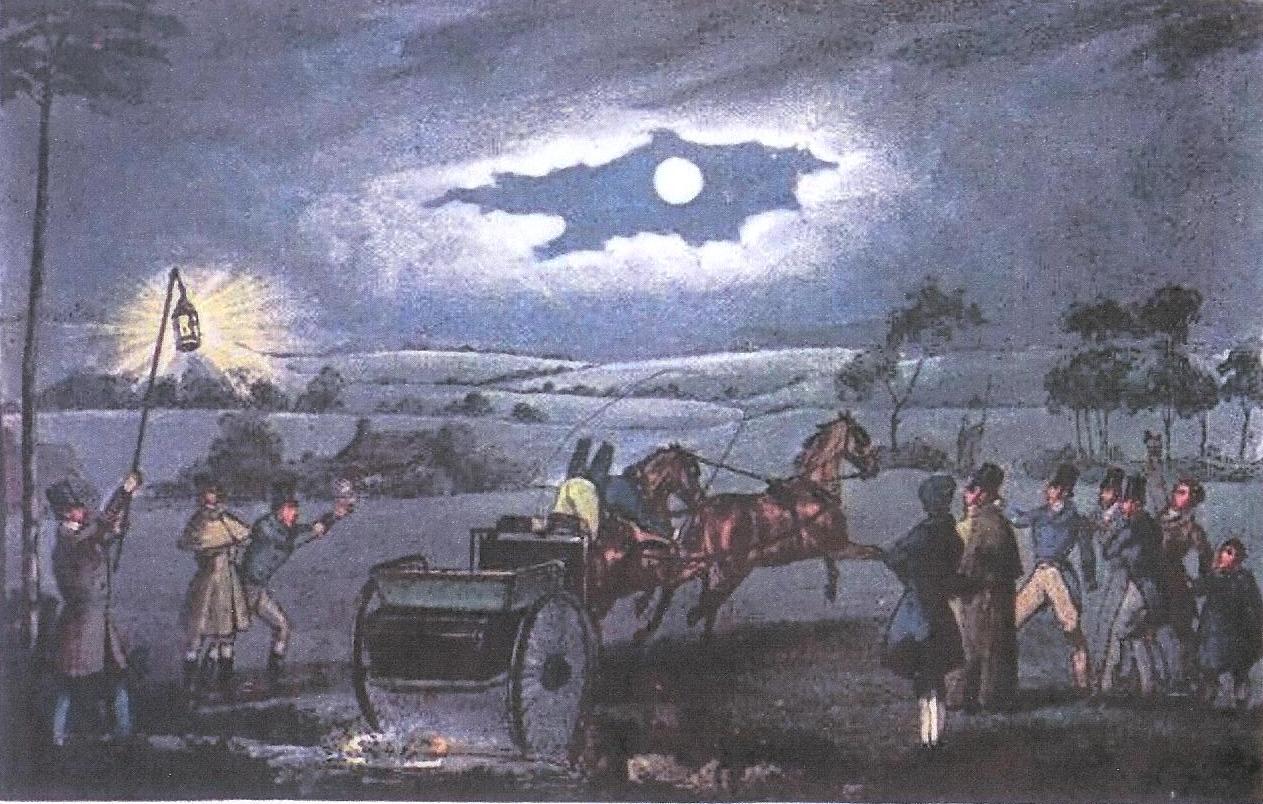
Mytton tossed onto the back of his wheeler horse while driving tandem drunk, and over a sunken fence.

Mytton tossed onto the back of his wheeler horse while driving tandem drunk, and over a sunken fence. Those wretched coattails just fly off one’s buttocks, don’t they?

How the devil does one stay inebriated continuously? John Mytton’s biographer Nimrod makes the stunning observation that there were few drunken parties at Halston, the rake’s country house. Indeed, he does not recall attending a single one even though Mytton’s best friends confirmed he was drunk almost all the time. There were two reasons for this:  Mytton was already drunk by the time his guests arrived and once they did, he wouldn’t sit still long enough for anyone to have a drink. He would jump out of a window or race off to the billiard table.

Mytton favored port wine and drank it all day as follows:

“He shaved with a bottle of it on his toilet; he worked steadily at it throughout the day, by a glass or two of it at a time, and at least a bottle of it with his luncheon; and the after dinner and after supper work — not losing site of it in the billiard room — completed the Herculean task.”

Nimrod goes on to speculate that it was the quality of the port wine Mytton drank, having aged about eight years, that took many years before it began to work against his constitution. William Pitt the Younger was known to be a “three-bottle man” for his consumption of port wine and it caught up to him in 1806 at the age of forty-seven, when he died looking more like he was seventy-seven. Nimrod believes it was the brandy Mytton eventually switched to that got the best of him in the end, citing the autopsy results (called an inquest upon the body at the time) that were widely published, perhaps as a cautionary tale.

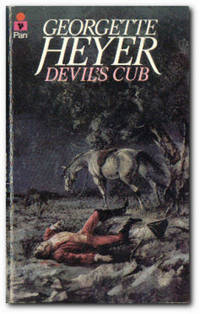
I just love these old Pan covers--a store on High Street in Egham, Surrey had loads of them

I just love these old Pan covers–a store on High Street in Egham, Surrey had loads of them

Not attractive, even if he is a rake.But in the hands of a masterful artist like Georgette Heyer, our drunk has become something not only seductive, but dangerous.

The Marquis was drinking steadily. So were several others, notably Mr. Quarles, whose scowl deepened with each glass. On the Marquis, the wine seemed to have little or no effect. His hand was steady enough, and there was only that glitter in his eyes to betray to one who knew him how much he had drunk.

Devil’s Cub (1932)

The Real Regency Rake – Introduction

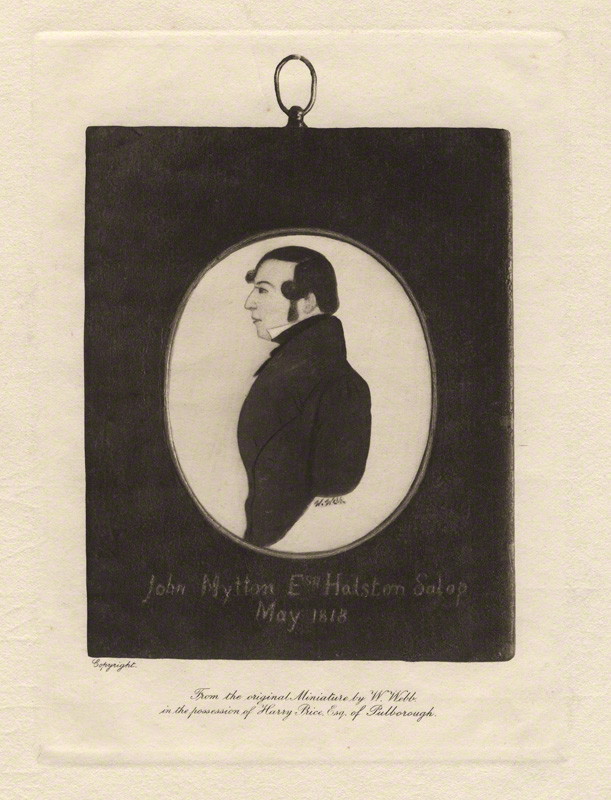
Mad Jack Mytton, 1818

Mad Jack Mytton, 1818

“Mad Jack” John Mytton (1796 – 1834) was the real Regency rake.

The biographies of this Shropshire squire are both numerous and admirable. This series will try to capture his more memorable exploits. They are largely taken from the recollections of his closest friend Nimrod, also known as Charles James Apperly.

Nimrod gives the best characterization of Mytton, proclaiming him a rake approaching that example so richly set by another a century and a half earlier–John Wilmot, 2nd Earl of Rochester (1647 – 1680), a man called the best English satirist and whose poetry was so distinguished it was censored during the Victorian period.

Nimrod compares them both, finally noting that in the end, repentance (or lack of it) separated the two:

“Rochester made himself mad with drink–ditto John Mytton

Was not the best of husbands–ditto John Mytton

Trusted to a death-bed repentance–ditto John Mytton

Promised to amend his life if he recovers from a severe illness…but John Mytton never did promise what he did not think he could perform.”

Memoirs of The Life of The Late John Mytton, Esq. (1835).

Mytton, like all rakes, alternately fascinates and repels. However, his character offers a cautionary tale to those who would pursue such exploits both in the real world and in fiction:

“There is but one excuse for a man being perpetually intoxicated and prostituting the reason of the man to the appetite of the brute; and that is, to attempt to divert grief which he has found impossible to subdue.” — Memoirs

Mytton fighting in a gambling hell

Mytton fighting in a gambling hell

Bibliomaniacs – Librarians to the Regency

“What wild desires, what restless torments seize

The hapless man, who feels the book disease..”

— The Bibliomania – An Epistle to Richard Heber by John Ferriar (1809)

He's almost as popular over formal room mantles as Gainsborough's Blue Boy

He’s almost as popular over formal room mantles as Gainsborough’s Blue Boy

As the portrait indicates, Richard Heber (1773 – 1833) was a handsome boy. He was also nearsighted, and perhaps for this reason conceived a passion for collecting books. He was later termed as having “bibliomania” and no wonder. His collection of books  filled several houses in England and abroad.

Richard’s father, to whom he owed a vast inheritance, decried his book-collecting, stating the indulgence should be nipped in the bud before it ruined him, having “no use nor end.” Little heed was paid to this advice. When Richard came into his inheritance in 1804, he embarked on a buying spree, travelling abroad after “ransacking” England in pursuit of entire collections and the most rare, original editions of selected works.

He not only loved book-collecting, he loved the friendships his passion brought him. He was very happy to lend his books and could be relied upon to provide the original edition if a copy was found to contain errors (as subsequent editions frequently did). His scholarship aided such luminaries as Sir Walter Scott, who dedicated the sixth canto of Marmion to him, and William Wordsworth. Richard’s influence among academia brought professorships and fellowships to those who sought his help.

After an abortive first try, he was finally elected to the House of Commons as a member of the Tory party. However, his propensity for being a friend made him less desirable as a representative, as far as his constituents were concerned. The fellow was just too conciliatory:

“..the assets of his ‘popular manners, his great library, his genuine Toryism and his assiduous canvass of near 15 years’ were offset by the ‘great cry’ raised against him by ‘the high churchmen’, who were said to ‘accuse him of travelling in stage coaches, of living at a brewery, of associating with the opposition, and of being favourably disposed towards the Catholics.’ — Althorp Letters, 115; Add. 51659, Whishaw to Lady Holland, 16 July 1821.

For all he did for his friends, they were conspicuously absent in his later years. In the end, he died alone, having never married.

Then, years later, an obituary appeared–that of Frances Mary Richardson Currer (1785 – 1861). She was the posthumous daughter of a Yorkshire clergyman and heiress to both her father and mother’s

Miss Currer's bookplate

Miss Currer’s bookplate

fortunes.  Her home at Eshton Hall held her collection of books which was estimated between 15,000 and 20,000 volumes. She was deaf, and therefore not active socially. However, this last mention of her included another:

“Miss Currer was an intimate friend of the great bibliomaniac Richard Heber, who filled many houses with his books. It was even rumoured that they might become united by a tie more permanent than that of kindred pursuits in literature. This however, is now a tale of times gone by.” — Gentleman’s Magazine, 1861

Francis Chantrey – Sculptor to the Regency

In 1813, a newly made widow was journeying to Bath, accompanied by her young daughter. Ellen-Jane, for she was named after her mother, was perhaps unused to travelling. It may have even been the unfamiliar surroundings. One night, as she was preparing for bed, the little girl’s nightdress suddenly caught fire. She soon died of the burns she received. Distraught, the widow returned home to seek comfort in the company of her last remaining daughter, Marianne. Alas, a wretched illness overtook the child while they were in London. The widow had lost her entire family in the space of a few years.

Chantrey's Sleeping Children - photo licensed under the Creative Commons Attribution-Share Alike 3.0 Unported license)

Chantrey’s Sleeping Children – photo licensed under the Creative Commons Attribution-Share Alike 3.0 Unported license)

Look at those sleeping children; softly tread, Lest thou do mar their dream, and come not nigh
Till their fond mother, with a kiss, shall cry,  ‘Tis morn, awake! awake! Ah! they are dead!

William Lisle Bowles, chaplain to the Prince Regent

Untimely death was so very common in those days. However, this widow was determined her children would not be forgotten. She commissioned their likeness so their memory may live on. In death, their sculpture took the  ton by storm. By the time the Sleeping Children had been moved to the cathedral in Lichfield, the creator had become the new sculptor to the Regency:  Sir Francis Chantrey (1781 – 1841)

“Chantrey was designed by his father for the law; accident made him a carver in wood, poverty a painter, and his own genius a sculptor.” — The Eclectic Museum of Foreign Literature, Science and Art (vol. II, 1843)

His genius was clearly apparent in the tender simplicity expressed in his work. It is almost as if Chantrey was driven to create an unforgettable impression. Perhaps he had been moved by the widow’s fear her little girls would be forgotten, having been on this earth for such a short time. Indeed, it seems Chantrey was driven all his life to set portraits in stone before death destroyed the sitter’s flesh–and time his memory.

Chantrey’s sculptures of the Georgian era’s greatest figures still remain, even if their legacies are less certain: George III and his son, the Prince Regent. William Pitt the Younger and George Canning. They are also so numerous one can scarcely travel through England without encountering a roundabout circling “a Chantrey.”

The sculptor had a reputation for being blunt, which was somewhat surprising in a man who carved with such delicacy. That candor is perhaps a clue into his genius–a sign that Chantrey himself was suffering from an inordinate fear of being forgotten. It seems he felt that the ones who should remember him won’t. That the ones who he hoped loved him best will forsake his memory all too soon.

The acts of women in this regard seemed to have vexed him most particularly.

Grave of Marie Louise of Austria - Kaisergruft, Vienna

Grave of Marie Louise of Austria – Kaisergruft, Vienna

On several occasions he expressed extreme displeasure when any widow cast off her black weeds. His own mother had remarried after his father died, an act which he never forgave her for. Throughout the rest of her life he called her by her first married name–Mrs. Chantrey–and made certain all his letters to her were addressed in the same way. After he had become famous, his opinion on Napoleon’s widow remarrying made the rounds in Mayfair. His ideal was the famous Duchess of Marlborough, who swore never to remarry. Although her own architect (in a fit of temper) wished a Scottish ensign to have her, Sir Chantrey quite approved of the example she set.

When his own death approached, the sculptor took no chances. He drew up a will cutting off Lady Chantrey’s income if she should remarry. He had less success with the plans for his elaborate tomb. A close friend thought he was mad, not understanding how one should desire to be sealed up “like a toad in a stone for some future geologist to discover.”

But no marble tomb or bust encrusted with pigeon droppings can compare to the legacy Chantrey’s will created. Dutiful to the last, his widow left behind his fortune for the benefit of others. This bequest created and maintained England’s marvelous Tate Museum, an effort which continues to this day.

Thanks for the memories.

Regency Brothers — the Arsonist

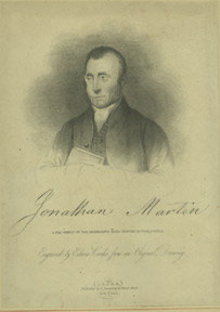
The last of these Regency brothers, Jonathan Martin became the best known for the worst of reasons–he was the Incendiary of York Minster.

But before that, he was the scourge of the Regency’s churches:

“No Covenanter, no Cameronian, ever pursued Episcopacy with a bitterer hatred or more impassioned denunciations than he. All the anathemas that Luther directed against the Church of Rome, Jonathan inflicted on the Church of England.” — All the Year Round by Charles Dickens (vols. 15-16, 1866) Jonathan Martin

In 1804, after a period of being apprenticed to a tanner, Jonathan Martin decided to see the metropolis of London. He was a twenty-two year old raw lad from Yorkshire and easy prey. Having confided to a stranger he should like to see more of the world, he was swept up in the clutches of a press-gang and made to serve aboard the Hercules in the Copenhagen campaign under Lord Nelson. After a successful engagement against the French, Martin’s ship set off for Lisbon. During this voyage, Martin related a number of fanciful dreams and excursions he had taken, even seeing the buildings Joseph used to store grain against Egypt’s future famine. This vision was evidence of his future calling–to warn and prophecy against coming doom.

Martin’s shipmates remember him always preaching and exhorting them. He didn’t pray much, apparently, preferring to argue with others on religious subjects instead. He always enjoyed talking about the stars observed on board ship, but would quake at the thought of anyone pointing at a celestial body. It is said in Yorkshire that to point to a star would mean certain death, as it is a grave sin.

His shipmates had mixed emotions about him. Some thought his behavior was very odd, dangerous even. Once he fell from the top mast of the ship, catching the hair of a shipmate on the way down and tearing off part of the poor devil’s scalp. Another time he complained his book had been shot from his hand during battle. He took it as a warning from heaven. His shipmates took it to mean “he ought to have been otherwise employed rather than in reading at such a time; a reply to which he abused the person who rebuked him.”

He was also remembered for being absolutely fearless, once dousing a fire set off by a gunner’s yeoman below decks when everyone else was making for the lifeboats. He would calmly sing psalms in the mortar boat, an auxiliary vessel for firing additional munitions, oblivious to the hazards attendant to navigating the open sea in a leaky container filled with a large amount of explosives. The sharks that followed the ship (for many had died and their bodies were discharged overboard) were of little concern to him. He would oblige the crew and catch one or two for eating, hooking them with burnt bricks disguised in the funereal shrouds the fish had learned to recognize as a covering for their next meal.

It was a deception which he eventually abandoned, convinced that God could not be happy with such guile that fooled his creatures.

Martin left the navy and returned to Yorkshire, taking up farming and marriage. After attending a Methodist service, he became entranced with the notion that his hitherto random existence was for a specific purpose and completely justified by his faith in God alone. To his wife’s dismay, he broke off farming for preaching and was soon berating what he considered Regency England’s greatest evil–the Established Church and in particular the laxity of its clergy which always “pursued parties, balls and plays.”

When no one was in a church, he would break in and hide himself in the pulpit until the service began, at which time he would leap up and begin to preach, with “violent gesticulations.”

Then reports came that the Bishop of Oxford was to come to Yorkshire and hold a confirmation for the Bishop of Durham.

York Cathedral (photo licensed under the Creative Commons Attribution-Share Alike 3.0 Unported license)

York Cathedral (photo licensed under the Creative Commons Attribution-Share Alike 3.0 Unported license)

“I was glad to hear so good a report of him, and concluded that if he really were so good a man and so eminent a Christian, he would not fear death, and (I) resolved to try his faith by pretending to shoot him(!)” — from Jonathan Martin’s memoir which appears in The Incendiary of York Minster

Already convinced those dreadful Methodists had unhinged her husband, Mrs. Martin had threatened to leave him if he did not leave them. All seemed well when they threw Martin out, until Mrs. Martin observed her husband had obtained an old pistol from his soldier brother in Newcastle. She asked him what he was going to do with it and he, in his usual forthright fashion, told her his intentions. Quietly she removed the pistol when he wasn’t looking.

Martin was taken in for questioning when word got around about his intentions. Eventually this led to his commitment to an insane asylum and onto greater notoriety.

His wife died in the meantime, leaving a son who later committed suicide over his father’s misfortunes.

There are those who caution against thwarting God’s will. Don’t forget about the will of one’s wife.

Amen.