Regency Trolls

In the August 1818 volume of La Belle Assemblee, the Listener, who never revealed his true identity, nevertheless admits:

“I have ever regarded the anonymous letter-writer in the same light as I do an assassin who stabs in the dark.”

Nevertheless, he addresses himself almost always to anonymous writers.

English walking dress featured in La Belle Assemblee, October 1818: "Garter purple poplin pelisse, ornamented with black velvet. Mary Scot bonnet and Waterloo half boots.

English walking dress featured in La Belle Assemblee, October 1818: “Garter purple poplin pelisse, ornamented with black velvet. Mary Scot bonnet and Waterloo half boots.

These supplicants, he explains, are very different. They cringe from identifying themselves because of the trouble they find themselves in. They:

“..are a far more different temperament from those miserable beings to whom I allude. They write to me for advice, they lash, in a good-humoured way…”

What of  those  critics who adopted obvious pseudonyms in Regency-era literary reviews? The Leopard and the Scorpion, for instance, who’ve been subjects of this blog in the past?

They were assassins, too, but they stabbed in broad daylight.

No, it is the anonymous writer who deliberately seeks out publicity with the sole  intent to wound that the Listener despises. This malcontent “vents his spleen” and “pours forth her venom” in order to make mischief and sow discord.

“Anonymous” in this regard criticizes an artist’s character (rather than his work) , wrecks marriages, breaks up romantic engagements and sets children against their parents.

The signature of this troll, whether it be Incognito or Ivan the Terrible, is a “dirty mantle.”

“Beware my sting, I inflict it unseen; for Cowardice and Malignancy are my parents; and Envy my instructress and nurse!”


The Regency Hostess

“Tell me your company, and I will tell you who you are.” — old proverb

Many times this blog has addressed that fascinating character of Regency society–the hostess. She may be one of the ‘best women in the world,’ or from hell. She might be cold as her unheated country house in winter, an accommodating peeress in her own right, an Irish nobody, or a royal eccentric.

The Regency confessor heard from one Hypolotis, who wrote of his experience with a particular hostess who turned out to be quite cunning.

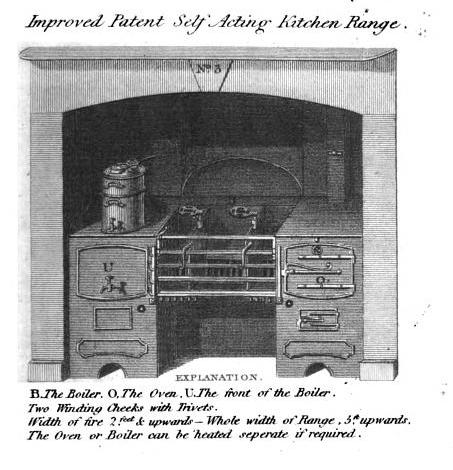
New Self-Acting Kitchen Range -- La Belle Assemblee, August, 1818 "To every family, more especially for Large Establishments, a constant supply of pure hot Water and Steam, must be a valuable acquisition"

La Belle Assemblee, July, 1818 “To every family, more especially for Large Establishments, a constant supply of pure hot Water and Steam, must be a valuable acquisition” — no Regency hostess would be without one!


The correspondent’s story begins after a brief accounting of his travels, in which he asserts his congeniality:

“My character is naturally frank and open, and this procures me the friendship of all classes.”

— “Acquaintances,” by the Listener in La Belle Assemblee, July, 1816

In Green Park, he gains admirers among the children when he bestows upon them “balls, tops or cakes.” At the theatre, he is complimented by gentlemen on the “fineness of his linen and the elegant cut of his clothes, and in particular, the lustre of the brilliant on his finger.”

Acquaintances among the latter he tended to form rather easily, he relates, and on one occasion a “man of fashion” hailed him outside of St. James’ Coffee-house. Upon being asked of his plans for the evening, Hypolotis disclosed he’s been invited to an exclusive faro party in Hanover Square. With surprising presumption, the newcomer begged to be included.

Of course, one’s companion might be welcome to a party, but  Hypolotis scarcely knew this fellow. If it were up to him, he’d not deny the request, but he must think of his hostess, for Society jealously guarded the boundaries of her circle. Suitable birth and fortune were just as important in Hanover Square as they were in St. James’.

“What signifies that?” his odious, pushing companion retorted. “Surely one man of fashion may introduce another.”

In the end, congeniality won over good sense and both presented themselves at the faro-party that evening. Their hostess, whose name the correspondent sensibly abbreviates to Mrs. R., admitted both very graciously so that the two men proceeded to play faro and “gallantly” lose to “fair adversaries”–mingling as “two charming young men of fashion and of the most elegant manners.”

However, once separated from his companion, Hypolotis was confronted by Mrs. R’s whisper, desiring that he repeat the name of his particular friend.

“His name?” He is, I assure you, a man of fashion and fortune, and of very good family.”

“But what is his name?”

“(Er) Edmonds.”

Alerted to Hypolotis’ awkward response, she set about unveiling the true identity of the interloper in her ballroom. Moments later, her footman announced that a message was awaiting “Mr. Edmonds” and would he please step into the foyer?

No one came.

Mrs. R. bided her time until her company gathered to leave, when she quietly reprimanded Hypolotis for playing such a trick on her. His friend was no more Mr. Edmonds than she was. Showing even more cunning and discretion, she advised him to find out who his friend really is. If he’s “of family,” she would be happy to host them both again.

Hypolotis did as she requested. To his relief, his rude and inconsiderate acquaintance actually ranked very high in polite society. However,

“… had he been deficient in the former qualifications I could never have shown my face again amongst those who I am continually accustomed to meet in the elegant circles of my honourable female friend.”

 

The Regency Traveller

Another cautionary tale shared by the Listener at La Belle Assemblee, lamenting the fashion during the Regency of travelling abroad:

“Engaged in a continual tumult, he calls that living which is only wandering through the wilderness of existence.”

— La Belle Assemblee, February, 1818

From the October 1818 edition, La Belle Assemblee, we have the Parisian promenade dress made of cambric muslin and trimmed in muslin medallion puffs which are separated by rich embroidery, topped by a bonnet of white crape trimmed with blond and purple poppies on the side

From the October 1818 edition, La Belle Assemblee, we have the Parisian promenade dress made of cambric muslin and trimmed in muslin medallion puffs which are separated by rich embroidery, topped by a bonnet of white crape trimmed with blond and purple poppies on the side

The writer, simply named Alfred, relates that travel used to be extremely arduous, even dangerous, and undertaken only in matters of urgent business, like claiming an inheritance or filing a lawsuit.

The traveller would be male, well-matured and careful to put his affairs in order before setting out, even if it meant updating his will.

His departure was attended with tears and ardent prayers for his safe return.

Nowadays, he writes, travelling is undertaken not so much to accomplish anything, but for pleasure alone:

Irishmen come to England and Englishmen go to Ireland. The natives of Somersetshire come to London, and the Londoners flock to Bath.

It has become common for families to be divided by great distance, and, more sadly, by time, spanning as much as thirty years. The traveller nevertheless is content, and eventually forgets “his dearest friends and brethren.”

Still, he cannot escape the dissatisfaction of a prodigal son, finding few he can call truly friend and surrounded by “men who seek to deceive us, and women who beguile us.”

Truly unfortunate is the one who realizes, when he finally returns home, that Death has taken the place of the one–

“..whom he had ardently desired to have embraced once more, or to have had the pious gratification of catching their last sigh, and closing those eyes that were shut forever from the light of day!


On Regency Wealth

Not limited to the role of confessor, the Listener (whose real name, it should be repeated, is Timothy Hearwell) heard cautionary tales of advice to Regency-era readers.

The following letter he received from “Prosper” on the “vexations attendant on wealth:”

From the October 1818 issue of the Magazine--a round dress of fine cambric with muslin flounces richly embroidered in Clarence blue.  A Clarence bonnet trimmed with larkspur flowers and a Clarence spencer besides, with lapels of white satin.

From the October 1818 issue of the Magazine–a round half-dress of fine cambric with muslin flounces richly embroidered in Clarence blue. A Clarence bonnet trimmed with larkspur flowers and a Clarence spencer besides, with lapels of white satin.

“..after having ardently desired riches and honour, I am almost tempted to curse the chance that led to them.”

— La Belle Assemblee, January, 1818

What follows is a detailed explanation on the bother and mind-numbing exhaustion that comes from being wealthy in the Regency, particularly when one is not accustomed it.

For instance, one rolls about town in an elegant carriage, foregoing the exercise of walking that had been of such benefit to the constitution. At home, the valet (or one’s “gentleman” as the out-and-outers say ) will hardly allow a man to take off his own shirt. In his study, the secretary commandeers his signature and the steward his accounts.

There’s nothing to do, Prosper complains, but loll on the couch “in the fashionable half-daylight that illumines my apartment, injures my sight and makes me gloomy.”

And yet having cast him into sloth, wealth keeps busy, attracting the noble and the notable. They come for a visit, to gape at his “opulence,” and still others come for a four-course dinner at his board, dishing out “fulsome flattery” on the food served, the plate and even the candles themselves.

Efforts to find some enlivening companionship away from home are met with disappointment. Having been assured that all one needs is “good company,” Prosper fixes his attention upon a lady who has been recommended to him because she dresses well and “has written a stupid romance.”

Once they are at the Opera, he comes to regret their association,

“According to her ideas I should be like a fellow just come from the country if I listen to the performance..if I elevate my eye-glass to look at the actresses, I have vile taste.”

Prosper sighs, longing for the comfort of a few key friends and the two-shilling gallery at the Cock-Pit or Covent Garden.


Regency Confessor: Rusticus Returns (part two)

The report on Rusticus’ return to Regency Society continued upon his arrival at the second party to which he’d been invited. This was a celebration of a young matron’s birthday, and invitees were obliged to offer natal congratulations in the form of a literary device.

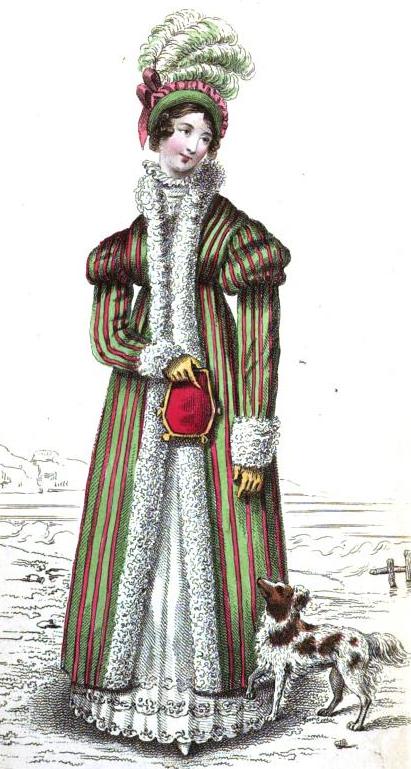
The English Winter Carriage Costume, from the Magazine's March 1818 edition: "round dress of fine cambric muslin, superbly embroidered round the border in three distinct rows. Pelisse of rich Tobine silk striped, of Christmas holly-berry colour, and bright grass green, trimmed round collar, cuffs and down the front with very broad swansdown."

The English Winter Carriage Costume, from the Magazine’s March 1818 edition: “round dress of fine cambric muslin, superbly embroidered round the border in three distinct rows. Pelisse of rich Tobine silk striped, of Christmas holly-berry colour, and bright grass green, trimmed round collar, cuffs and down the front with very broad swansdown.”

One of those in attendance was a celebrated poet, but ostensibly complaining of the head-ache, his offering only served to confirm (in the opinion of our hero) that the poor man might indeed be suffering from “a disorder in his brain.”

Emboldened by his fellow party-goer’s failing, Rusticus eagerly offered his own ditty, which was based upon a polonaise taken from the comic opera The Cabinet, popular at the time. Despite careful preparation of the selection:

“There were three verses; and I declare I knew not of one indecorous word or meaning they contained; but such is the delicacy of modern ears, and the quickness of modern conceptions, that at the first verse the ladies blushed up to their eyes, at the second the mammas began to shrug their shoulders and find their seats uneasy, and at the third there was not a papa but what turned his back upon me.”

— from the Listener’s “A Second Letter from Rusticus,” La Belle Assemblee, November 1816

Somehow, he’d made a mull of it.

Better received at the party was a singular young lady who’d been implored to Catalanize to the company–that is, to sing in the style of the great opera singer of the time, Madame Catalani. Apparently, opera wasn’t objectionable to the company, just the person who performed it.

Rusticus, still smarting from being rebuffed, acidly noted:

“..the cruel virtuoso deprived us of the pleasure of hearing any more than two or three notes…(it seems) a young person is not to learn to sing to be called upon every occasion; formerly, when they had only one singing master, they were more obliging; now they have ten music-masters, and never sing when they are first asked.”

Presently a waltz played and Rusticus was determined to dance. He chose a lady who demonstrated some skill, but instead of becoming her dance partner, he became her “victim,” managing to bump into every other couple in the room and knock over a group of spectators standing by, which led him to become “totally disconcerted.”

By now it was two in the morning. Taking an embarrassed leave from the birthday party, Rusticus went to a faro-party being given by an older female relative. Unfortunately, he arrived only in time to discover a “German Baron” had made off with all the winnings, which put all the ladies sadly out of countenance. Too late to retreat, Rusticus found himself obliged to escort home one “pretty gambler” who’d lost her last shilling and was consequently without a feather to fly. This task was made miserable for two reasons–the lady was in high ill-humor for having lost all her money and the manner of conveyance was another hackney carriage, just as wretchedly slow as the last one.

“Now what have I gained by my journey to town but fatigue and crosses? Ah! my dear friend, say no more against the comforts of my dear fire-side in the country, where I can enjoy my Homer and my Plutarch without molestation.”

Wasn’t it Homer who said, “it is equally offensive to speed a guest who would like to stay and to detain one who is anxious to leave..”?

London need not weep for Rusticus.

Regency Confessor: Rusticus Returns (Part One)

Rusticus, that erstwhile town buck now turned country gentleman, obliged the Listener (and his readers) and returned to London, for the purpose of recording what it is like to re-enter Society. This he did, detailing a progression of experiences during one night on the town which tended to arouse discomfort in others and disgust in himself.

Self-conscious of the figure he would cut, Rusticus began his preparations at 3 o’clock in the afternoon. It was a good thing, too, that he began these early, as he encountered considerable difficulties making his person presentable.

Summer recess ball dress: frock of white crape, Venetian gauze, richly embellished at the border with small double Indian roses of a beautiful pink colour, and mingled with leaves of crape and pearls...the headdress consists of a double wreath of Indian roses...white satin shoes and white kid gloves.

Summer recess ball dress: frock of white crape, Venetian gauze, richly embellished at the border with small double Indian roses of a beautiful pink colour, and mingled with leaves of crape and pearls…the headdress consists of a double wreath of Indian roses…white satin shoes and white kid gloves.

For instance, his hairdresser took entirely too long to “turn” the curls on the top of his head,  by reason that his hair had become “as straight as a candle and stubborn as the bristles on a hog’s back.”

Meanwhile, articles of the latest in London fashion had arrived. From the great English bootmaker Hoby–six pairs of dress shoes, none of which fitted very well. Indeed, “the pair I kept were so short and tight round the heel that they took my skin off.” His tailor fared no better, and our returning hero was obliged to wear an overly large pair of cream Kerseymere short clothes, “for the fear of the consequences of having (the black satin ones) too tight.” It was not until 5 o’clock that his brand-new shirts, “frilled in the finest French cambric,” returned from the laundress, imperfectly pleated and still damp to the touch.

In retrospect, it would have been a good thing had he ordered the carriage early as well. The hackney coach Rusticus hired to take him to the first of three parties to which he’d been invited had only to cross the square and navigate two short streets. Still, it took the coachman such a long time to get there that it seemed he must have expected to be paid by the hour. The consequences of this dilatory progress made Rusticus late to dinner, a circumstance that was thoroughly embarrassing:

“..the servants looked very angry at seeing me arrive so late; I was desirous of taking my seat without deranging anyone, but I deranged every body.” — La Belle Assemblee, July 1816

Between his teeth, the butler said something naughty as he admitted Mr. Rusticus to the dining room and the diner at the foot of the table made plain his displeasure at the door opening against his chair. Moreover, a “handsome Viscount” was furious that his witty observation to a lady had been interrupted:

“..he was on the right of the lady and I was placed on her left, and she very obligingly half turned her back on me all dinner time.”

Rescue came in the form of that consummate artist of Good Taste and Sense–the Regency hostess:

“..she is one of the best women in the world, and she continually addressed to me that kind and polite conversation which could not fail to console me in the midst of tortures.”

Torture indeed, for the night was only just beginning!


Regency Confessor: A Suitor Responds

It was not long after our widow poured her desire into the Listener’s ear that she received a response.

“To the young widow who seems desirous of marrying again..this challenge of yours operates like an electric shock, and revives my hope of still being married.”

— “To the Young Widow Who Seems Desirous of Marrying Again,” The Listener, La Belle Assemblee, May, 1818

Signed Frederic Freeman (italics mine), the respondent, rather cleverly, admits that he has had ill luck at love. The woman he intended to marry was, alas, naught but a coquette who cast him and his extended courtship of her hand aside with nothing more than “an unfeeling nod.”

"Round dress of the new Parisian tissue silk, of a beautiful blush colour, trimmed round the border with Persian of the same hue...Bonnet of white Gras de Naples...triple ruff of fine lace, black kid slippers, tan-coloured kid gloves, and parasol of pearl gray."

“Round dress of the new Parisian tissue silk, of a beautiful blush colour, trimmed round the border with Persian of the same hue…Bonnet of white Gras de Naples…triple ruff of fine lace, black kid slippers, tan-coloured kid gloves, and parasol of pearl gray.”

He makes some noise of appreciation over the widow’s declarations of “plain dealing.” Her warning about conduct and character does not dismay him and agrees that such practical considerations can be dealt with later.

With that said, he busies himself with a more important task at hand–the kindling of romance.

“If I should be the man of your choice you never would have red eyes with crying for the coldness and unkindness of your husband (as too many of our modern ladies have); neither would you look “like a witch” through sorrow, or decrease your “native plumpness” through vexation.”

What shall I wear to please you? he asks, since the widow is ready to cast the color of black aside. Any color in the rainbow, he swears, if only to show her how accommodating a spouse he would make. As for those drawing room gentlemen she complains of–he is not of their ilk, that class of males called rakes. Indeed, he staunchly declares, such a suitor would make Euphrasia the worst of a second husband.

He speaks with peculiar authority on the matter, I daresay.

In any case, it is amusing to speculate on the result of such determined courtship on the part of a gentleman who exquisitely relates his past experience at love as a whipping by “Lucretia’s” lash. But that is all in the past, for he is filled with confidence that he is the man she will choose, and calls upon the Greek god of marriage as witness:

“If you, Madam, will take me for better and for worse, I also will be preparing my wedding garments. Then Hymen will announce to all his neighboring deities that Euphrasia and Frederic shall be an example of connubial felicity.”


Regency Confessor: Widow Seeking Husband

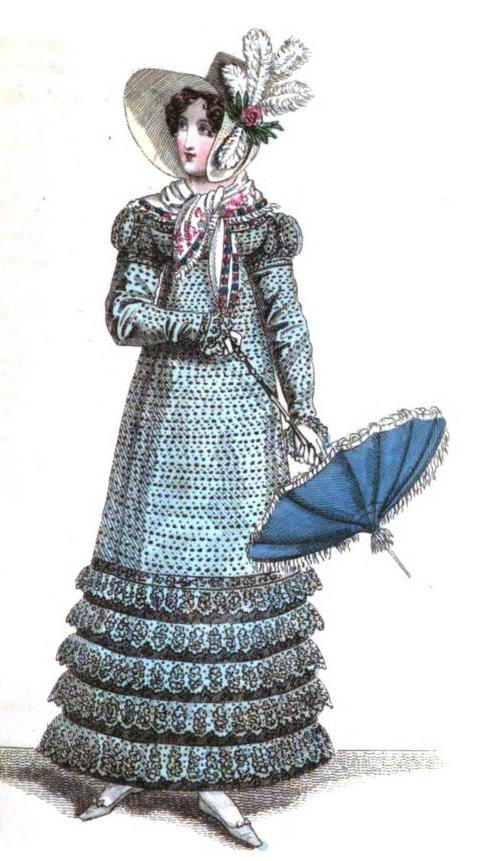
From the Magazine's September 1818 issue: "Parisian walking dress is a round dress of printed muslin, of a cerulean blue spotted with black, with bordered flounces of the same material to correspond, between each flounce a layer placed of black brocaded satin ribbon--bonnet of black brocaded satin ribband..parasol of barbel blue..slippers of pale blue kid and washing leather gloves."

From the Magazine’s September 1818 issue: “Parisian walking dress is a round dress of printed muslin, of a cerulean blue spotted with black, with bordered flounces of the same material to correspond, between each flounce a layer placed of black brocaded satin ribbon–bonnet of black brocaded satin ribband..parasol of barbel blue..slippers of pale blue kid and washing leather gloves.”

I am going to pass a week at Richmond, while my house in Manchester-square is getting ready; but do not imagine I am going alone.

— The Listener, “Letter from a Young Widow,” La Belle Assemblee, May, 1818

So writes a young widow who publicly states her desire for a companion–not another widow, or even a female.

But a man.

After two years of grieving the death of her husband, she had been left thin and red-eyed as a witch. She’s quite recovered her looks, she hastens to add, even so much as to be proud that her “native” plumpness has returned (!)

Now she will open her London town house and, as she plainly says in her letter to the Listener, she seeks a husband.

“I do not want a philosopher; but a man of mild and agreeable manners, and an easy temper: I would wish him always to be well-dressed; and, above all things, to have his heart in the right place.”

Upon this last quality she dwells a good deal, so that one wonders how unhappy her previous marriage had been. Indeed, there is mention of faithfulness, that women would never stray from their marital vows if their husbands did not cause them to do so. As if afraid she may have revealed too much, she states firmly her clear conscience regarding  the matter of her previous marital relationship.

Indeed, the purpose of her letter, she reminds the reader, is one of exigency. The drawing room should be the proper place to seek a second husband, but alas, that place:

“..is frequently deserted for the pleasures of Bacchus; and over the bottle, politics, fortune, and the way to rise in the world, are the favorite topics of men’s discourse, as they have long been the deities of their worship.”

Having failed through normal channels, she offers her hand to the Listener’s well-numbered audience, but in the words of a challenge. If any man should pick up the glove she has thrown down, he must be in earnest, for she will not enter marriage a second time without an abundance of caution:

“I shall take care to acquaint myself with every particular of their conduct and character.”

Signed, Euphrasia, for that well-known herbal remedy to clear the eyes.


Regency Confessor – London Buck turned Country Gentleman

From La Belle Assemblee, June, 1816 edition–another offering from The Listener:

“Letter from a Gentleman, Formerly a Modern Buck:”

I was for some time an inhabitant of London, and fluttered around all the goddesses of fashion and beauty; but now I am become a complete country gentleman, and no one can distinguish by my present appearance that I have been a dashing buck of the town.

The writer signs himself merely “Rusticus” (!) and extols the virtues he has discovered since retiring from town life. He describes these new virtues as follows:

Opera dress, as exhibited in the magazine, consisting of a slip of pink satin, ornamented down the front and border in black velvet bias, under a robe of black satin richly flowered in black velvet down the sides, full sleeves of black satin ornamented with pink, over a chemisette sleeve of white sarsnet. Hat of fancy spotted straw, lined with pink satin, with a superb wreath of full-blown roses. Shoes of white satin , with white kid gloves.

Opera dress, as exhibited in the magazine, consisting of a slip of pink satin, ornamented down the front and border in black velvet bias, under a robe of black satin richly flowered in black velvet down the sides, full sleeves of black satin ornamented with pink, over a chemisette sleeve of white sarsnet. Hat of fancy spotted straw, lined with pink satin, with a superb wreath of full-blown roses. Shoes of white satin , with white kid gloves.

In town, he would dine out, but hardly ate a thing. Instead, he would swear at the waiters, poke holes in the damask breakfast cloths or throw wine he found disagreeable out of the window. In the country:

I can attack a venison pasty with that keenness of hunger given by the sports of the chace, and even when I see my servant cut the bread with hands not over-clean, I fall to, without taking time to reprove him.

His clothes used to require hours planning with his tailors to prepare for the upcoming season, making certain his coats were tight at the bottom of his waist and his pantaloons preserved the exact shape of his knees.

Now I am very easily pleased; my wife’s dressmaker makes all my waistcoats and pantaloons, and this young woman, who is very clever, comes every six months and stays with us a fortnight, during which time she makes our clothes for the next six.

As much as London offered many amusements, they were all fatiguing. Plays full of cold chambermaids, grimacing footmen and the inflated language of lovers left him searching for something better, until he finally found it in the country:

Now I find the most beautiful spectacle in the rising sun, the beauteous hills and vallies, the verdant carpet and the glassy current.

On conveyances:

I had a telegraph in town as light as a fly, the best calculated in the world to throw anyone out…Now I have a good solid Yarmouth cart, which is never overturned, let the roads be ever so bad.

He used to have as many as ten “favourite” ladies, which equally swore fidelity to him even as he falsely promised them the same. Constant declarations such as these were tedious as much as they were hypocritical. But now that he is married:

My wife is the only woman I really love; I have no occasion where I must continually repeat my vows to her, she sees what my daily conduct is toward her, she knows the inmost thoughts of my heart; I divine hers, and our life is a series of mutual confidence, happiness and concord.

A veritable paragon of a man, I daresay.


Regency Confessor – Chance over Reason

From the archives of La Belle Assemblee, we find a section  entitled “The Listener,” a sort of  “Dear Abby” column for Regency readers. The next few posts will be taken from this informed source, appropriately named Timothy Hearwell, Esq.,  on salient points of good character during the reign of the Prince Regent.

From “Chance over Reason,” March, 1816 edition:

“There are, as Solomon says, those who strive and strive and yet are more behind.”

In this column, the writer pours a tale of caution into “the Listener’s” ear. He had got up a business, purely by chance, and made a considerable fortune.

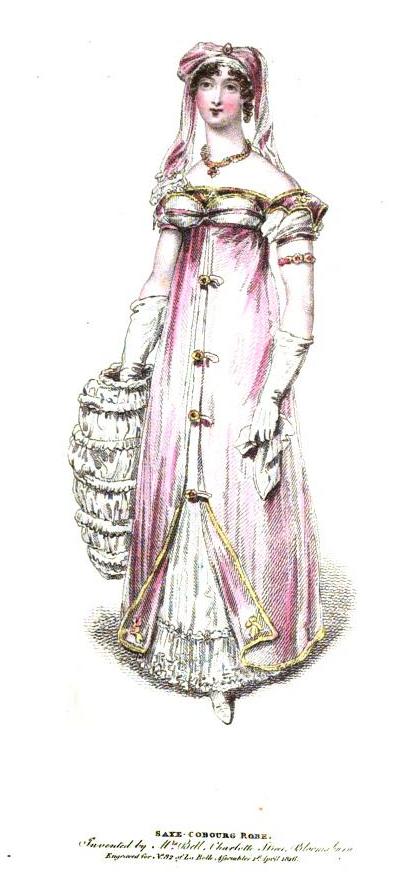
The Saxe-Coburg robe for evening dress as featured in the magazine

The Saxe-Coburg pink robe for evening dress, featured in the magazine, worn over a white satin slip flounced with crape, finished by blond. Bridal veil, fastened with a brooch of pearl and pink topazes, with the hair simply dressed in light curls and parted on the forehead. A muff formed of white satin and gossamer silk trimming. Necklace and armlets of pearls and pink topazes. White satin slippers and white kid gloves.

.

Ashamed of owing everything to good luck, and nothing to my own genius, wishing, as much as in me lay, to justify the favors of Heaven, I began to work (with purpose)….”

To his chagrin, his earnest labors were met with either criticism or downright annoyance, as his efforts seemed only to be getting in the way of the business, until even his friends avoided him. The business turning to failure, the penitent wrote a play about his troubles, a comedy, and later romantic novels that were written hurriedly, (and badly):

I took no pains to conceal the machinery by which I set my puppets in motion. I took care to banish from my works every serious and moral reflection, and only thought of crowding events one upon the other.

Having made another fortune in this accidental endeavor, the writer resolved to marry. His protestations of love with one young lady were met with little comment, she answering his suit by merely raising her “beautiful” eyes upward, as if overcome with like sentiment. This went on for some time, until one evening, as he was leaving her house, he spied a dark figure dropping to the street from the balcony of her window. He raised the alarm, thinking thieves were at work, but soon discovered his beloved in the act of elopement. Therefore, he cautions,

we must not always trust to simplicity of demeanor, or fine eyes cast modestly toward heaven.

Cursing his belabored attempt at matrimony, the writer resolved to flirt injudiciously with every pretty woman he met, having no regard for the feelings of expectation he might arouse in the feminine breast while himself remaining insensible to any like feeling the recipient of his “dishonorable” addresses might arouse in him. He happened upon a widow with five daughters, who made their living by executing painting on velvet (!). They, too, were victims of his false blandishments, except for one. This daughter remained “sprightly” in spite of his flirting, her fine mind ultimately catching his regard and his love, so that:

I had united my fate with the best of women, and ever since I have a thousand times blest that destiny which has always been a safer guide to me, than my own prudence.”

A destiny that was further rewarded by immense wealth bestowed on the widow and daughters by an uncle’s will, securing the happy couple’s financial future and rewarding, quite by accident, the writer’s trust in chance.