Regency Essay on Ghosts

From a delightful Regency-era discussion in the Edinburgh Observer, or, Town and Country Magazine, Jan. 3, 1818:

“ON GHOSTS”

In churchyards:

“(they) have no particular business, but seem to appear, pro bono publico, or to scare idle apprentices from playing pranks over their tombs.”

Their appearance:

“dragging chains is not the fashion of English ghosts; chains and black vestments being chiefly the accoutrements of foreign spectres, seen in arbitrary governments.”

The female:

“if a tree stood in her way, she will always go through it. This I do not doubt: because women will go through anything, even if it be fire and water, much less a sturdy oak, to compass their end.”

they call him "Skeletor" -- an unexplained figure captured by closed-circuit camera at Hampton Court Palace

they call him “Skeletor” — an unexplained figure captured by closed-circuit camera at Hampton Court Palace

The effect of Christmas Eve:

“It is an established law, however, that none can appear on Christmas Eve…(and) there being some persons, particularly those born on Christmas Eve, who cannot see spirits.”

Conversing:

“The most approved mode of addressing a ghost is by commanding it in the name of the three Persons of the Trinity to tell you who it is, and what is its business. This may be necessary to repeat three times; after which it will, in a low and hollow voice, declare its satisfaction at being spoken to, and desire the party addressing it not to be afraid, for it will do him no harm.”

Mode of redress:

“In cases of murder, a ghost, instead of going to the next justice of the peace, or to the nearest relation of the deceased, appears to some poor labourer who knows none of the parties, draws the curtains of some decrepid nurse or alms-woman, or hovers about the place where the body is deposited.. the ghost commonly appl(ies) to a third person, ignorant of the whole affair, and a stranger to all concerned.”

Method of approach:

“The coming of a spirit is announced some time before its appearance, by a variety of loud and dreadful noises; sometimes rattling in an old hall, like a coach-an-six, and rumbling up and down the stair-case like the trundling of bowls or cannon balls..when any eminent person is about to enter their regions they make a great noise, like women..at a fire in the night-time.”

Getting rid of them:

“The process is to issue a summons to his worship, the parson of the parish , and another to the butler of the castle, who is required (by duces tecum) to bring him some of the best ale and provisions which he can find in his master’s larder. ..he is met and discomfited with ease by the parson in a Latin formulary:–a language that strikes the most audacious ghost with terror. What would be the effect of Greek, or wild Irish, or the American Choctaw, is not yet known.”

Place of banishment:

“..a but of beer, if an alderman–a pipe of Madeira, if a gentleman–he may be rolled up in parchment, if a lawyer, or confined to the garret, if an author.

HAPPY HALLOWEEN!

an authoritative book on the matter for late twentieth century juveniles

another authoritative source on the subject aimed at an audience of late twentieth century juveniles


Regency Critics: ‘No Such Things as Ghosts’

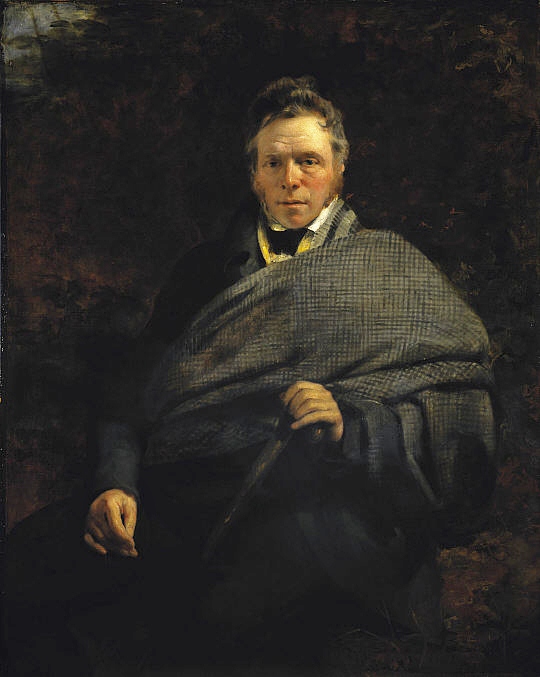
James Hogg (1770-1835) was the son of a tenant farmer and largely self-taught, the Bible being his primer. He worked as a sheep drover for another farmer, Laidlaw, who gave him more books to read and his son Will as companion. He began to write plays and pastoral poems, taking walking tours in the summers.

So things might have remained thus but for the approach of that ‘Wizard of the North:’ Sir Walter Scott.

This was 1802 and well before Scott singlehandedly rescued Scotland’s literary past from an undeserved reputation for being “provincial and antiquated.” As the composer Ralph Vaughan Williams was to later do for English folk music (I’m listening to his Symphony No. 3 even now), Scott immortalized the history of Scotland’s literature, collecting rural ballads and other oral traditions of the countryside for publication.

He was doing so ostensibly to feed the growing appetite for Romanticism, but he was quite keen to seek out the rustic and historical, preferably from the lips of old women and, you guessed it, shepherds. What he got instead was a poem Auld Maitland, so finely written that it could not have had its birth among the hills and forests of the Borders.

Jamie in his plaid.

Jamie in his plaid.

The author was “Jamie the Poeter,” who was promptly fetched from the sheep herds “down Ettrick break.” When Hogg was brought into Scott’s presence, he was a braw young man, tall and guid-looking. No’ unlike the fair hero of Gabaldon’s Outlander when he took off his bonnet, ‘from which fell a mighty cataract of fine red hair that flooded his back and shoulders.’*

Still, he was a peasant with coarse manners. Worse, he was not in the least cowed by being among those better educated than he. Above all, he insisted the ballad of Auld Maitland was genuine, having been sung by his mother. Indeed, he was verra proud of his parentage:

“This Hogg came of interesting stock, for there had been witches on the paternal side, and his maternal grandfather, Will o’ Phawhope, was the last man on the Border who had spoken with the fairies.” — Sir Walter Scott, John Buchan (1932)

Having met with Scott’s approval, the shepherd was engaged to collect more ballads and continue his fledgling career as a published poet. Between lovers and financial troubles, this man of the earth with unrefined tastes eventually found himself taken up by Blackwood’s Magazine to co-author the infamous Chaldee Manuscript, the very work which threw Whig society in an uproar.

He might not have fully understood the scandal and subsequent withdrawal of something deemed libelous. In his mind, the satire that was Manuscript was a fine piece. Moreover, he was basking in the glow of working with powerful critics such as John Lockhart and John Wilson. Indeed, he became quite caught up in the whirlwind of satire and duplicity that was attendant in working with those fellows. It was exhilarating at first, even if he was rather spooked by Lockhart’s personality, so like that of a mischievous brownie:

‘I dreaded his eye terribly,’ (Hogg) says, ‘and it was not without reason, for he was very fond of playing tricks on me..’

Christopher North, A Memoir of John Wilson, by Mary Gordon (1862)

But if his forthright mind could not immediately perceive what was happening, his friends became rather alarmed, particularly as they recognized Hogg’s  Shepherd persona with broad Scots accent and buffoonery being used rather liberally to amuse others at his expense. It was becoming clear he was no match for the Scorpion and the Leopard, their cleverness confounding him. So he left the critics to return to writing of the countryside’s mysterious, dark beauty, with its abandoned towers and glimpses of fairies, and the supernatural stories he’d heard at his mother’s knee.

His collection of those stories was bound in a volume he entitled Shepherd’s Calendar — so well-received he was finally able to retire much of his debts and happily ignore the caricature his former colleagues had created of him, a character which went on years afterwards delighting readers of Maga. Let them make sport of him, for he was to turn the tables, publicly chiding them for their false pride and superiority.

One of the tales Hogg included in his Calendar concerned the strange spectre of a lovely girl. She wore a green bonnet, its crown could be seen bobbing just over the horizon of a lonely path but would disappear as her pursuer approached, a wealthy, landed gentleman who would have fit in well among posh Edinburgh society. He was thwarted, bewitched by that which he didn’t understand, trying to catch a phantom old women warned him to stay away from, a warning he ignored, leading to a frustration and fear ending in madness:

“A great number of people now-a-days are beginning broadly to insinuate that there are no such things as ghosts or spiritual beings visible to mortal sight. Even Sir Walter Scott is turned renegade, and, with his stories made up half-and-half, like Nathaniel Gow’s toddy, is trying to throw cold water on the most certain, though most impalpable, phenomena of human nature.” — The Mysterious Bride

It was a different kind of literary criticism, and readers found delight in how the Shepherd’s characters, without regard to their education or their sophistication, would fall prey to the supernatural that still lurked in the country he loved.

* (as reported in Carswell’s Sir Walter, a Four Part Study in Biography)

Ettrick Forest Castle